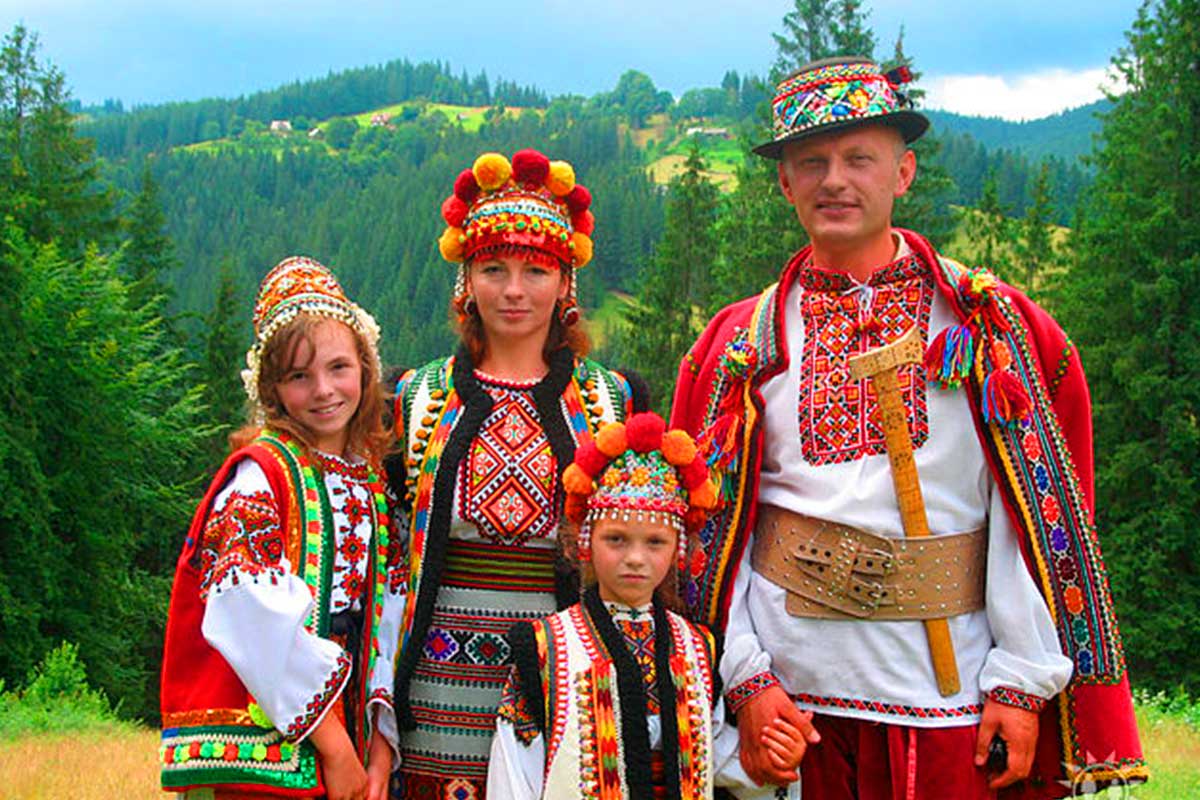
Про цей феномен Карпат бодай краєм вуха чув кожен шанувальник народного мистецтва та промислів. І не лише в Україні, але й далеко за її межами.
Thus, it is a pilgrimage site for thousands of tourists who seek to "partake" in embroidery and lace, wooden and ceramic products. For behind the souvenir facade lies something more: Kosiv – an ancient city of masters, and the local market is not only a search for new channels for product realization but also a kind of "hangout" for masters, a creative competition, a vernissage of fresh works. A small part of the Kosiv market is reflected in the online store.
Hutsul Klondike
Kosiv Market is just one of three "wells" of Hutsul art (similar folk craft markets are also in more famous Kolomyia and Yaremche). However, it is in Kosiv that it is the largest center where the producers of this unique beauty gather. Moreover, on the outskirts of the market, ancient items are sold by impoverished Hutsuls from distant mountain hamlets (the poetically celebrated Kryvorivnya alone has eight such hamlets scattered in the mountains for dozens of kilometers!), as well as ubiquitous resellers who travel through remote mountain villages in search of rarities.
So, if you have often sadly shrugged your shoulders at the Lviv Vernissage upon hearing the price of a desired item, if you are looking for embroidered shirts or other Hutsul color at an affordable price – drink some Lviv coffee, indulge in local chocolate, and take a train to Ivano-Frankivsk, to transfer to a bus to Kosiv. Every Saturday (and also on Ivan Kupala, on City Day, when a traditional folk art and crafts festival takes place) producers from all over Hutsul region gather here – from Frankivsk region and from many districts of Bukovina and Transcarpathia…
What you can see at Kosiv Market! Pysankas, carved, inlaid, and burned wooden vases, boxes, spoons, barrels, berbenytsia, painted ceramic dishes, kumantsi, sculptures, tiles, embroidered and woven shirts, towels, carpets and blankets, bedspreads, products made of beads, metal, leather, and even cheese…
The main advantage of this colorful trading is truly original products that can be bought much cheaper than at markets in other mountain towns. Because prices here are lower not only because you avoid the chain of intermediaries but also because there are far fewer tourists here than in Yaremche.
However, to catch the widest selection and buy the desired item directly from the author, keep in mind: masters arrive here as early as two or three o'clock in the morning from Friday to Saturday. In the dark, they shine flashlights, searching for their spots. Before they can unpack their goods, the first buyers – wholesalers who buy Hutsul souvenirs from the masters to resell them at other markets or in specialized stores, but at much higher prices – pounce on them. So at dawn, those eager for souvenirs are so many that it seems they are going to the bridge over the Rybnytsia River for spawning. And it is better to arrive in the town the day before.
For example, if in Lviv they ask for 10 or more hryvnias for such a wonder as cheese horses, in Kosiv you can buy four, five, or even seven if you are lucky and the craftswoman is in a hurry to go home for "ten". And a luxurious long embroidered women's dress, which is valued at 8 thousand hryvnias or even a thousand dollars in Lviv, can be bought at dawn in Kosiv for two or three thousand.
This is explained simply: high-art works are expensive, and trading them is a significant risk (it may take months before they find their buyer). Meanwhile, ordinary buyers, especially tourists who are still sweetly sleeping at this moment, or at best just rubbing their eyes, get what remains after the first wave of resellers.
By the way, almost every Hutsul village has its specialization: Richka is famous for carving, Sokolivka and Yavoriv for blankets, and Kosmach for pysankas (the local pysankas are of the highest level because they are very finely painted).
You will be amazed by the variety of patterns and styles of execution. In particular, pay attention to shirts embroidered with beads (but keep in mind that this "beauty" weighs 3-4 kg!). For instance, when my second cousins from Australia acquired a dozen embroidered shirts here in less than two hours (after previously shopping for national costumes at the famous Sorochyn Fair!), my nephew, who accompanied them, could not hold back his tears: "You will take all of Kosiv away!" To which they, smiling, replied: "And the Ukrainian family in Melbourne is quite large!"
You can match jewelry – herds or corals – to the shirts. And if you want to embroider a shirt yourself, you can buy everything you need here: threads and yarn, fabric, and beads.
And you haven't even walked through the rows of blankets (which, besides aesthetic, also have healing properties) and spinning wheels, carved plates and chess (where all the figures are Hutsuls: white – from maple, black – from walnut), haven't squandered on wooden flutes, haven't looked at ceramic products – jugs and pots, decorative plates and tiles, whistles and jars, candy bowls and bells, pysankas and pleskantsi, kumantsi! And how will you manage to see all this if it is almost 11 o'clock and the market is already starting to close?
However, the thesis that "producers here are only locals" has long been a myth: in stationary stores, embroidered shirts of various price categories coexist peacefully: both hand-embroidered and machine-made (including from China!), woven and combined, embroidered on fabric and sewn onto cheaper fabric… That is, if earlier Kosiv Market attracted with its uniqueness, now its popularity is primarily ensured by pricing policy – cheaper, cheap, and very cheap.
Sometimes, when you are lucky to stumble upon elderly Hutsul women on the outskirts of the market, who, to survive, sell truly ancient items that have lain in trunks for decades, sometimes even a hundred years as inheritance. Prices for them can be very "funny": an authentic men's embroidered shirt made of hand-woven (if lucky, even hemp) fabric over a hundred years old could still be bought last year for 100-150 UAH, a women's one – from 200 UAH. The same goes for other types of clothing (aprons and trims), ceramics and embossing, ancient coins, etc. And now that there is a real boom for such items, even these impoverished women sometimes sigh and say: "My granddaughter said that for such things on the internet they ask hundreds of dollars."
In short, there is everything here! "You can even buy the devil here," the Hutsuls joke.
A pearl in... mud and dust.
On the other hand, the vast territory of this market was only recently started to be somewhat organized, several rows of brick and wooden pavilions were built. However, the rest of the infrastructure – despite good collections from each seller – is practically nonexistent: people trade either directly from cars or in mud (after rain) or dust (when it is hot). There is one "outhouse" type toilet for the entire market, and that one is at the very end, practically already in the forest…
Back in June 2011, a meeting took place at the market with the participation of district leaders, electrical networks, veterinary medicine management, architecture, and district sanitary epidemiological station. They gathered not by chance, as the Kosiv (officially Smodnyansky) market at that time underwent reconstruction: new brick buildings were built, and trading rows for souvenirs and other products were expanded. And it was decided: "a lot still needs to be done to ensure that this large area has a decent civilized appearance. So that even local people are not deterred by the very thought of visiting the market, especially in rainy weather."
Six years have passed (!), and the situation has changed little.
Thus, one of the main promising tourist "pearls" of Hutsul region is currently in mud (when it rains), or in dust (when it is dry)… And it could complement the "golden horseshoe" of Bukovel, Yaremche, and Vorokhta with Hoverla. The main problems of Kosiv today are "underdevelopment", that is, informational isolation and lack of investment.
Moreover, in Kosiv there is also a large (still from Polish times, but neglected during Soviet times) lift (to Mount Mykhalka), a huge but "Soviet" tourist base (during independence, mainly school-age children rest there, as they are less demanding about infrastructure), a picturesque Huk waterfall (which periodically collapses, but the strengthening of the banks is worked on from time to time due to lack of local funds), legendary mountains and forests (in the reserve, M. Azarov once built a modern recreation complex – a hotel with fishing opportunities in a pond and in an artificially built waterfall) and so on.
And during Austro-Hungarian and Polish times, the local salt sanatorium, located near the current market place, attracted gentlemen who were promised quick weight loss, not only from Warsaw and Krakow but also from Vienna…
Healing nature – instead of pills and injections
Doctor Apolinary Tarnawski (1851-1943) entered the history of medicine as a pioneer and popularizer of natural medicine, which was the foundation of the institution he established in 1893 in Kosiv. He bought land here and began building his medical facility in 1893. And since there was a wise law in both Austria and Poland that encouraged construction: as long as someone builds, they are exempt from taxes, he kept building: one villa, then another, then a dining room, then baths, and so on…
Interestingly, he forced his wealthy patients to move a lot: to walk in the mountains, work in the garden and vegetable garden, carry bricks and stones in wheelbarrows. Bathing – in the cold water of the mountain Rybnytsia. And he gave little to eat and no meat, only all sorts of greens and vegetables. In the evenings, they had to dance and sing, as the doctor considered this medicine too. No one was allowed to taste vodka or light a "cigarette". And if someone violated the order – they had to leave the institution, and the doctor did not return the money. Whether it was an officer, a minister, a bishop, or a factory owner – he did not care. But he also cured patients without pills, powders, or injections. He also taught everyone how to live to be healthy: "The healthiest food is what you leave on the plate!" And at the gate of the institution, it was written: "Master yourself!"
"The institution created by Tarnawski was an unusual place, with a unique character, thanks to which many prominent politicians, scientists, artists, sculptors, musicians, writers, and journalists came to Kosiv. Moreover, artists from the best theatrical and musical scenes were treated here, performances and concerts were organized, which did not yield in artistic level to the theaters of Lviv and Krakow. The wonderful landscapes of Pokuttya and Hutsul region inspired artists, who immortalized the unique beauty of this place in landscapes, poets and writers expressed their admiration in numerous works, and journalists contributed to making Kosiv famous throughout the region. Thanks to the fame of the institution, Kosiv became a popular vacation spot for guests even from distant cities, such as Warsaw or Poznań," emphasizes the author of the book "The Healing Institution of the People. The Cultural Role of the Natural Healing Institution of Doctor Apolinary Tarnawski in Kosiv in Pokuttya 1893-1939" (Krakow, 2016) Natalia Tarkovska.
Thanks to his efforts, a dendrological park was established on the territory of the sanatorium, where a unique collection of trees and shrubs still grows – 729 specimens of 44 species of plants, including ginkgo biloba, tulip tree, nut-bearing cypress, plane tree, magnolia soulangeana, pseudotsuga menziesii, and others.
Before World War II, there were several unique style houses with 70 rooms here. So in 1939, when the Bolsheviks came, and the family forcibly took him out of Kosiv, he even tried to jump out of the car on the way to Kut: he was very upset that he had to leave everything he had done in his long life…
In 1946, this institution was restored as a state medical institution, and later a new three-story building and school were built. In 1993, the sanatorium was recognized as a monument of architecture. Today, the specialized sanatorium "Kosiv" of the Ministry of Health of Ukraine is a therapeutic and preventive institution that offers medical treatment for upper respiratory tract diseases.
Another significant reason for foreign tourism: it was in Kosiv that Hasidism originated – one of the currents of Judaism. Its founder was Israel ben Eliezer, or Baal Shem Tov, who in the mid-18th century founded the first Hasidic community in Kosiv… However, in 1941, almost all the Jews of Kosiv and the district were exterminated by the Nazis. A memorial sign was erected at the site of the mass murder, and a Jewish cemetery has been preserved in the city.
Hutsul Davos: history or future?
The rector of Opole University (Poland) Stanisław Sławomir Nić, the author of the four-volume work "Kresowa Atlantis. The History and Mythology of Kresy Cities", emphasizes that Kosiv was once called the "Hutsul Davos". In favor of such a comparison – in particular, the completely similar climate of the well-known Swiss resort and the forgotten even in Ukraine resort towns.
By the way, according to the resolution of the Cabinet of Ministers dated July 16, 2001, No. 878, Kosiv received the status of a historical city. And since September 2004, Kosiv has been assigned a new status – resort city.
An entrepreneur and public figure in Kosiv dreams of reviving the project "Kosiv – Hutsul Davos". Oleksandr Vuytsyk, coordinator of the community committee created two years ago, is confident: "We have all the prerequisites for this – wonderful nature, ecology, culture, ethnography. We just need to create a vision of what we want to do. It should be a project drawn on paper, virtual or created in the form of a model that can be viewed from all sides, touched."
Currently, according to him, "there is not even a general plan for the city. The Kosiv Institute is nearby, but there is no original garden-park sculpture, no small architectural forms. Why don't we raise the question of creating a department of architecture and urban planning at KIPDM? Let's involve artists, let's do something creative."