Western capercaillie
About
The Western capercaillie, often called gлухар in the Carpathians, is the largest bird of the mountain forests. In Ukraine, it lives in the Carpathians and Polissia; in the mountains, it inhabits old coniferous and mixed forests up to the upper tree line. Western capercaillies are also found in Poland, Slovakia, and Romania, but they are declining almost everywhere.
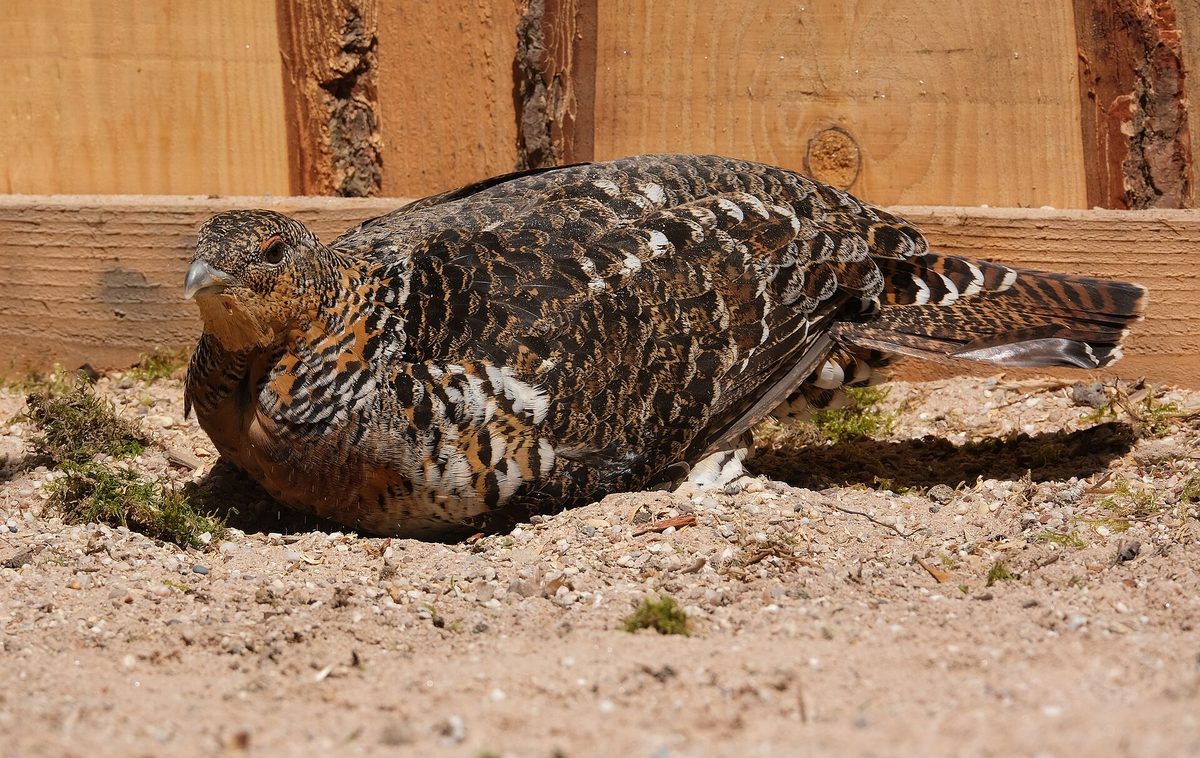
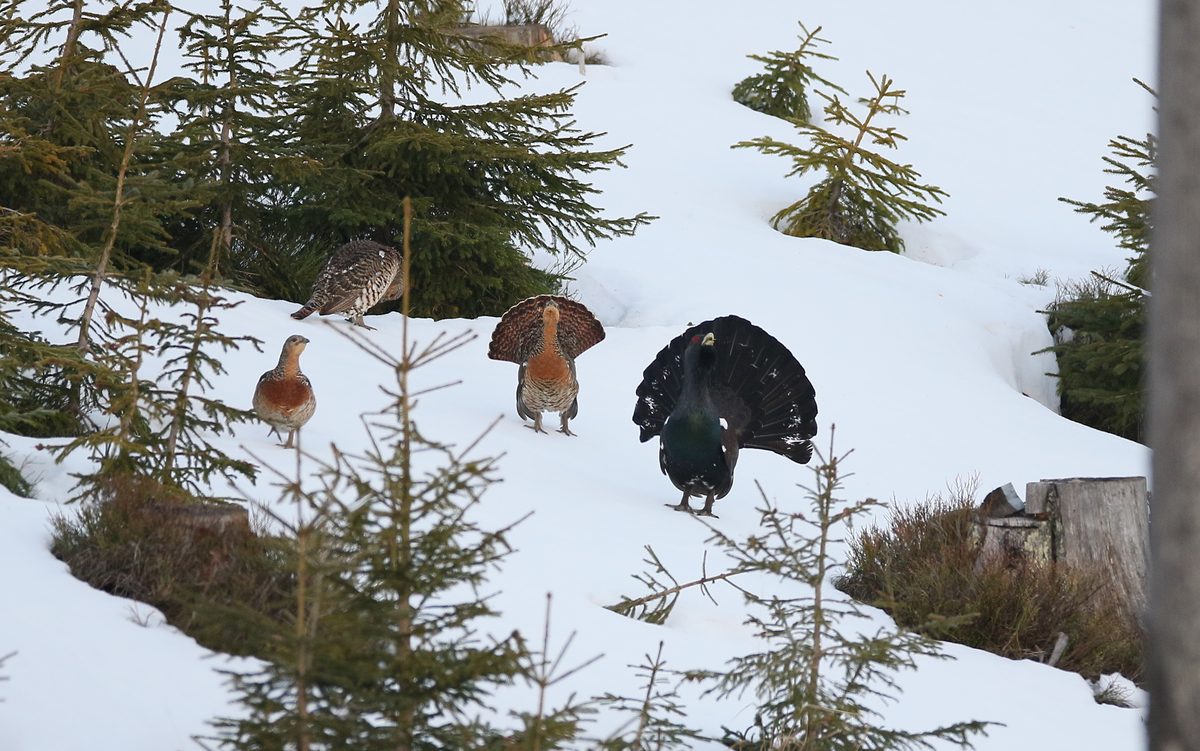
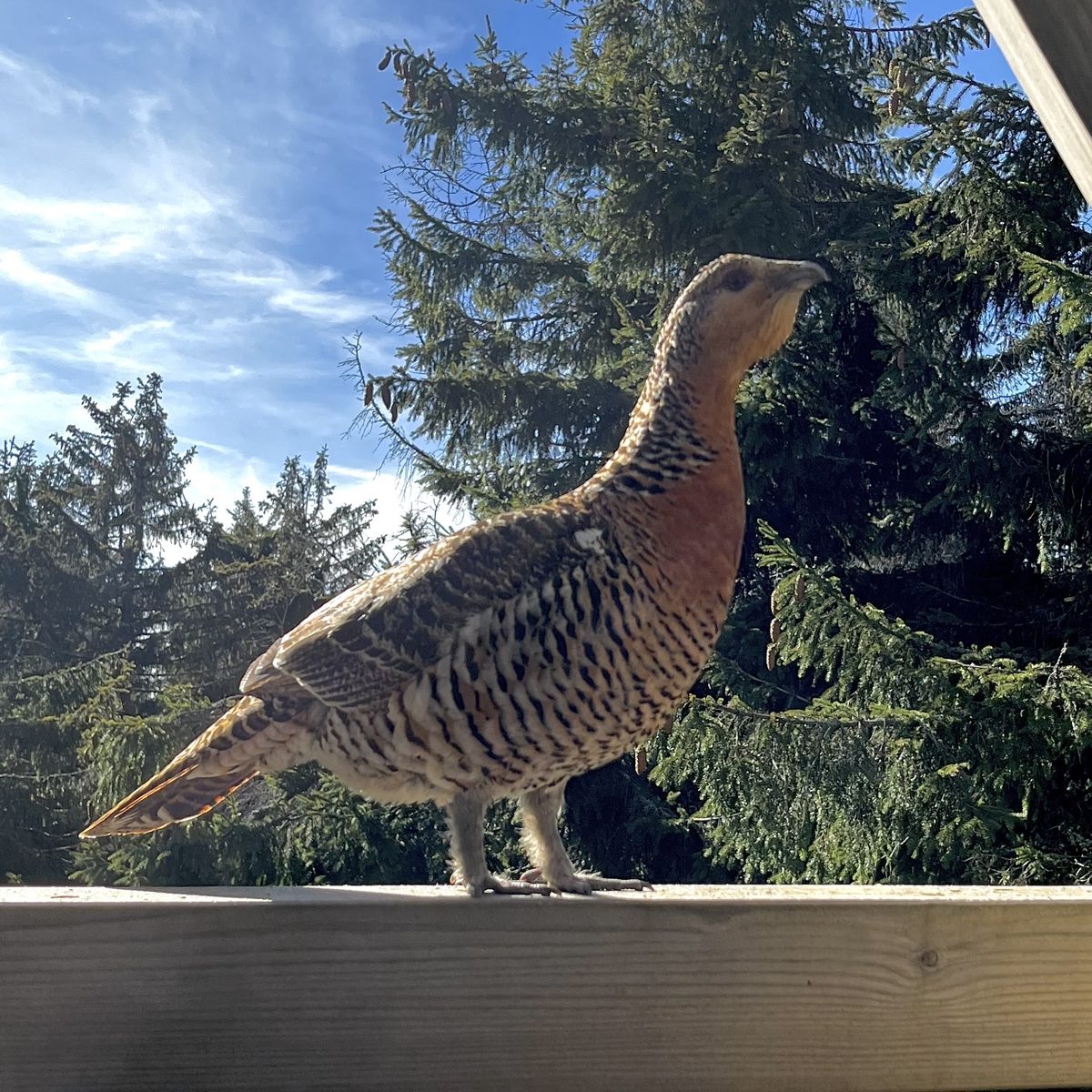
The male is enormous: together with females, the weight of the birds ranges from 2.5 to 6.5 kg, the body length is 60–87 cm, and the wingspan can reach up to 1.25 m, with the largest being the males. It is dark gray, with a greenish sheen on the chest, a white spot on the wing bend, a bright red 'brow' above the eye, and a wide tail that it fans out during the display. The female is significantly smaller, reddish-brown, mottled, and well-camouflaged, making her nearly impossible to spot on the nest among the bilberry bushes. The chicks walk after their mother and gather insects on their own just a few hours after hatching.
In winter, Western capercaillies descend lower, to about 800 m, and feed exclusively on the needles of fir and spruce. In summer and autumn, on the other hand, they ascend to the subalpine zone, where they feast on blueberries, lingonberries, and other berries.
The most famous event in the life of Western capercaillies is the spring display. It begins in mid-April when there is still snow in the forest. Males arrive at the display ground in the evening, and they start singing before dawn; a few minutes before sunrise, females fly in to them. During part of the song, the male hears nothing for a moment — hence the name 'глухар'. The female makes a nest directly on the ground and lays 7–9 eggs, from which the chicks hatch after 22–25 days.
In winter, the presence of Western capercaillies is indicated by large three-toed tracks in the snow and clusters of droppings with needles under the trees where the birds roosted. In Ukraine, there are only about three thousand Western capercaillies, of which about 300 are in the Carpathian Biosphere Reserve. They are harmed by clear-cutting, livestock grazing, poaching, and disturbances at display grounds and nests, particularly from tourists. Therefore, the Western capercaillie is listed in the Red Book of Ukraine as a disappearing species, and the locations of display grounds are not published anywhere. If you accidentally encounter a bird in spring, quietly walk away and do not return.
Where in the Carpathians

The map shows where naturalists recorded the species (GBIF, CC0 and CC BY records), not every place it lives. The Ukrainian Carpathians are less studied, so a blank area does not mean the species is absent. For rare and vulnerable species the map is deliberately coarse (hexagons of ~250 km² or more) so that it never points to dens, nests or growing sites.
- Countries
- Ukraine · Romania · Slovakia · Poland
- Mountain ranges
- Chornohora, Gorgany, Maramureș Mountains, Harghita and Gurghiu Mountains, Greater Fatra, Pokuttia-Bukovina Carpathians, Skole Beskids, Low Tatras, High Tatras, Piatra Craiului
- Altitude belts
- Beech forests (600–1200 m) · Conifer forests (1200–1600 m)
When to see it
| Jan | Feb | Mar | Apr | May | Jun | Jul | Aug | Sep | Oct | Nov | Dec | |
|---|---|---|---|---|---|---|---|---|---|---|---|---|
| Sightings |
From naturalists’ observations in the Carpathians (iNaturalist, research grade): the darker the cell, the more often the species is seen that month.
Protection and rules
Hunting is prohibited: the species is listed in the Red Book of Ukraine. Do not approach display grounds and nests.
FAQ
Do Western capercaillies live in the Carpathians?
Yes, the Western capercaillie lives in old coniferous and mixed forests of the Ukrainian Carpathians up to the tree line, but it is a rare bird: there are only about three thousand in Ukraine.
When do Western capercaillies display?
The spring display begins in mid-April when there is still snow in the forest. Males sing before dawn. Display grounds should not be disturbed, so their locations are not published.
Is the Western capercaillie listed in the Red Book of Ukraine?
Yes, the Western capercaillie is listed in the Red Book of Ukraine as a disappearing species.
Similar species
Where to meet it
Ranges where it occurs: Chornohora, Gorgany, Maramureș Mountains, Pokuttia-Bukovina Carpathians, Skole Beskids, Hryniava Mountains, Chyvchyn Mountains. In other countries: 🇷🇴 Harghita and Gurghiu Mountains, 🇸🇰 Greater Fatra, 🇸🇰 Low Tatras, 🇸🇰 High Tatras, 🇷🇴 Piatra Craiului, 🇷🇴 Bihor-Vlădeasa Mountains, 🇷🇴 Cindrel Mountains
Trails and peaks near which naturalists recorded the species (GBIF, iNaturalist), matched by altitude and habitat. Sightings are not guaranteed.
Sources
- Вікіпедія: Глушець
- Wikipedia (en): Western capercaillie
- Перелік видів тварин, що заносяться до Червоної книги України (наказ Міндовкілля від 19.01.2021 № 29, зареєстровано в Мін'юсті 01.03.2021 за № 260/35882)
- Міндовкілля: текст переліку видів тварин Червоної книги України (PDF)
- GBIF: таксон і категорія МСОП
- Директива 2009/147/ЄС про збереження диких птахів
GBIF · iNaturalist · Wikidata · Distribution data: GBIF.org (CC0 and CC BY records), iNaturalist; names and identifiers: Wikidata (CC0). Text: Karpaty.rocks, checked 09.11.2026.
