Rose chafer
About
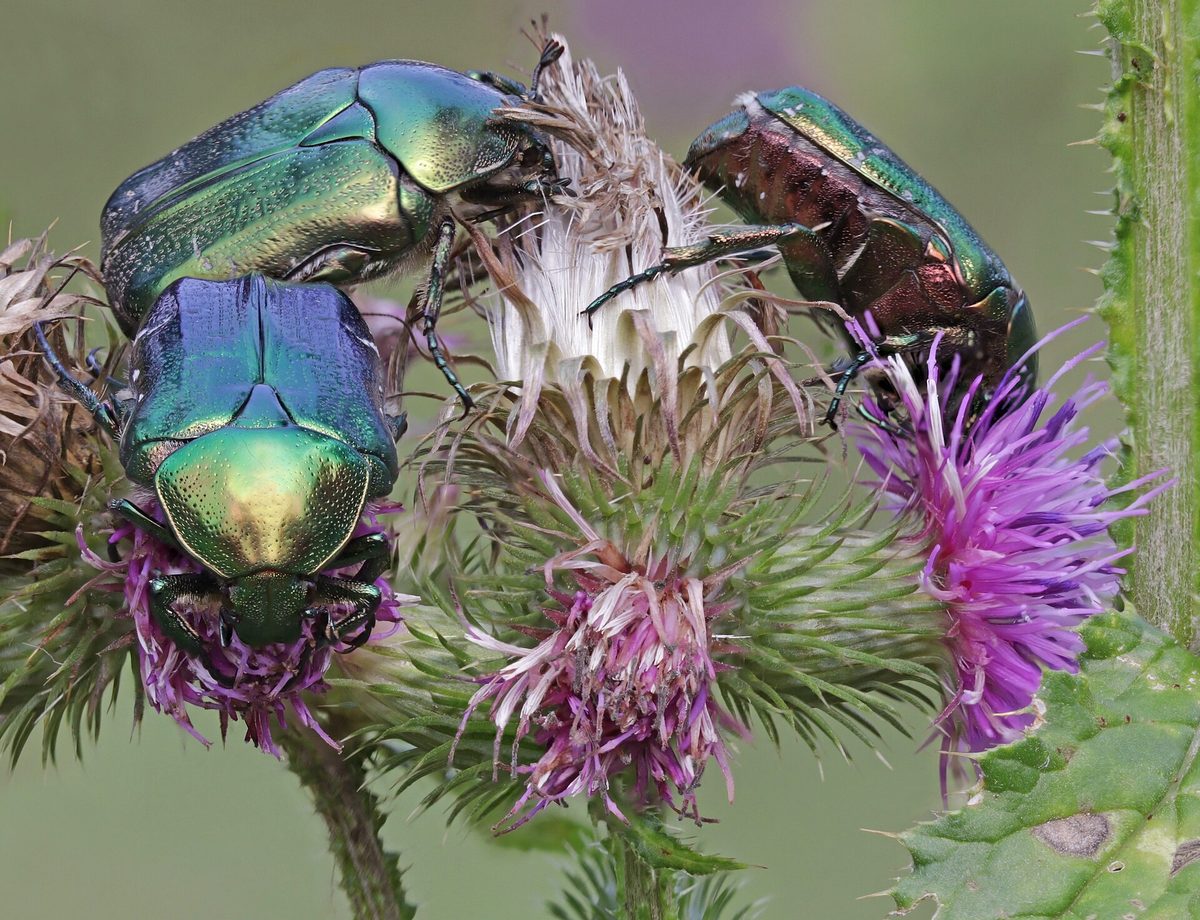
The Rose chafer is a beetle that is hard to miss: on a sunny day, it sits right in a flower, shining with a metallic green color. In Ukraine, the nominal subspecies is known throughout the territory, while the species is widespread almost all over Eurasia, except for high mountains and deserts. In the Carpathians, Rose chafers are most often seen in valleys and foothills — in flowering forest edges, meadows, and gardens.
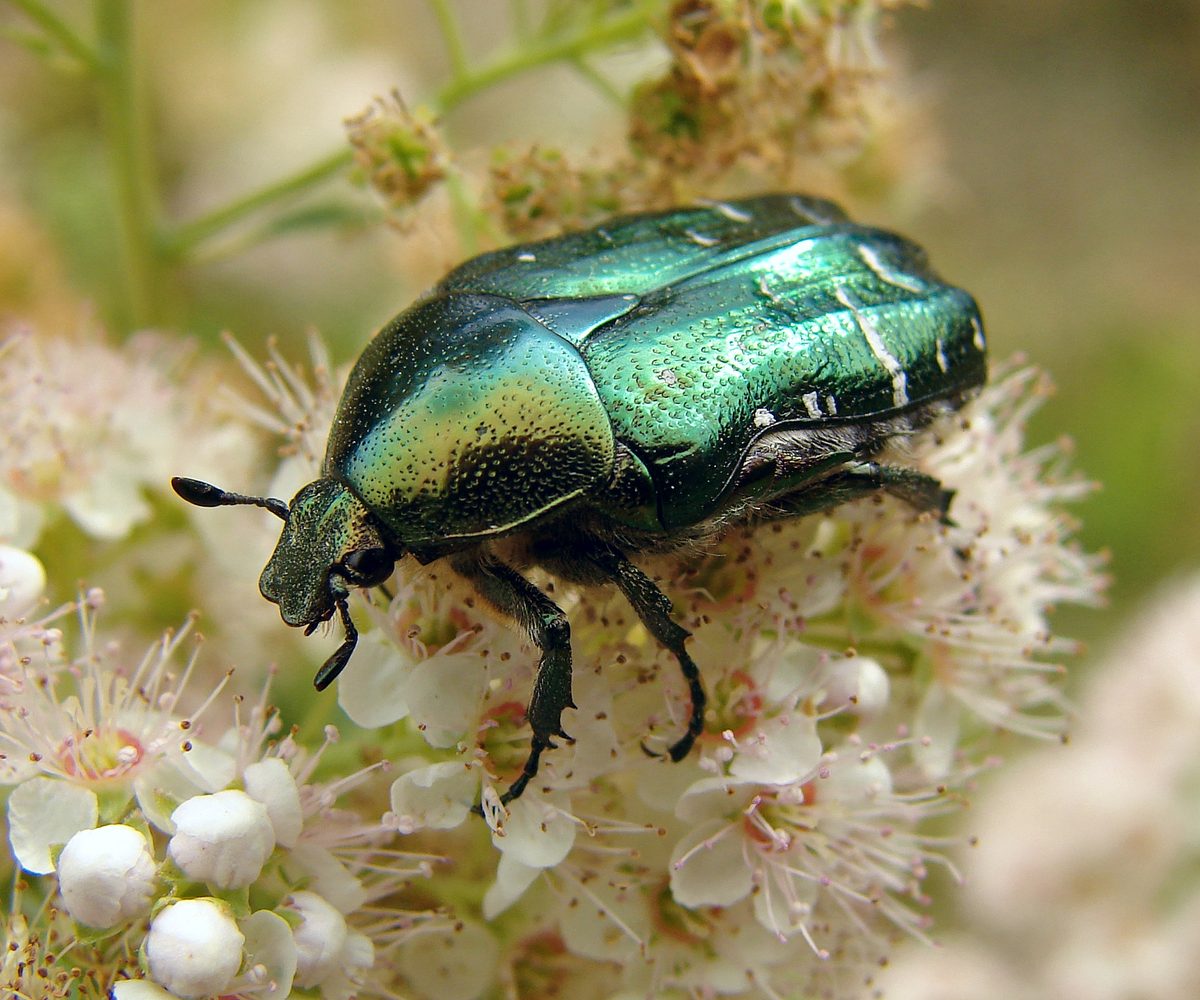
The beetle is 14–22.5 mm long, elongated-oval and wide. It is most often green with a metallic sheen, although it can be coppery, gray, or even black; the upper body is mostly covered with hairs. A characteristic feature is a noticeable triangular scutellum between the bases of the elytra, elongated backward like the letter V. The Rose chafer flies excellently and does so unusually: it does not open its elytra like most beetles but releases its wings from the sides under the lowered elytra.
Adult beetles feed on pollen, nectar, and petals, particularly loving roses and wild roses, as well as flowers of wild plants and fruit trees. They are most often seen from May to June–July, occasionally until September. The beetles fly quickly and skillfully from flower to flower. Despite eating flowers, Rose chafers do not cause serious damage to gardens.
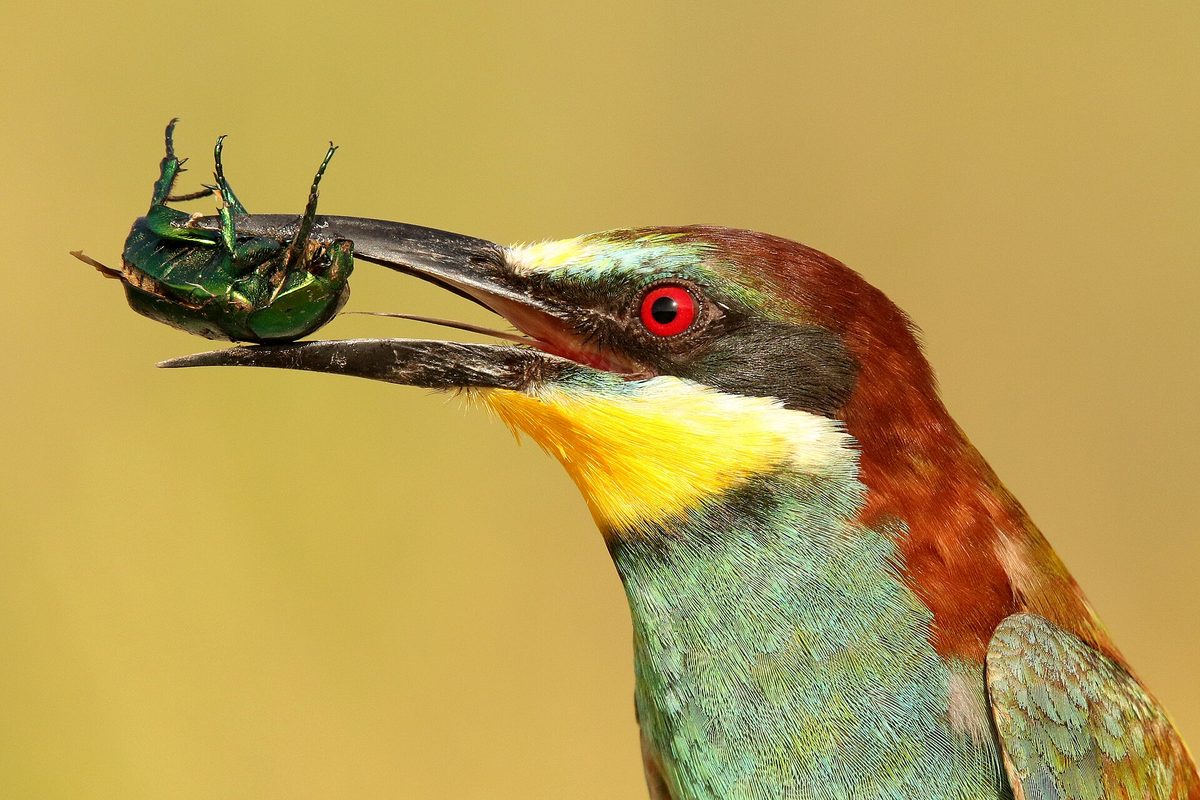
Larvae — thick, bent in the shape of the letter C, with small heads and short legs — develop in decaying wood, leaf litter, compost, or manure and winter there. The Rose chafer is not listed in the Red Book of Ukraine.
Where in the Carpathians

The map shows where naturalists recorded the species (GBIF, CC0 and CC BY records), not every place it lives. The Ukrainian Carpathians are less studied, so a blank area does not mean the species is absent.
- Countries
- Hungary · Slovakia · Romania · Ukraine · Czechia · Austria · Poland
- Mountain ranges
- Bükk, Mátra, Zemplén Mountains, Börzsöny and Cserhát, High Tatras, Piatra Craiului, Little Carpathians, Low Tatras, Maramureș Mountains, Gorgany
- Altitude belts
- Foothills (below 600 m) · Beech forests (600–1200 m)
When to see it
| Jan | Feb | Mar | Apr | May | Jun | Jul | Aug | Sep | Oct | Nov | Dec | |
|---|---|---|---|---|---|---|---|---|---|---|---|---|
| Sightings |
From naturalists’ observations in the Carpathians (iNaturalist, research grade): the darker the cell, the more often the species is seen that month.
Protection and rules
Not listed in the Red Book of Ukraine.
FAQ
What is the green shiny beetle sitting in the flowers?
Most likely, it is the Rose chafer: a metallic green beetle 1.5–2 cm long that feeds on pollen and petals.
Is the Rose chafer harmful?
Adult beetles eat flowers, but they do not cause serious damage to gardens. Larvae live in decaying wood, litter, and compost.
Similar species

Where to meet it
Trails
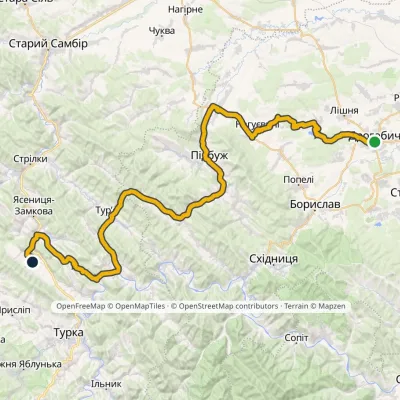 HardMulti-dayMarkedNo. 502-1 Drohobych RozluchElevation profile292–733 m78.1 kmascent 921 m
 HardMulti-dayMarkedVoronenko village to Vorokhtavia Mount KukulElevation profile748–1 539 m24.8 kmascent 845 m≈ 8 h walking
 HardMulti-dayMarkedVorokhta to Yasiniavia Mount KukulElevation profile719–1 496 m36.3 kmascent 861 m≈ 11 h walking
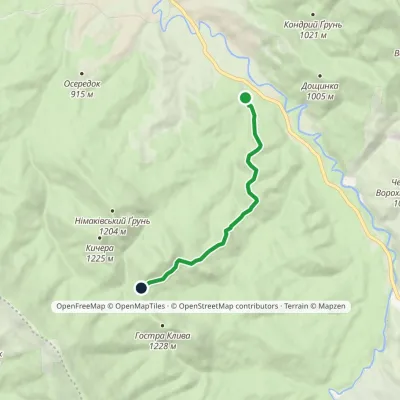 EasyOne-dayMarkedVorokhta Borsuchyna polonynaElevation profile793–1 140 m5.4 kmascent 390 m≈ 2 h walking
 HardMulti-dayMarkedVoronenko village to Vorokhtavia Mount KukulElevation profile747–1 539 m25.2 kmascent 603 m≈ 7.5 h walking
 HardMulti-dayVoronenko village to Vorokhtavia Mount KukulElevation profile745–1 451 m30.3 kmascent 811 m≈ 9 h walking
 EasyOne-dayMarkedMount Kukul VorokhtaElevation profile765–1 539 m9.2 kmascent 53 m≈ 2.5 h walking
 ModerateOne-dayMarkedVorokhta Mount Kukulvia Perehslyp tractElevation profile740–1 539 m11.7 kmascent 805 m≈ 4.5 h walking
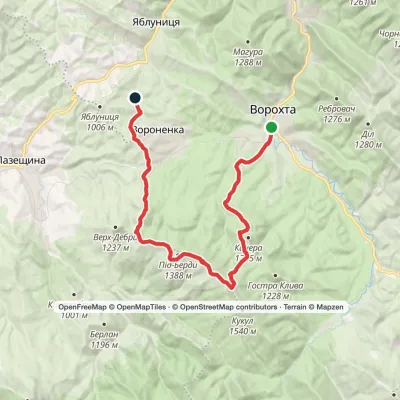 HardMulti-dayMarkedVorokhta to Yablunytsia villagevia Mount KukulElevation profile740–1 455 m24.6 kmascent 876 m≈ 8 h walking
 ModerateOne-dayMarkedVorokhta village Rizhi PassElevation profile761–1 295 m8.8 kmascent 570 m≈ 3.5 h walking
 HardTwo-dayMarkedVoronenko village to Vorokhtavia Mount KukulElevation profile740–1 539 m22.7 kmascent 797 m≈ 7.5 h walking
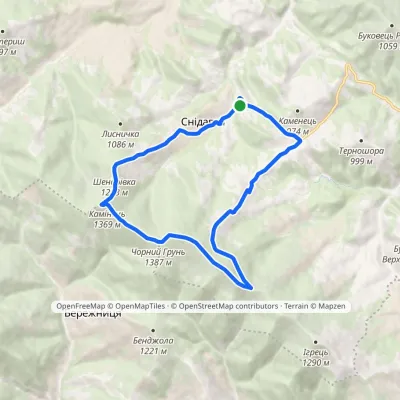 ModerateOne-dayMarkedSnidavka village loopvia Chornyi HrunElevation profile767–1 387 m13.6 kmascent 728 m≈ 5 h walking
Mountain ranges: Maramureș Mountains, Gorgany. In other countries: 🇭🇺 Bükk, 🇭🇺 Mátra, 🇭🇺 Zemplén Mountains, 🇭🇺 Börzsöny and Cserhát, 🇸🇰 High Tatras, 🇷🇴 Piatra Craiului, 🇸🇰 Little Carpathians, 🇸🇰 Low Tatras, 🇷🇴 Mehedinți and Cerna Mountains, 🇷🇴 Almăj and Locva Mountains, 🇸🇰 Slovak Ore Mountains, 🇸🇰 Strážov Mountains
Trails and peaks near which naturalists recorded the species (GBIF, iNaturalist), matched by altitude and habitat. Sightings are not guaranteed.
Sources
- Вікіпедія: Бронзівка золотиста
- Wikipedia (en): Cetonia aurata
- Перелік видів тварин, що заносяться до Червоної книги України (наказ Міндовкілля від 19.01.2021 № 29, зареєстровано в Мін'юсті 01.03.2021 за № 260/35882)
- Міндовкілля: текст переліку видів тварин Червоної книги України (PDF)
- GBIF: таксон і категорія МСОП
GBIF · iNaturalist · Wikidata · Distribution data: GBIF.org (CC0 and CC BY records), iNaturalist; names and identifiers: Wikidata (CC0). Text: Karpaty.rocks, checked 09.11.2026.
