Aesculapian snake
About
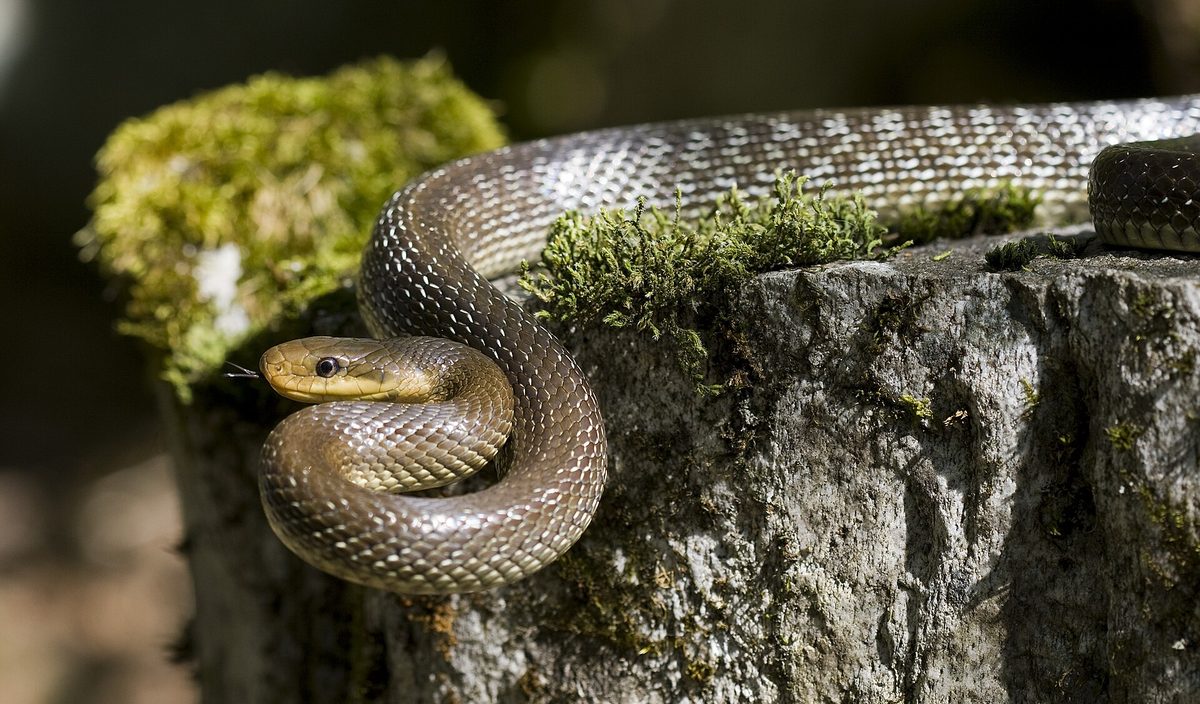
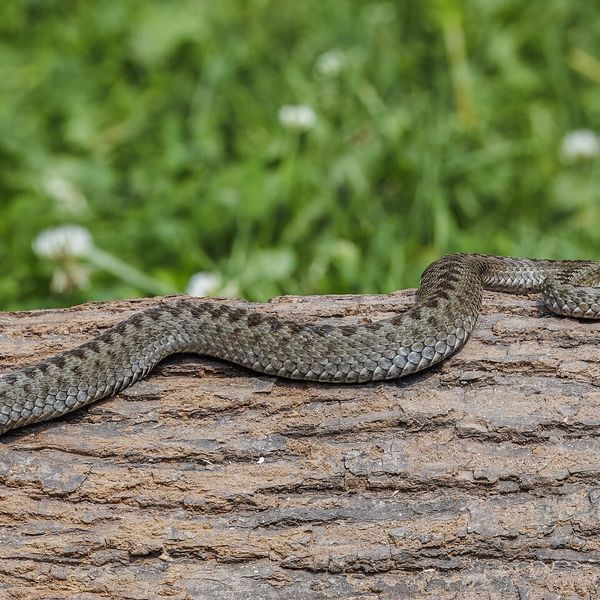
The Aesculapian snake is the longest snake of the Ukrainian Carpathians and one of the rarest. In Ukraine, it lives in Zakarpattia, Prykarpattia, and the southwestern regions, mainly in the foothills of the Carpathians. The snake prefers light deciduous forests with underbrush, rare beech forests, forest edges, clearings, bushes, rocky slopes, and the ruins of old castles, while avoiding dense forests, swamps, and arable land. It is also found in Poland (Bieszczady), Slovakia, and Romania.
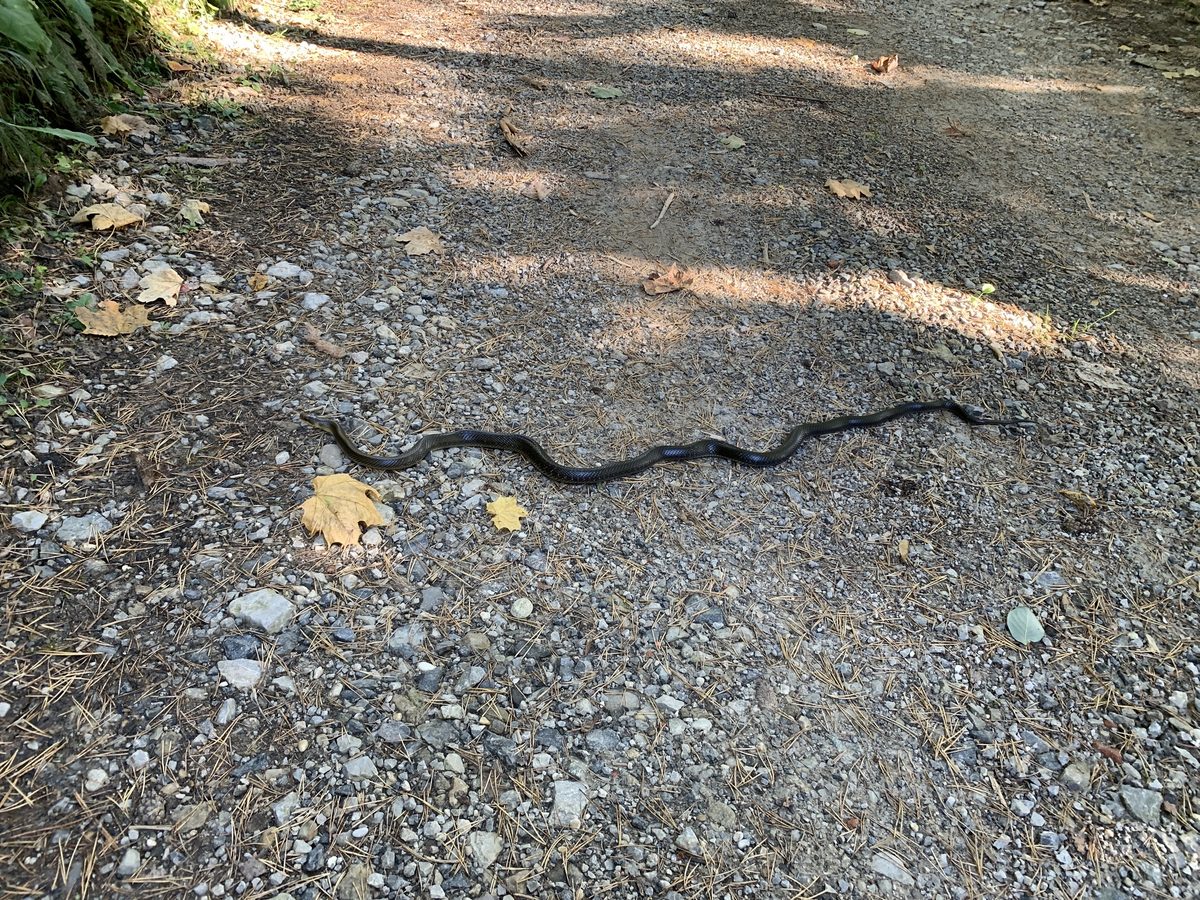
In Ukraine, the snake can reach a length of up to 190 cm, but usually measures around 120 cm. Its body is slender, olive-brown or grayish-brown, with smooth scales and small white spots; the belly is yellowish. The head is small, without distinct markings, and the pupil is round. The snake is excellent at climbing trees and rocks and swims well.
This is a warm-loving diurnal snake. In the Carpathians, it primarily hunts in the morning, until around noon, and then again in the evening. It feeds on rodents, birds, and bird eggs. Mating occurs in May–June, with females laying eggs at the end of June to July, and in cold years, even in August. Aesculapian snakes go into hibernation earlier than other snakes, and after early October, they are rarely seen.
The snake is non-venomous, but it can bite painfully when threatened, so it is not advisable to handle it.
The Aesculapian snake is listed in the Red Data Book of Ukraine as a vulnerable species. Catching, keeping, and killing it is prohibited.
Where in the Carpathians

The map shows where naturalists recorded the species (GBIF, CC0 and CC BY records), not every place it lives. The Ukrainian Carpathians are less studied, so a blank area does not mean the species is absent.
- Countries
- Ukraine · Romania · Hungary · Austria · Slovakia
- Mountain ranges
- Maramureș Mountains, Polonynian Ridge, Krasna Polonyna, Rivna Polonyna, Vihorlat-Gutin Volcanic Ridge, Bieszczady, Bükk, Gorgany, Almăj and Locva Mountains, Borzhava
- Altitude belts
- Foothills (below 600 m) · Beech forests (600–1200 m)
When to see it
| Jan | Feb | Mar | Apr | May | Jun | Jul | Aug | Sep | Oct | Nov | Dec | |
|---|---|---|---|---|---|---|---|---|---|---|---|---|
| Sightings |
From naturalists’ observations in the Carpathians (iNaturalist, research grade): the darker the cell, the more often the species is seen that month.
Look-alikes — how to tell them apart
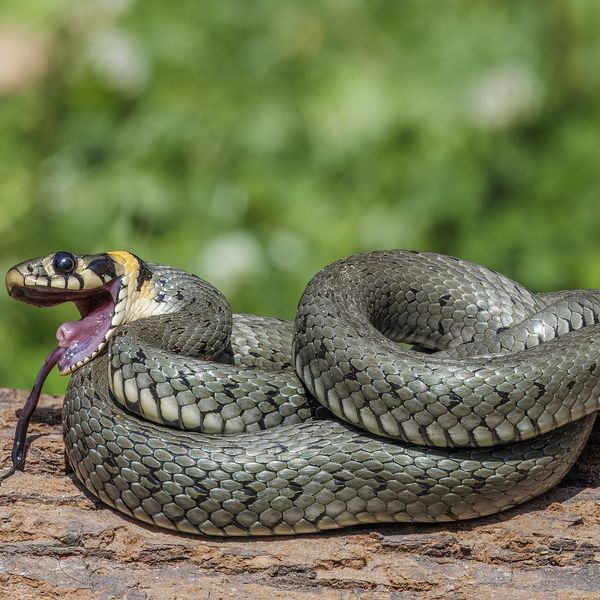
The common grass snake has bright yellow or orange spots on the back of its head; the Aesculapian snake does not, and its body is uniformly olive-brown with small white spots.
Protection and rules
Catching, keeping, and killing the Aesculapian snake is prohibited: the species is listed in the Red Data Book of Ukraine.
FAQ
What is the largest snake in the Carpathians?
The longest snake of the Ukrainian Carpathians is the Aesculapian snake: it can reach up to 190 cm in Ukraine, but usually measures around 120 cm. It is non-venomous and rare.
Is the Aesculapian snake venomous?
No, the Aesculapian snake is non-venomous, but it can bite when threatened. It is listed in the Red Data Book of Ukraine as a vulnerable species.
Similar species
Where to meet it
Trails
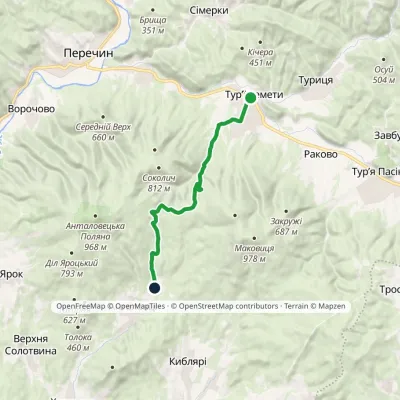 ModerateOne-dayMarkedTuri Remety village Antalovtsi villageElevation profile182–711 m14.2 kmascent 547 m≈ 4.5 h walking
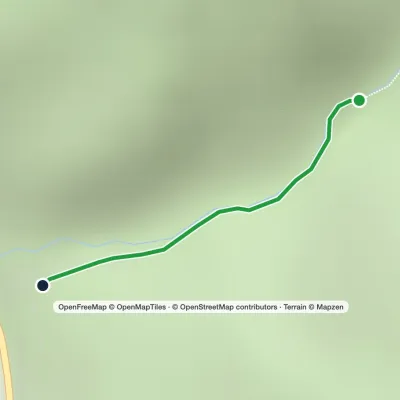 EasyOne-dayMarkedTo Sokolyne BerdoElevation profile331–674 m2.6 kmascent 344 m≈ 1.5 h walking
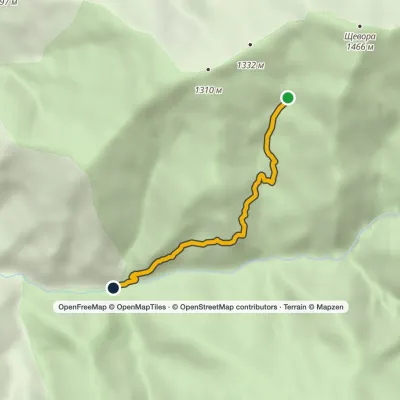 EasyOne-dayMarkedTo Yalynskyi WaterfallElevation profile453–1 047 m4.6 km≈ 1 h walking
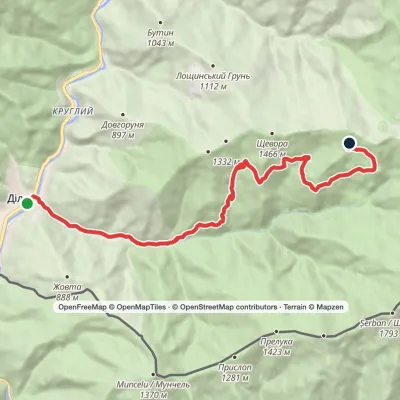 ModerateTwo-dayDilove village to Shchavora polonynavia Yalynskyi WaterfallElevation profile346–1 338 m16.3 kmascent 1 042 m≈ 6 h walking
 HardMulti-dayDilove village to Kostylivka villagevia Mount Pip Ivan MarmaroskyiElevation profile346–1 521 m37.9 kmascent 1 570 m≈ 12.5 h walking
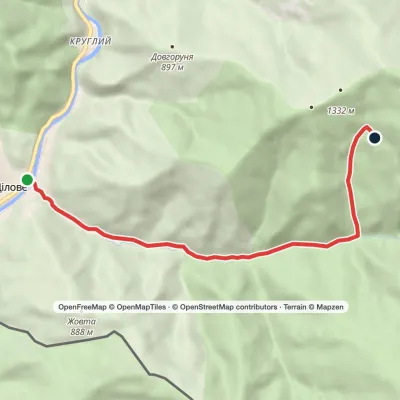 ModerateOne-dayMarkedDilove village Yalynskyi WaterfallElevation profile346–1 063 m7.6 kmascent 716 m≈ 3.5 h walking
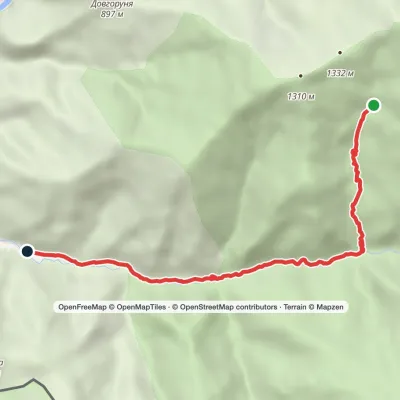 EasyOne-dayMarkedYalynskyi Waterfall Dilove villageElevation profile393–1 030 m8.2 kmascent 7 m≈ 2 h walking
 HardMulti-dayMarkedDilove village loopvia Mount Pip Ivan Marmaroskyi, Mount ZherbanElevation profile346–1 936 m50.5 kmascent 1 783 m
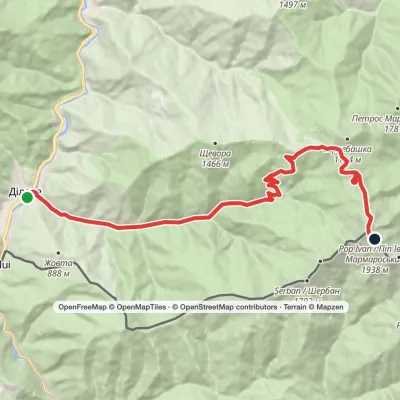 HardTwo-dayMarkedDilove village to Mount Pip Ivan Marmaroskyivia Lysycha polonynaElevation profile346–1 936 m19.4 kmascent 1 663 m≈ 8 h walking
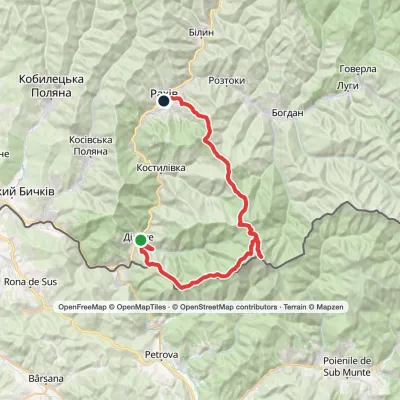 HardMulti-dayDilove village to Rakhivvia Mount Zherban, Mount Pip Ivan MarmaroskyiElevation profile346–1 936 m44.9 kmascent 1 990 m
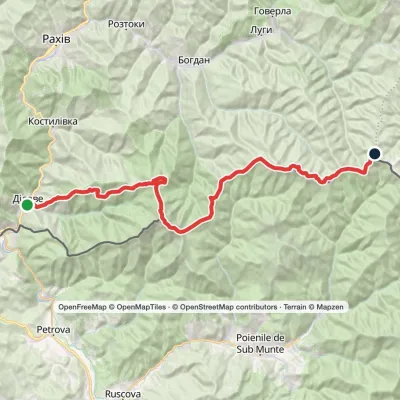 HardMulti-dayDilove village to Mount Stihvia Mount Pip Ivan Marmaroskyi, Mount Mika-Mare +1Elevation profile346–1 936 m45.1 kmascent 3 322 m
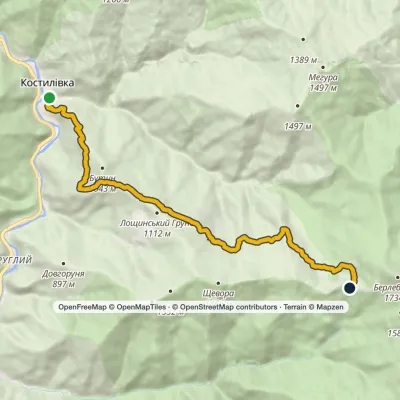 ModerateOne-dayMarkedKostylivka village Berlebashka polonynaElevation profile394–1 403 m12.6 kmascent 1 037 m≈ 5 h walking
Peaks and meadows
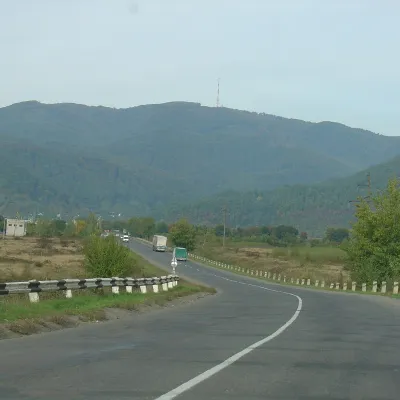 PeakMount TupyiImstychovoaltitude 878 m · Volcanic Carpathians rangeTupyi is the highest summit of the massif of the same name, part of the volcanic ridge of the Ukrainian Carpathians.
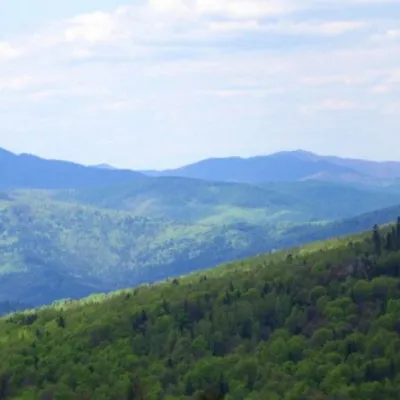 PeakMount KlyuchKamiankaaltitude 927 m · Skole Beskids range2 trails to the topMount Klyuch is one of the peaks of the ridge in the Skole Beskydy, which starts from the Sukel River (Bukivets...
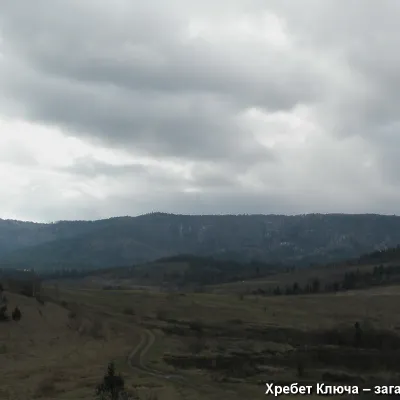 PeakMount YavorinkaTrukhanivaltitude 940 m3 trails to the topThe top of Mount Yavorinka is 940 meters above sea level. Mount Yavorinka is the highest peak of the Klyucha ridge,...
Waters and waterfalls
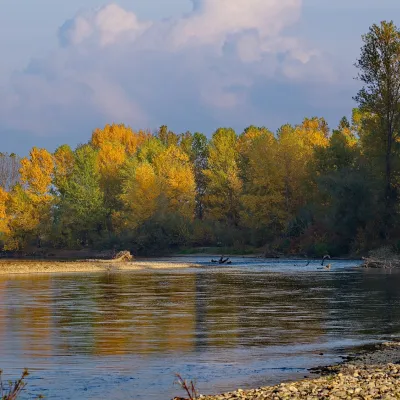 RiverTysa River (Tisza)RakhivThe Tysa (Tisza) is the main river of Zakarpattia. It begins on the north-eastern edge of Rakhiv, where the Chorna...
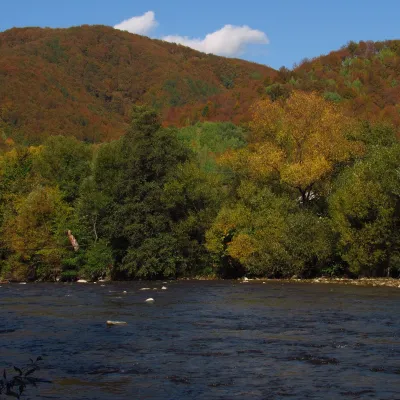 RiverUzh RiverVelykyi BereznyiAbove the Uzh near Kamianytsia stand the ruins of Nevytsky Castle, and in Uzhhorod the Masaryk Bridge offers a good...
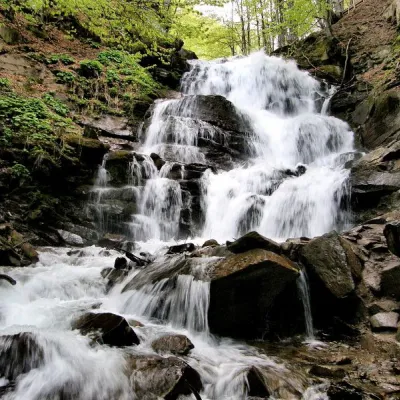 Waterfall"Shypit Waterfall" PylypetsPylypetsIn a cozy corner of the Carpathian Mountains, among the evergreen mountain forests and steep, sharp cliffs, lies the...
Mountain ranges: Maramureș Mountains, Polonynian Ridge, Krasna Polonyna, Rivna Polonyna, Vihorlat-Gutin Volcanic Ridge, Bieszczady, Gorgany, Borzhava, Skole Beskids, Chornohora. In other countries: 🇭🇺 Bükk, 🇷🇴 Almăj and Locva Mountains, 🇷🇴 Trascău and Metaliferi Mountains, 🇷🇴 Căpățânii Mountains
Trails and peaks near which naturalists recorded the species (GBIF, iNaturalist), matched by altitude and habitat. Sightings are not guaranteed.
Sources
- Вікіпедія: Полоз лісовий
- Wikipedia (en): Aesculapian snake
- Перелік видів тварин, що заносяться до Червоної книги України (наказ Міндовкілля від 19.01.2021 № 29, зареєстровано в Мін'юсті 01.03.2021 за № 260/35882)
- Міндовкілля: текст переліку видів тварин Червоної книги України (PDF)
- GBIF: таксон і категорія МСОП
- Директива Ради 92/43/ЄЕС про збереження природних оселищ (консолідована редакція)
GBIF · iNaturalist · Wikidata · Distribution data: GBIF.org (CC0 and CC BY records), iNaturalist; names and identifiers: Wikidata (CC0). Text: Karpaty.rocks, checked 09.11.2026.
