Eurasian beaver
About
The Eurasian beaver is the largest rodent in Europe and a remarkable builder. In the 19th and 20th centuries, it was nearly exterminated, but thanks to protection and relocation, beavers have returned to the rivers of many countries, including Poland, Slovakia, and Romania. In Zakarpattia, beavers arrived relatively recently, and according to scientists from Uzhhorod University, they have spread here very quickly. Today, they are recorded, in particular, on the Tysa and Borzhava rivers.
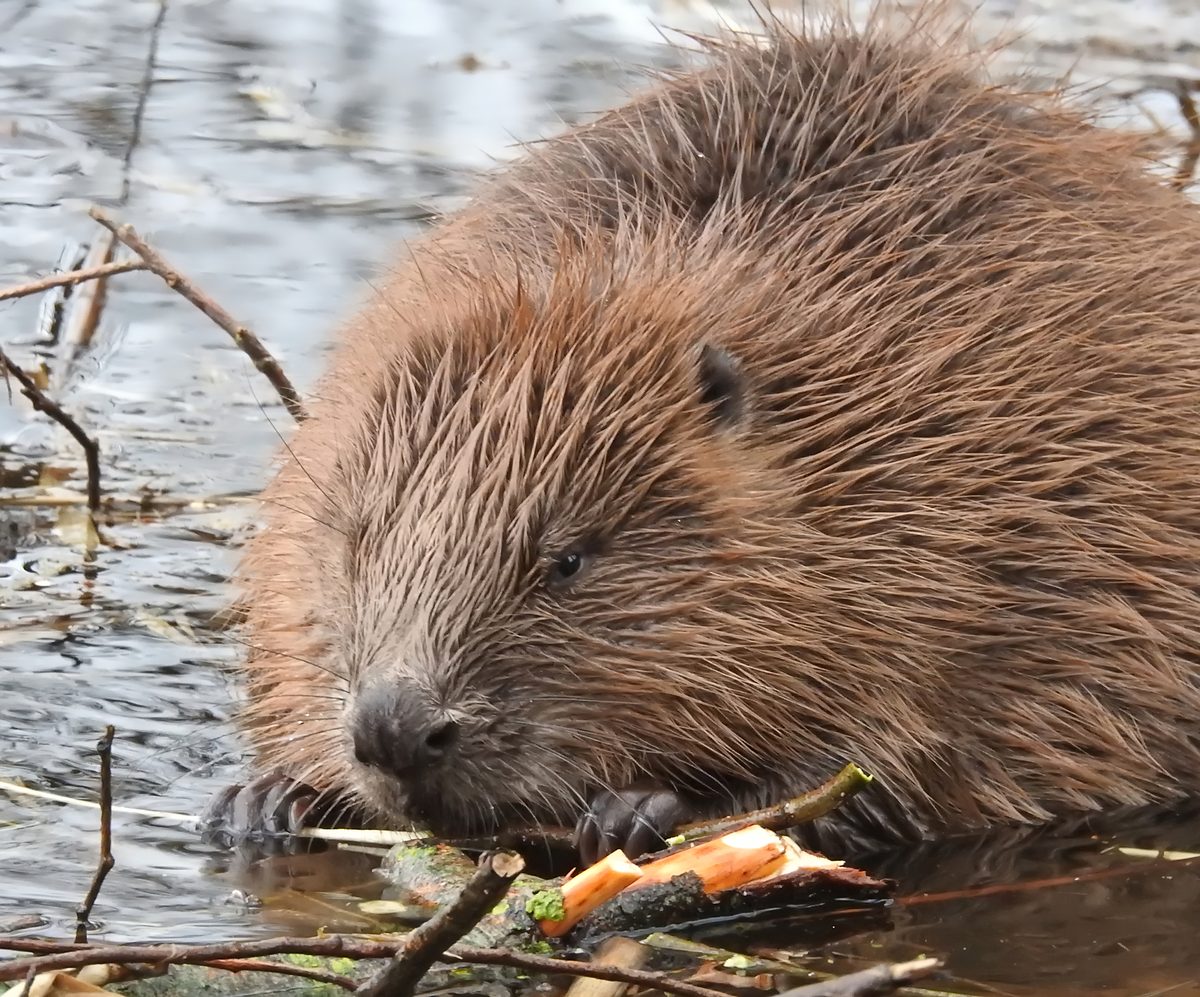
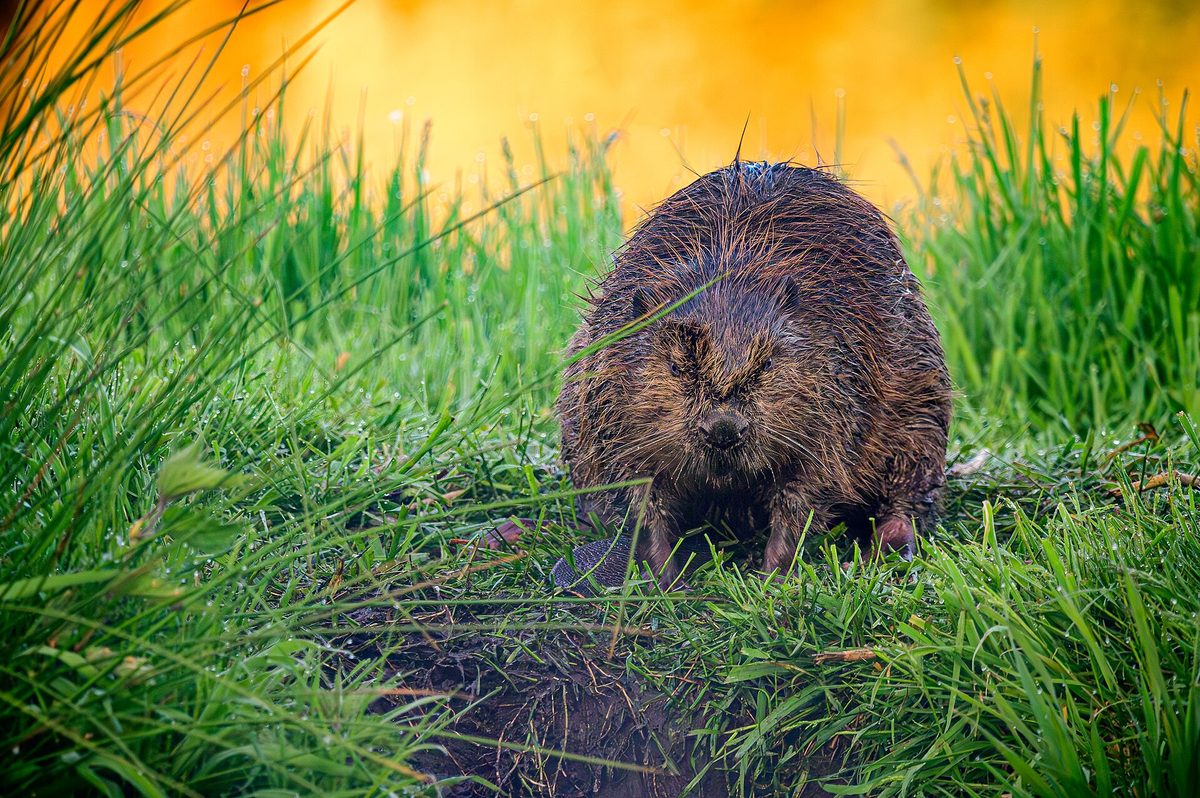
The Eurasian beaver is easily recognizable by its flat, scaly paddle-shaped tail, webbed feet, and large orange incisors. Its fur is dense, brown, and water-resistant.
The Eurasian beaver lives in families. It gnaws on trees near the water—willow, poplar, alder—and eats bark, branches, and aquatic and riparian plants. On small rivers, it builds dams to raise the water level and arranges its home in burrows in the bank or in 'lodges' made of branches and mud. The young are born in spring.
The best time to see a beaver is at dusk when it swims with only its head above water. During the day, it can be identified by gnawed stumps, sharpened like pencils, tree trunks with characteristic tooth marks, trails leading to the water, and dams.
The Eurasian beaver is not listed in the Red Data Book of Ukraine. In the EU, the species is included in Annexes II and IV of the Habitats Directive.
Where in the Carpathians

The map shows where naturalists recorded the species (GBIF, CC0 and CC BY records), not every place it lives. The Ukrainian Carpathians are less studied, so a blank area does not mean the species is absent.
- Countries
- Ukraine · Slovakia · Austria · Poland · Romania · Czechia · Hungary
- Mountain ranges
- Krasna Polonyna, Chornohora, Svydovets, Maramureș Mountains, Polonynian Ridge, Pieniny, White Carpathians, High Tatras, Żywiec Beskids, Levoča Mountains
- Altitude belts
- Foothills (below 600 m) · Beech forests (600–1200 m)
When to see it
| Jan | Feb | Mar | Apr | May | Jun | Jul | Aug | Sep | Oct | Nov | Dec | |
|---|---|---|---|---|---|---|---|---|---|---|---|---|
| Sightings |
From naturalists’ observations in the Carpathians (iNaturalist, research grade): the darker the cell, the more often the species is seen that month.
Protection and rules
Not listed in the Red Data Book of Ukraine.
FAQ
Are there beavers in the Carpathians?
Yes. Beavers have returned to the rivers of Poland, Slovakia, and Romania, and in Zakarpattia, they have spread relatively recently—they are recorded, in particular, on the Tysa and Borzhava rivers.
How can I tell if there are beavers living in a river?
By gnawed stumps and trunks near the water, trails leading to the river, and dams made of branches.
Recorded nearby
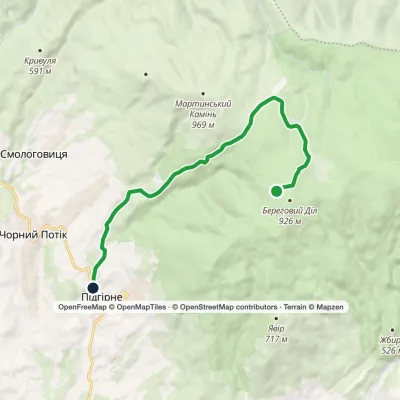 EasyOne-dayMarkedPidhirne Kupinkuvatevia Chorne BahnoElevation profile341–925 m10.8 kmascent 44 m≈ 3 h walking
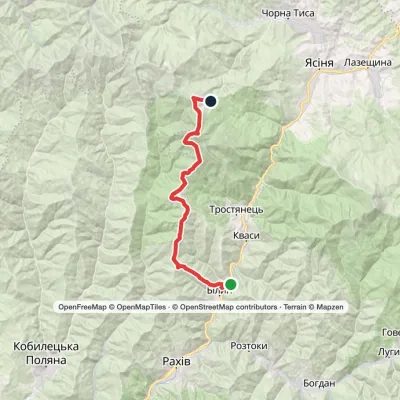 HardMulti-dayBilyn village to Dragobratvia Mount Blyznytsia, Mount StihElevation profile498–1 785 m26.5 kmascent 1 717 m≈ 10 h walking
 HardMulti-dayYasinia to Kvasy villagevia Mount Tataruka, Mount Dohiaska +2Elevation profile535–1 883 m62.2 kmascent 2 728 m
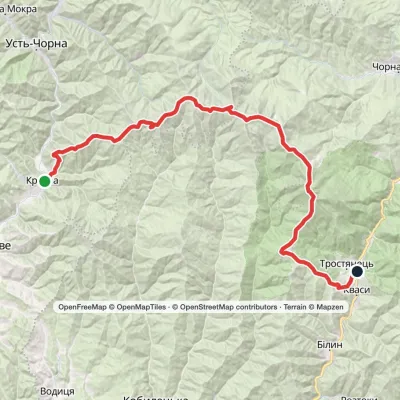 HardMulti-dayKrasna village to Kvasy villagevia Mount Tempa, Mount Unhariaska +2Elevation profile428–1 883 m51.3 kmascent 2 251 m
 HardMulti-dayKvasy village to Yasiniavia Mount Blyznytsia, Mount Stih +2Elevation profile558–1 883 m51.7 kmascent 2 810 m
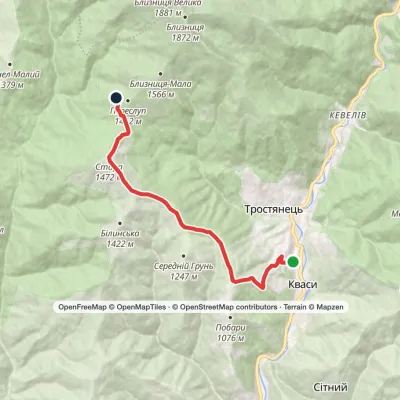 ModerateOne-dayMarkedKvasy village Mount PereslipElevation profile572–1 472 m10.2 kmascent 966 m≈ 4.5 h walking
Trails and peaks near which naturalists recorded the species (GBIF, iNaturalist), matched by altitude and habitat. Sightings are not guaranteed.
Similar species

Sources
- Вікіпедія: Бобер європейський
- Wikipedia (en): Eurasian beaver
- Башта А.-Т. В., Потіш Л. А. Експансія бобра європейського Castor fiber L. в регіоні (Науковий вісник УжНУ)
- Kutasi K. Az eurázsiai hód (Castor fiber) előfordulása a Tisza és a Borzsa medrében (ЗУІ ім. Ф. Ракоці II, 2024)
- Перелік видів тварин, що заносяться до Червоної книги України (наказ Міндовкілля від 19.01.2021 № 29, зареєстровано в Мін'юсті 01.03.2021 за № 260/35882)
- Міндовкілля: текст переліку видів тварин Червоної книги України (PDF)
- GBIF: таксон і категорія МСОП
- Директива Ради 92/43/ЄЕС про збереження природних оселищ (консолідована редакція)
GBIF · iNaturalist · Wikidata · Distribution data: GBIF.org (CC0 and CC BY records), iNaturalist; names and identifiers: Wikidata (CC0). Text: Karpaty.rocks, checked 09.11.2026.
