Turkey tail
Never identify a mushroom from a photo alone. If in doubt, leave it. In case of poisoning call 112 (103 in Ukraine) at once.
About
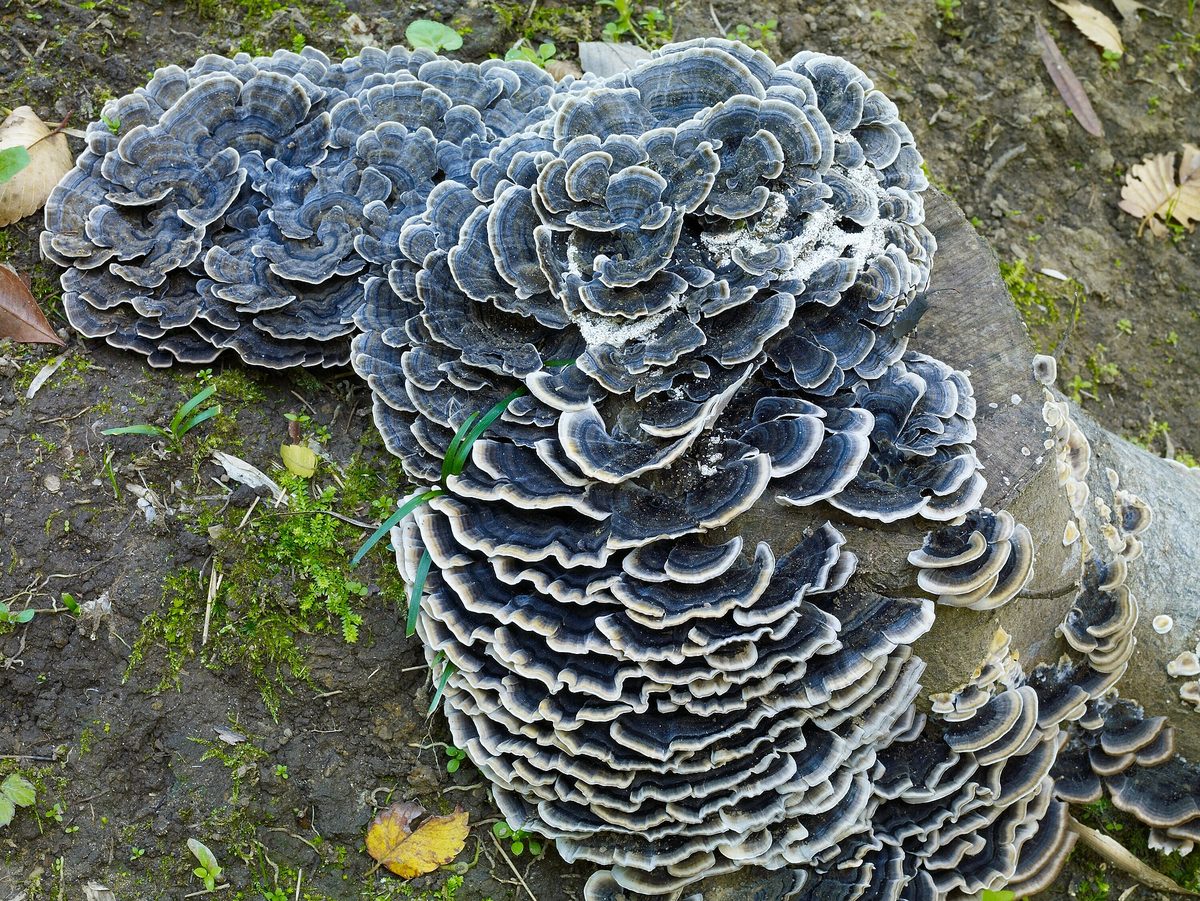
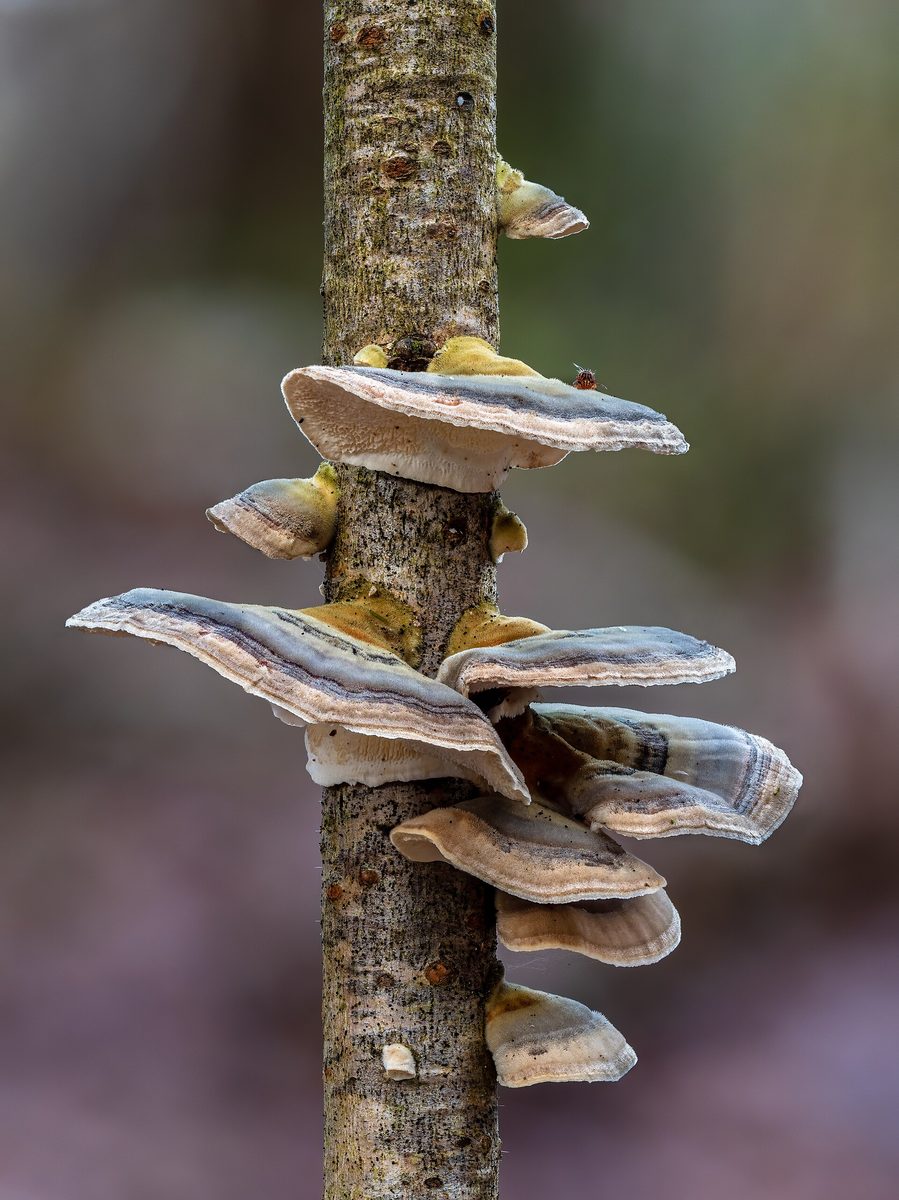
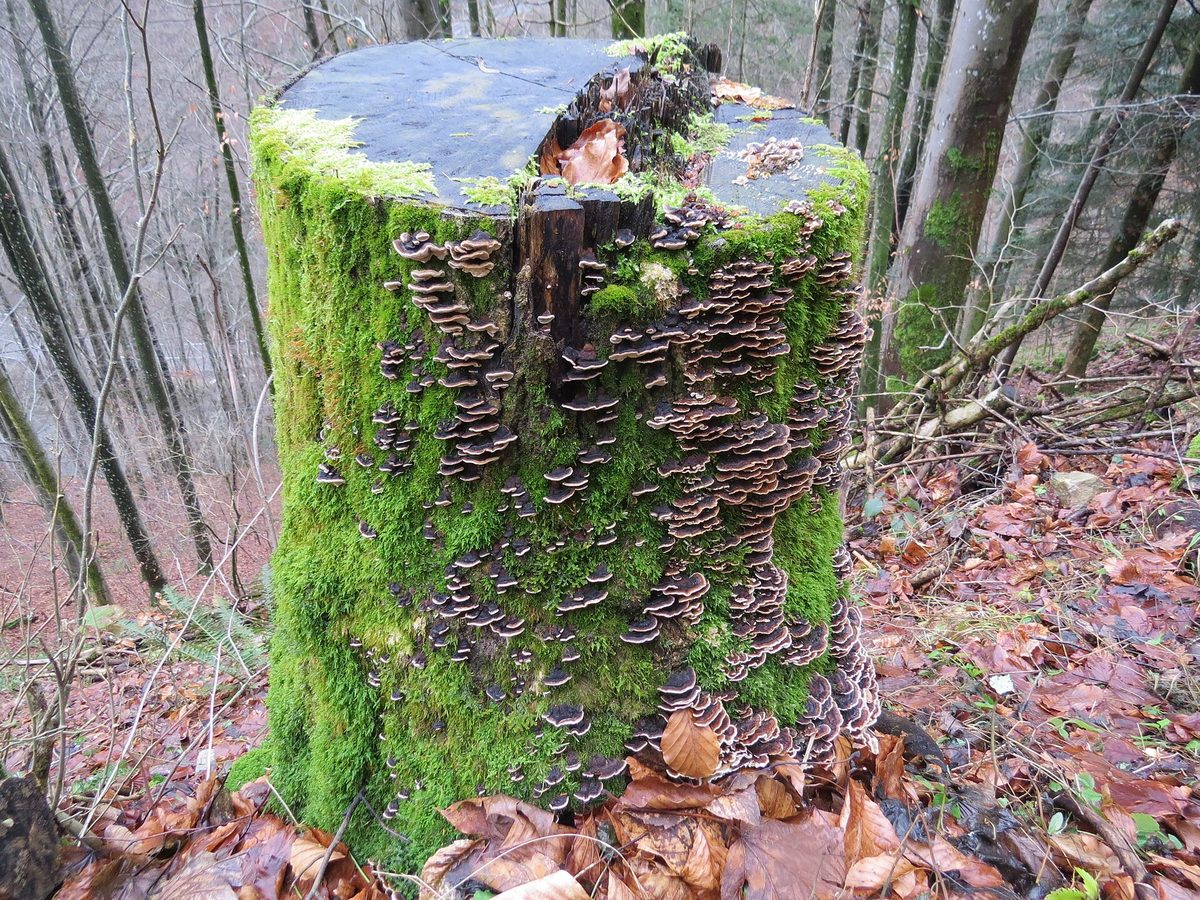
Trametes versicolor is one of the most common polypores. Its caps are thin, leathery, semicircular or fan-shaped, 2–8 cm wide. They grow in tiers and rosettes, overlapping each other, and sometimes cover the entire stump.
The top of the cap is decorated with concentric stripes: brown, gray, bluish, ochre, and almost black. The velvety stripes alternate with smooth, silky ones, and the edge is always light. Because of this pattern, the mushroom is called 'Turkey tail' in English. The underside is whitish or creamy, with very small pores — three to five per millimeter, barely visible without a magnifying glass.
Trametes grows on dead wood of deciduous species — stumps, fallen trunks, branches of beech, birch, hornbeam, oak, alder, and occasionally on conifers. It causes white rot: decomposing wood and returning nutrients to the soil. The fruiting bodies are annual but persist for a long time, so the mushroom can be seen at any time of the year, even in winter.
In the Carpathians, it is common in beech and mixed forests from the foothills to the upper limit of beech, in clearings and parks.
The mushroom is inedible — too tough. It is most often confused with Stereum hirsutum. That one also grows in tiers on deciduous wood, but its underside is smooth, without pores, yellowish. In Trametes versicolor, the caps are thicker, grayish, more uniformly colored, with coarse hairs.
Where in the Carpathians

The map shows where naturalists recorded the species (GBIF, CC0 and CC BY records), not every place it lives. The Ukrainian Carpathians are less studied, so a blank area does not mean the species is absent.
- Countries
- Austria · Poland · Slovakia · Ukraine · Hungary · Romania · Czechia · Serbia
- Mountain ranges
- Maramureș Mountains, Gorgany, Sądecki Beskids, Strážov Mountains, Bükk, Bucegi Mountains, Slovak Ore Mountains, Silesian Beskids, Babia Góra, Mátra
- Altitude belts
- Foothills (below 600 m) · Beech forests (600–1200 m)
When to see it
| Jan | Feb | Mar | Apr | May | Jun | Jul | Aug | Sep | Oct | Nov | Dec | |
|---|---|---|---|---|---|---|---|---|---|---|---|---|
| Sightings |
From naturalists’ observations in the Carpathians (iNaturalist, research grade): the darker the cell, the more often the species is seen that month.
Look-alikes — how to tell them apart
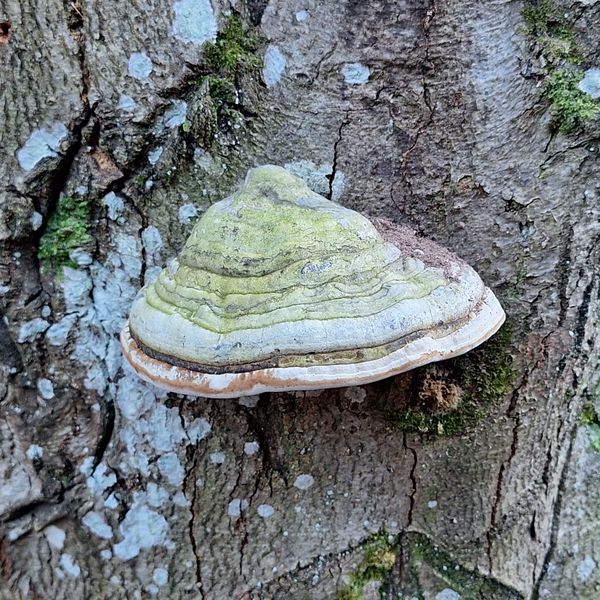
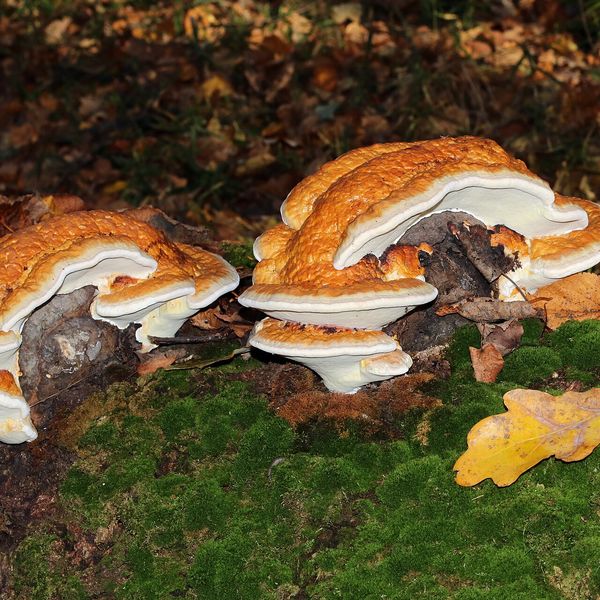
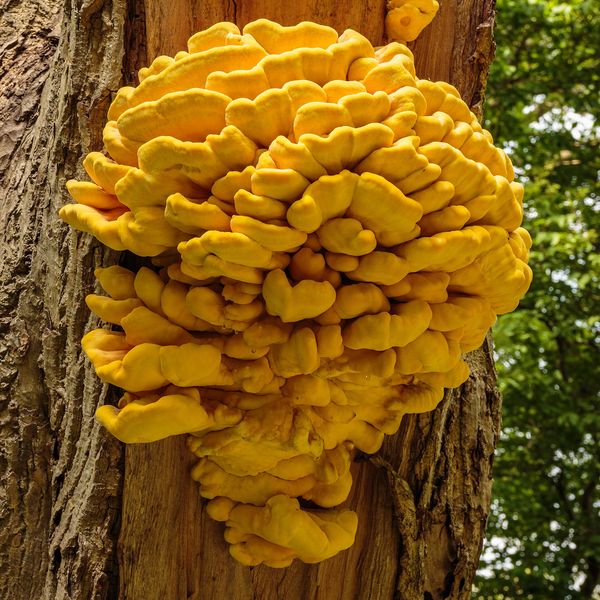
The underside is smooth, without pores, yellowish or ochre; the top is yellow-brown and hairy.
Protection and rules
Not listed in the Red Book of Ukraine.
FAQ
What striped mushrooms grow on stumps all year round?
Most often Trametes versicolor: thin leathery fans with multicolored concentric stripes and a whitish porous underside.
Is Trametes versicolor edible?
No, it is too tough and considered inedible.
Similar species
Where to meet it
Trails
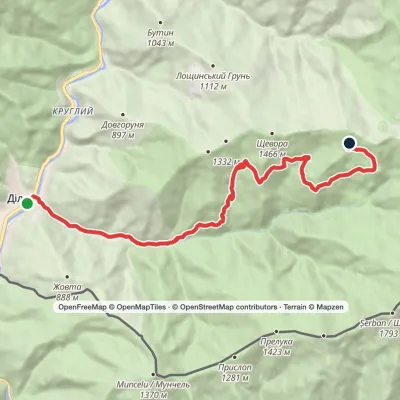 ModerateOne-dayDilove village to Shchavora polonynavia Yalynskyi WaterfallElevation profile346–1 338 m16.3 kmascent 1 042 m≈ 6 h walking
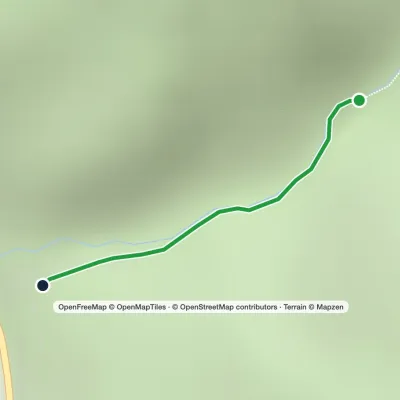 EasyOne-dayMarkedTo Sokolyne BerdoElevation profile331–674 m2.6 kmascent 344 m≈ 1 h walking
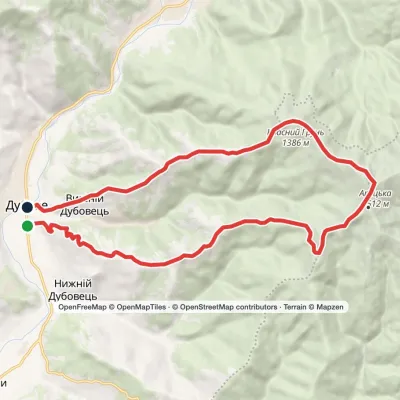 HardOne-dayDubove village loopvia Mount ApetskaElevation profile386–1 512 m21.2 kmascent 1 213 m≈ 7.5 h walking
Mountain ranges: Maramureș Mountains, Gorgany. In other countries: 🇵🇱 Sądecki Beskids, 🇸🇰 Strážov Mountains, 🇭🇺 Bükk, 🇷🇴 Bucegi Mountains, 🇸🇰 Slovak Ore Mountains, 🇵🇱 Silesian Beskids, 🇵🇱 Babia Góra, 🇭🇺 Mátra, 🇷🇴 Poiana Ruscă Mountains, 🇸🇰 Slovak Central Mountains, 🇵🇱 Low Beskids
Trails and peaks near which naturalists recorded the species (GBIF, iNaturalist), matched by altitude and habitat. Sightings are not guaranteed.
Sources
- Вікіпедія: Траметес різнобарвний
- Wikipedia (en): Trametes versicolor
- iNaturalist: Trametes versicolor (спостереження в Карпатах)
GBIF · iNaturalist · Wikidata · Distribution data: GBIF.org (CC0 and CC BY records), iNaturalist; names and identifiers: Wikidata (CC0). Text: Karpaty.rocks, checked 11.11.2026.
