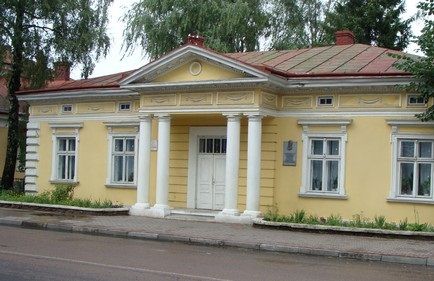
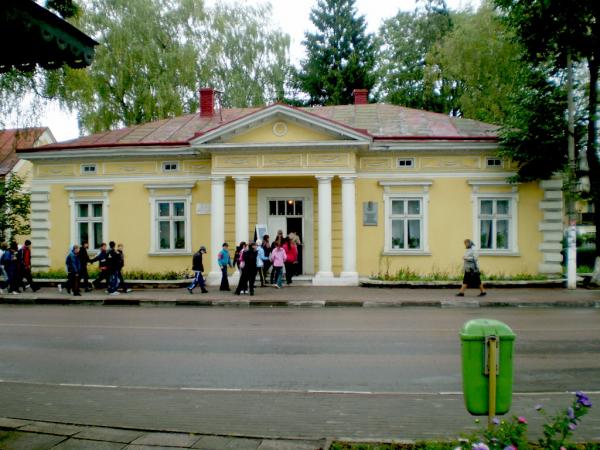
The Literary and Memorial Museum named after Mark Cheremshyna (the writer's real name is Ivan Semanyuk) was opened on July 17, 1949, in Snyatyn in the writer's own house. The neat building with luxurious architecture of the classicism era has remained unchanged for over two hundred years. It was in this house that the writer spent his last years. The solemn facade perfectly describes the essence of the museum house. The wide exhibition is recognized as one of the best that tells the biography of the famous Ukrainian figure, writer, and cultural activist.
Living here from 1912 to 1927, the author left behind hundreds of interesting works, archival documents, sketches, drafts, and other working materials. Visitors can explore these in detail while studying the exhibits in the memorial museum. Thanks to the work of historians and admirers of his creativity, the domestic environment of the house has remained unchanged. Dozens of personal items, a musical instrument, glasses, a pen, a writing desk, and family photographs have been preserved and restored. Admirers of Mark Cheremshyna's creativity have organized a whole creative club based at the museum, where young talents from Snyatyn gather. Nearby, it is worth visiting the museum of Vasyl Kasiyan.
From the time of the museum's opening until March 1974, its director was the writer's wife, N. V. Semanyuk. The first exhibition of the museum was created, illustrated by famous Ukrainian artists: I. Yizhakevych, V. Kasiyan, O. Kulchytska, F. Manaylo, and others.
The museum's exhibition consists of about 400 preservation units: photographs, documents, personal belongings, and the writer's library, which tell about his life and creative path. Visitors will find it particularly interesting to see Mark Cheremshyna's working office, which impresses with its modesty and simplicity. Here he not only worked but also received his friends and acquaintances. Separate rooms are dedicated to exhibitions that are regularly organized by the museum staff.
Mark Cheremshyna (Ivan Yuriyovych Semanyuk) was born on June 13, 1874, in the village of Kobaky, now in the Kosiv district. He spent his childhood with his grandparents, growing up "amid songs, fairy tales, and flutes, inhaling and exhaling them." From 1889, he studied at the Kolomyia Gymnasium, where he became close to Vasyl Stefanyk and Les Martovych, who became his closest friends. Under the influence of his friends, Ivan Semanyuk made his first literary attempts, and in 1889, his story "Kermanich" was published in the newspaper "Bukovyna" under the pseudonym Mark Cheremshyna, which from that time became Ivan Semanyuk's literary name.
After graduating from the gymnasium, in the autumn of 1896, Mark Cheremshyna entered the University of Vienna at the Faculty of Law. In 1901, his first collection of novellas "Karby" was published, which included 15 novellas from the life of the western Ukrainian peasantry. At the same time, in 1901, Mark Cheremshyna graduated from the university, and from 1902 to 1905, he took exams for his doctorate. He received his diploma in July 1906. In 1912, at the invitation of V. Stefanyk, he opened a law office in Snyatyn. The peasant theme is characteristic of Mark Cheremshyna's second collection "Selo vyhybaye" (1925). The third book of novellas was published in 1929, after the writer's death, under the title "Verkhovyna."
The writer's works have been published more than 30 times. Mark Cheremshyna's novellas have been translated into German, Czech, Moldovan, Bulgarian, Latvian, and Belarusian. On June 13, 1974, by the decision of UNESCO, the 100th anniversary of Mark Cheremshyna's birth was widely celebrated around the world.
- Museum hours: 10:00 AM - 6:00 PM.
- Ticket prices: adult - 10 UAH, child - 7 UAH.
- Tour prices: for adults - 20 UAH, for children - 15 UAH.
The museum has been included in the list of objects checked for accessibility for people with disabilities.
Brief description regarding the possibility of visiting by people with disabilities:
The museum is located in the central part of Snyatyn near the city hall. There is no special parking for cars near the museum. The building is one-story, has a clearly visible but practically inaccessible main entrance from the street, as the left half of the entrance doors does not open. Currently, there is a backup entrance through the yard at the back of the museum.
There are two large steps leading to the central entrance of the museum (there are no handrails or stationary ramps). The width of the central doors (if both parts are opened) is sufficient for wheelchair passage. The corridor behind the entrance doors is wide enough to turn around a wheelchair.
The backup entrance also has two large steps (there are no handrails or stationary ramps). The width of the doors is sufficient for wheelchair passage. Movement in the exhibition halls is convenient, the interior doors are wide and have no thresholds.
Nearby the museum, there is a monument to Mark Cheremshyna with unobstructed access.