Intercession Church, Lviv
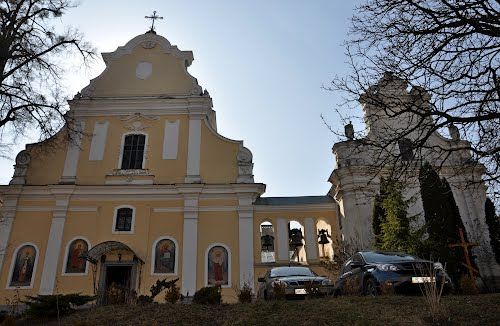
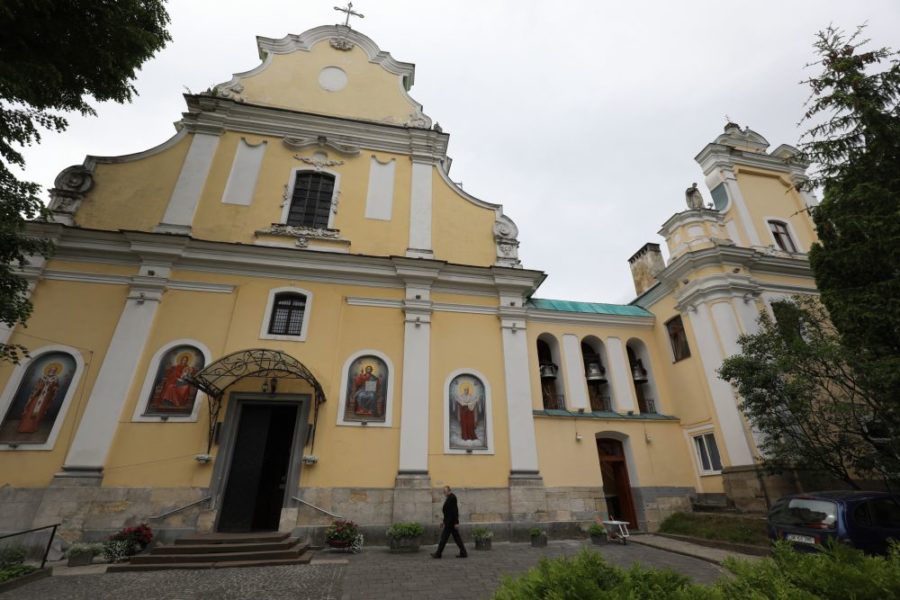
TheChurch of the Intercession of the Blessed Virgin Mary (formerly the Church of St. Nicholas, the Church of the Holy Trinity and St. Nicholas the Bishop, Trinitarian Church) is a functioning church, the cathedral of the Lviv-Sokal Diocese of the Orthodox Church of Ukraine, an architectural monument of the XVIII century in Lviv. It is located in the central part of the city, at 2 Mykhailo Hrushevskoho Street.
The first Trinitarians arrived in Lviv in 1685 from Spain. Gradually, they acquired several houses in Lviv's city center, where they set up a temporary monastery.
On August 22, 1693, they approved the first document regarding the monks' funds. In 1694, Mikołaj Strzalkowski donated 40,000 zlotys to the monastery. He also bequeathed the monks a plot of land in the Galician suburbs and funds for construction.
The wooden monastery on a stone foundation was built in 1694. Two years later, the construction of the wooden church of St. Nicholas was completed. In 1739-1745 the modern building was constructed at the expense of Samuel Mukhavetskyi and Jan Jablonowski. In 1769 a fire broke out. Reconstruction lasted until 1777. In 1782, the Trinitarian order was abolished - 9 caplans and 3 brothers who lived here were forced to leave the shrine.
The inventory of 1783 showed that the church had 10 altars (including the main one), a pulpit, and a 9-voice organ in the choirs. In 1790, the church became a parish church, and a plebeian community was housed in the cloister. In 1837 the church was given under the care of the Jesuits. In 1853, Lviv University was located next to the church, in the building of the Jesuit Convocation. In 1903, the restoration was completed under the leadership of Michał Łuzhetski.
The authorship of the project is attributed to the Italian Francesco Placidi. The builder was probably the Trinitarian monk Kazimierz Hronacki, a native of Lublin.
The church has three naves and is covered with semicircular vaults with fluted arches. The façade is crowned with a traditional pediment with volutes. The façade plane is divided by pilasters and significantly developed cornices.
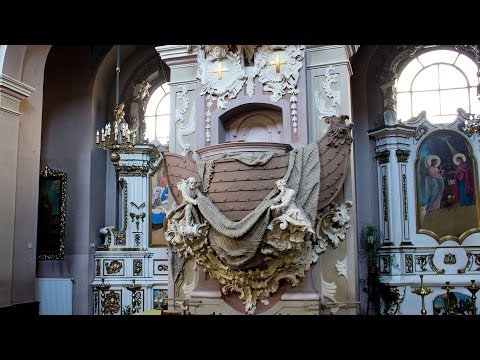
The interior is executed in the Rococo style and decorated with lush stucco moldings, wood carvings, and sculpture. The author of the stucco decoration, made in 1746, was the monk L. Pechytskyi (from Podlasie). The altar wooden sculpture belongs to the master Sebastian Fesinger.
A valuable artistic monument is the altar of the Scholz-Wolfowiczes, made around 1595, located in the left nave. It originated from the Latin Cathedral of Lviv, founded in 1595 by the Lviv rayon councillor Jan Scholz-Wolfowicz, and was sculpted by Jan Zaremba (Polish researcher Zbigniew Hornung suggested that it was by Andreas Bemer).
Since 1796, a statue of St. John Nepomuk has stood in front of the church, which was previously located near the bridge over the Poltva River in the Galician suburb, and then on Akademichna Square.