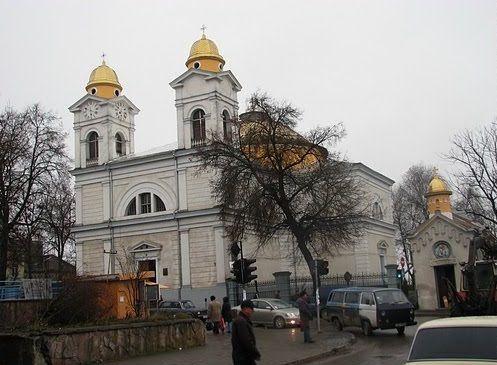
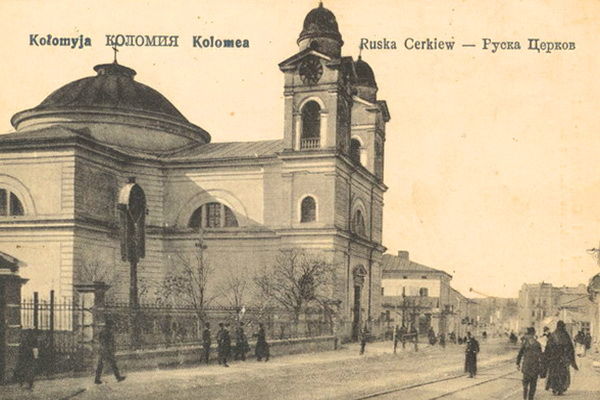
Church of the Archangel Michael, Kolomyia
The Church of Saint Archangel Michael was built in 1855. It has survived to this day practically unchanged. The authors of the church's iconostasis and images were the famous Ukrainian artist K. Ustiyanyovych and the Hungarian – Miklós. Immediately, the church became a center of spiritual and national-cultural development for Ukrainians in Kolomyia. The wall paintings of the temple were executed in several stages by the Kolomyia artist V. Krytsynskyi. In 1885 and 1892, he was assisted in the execution of the paintings by the teachers of the pottery school S. M. Dubytskyi and S. M. Dachynskyi. At that time, images of Christ the Blessing, the four evangelists, and a choir of angels were created. The church brotherhoods, which operated at the temple, stood guard over faith and national culture. Among them were: "Brotherhood of Saint Archangel Michael", the women's "Brotherhood of the Holy Family", and "Brotherhood of Saint Apostle Peter". The "Brotherhood of the Holy Family", composed mainly of Kolomyia women – parishioners of the Church of Saint Archangel Michael, lasted the longest. The brotherhood existed until September 9, 1955.
This Lord's abode was developed for Kolomyia in Vienna. The foundation of the building, as we know, is the foundation. This powerful wall with buttresses is reinforced with an artificial earthen embankment and was erected on the remnants of medieval defensive bastions, on which the monastery of the Dominican fathers stood until 1788. Until recently, the upper layer of the hill was covered with charred bones, fragments of household items, jewelry, and coins. By the mid-20th century, the square near the church was referred to as the "Dominican square", echoing the Latin monastery.
"Russkaya Rada" from June 1, 1902, states: "... the city church was built with great difficulties and obstacles. Its foundation was laid back in the serfdom era, around 1838, – its plans were made in Vienna. It is unknown what style it is, as one part is Byzantine, while the other seems Gothic."
In 1855, a new cathedral was built of brick on the site of the ancient Dominican monastery, which became possible thanks to the active support of the then parish priest, storyteller, publicist, and cultural and social activist Luka Danykevych. The parish-mother church gradually took on the appearance familiar to us. Surprisingly, a significant part of the construction of the Ukrainian shrine was contributed by the ethnic Austrian Rudolf Kurtsvayl – the mayor of Kolomyia at that time, a patron, and owner of nearby estates. The Church of Saint Archangel Michael was built in the year of our Lord 1864. However, even then, newspapers sounded the alarm that the stones in the walls were shifting, and the temple seemed to be encircled by iron rods. Soldiers were quartered in the unfinished church walls.
The community spent 100,000 rynok on the new project estimate for the completion. Those who had oxen or horses had to work for a week on the construction of the church. From the stories of the old-timers, it is known, for example, that each of the Ditykovets people worked here for 40 days. And the parish priest Ivan Ozarkevych traveled twice by cart to the capital of the empire, Vienna, to personally obtain permission from the emperor for the faster completion of this pious endeavor.
After the solemn consecration on August 6, 1871, the largest church in the city opened its massive oak doors to the laity. Starting from 1878, the church was managed by the father-superior and two cooperators. As is often the case, finishing works continued for a long time even after the church was opened, from 1885 to 1892. Part of the paintings was carried out in several stages by the teacher of the pottery school Stanislav-Mieczysław Dubytskyi. At that time, images of Christ the Blessing, Saint Princess Olga, Saint Cyril and Methodius, and the four evangelists were created... Thus, the church combined a museum and a shrine of our culture, where wonderful examples of Ukrainian religious painting by Korniy Ustiyanyovych, Teofil Kopystynskyi, Severyn Dachynskyi, and Yaroslav Lukavetskyi were collected. The latter created the image of the crucified Christ, bent over the chalice: "For all of you...", which is placed at the entrance on the left; a copy was kept in the home of the Vonsul family, at the corner of Mytskevych and Zamkova streets. Regarding Ustiyanyovych, after obtaining an education at the Vienna Academy of Arts, he began working on the painting of the iconostasis and images. However, most of the painter's works, unfortunately, are no longer available; some were poorly restored, and only the solitary "Sower" above the carved wooden pulpit remains. The canvas is filled with symbols borrowed from the Bible, with the sea and a sailing ship in the background. The interior captivates the eye with the extraordinary beauty of the gilded woodwork of the iconostasis, crafted by the carver Yurko Morosenko from Transcarpathia. In 1912, 300 golden rynok were donated for its creation by the future emperor Karl Franz Joseph, who was then serving with the Kolomyia dragoons.
The Hungarian O. Miklós left us his vision of the "Last Supper" on the altar ceiling, giving the apostles simple peasant traits. In 1926, this monumental creation was restored by the Pole Adolf Orzhekhovsky, as evidenced by his signature. A Polish drawing teacher at the pottery school, Valeryan Krytsynskyi, worked on the wall paintings of the heavenly patrons in the Church of Saint Michael. Almost unchanged, the images of the angelic choirs on the vault of the main church nave have reached us, executed according to the canons of the Eastern rite. Later, their reproductions were published on black-and-white postcards, which were mass-produced in Prague. Comparing them with the modern version, we can see a significant difference, not in favor of the latter. And only faithful to his image, the archangel Michael invariably occupies his rightful place in the temple – in the right niche of the central vault, on the tetrapod, and finally proudly rises above the altar in the sacristy. To implement this architectural project, the church "twenty" had to wisely distribute the people's donations. "Instead of repairing the roof and the steeple, in 1901, the church brotherhood of the Saint Michael's temple built an iron, forged fence, which cost 4000 gold rynok," wrote "Russkaya Rada" in 1902. This fence, quite substantial, was partially installed, that is, not around the church, as one would wish, but only from the main facade. Thus, it has remained to this day. Some kind of wire fence along the slope of Yaroslavsky Street (now Andrey Sheptytsky) appeared in the late 1960s to prevent children from trampling the grass from neighboring quarters.
During the Russian occupation, not only the bells were taken from the main Uniate church, but also the copper roof. Instead, the Russians issued 15 bottles of white wine monthly for church needs starting in November 1916. Seventy-seven serpentine oak steps must be climbed to reach the highest point. Four bell-ringers were installed under the dome only in 1923. On the external pedestal, there is an inscription: "Sacristy" Sambor general patronage of the bell founder Karl Schwabe in Biala." The installation was carried out under the supervision of the blacksmith Mykhailo Rubych, for which he was honored to be called the "godfather" of Kolomyia church bells. The largest bell was named Michael, as evidenced by its "baptismal certificate". The smallest was named Andriychyk for its ringing major voice. From here, there is a view of the neighboring tower with an old clock mechanism. To get there, one must open low doors with a mysterious date inscribed on them: "1883". Everything behind them indicates that no one has particularly visited here for a long time, except for pigeons, which peacefully hatch their offspring in their nests. The massive pendulum of the clock has stopped its movement.
Oleksandr Rusyn was destined to be the last Greek-Catholic priest of the Church of Saint Michael. After the pseudo-synod of 1946, he was forced, at the advice of higher clergy, to "sign" Russian Orthodoxy. Without the active participation of this conscious religious figure, the long-time Kolomyia dean, no event in the city during the relatively peaceful interwar period went without him. Thanks to him, Kolomyia orphans and children of poor townspeople were placed in "shelters" under the care of the nuns of the Order of Saint Basil the Great. One of those shelters still stands on O. Dovbusha Street, where there is now a geriatric nursing home. Then, during the interwar period, at the initiative of the father-dean, a solid brick chapel was built. Above the entrance is a relief image of the Mother of God with a child, below it the inscription: "This is your mother". During the Soviet era, the stucco was dismantled, and the chapel itself was repurposed for a medical accounting office, which lasted until the declaration of Ukrainian independence.
In 1944, people left the village of Illintsi, where they temporarily stayed during evacuation. Already on their native Kolomyia land, they dug up hidden images in the garden near their home, wrapped in old cloth, plates with Franz Joseph, and small utensils. Mass mobilization began in the city. As the Soviet army advanced westward, wealthy Kolomyia families of conscripts brought "voti" – donations to the Saint Michael's church for the safe return of their children from the front. For this, a narrow box was displayed, where rings and chains sparkled on black velvet. Just before the Soviet advance on the city, a German soldier was killed by a shell in front of the church doors, and he was hastily buried on the opposite side of the street. And on the church wall to the right of the entrance, the trace of the explosion remained for a long time.
The "black March" of 1946 came. The so-called Lviv Synod banned the Ukrainian Greek-Catholic Church. The priest of the temple, O. Rusyn, and the sacristan received a warning from the authorities not to use the bells, as they made too much noise. A threat of closure hung over the church. At that time, valuables also disappeared. And in high offices, there were plans to repurpose the cult building into warehouses. On October 11, 1955, tens of thousands of townspeople, accompanied by 29 priests, bid farewell to their shepherd Oleksandr Rusyn for the last time.
After the death of Dean Rusyn, a native of Bukovina, the Orthodox priest S. Bilynskyi began to serve in the main church of the city, whom the townspeople never recognized. Credit should be given to the long-time leader of the church choir, Emilia Matsiborko, who convinced the choir members not to stop attending rehearsals. Members of the church committee distributed the most valuable cult attributes, which in one way or another differed from the Orthodox of the Moscow Patriarchate, to neighbors and family for temporary storage: fans, crucifixes, literature.
A heavy cross fell on the Kolomyia clergy. O. M. Sulyatytskyi, O. M. Reshetylovych, O. V. Tymoshchuk, and O. M. Kysil were arrested and exiled to camps in Kazakhstan. Father Mykola Vonsul was arrested twice, but even this was not enough for the red occupiers – in 1974 he was found murdered in his native home.
Nahirnyi V. Recent histories of the ancient city.- Kolomyia: Vik, 2011.- P.215-220.
Accommodation around Church of the Archangel Michael, Kolomyia:


Which trails pass by Church of the Archangel Michael, Kolomyia?
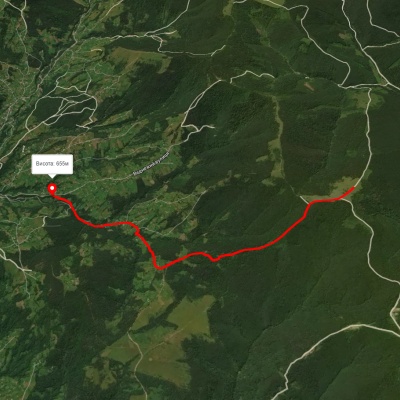
We suggest these hiking trails through or near Church of the Archangel Michael, Kolomyia: Sheshory – Rosokhata, Opryshky Road, Kosmach village, via Mount Rotylo, Mount Hrehit and Mount Bila Kobyla to Bukovets village, Mykulychyn village, via Mount Khorde and Mount Rotylo to Kosmach village, Medvezhyi tract – Mount Kuratul, Nimchych Pass – Protiate Kaminnia


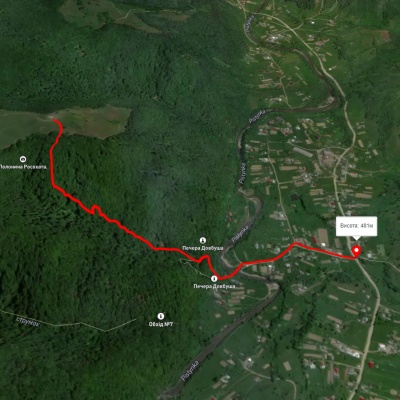
Sheshory – Rosokhata
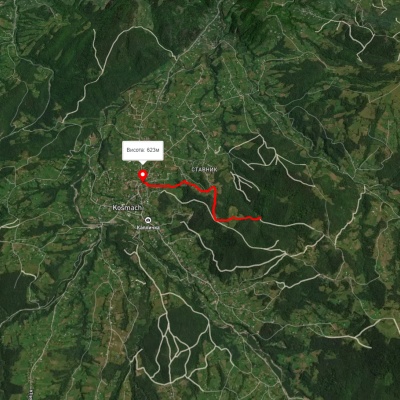
Opryshky Road
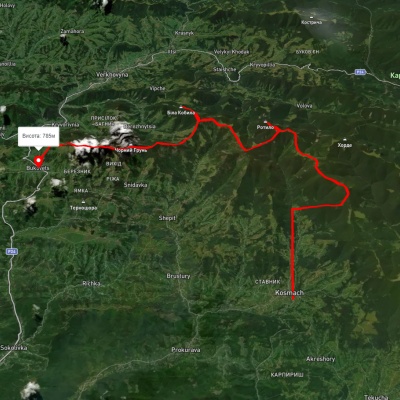
Kosmach village, via Mount Rotylo, Mount Hrehit and Mount Bila Kobyla to Bukovets village
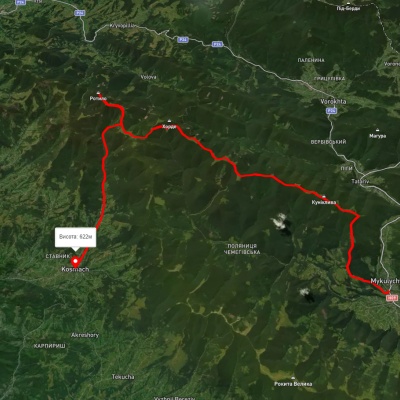
Mykulychyn village, via Mount Khorde and Mount Rotylo to Kosmach village