Black stork
About
The Black stork is completely different from its white relative that lives near humans. This secretive bird of old forests avoids people. In the Carpathians, it nests in all countries — from Bieszczady and Polonyny to Romania, and in Ukraine — in large forested areas of Zakarpattia and Prykarpattia, where there are clean streams, rivers, and wet meadows nearby.
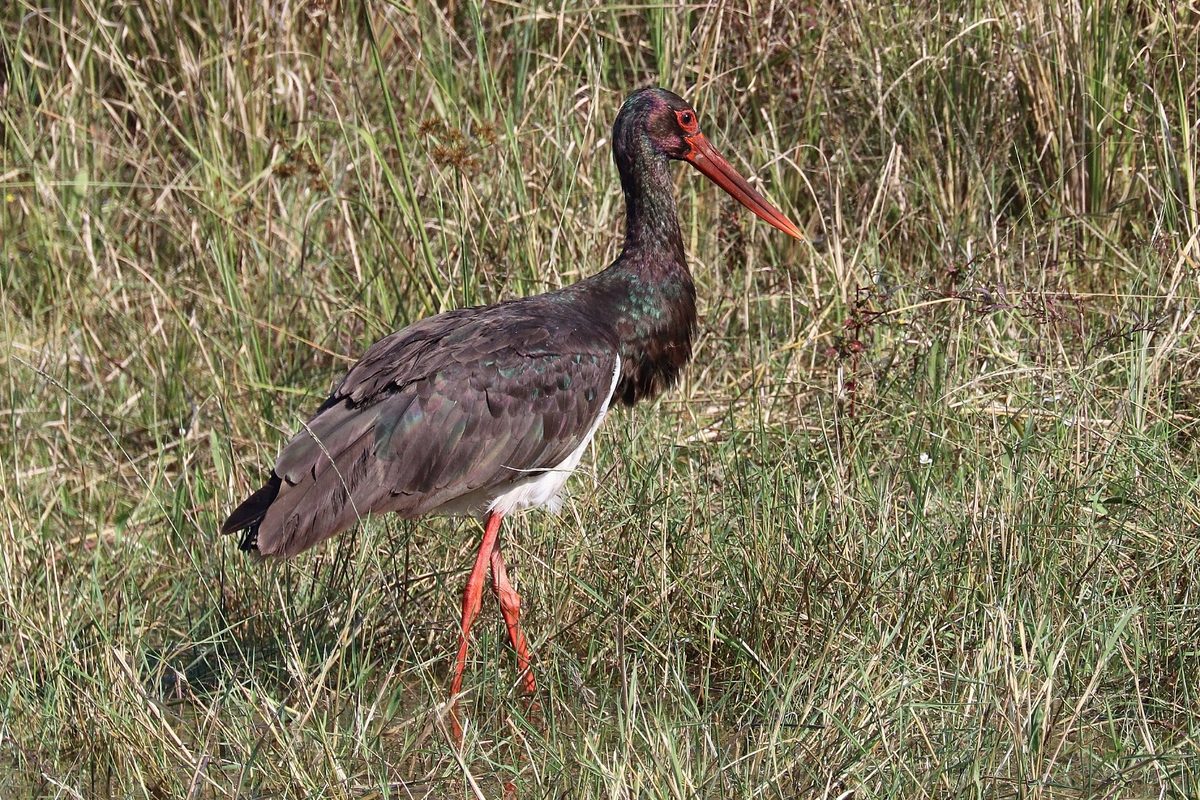
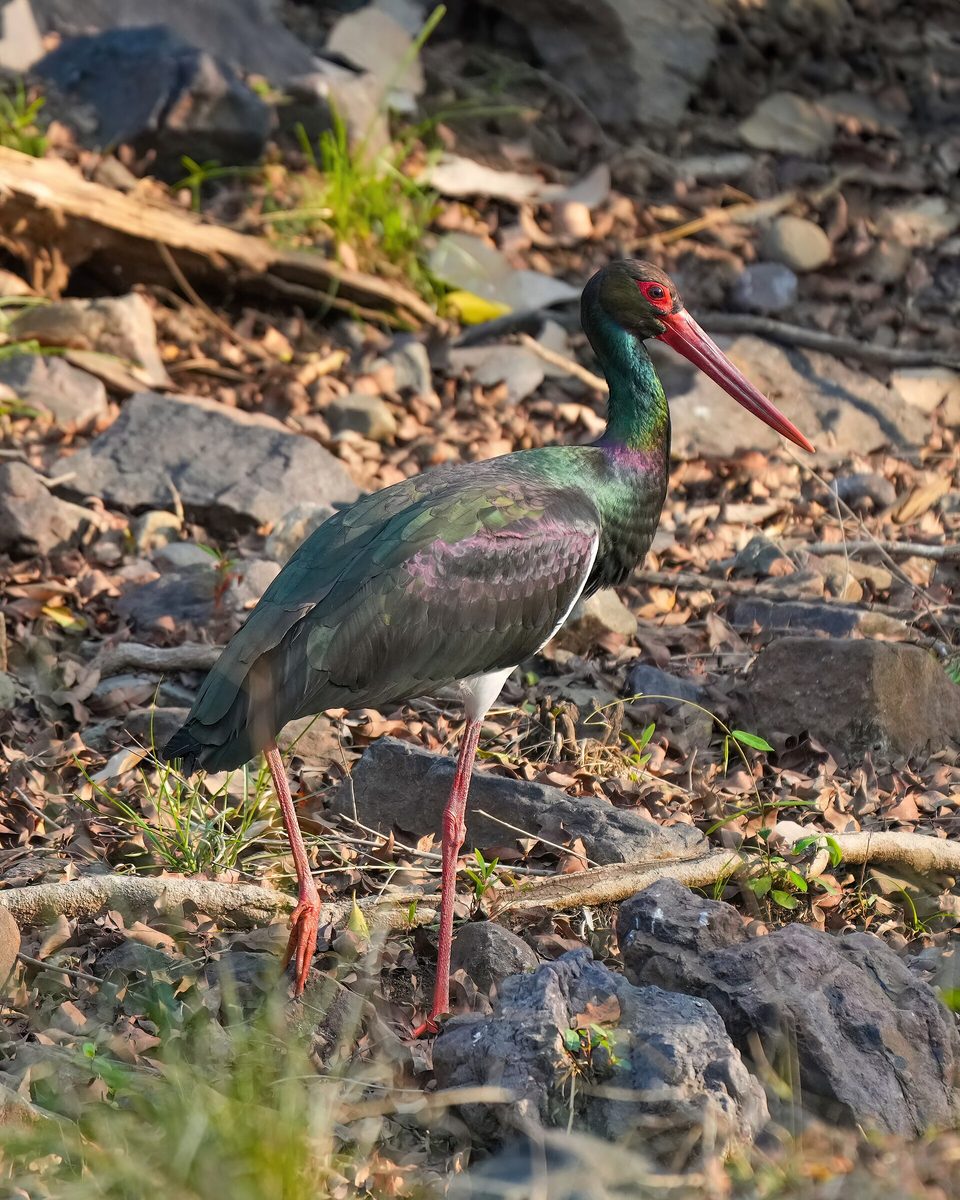
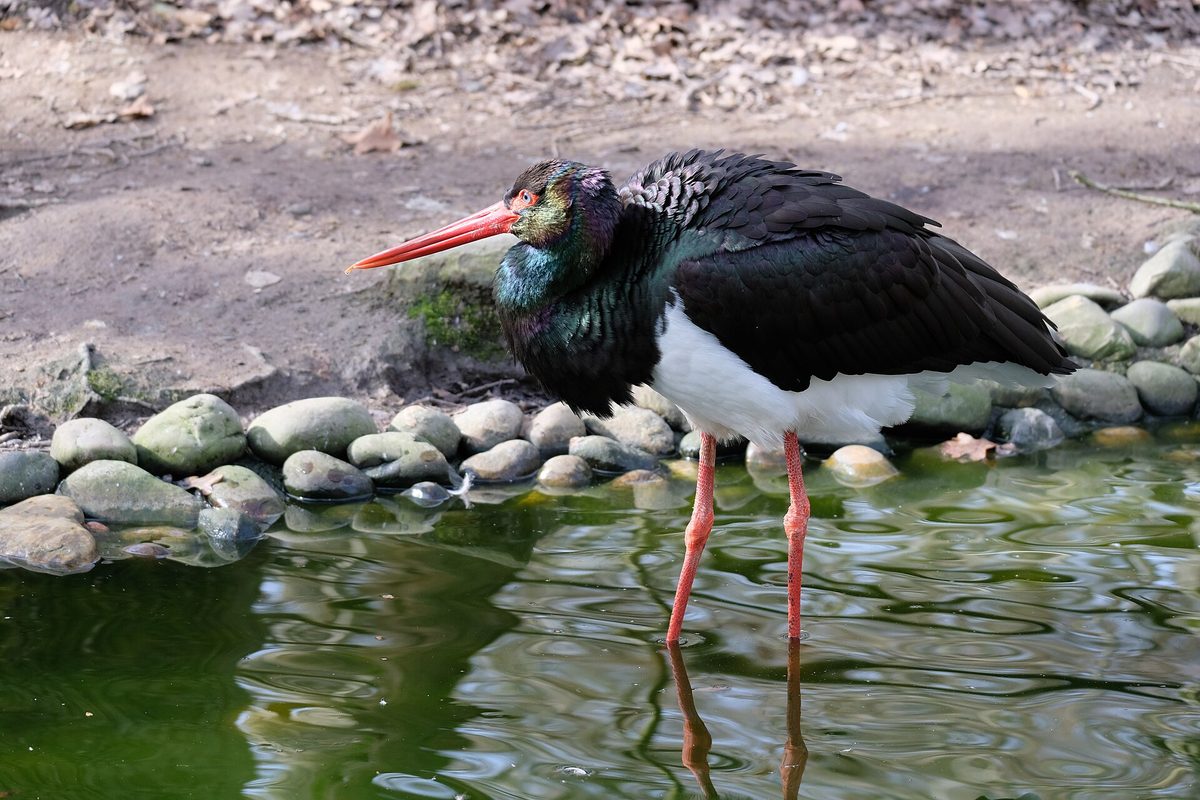
The bird is large, with a wingspan of about two meters. Its plumage is black with a metallic green and purple sheen, the belly is white, and the beak and long legs are bright red. In flight, the black stork stretches its neck forward, like the white one, and often soars on warm rising air currents.
The stork searches for food by wandering in shallow mountain streams, near brooks, in floodplains, and on wet meadows: it catches small fish, frogs, newts, and aquatic insects. The nest — a large structure made of branches — is built on an old tree deep in the forest or on a cliff and is used for years.
The black stork is migratory. It arrives in the Carpathians in March–April and departs in August–September to winter in Africa.
The species is very sensitive to disturbance and logging near nests, so nesting sites are not published. The black stork is listed in the Red Book of Ukraine as a rare species, and in the EU — in Annex I of the Birds Directive. If you spot it by a stream, observe from a distance and do not approach.
Where in the Carpathians

The map shows where naturalists recorded the species (GBIF, CC0 and CC BY records), not every place it lives. The Ukrainian Carpathians are less studied, so a blank area does not mean the species is absent. For rare and vulnerable species the map is deliberately coarse (hexagons of ~250 km² or more) so that it never points to dens, nests or growing sites.
- Countries
- Czechia · Slovakia · Poland · Ukraine · Hungary · Austria · Romania · Serbia · BG
- Mountain ranges
- Skole Beskids, Gorgany, Bieszczady, Pokuttia-Bukovina Carpathians, Moravian-Silesian Beskids, Pieniny, Zemplén Mountains, Western Tatras, Slovak Ore Mountains, Polonynian Ridge
- Altitude belts
- Foothills (below 600 m) · Beech forests (600–1200 m)
When to see it
| Jan | Feb | Mar | Apr | May | Jun | Jul | Aug | Sep | Oct | Nov | Dec | |
|---|---|---|---|---|---|---|---|---|---|---|---|---|
| Sightings |
From naturalists’ observations in the Carpathians (iNaturalist, research grade): the darker the cell, the more often the species is seen that month.
Protection and rules
Listed in the Red Book of Ukraine. Do not approach nests, do not disturb feeding birds.
FAQ
Does the black stork live in the Carpathians?
Yes, it nests in large old forests of Zakarpattia and Prykarpattia, as well as in Poland, Slovakia, and Romania. It is a secretive and rare bird.
Is the black stork listed in the Red Book of Ukraine?
Yes, as a rare species.
Similar species
Sources
- Вікіпедія: Лелека чорний
- Wikipedia (en): Black stork
- Перелік видів тварин, що заносяться до Червоної книги України (наказ Міндовкілля від 19.01.2021 № 29, зареєстровано в Мін'юсті 01.03.2021 за № 260/35882)
- Міндовкілля: текст переліку видів тварин Червоної книги України (PDF)
- GBIF: таксон і категорія МСОП
- Директива 2009/147/ЄС про збереження диких птахів
GBIF · iNaturalist · Wikidata · Distribution data: GBIF.org (CC0 and CC BY records), iNaturalist; names and identifiers: Wikidata (CC0). Text: Karpaty.rocks, checked 09.11.2026.
