Tustan
Tustan is a village of Halych district of Ivano-Frankivsk region. It is the center of the village council. It is located on the left bank of the Dniester (between the rivers Hnyla Lypa and Bybelka), 2.5 km from the district center and the railway station Halych. The road to Halych and Pidhaitsi passes through the village. The population is 1527 people. The suburban train Khodoriv - Ivano-Frankivsk stops at the Tustan platform.
On the territory of Tustan, a settlement of ancient Russian times was discovered, and on the territory of neighboring Medukha - stone tools of the Bronze Age and an anthropomorphic figure. In the XII-XIII centuries. Tustan station was a place of anchorage for river vessels sailing along the Dniester. The first written mention of the village dates back to 1621.
The village used to be the central estate of the Leninskyi Shlyakh collective farm. The farm had 2551.6 hectares of land and specialized in pork production. For high corn yields, the collective farm participated in the USSR VDNKh in 1963 and was awarded a second-degree diploma. In 1965, it won the regional transitional Red Banner for high milk yields and fulfilling its obligations to sell meat to the state. In 1983, the villages of Semakivtsi and Khorostkiv were annexed. In the books of the Galician court, Khorostkiv is mentioned on June 24, 1447, and Semakivtsi on May 5, 1449.
The village has a twelve-year school, a club, a library, a medical center, six shops, and a nursery. During the Soviet era, the village was half rebuilt, and 62 families became new settlers. The decline in agriculture and livestock production was interrupted in the 2000s by the emergence of the Ukrainian-Danish agricultural company Danosha, which built a modern farm complex in Tustan with a powerful pig farm and fodder production. The company announced the upcoming construction of a biogas plant at the end of 2019.
The Church of St. Basil the Great was built in 1936. The previous wooden church, which was located in the village of Semakivtsi (now part of the village of Tustan), was called the Church of the Resurrection of Christ, and was destroyed during the First World War. In 1925, a temporary wooden chapel was built in Tustan, and the construction of the existing church was completed in 1936. It was a branch church. The church is used by the UGCC community.
The Pokrovskyi Convent of the Moscow Patriarchate, established in 1995, is located in the village and is headed by Abbess Maria (Tymishak).
- The village is home to the famous Ukrainian teacher, translator, and lexicographer of the sixteenth century Lavrentii Zyzanii.
- Volodymyr Chaviak "Chornota" is a legendary insurgent commander and Gulag prisoner, author of memoirs.
- Stepan Dmytrovych Yarytskyi - commander of the UPA "Beasts" hundred, Knight of the Bronze Cross of Military Merit of the UPA.
- Andrii Omelianovych Dobrovolskyi (*11.12.1996-†17.11.2017) - a native of the village of Tustan, commander of the 8th Battalion of the 10th Separate Mountain Assault Brigade, died in the war with the Russian occupiers.


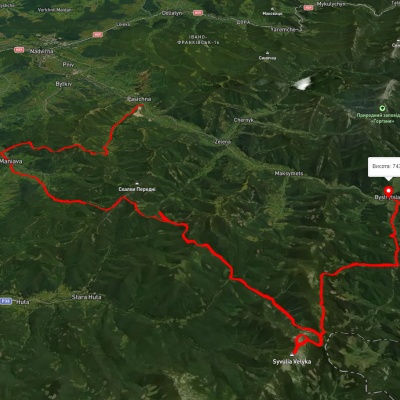
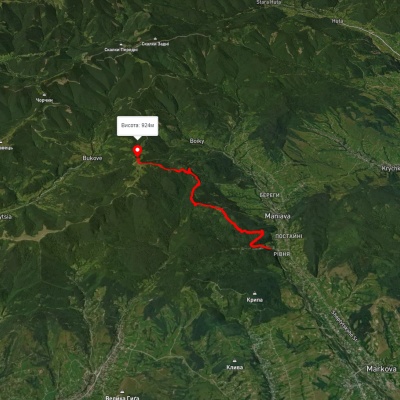
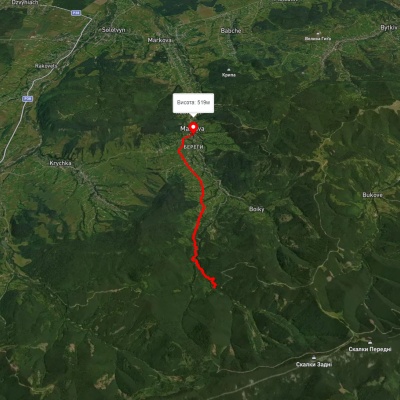
Which hiking trails pass through or near Tustan?
We suggest these hiking trails through or near Tustan: Pasichna village, via Maniava village, Maniava Waterfall and Mount Velyka Syvulia to Bystrytsia village, Maniava village - Monastyretska polonyna, Maniava village – Maniava Waterfall, Huta village – Pasichna village, Dora village, via Mount Syniachka, Pereslip Pass, Turshuhuvata polonyna and the Yavirnyk ridge to Yaremche, Dora village, via Mount Syniachka and Pereslip Pass to Yaremche