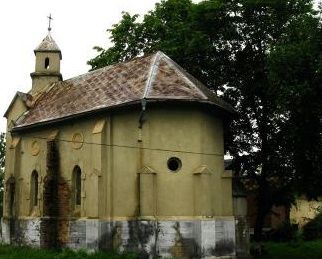
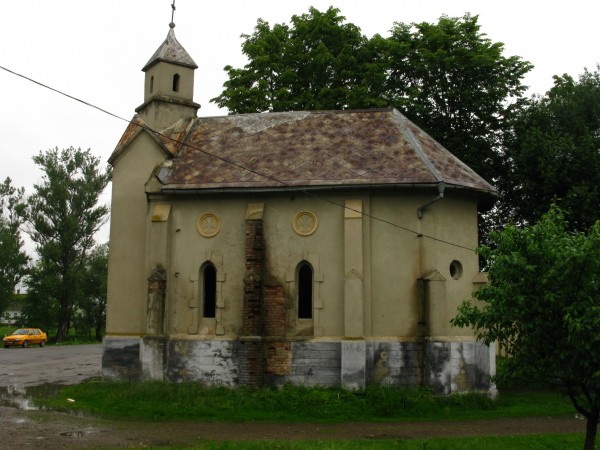
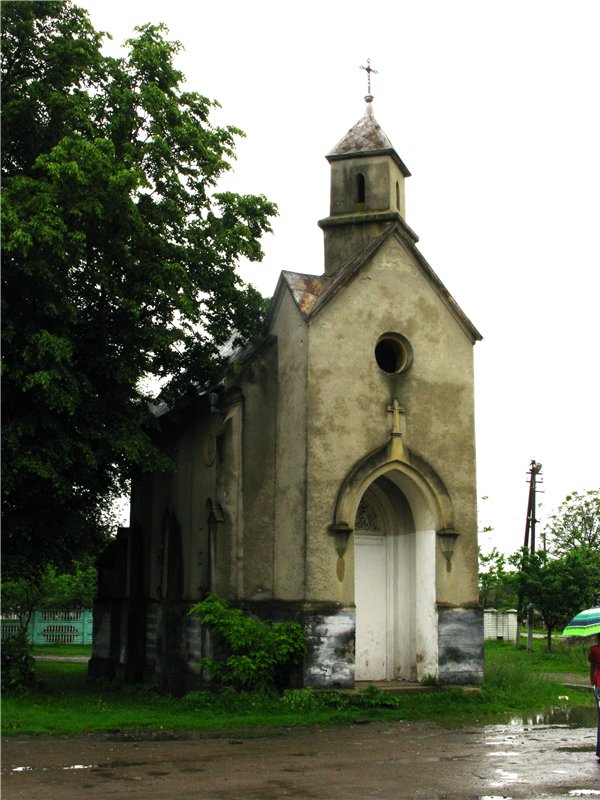
Catholic chapel, Dubivtsi
The village of Dubivtsi, located in the Kitsman district, has preserved several attractions that attract travelers. One of them is a Catholic chapel, which, despite the destruction and decline in the past, has survived to the present.
The chapel was built in the 18th century. Along with the decline of the village's Catholic community, the chapel itself was also deteriorating. Until it was rebuilt by Baron Shymonovych. He built himself a small palace in the village and often visited it, even though he lived in Chernivtsi. By the way, the palace has been preserved and today it houses the local village council.
The Catholic chapel has been preserved in the Neo-Gothic style with admixtures of local architectural traditions. The interiors have not been preserved. Today, it is not functioning and is in a state of disrepair with its doors boarded up right in the center of the village. The church's pediment bears the family coat of arms with two lions holding a crown.
Unfortunately, it is difficult to identify the church: the building is not listed as an architectural monument of either national or local significance, and the Roman Catholic community in the village has long since ceased to exist.
The village is located on the H-10 Ivano-Frankivsk-Chernivtsi highway, at the turn towards Vyzhnytsia and Putyla. The nearest railway station is the village of Luzhany, which is a few kilometers away. Suburban trains from Chernivtsi and Kolomyia stop here. It is also convenient to get there by buses going in the direction of Vyzhnytsia or Putyla, you need to get off at the Dubivtsi bus stop of the same name.
The first written mention of the village of Dubivtsi and the first settlements, according to archaeological data obtained from excavations in 1966, appeared in the Yeshkiv tract - ancient Slavic settlements of the Cherniakhiv culture of the II - V centuries AD and in the Hora tract - an ancient Rusyn village of the 12-13 centuries. For the first time, in 1464, the village of Dubivtsi was mentioned in the chronicles found. The name of the village comes from the oak forest. Initially, the name was used in the singular form - Dubovets, and from the end of the 18th century (1782) it was called Dubivtsi. There is also a legend about the origin of the village. Two brothers named Tsyhanchuk, fleeing from Basarabia from the Turkish enslavers, wandered into the forest near the Prut. They were handsome, statuesque, tall and strong, like two oaks. The brothers built their homes in the forest. They started farms and families. And their children were strong, tall and beautiful, like oaks. Hence the name of the village. There is something to see in this small village for an architecture lover. Almost at the beginning of the village, to the right of the road, a two-story light green house from the Austrian times, similar to a small palace, will attract attention. This house, built in 1914 by Baron Shymonovych, served as his family estate for several years. Nowadays, the village council is located here. Further, on the left, there is a church-chapel built by the Shymonovych (although there is evidence that the church dates back to the eighteenth century), which, unfortunately, stands empty with its doors boarded up right in the center of the village. The complex of buildings in Dubivtsi is included in the list of monuments of national importance. It is a wooden Assumption Church with a bell tower. It dates back to the late seventeenth century. The church was rebuilt in 1782, as evidenced by the inscription on the door of the Babynets. Local legend says that the shrine was moved to the village from the neighboring Hlynica, which lies on the opposite bank of the Prut River. The old church fence, also made of wood, has been preserved. Although the word "also" now refers more to the square two-tiered bell tower. The temple itself is now, as is common in Bukovyna, clad in tin.Dubivtsi is a village located in the Kitsman district, Chernivtsi region. The distance to the regional center is 19 km. The population is 1318 inhabitants. The village has the following institutions: post office, police, medical institution, banking institution, educational institution, club, library, local history museum. The main population is Ukrainians. The villagers are engaged in farming and animal husbandry, entrepreneurial activity and work in various institutions.
Accommodation around Catholic chapel, Dubivtsi:


Nearby hiking trails near Catholic chapel, Dubivtsi:
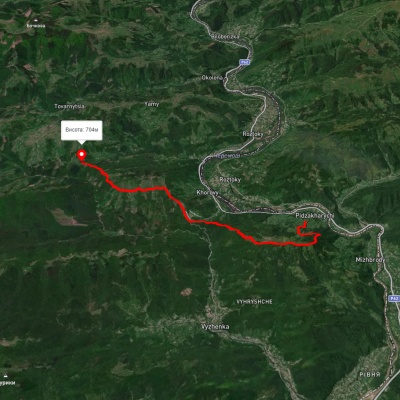
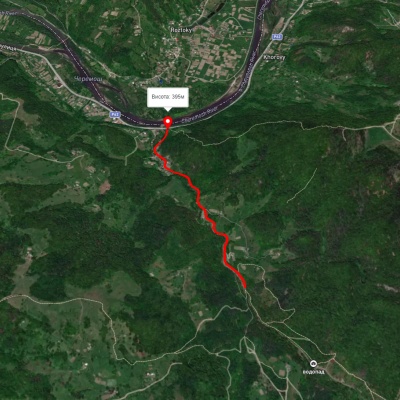
Which trails pass by Catholic chapel, Dubivtsi?
We suggest these hiking trails through or near Catholic chapel, Dubivtsi: Nimchych Pass – Protiate Kaminnia, Smuharski Waterfalls