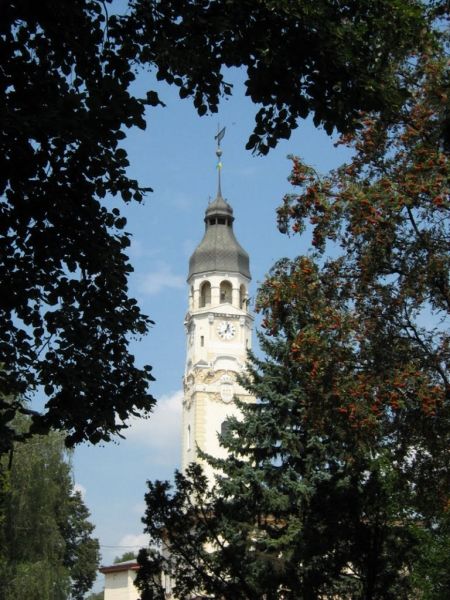
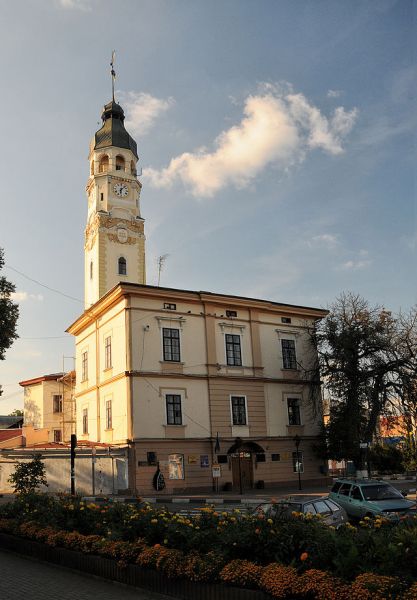
The Sniatyn Town Hall is an architectural monument, an ensemble of the town hall of the former magistrate of the town of Sniatyn in Ivano-Frankivsk region. It is located on the central square of the city at 70 Shevchenka Street. The architect, Josef Schreiber from Chernivtsi, designed the tall building, taking into account the seismicity of the area and the soil properties of the rocky hill, and supervised the construction with the help of the city builder Anton Berka. The masonry and carpentry work was done by master Stanislav Oleksandrovych, and the roof was covered with copper by local craftsman Yurii Kesler.
The town hall was built in the style of early historicism and a mixture of elements of neoclassicism, neo-Renaissance, English neo-Gothic and neo-Baroque. It is considered to be one of the most beautiful and tallest in Ukraine - its height is 50 meters, and it is second only to Lviv City Hall. The town hall tower can be seen from several kilometers away, at the entrance to the city.
The first magistrate's office in the city was mentioned in 1790. In 1861, the town hall was built, consisting of a part of the present town hall (the southeastern block on the city side) along with the first staircase. The next stage, which was carried out by expanding the building, dates back to 1868. It was then that the walls of the town hall tower were built "up to the marceline". Obviously, the entire building was already built then. The main purpose of the magistrate's office was to hold meetings of the community council. The first elected mayor of Sniatyn was Marceli Niemczewski. He laid the foundation for the town hall. The foundations were made of stone on so-called "pillows" to protect it from vibrations, as it had already experienced earthquakes in May 1822 and November 1829. One of his successors, Titus Nemczewski, built the town hall tower, because according to the laws of the time, a tower was to rise above the magistrate's office, where the state flag and the banner of the city government were to fly. Old-timers said that the concrete under the town hall was mixed with eggs for strength. Engineers claimed that this would make the town hall and its tower last at least three hundred years. At the bottom (on the second floor), the walls of the tower are 1.70 meters thick, gradually decreasing towards the top.
The construction of the tower was completed and on August 27, 1909, the opening ceremony of the majestic structure took place. None of the workers were injured during the construction.
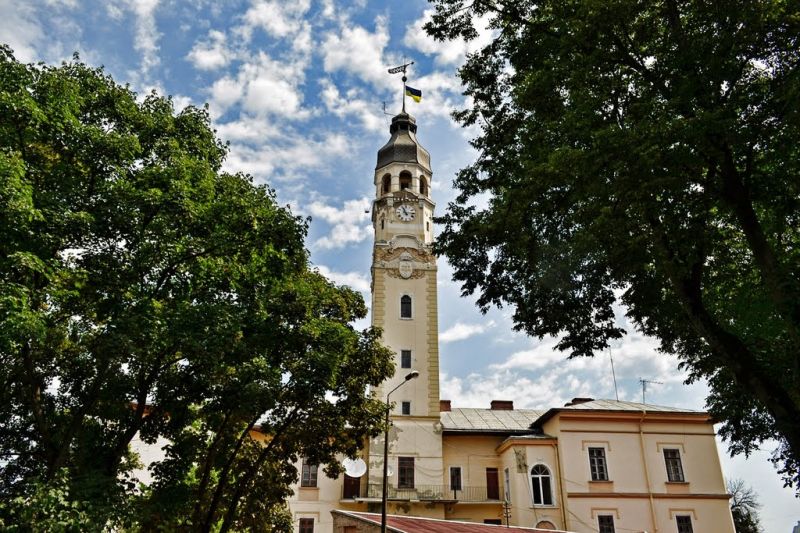
The town hall in Sniatyn is a dominant feature in the town's landscape silhouette. This argument is indisputable, as the town hall is located on a rocky hill at 270 meters above sea level. The square tower consists of three parts that dynamically taper upward. The corners of the town hall are decorated with rusticated walls, fixing it in space. On the axis are windows to illuminate the staircase. The upper one, which has a trapezoidal ending, is decorated with a keystone and a geometric frame. The first level is completed by a decorative plastic cornice, in the plane of which a sculptural composition is made (eagles with powerful wings guarding the coat of arms of the border town, crowned with cascading garlands).
The facade decoration is mixed: the first floor is designed as a plinth with linear rustication, the second floor windows are decorated with English Neo-Gothic sandriks, and the third floor windows have straight sandriks, as in classicism. In the center of the façade is a risalit with arched windows. The neo-Baroque decoration of the tower is later (the date 1909 is on the weather vane in the spire) and looks more abundant, which contrasts with the building.
The dome of the tower is made of metal sheets in the form of scales. Above the skylight is a spire with a weathervane, under which there is an apple (bronze ball), which holds historical documents that were put there in 1958 during the celebration of the 800th anniversary of Sniatyn.
The magistrate's building, which consisted of three floors, had forty-four rooms. First of all, there were rooms occupied by representatives of the city authorities. This was a meeting room where not only representatives of the city but also of the county authorities met. It is known that the county council building was built only in 1900. Several rooms of the magistrate's office were occupied by a school. From the very beginning, the building was constantly occupied by a fire brigade. There was a prison in the basement. The town hall (magistrate) was governed by the mayor, the magistrate court, and the bench councillors elected by the townspeople.
In the 20s and 30s of the twentieth century, the Polish bursa was located in the magistrate's building. This is evidenced by a marble plaque installed on the facade of the building. During the Second World War, according to H. Hulenchyn, the magistrate's premises were again used as a school. After the war, one of the military units was located here until 1954.
Since 1954, the former magistrate's building has housed the Sniatyn Cultural and Educational School. It trained specialists in choral singing, musicians, librarians, and later choreographers. Among the graduates were talented singers and musicians.
Today, the magistrate's house is again home to the Sniatyn City Council, headed by Mayor Anatolii Shumko, deputy mayors Viktor Kushyk and Myroslav Tymofiychuk, and council secretary Maria Oryshchuk. The executive committee consists of eleven members. The deputy corps consists of thirty-six deputies.
There are three museums in the city hall:
- Vasyl Andrusiak Museum of the Liberation Movement,
- Mykhailo Bazhansky Museum and Library,
- Museum of Culture and Books of Pokuttya.
The third floor houses the Sniatyn TV company, which broadcasts, in addition to Sniatyn, also parts of Horodenka, Kolomyia, Kosiv, and some districts of Bukovyna.
On November 5, 1790, the coat of arms of Sniatyn was legalized. It was used by the authorities in the late eighteenth and early twentieth centuries without change. After receiving the privilege of Magdeburg Law, the coat of arms granted to the city by the diploma of the Austrian Emperor Leopold II depicts a silver city wall with three towers. As for the heraldic colors, there are two of them in the coat of arms of Sniatyn: blue and silver (blue is a symbol of loyalty, honesty, and impeccability).
The coat of arms of the town is stylized on the town hall. It belongs to the Spanish type, resembling the shape of a shield. In the upper part, it has a rectangular shape with a rounding at the bottom. The shield depicts a castle with three towers, the Latin letter "S" below, and a crown above the shield. Each of these signs has its own symbolism: the crown means that the city is royal; the towers are symbols of inviolability, development, and prosperity; S is the initial letter of the city's name.
Around the coat of arms on the tower are architectural decorations made of cement, which were made by the carver Oskar Chornyi from Chernivtsi, apparently according to the design of the architect Josef Schreiber. The four sides of the tower are decorated with two-headed eagles, symbolizing the Austrian Empire. At the bottom of the coat of arms are oak and laurel branches. The laurel branches are a symbol of Sniatyn's historical glory, and the oak branches symbolize the strength and unconquerability of the fortress city in the Middle Ages. The town also had its own flag. It served until 1918.
In the context of the Ukrainian statehood, the fifth session of the Sniatyn City Council of the third democratic convocation decided on the content and description of the symbols of the city of Sniatyn.
The coat of arms depicts a silver brick wall in a blue field with four loopholes and three silver towers crowned with red roofs. The towers have black windows, the upper part of which has three teeth, the middle tower has a yellow-blue-yellow flag, and the wall has a red letter "S". The coat of arms is presented on a decorative shield, which is included in a regular shield with a sharply narrowed lower part. The shield is crowned by a five-pointed crown of light brown color.
The flag - the banner of the town of Sniatyn - is a square cloth of three horizontal stripes: yellow, blue and yellow in the ratio of width 1:2:1, in the hoist is a silver brick wall with three towers, completed with red roofs, on the middle tower is a yellow-blue-yellow flag, on the wall is a red letter "S". The main meaning of the flag is the Prut River in the fertile banks of sunny skies and ripe wheat.
The clock, which was delivered by engineer Michał Męsowicz from Krosna (Poland) and installed on the town hall tower, had a black dial with white numbers. The gilded hands were about 80 cm long. The two bells, made by the caster Carlo Schwabe from Biala, chimed in different tones around the clock. There is a legend that the bells were carried up the spiral staircase of the tower to the desired height by a resident of the city with heroic health named Onyshchuk.
There are dials on the four sides of the tower, and for more than a hundred years the townspeople have been hearing the melodious chimes of the clock.
The mechanical clock needed regular maintenance. In the 20s and 30s, a resident of the city, Kholevchuk, was assigned to the magistrate's house, the town hall, and the clock (according to I. Slavnytskyi's memoirs). Since 1939, the town hall clock was made by a German, Franz Baumgartner. In the 70s he was replaced by his son-in-law Kazymyr Verbitskyi. Since 1990, his brother Zbigniew has been the master of the Sniatyn chimes, and he trained his son-in-law Vasyl Sobchuk, who officially began working here in 1999. The town hall chimes tell the residents the time every 15 minutes.
Today, the town hall in Sniatyn is a symbol of the town. Its image on emblems, medals, and badges testifies to the special attitude of contemporaries to the magnificent architecture, which is already 100 years old.