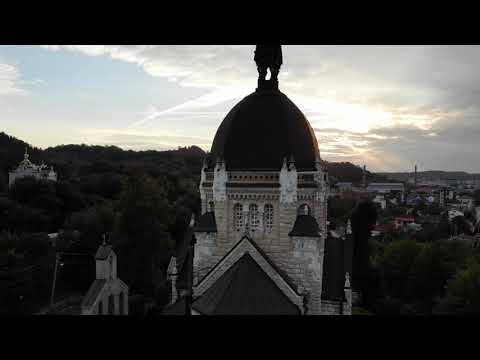
Church of the Ascension, Lviv
TheChurch of the Ascension is a Greek Catholic church in Lviv, in the Stare Znesinnia neighborhood. It is located on the site of an older wooden church dating back to the early seventeenth century. If you are traveling to Lviv by train from the east side, leave your suitcases behind and look out of the window on the left. Among the gray and uninteresting industrial area of Lviv you will see this architectural monument. Some historians (in particular Ivan Vahylevych) were convinced that it was on the territory of the Ascension that Prince Danylo Halytskyi founded Lviv.
It is likely that a church was founded on the site of an ancient sanctuary on Znesinnia behind the High Castle, from which the settlement got its name. The oldest known church building was erected in 1602 and burned down during the sieges of Lviv. Of the earliest documents relating to the church, only two documents from 1687 and 1758 are known, confirming its privileges and the appointment of new priests. The rebuilt wooden church stood until 1901, when the present brick church was built in its place. However, there is a description and images of the old church from the mid-nineteenth century. The walls of the church were painted with battle scenes, and there were two side altars with images covered with silver gilded vestments. The first researcher to draw attention to the value of the monument was the Austrian archaeologist Adolf Wolfskron, who published a drawing and plan in 1858 in a Vienna edition in an article about wooden churches in Moravia, Silesia, Hungary, and Galicia. In the same year, Felician Lobieski described the artistic monuments in the newspaper Rozmaitości (a supplement to Gazeta Lwowska). Later, the church was mentioned in their works by Fedir Bilous (who provided a drawing by Wolfskron), Józef Lepkowski, Kazimierz Mokłowski, Bohdan Janusz, and Mykhailo Dragan. In the mid-nineteenth century, the church was in poor technical condition. There were plans to build a new one.
The iconography allows us to get a certain idea of the church. It was a three-dimensional two-story church oriented on the south-north axis with an entrance from the south. It consisted of a rectangular nave, a square narthex with a chancel of the same width, and a somewhat narrower rectangular altar part. The nave and chancel were crowned with quadrangles with archaic low tent roofs; the top of the chancel served as a bell tower. The roof over the altar part is gable. The entire building was surrounded by a perimeter porch. An inventory of the second half of the nineteenth century lists the following buildings on the church grounds: a wooden house ("monastery") with four rooms; a kitchen (or bakery) with a living room; a stable; another building that combined a barn, a carting house, and a stable; a barn; and a stall. All of them are wooden, covered with shingles or straw, and mostly in poor condition.
Theinterior ofthe church was painted with scenes from the Old and New Testaments. Behind the iconostasis was an icon of the Crucifixion with the Torturers from 1701. Icons of historical content were also placed near the altar. Fragments of the highly artistic icon "Ascension of the Lord" from 1652, which was located in front of the iconostasis, have survived to this day. The church had a bell dating back to 1557 that came from another, older church. A handwritten Gospel from 1603, written by the priest Zacharias of Ascension, was kept here.
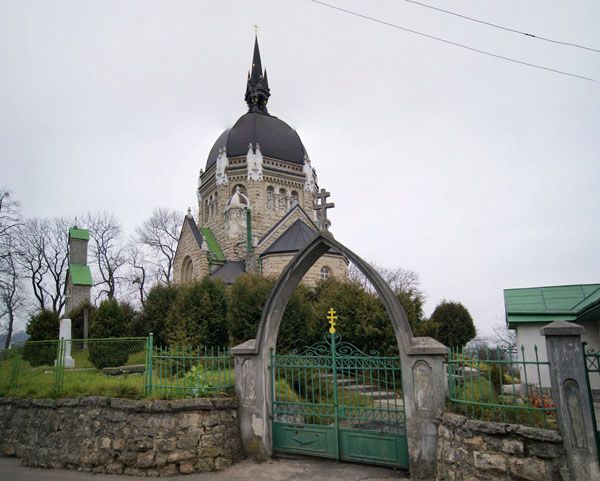
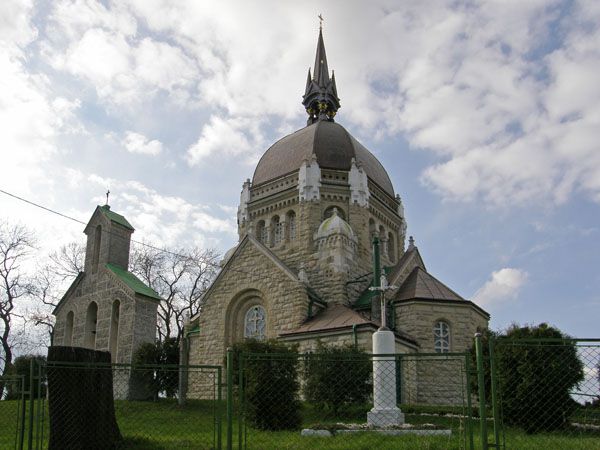
There were plans in 1888 to build a new church designed by Vasyl Nahirnyi. For unknown reasons, this did not happen. The new project was made by Władysław Halytskyi and implemented during 1897-1901. The old church was not destroyed immediately. It was gradually built up with new walls and dismantled after the construction was completed. In 1922, a lancet neo-Gothic arch was built over the entrance to the churchyard, and later in 1924, a two-tiered wall bell tower with semicircular arched openings for bells was built.
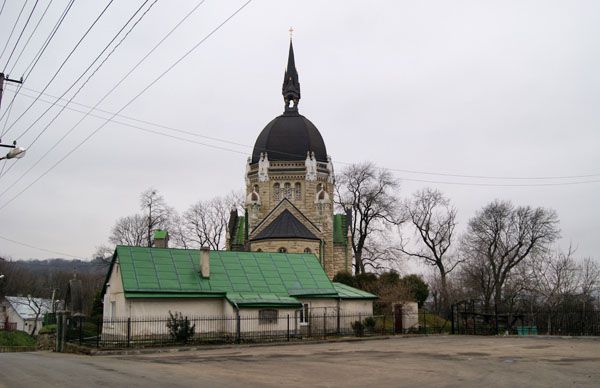
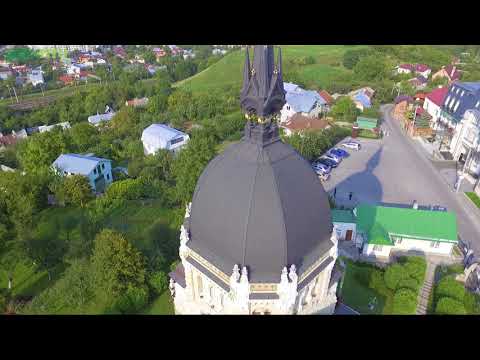
The church is located on a high hill. The plan has the shape of a cross with weakly expressed frames. It is crowned with one large octagon with a tin-covered dome and a tall tin signature, with which the total height reaches 31 m. The material used was brick, with the exterior lined with roughly worked sandstone quarried nearby. For the architectural elements, fine-grained sandstone from the village of Demni, near Mykolaiv, was used.
The interior features a low, single-tiered iconostasis with carved royal and deacon gates. Among the vicarage icons are two painted on wood, differing in the manner of execution. Their author was probably a monk of St. Ivan's Studite Lavra on the Descent, Raphael Khomyk (first half of the 20th century, monogram "H. R." on the image of St. Nicholas). The thrones in front of the iconostasis and the side altar (at the south wall) are decorated with reliefs by Andrii Koverko. The same author is responsible for the pulpit under the main throne and the relief "The Good Shepherd" in the main nave. The south altar contains an image of Christ painted by Anton Manastyrskyi. The northern side altar contains an early eighteenth-century image of the Mother of God, Eleusis, which originated in the predecessor church. The icon was made in 1701 and is signed on the back with the monogram "A.I.M." or "A.L.M.", which possibly stands for "Alexander Lianitsky the painter". The walls of the church are covered with modern paintings with scenes mostly from the New Testament.
Of course, there were opponents of the fact that one of the oldest wooden churches was being rebuilt. Historians say that the old church was in a rather poor condition.
TheChurch of the Ascension is a bizarre interweaving of neo-Gothic style and neo-Romanticism. The interior is dominated by paintings from the early 20th century, but there are also icons in the church that were in the wooden church. The sandstone used for the exterior walls was quarried in the village of Demnia, near Mykolaiv (Lviv Oblast).
The Church of the Ascension is located on Staroznesenska Street. There is only one bus to the church, bus number 25 (Korduba Street - King Cross Leopolis shopping center). You can also walk through the Ascension Park.
A little higher on this street is the Congregation of the Sisters of Jehoshaphat. In the Soviet years, the church was demolished. Now a new monastery stands there.