Holy Spirit Church, Kolochava
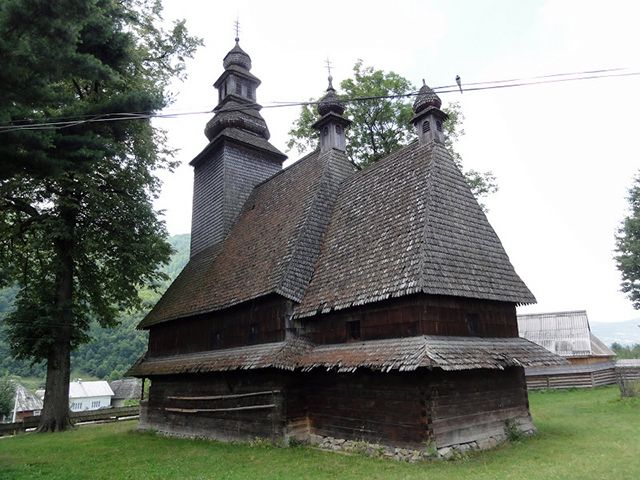
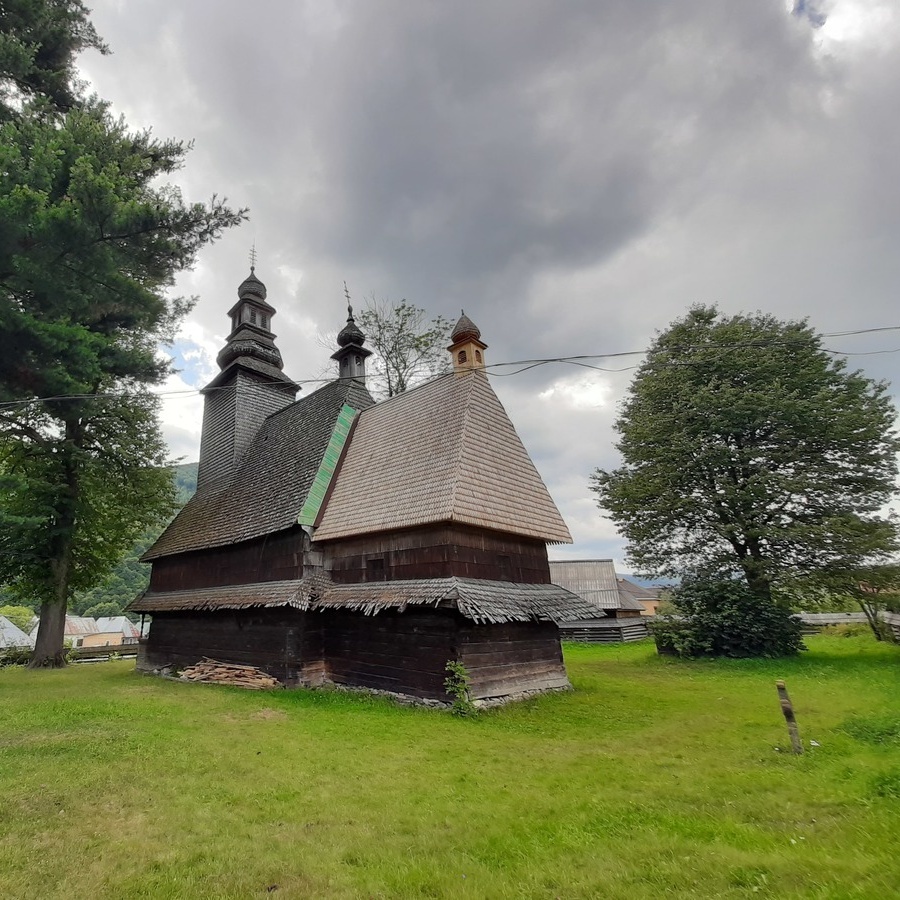
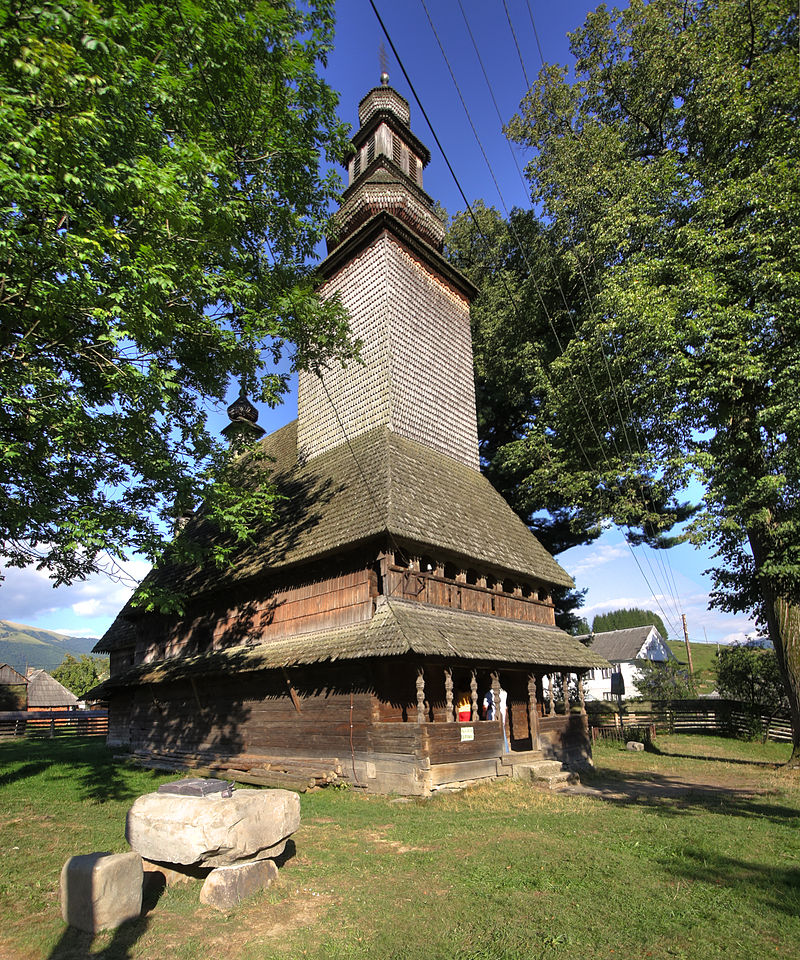
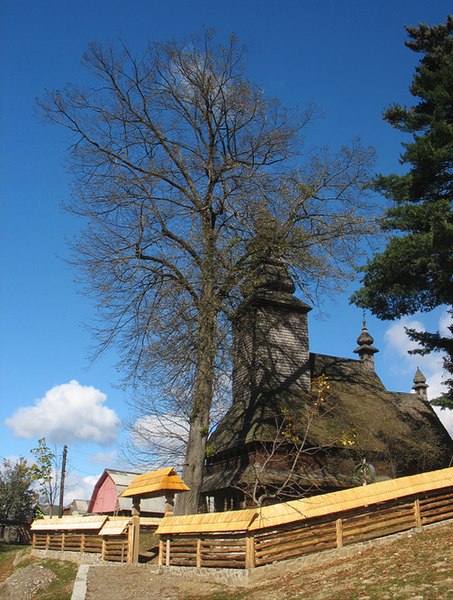
TheChurch of the Holy Spirit is a wooden church-museum located on a hill near the main road among the spruce trees in the village of Kolochava, Mizhhiria district, Transcarpathian region. It is the best example of a church of the Mezhyhiria group of Transcarpathia, an architectural monument of national importance (#216).
The building is the best example of a church of the Mezhyhiria group of Transcarpathia. The building is very old, and therefore stopped functioning as a church in the last century. The Church of the Holy Spirit was founded in 1795, during the reign of King Francis II and the parish priest John Popovich, by master Ferenc Heka, according to the inscription on the doorjamb. As it says, there was a great famine in those days. Today it houses the Kolochava Museum of Local Lore, which preserves the memory of the robber-opryshko Mykola Shuhai and the famous writer Ivan Olbracht.
The church reflects in its architecture a noticeable influence of Baroque stylistic principles. This is manifested primarily in the characteristic shape of the decorative cupolas above the apse and nave and, especially, in the emphasized picturesqueness of the crown of the western tower. In all other respects, the architecture of St. George's Church follows the type of three-tiered church with a high frame tower above the western log house, which is common in Transcarpathia. The altar log cabin has a hexagonal, central square, and western rectangular plan, elongated in the transverse direction. The log cabins are consistently raised in the western direction, towards the tower. All three log cabins are surrounded by a plastic roof on curly brackets, which on the western façade is transformed into an openwork arcade-gallery on carved columns. A similar gallery is arranged around the emporium above the chancel, further enhancing the importance of the western façade in the overall composition of the building.
The main volumes are amazingly balanced horizontally and vertically. The unrestrained swiftness of the main façade is balanced by the buildings of the nave and altar and at the same time supported by the steep roof slopes. The tall tower above the chancel is crowned with a magnificent Baroque ensemble consisting of a faceted cupola with a roof, a lantern, and a spherical head above it. The lanterns with the heads successfully accentuate the roof ridges above the nave and the altar.
The compositional dominant of the church's interior is the relatively high nave space, decorated with works of monumental and decorative and applied art. This is largely facilitated by the arrangement of a developed box vault above it, while the nave is covered with a flat plank ceiling and the altar with a low closed vault. All the elements of the interior decoration of the monument, as well as its exterior design, are characterized by exquisite proportions and skillful modeling of forms. This gives grounds to refer the building to the best examples of the churches of the Mezhyhiria group of Transcarpathia.
The bell tower is a typical example of one of the most common types of frame bell towers in Transcarpathia. The monument consists of two tiers (the lower one is covered, and the upper one is open) and is surrounded at the base by a fence on carved columns. This achieved an exceptional stylistic unity with the church building, which ensures the artistic integrity and perfection of the entire ensemble.
According to the inscription on the doorpost, "This church was built in 1795 under the parish priest Ioan Popovych under Tsar Francis II by master Ferenc Tekka. There was a great famine then." In ancient times, famine often accompanied Verkhovyna life, and such misfortunes were sometimes recorded in parish books, and in Kolochava the record even got on the church doorpost.
In 1801, the documents of the bishop's visitation state that "Kolochava has two wooden churches: the mother church, built in 1797, can accommodate 300 parishioners, and the second one is a branch church for 300 parishioners, well built" (perhaps this is a branch church in Lazy).
The church was deregistered as a functioning church on January 9, 1953. Later, the icons were mounted in the iconostasis of the Shelest church in the Uzhhorod Museum of Architecture and Life. It is possible that the Kolochava church survived because of its museum status, although the portraits of proletarian leaders installed in place of the iconostasis were probably not very comfortable there. In any case, both the church and the bell tower have survived to this day. Both monuments were restored in 1969-1970.
The wooden two-tiered frame bell tower that stood near the church was moved to the nearby Orthodox church and covered with tin. The paradox is that the bell tower, which was used by the community, lost its architectural face, while the church, which had been closed for a long time and was called the "museum of atheism," remained intact in its original beauty, although it was completely devastated inside. The local priest, Mykhailo Bobyk, was a prisoner of Soviet concentration camps from 1948 to 1955.
Today, the church houses the Kolochava Village Museum of Local Lore, where the memory of the famous opryshko robber Mykola Shuhai and the famous writer Ivan Olbracht is preserved. The church does not function as a religious building.
There are several Czech graves on the territory of the church-museum, as well as the burial of a Hungarian postman. In ancient times, it was also common to bury famous people and patrons of the arts near the church. This was considered a special honor to such a person. Many such burials have been preserved near the wooden church of the Holy Spirit. One of them is an unknown grave under a tree that dates back to the 80s of the nineteenth century. It bears only the name Sekeresh. Most likely, some famous Kolochava philanthropist is buried there.
One of the most unique monuments in the village stands at the entrance to the church. It is dedicated to the outstanding monument of the sacred manuscript by Kolochava clerk Ivan Luhosh "Precious Pearl". The composition looks like a chronicler's "workplace": an open bronze book lies on a large stone, with an inkwell and a pen next to it. Next to it is a stone chair, on which the author of the manuscript seems to have just sat. A 418-page color copy of the manuscript is housed inside the wooden church.
Near the church, old spruce trees grow, swaying in the wind, telling visitors an ancient Kolochava custom. Once upon a time, a girl who had an illegitimate child was forced to stand at the entrance to the church for one day as an example for the villagers.
Near the church there are spruce trees as old as she was. There was also a wooden two-tiered bell tower in the courtyard, but it was moved to the Orthodox church. There are several Czech graves on the church grounds and the grave of a Hungarian postman.
The Holy Spirit Church is located in the small mountain village of Kolochava. You can get there by train from Uzhhorod to Volovets and then by bus to Kolochava. Or you can take the buses Lviv-Khust, Lviv-Tiachiv, or Kyiv-Khust to the village of Mizhhiria, from where you can take a minibus to Kolochava.
Video
 Церква Святого Духа в с. КолочаваІгор Опацький
Location on the map
Comments
Places to stay nearby
All stays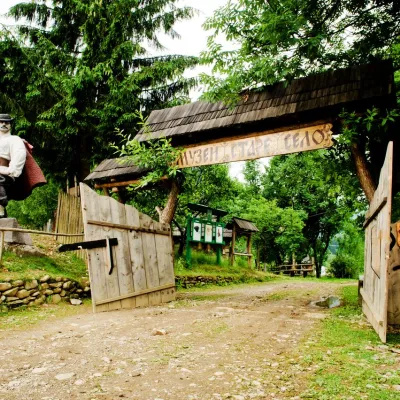 HotelComplex "Stare Selo" MykulychynKolochavaunder 1 km from Holy Spirit Church, KolochavaParkingTransferNearby: Holy Spirit Church 200 mMt Strymba 6.9 km11 trails
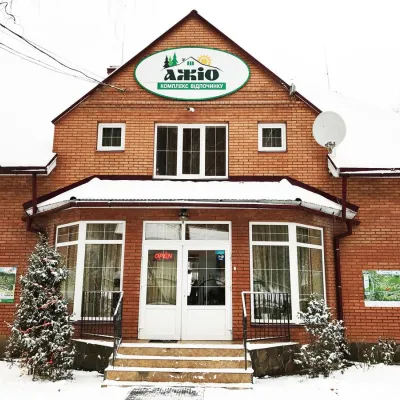 HotelRecreation Complex "Azhio" Mykulychyn VillageKolochava1.2 km from Holy Spirit Church, KolochavaSaunaKitchenTransferNearby: Holy Spirit Church 1.2 kmMt Negrovets 7.8 km10 trails
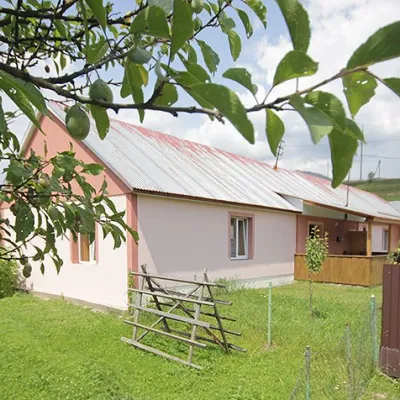 CottageCottage "Yalivets" KolochavaKolochava1.7 km from Holy Spirit Church, KolochavaHot tubBBQKitchenNearby: Holy Spirit Church 1.7 kmMt Negrovets 7.3 km10 trails
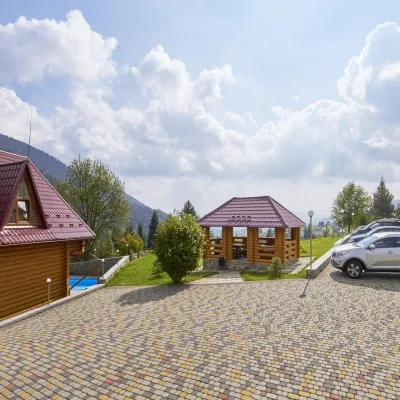 HotelRecreation Base "Kamyanka" MykulychynMizhhiria15 km from Holy Spirit Church, KolochavaPoolSaunaSPANearby: Synevyr Pass 400 mKamyanka Mountain 2.9 km4 trails
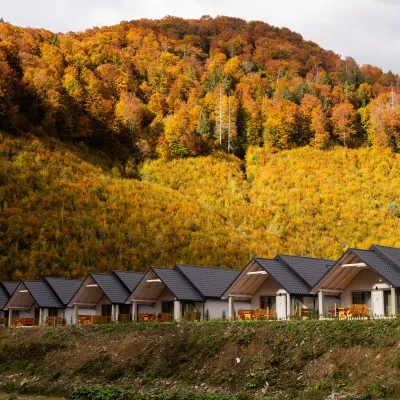 CottageCottages Mizhhirya Mountain ResortMizhhiria18 km from Holy Spirit Church, KolochavaRest in the mountains: Cottage village in Mykulychyn ? Looking for a comfortable place for family or friends?Nearby: Mt Menchul 4.1 kmChurch of Peter and Paul 4.2 km4 trails
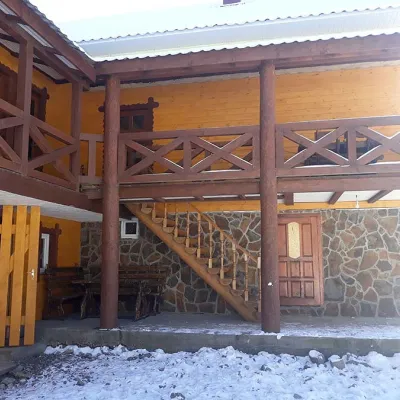 HomesteadHomestead "BILYA SYNEVYRU" Synevyrska PolyanaSynevyrska Polyana17 km from Holy Spirit Church, KolochavaSaunaBBQKitchenNearby: Kamyanka Mountain 3.2 kmSynevyr Pass 6.3 km3 trails
Trails nearby
All trails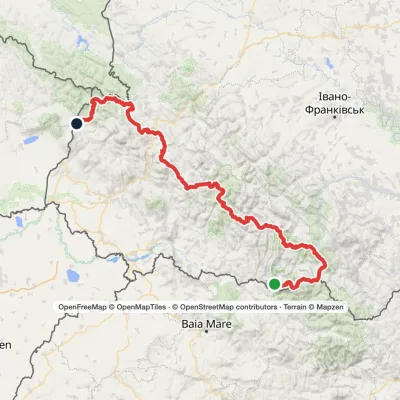 HardMulti-dayMarkedTranscarpathian Tourist TrailElevation profile202–2 054 m393.2 kmascent 16 874 munder 1 km from Holy Spirit Church, Kolochava
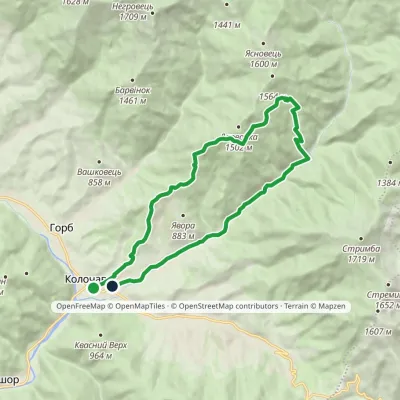 ModerateTwo-dayMarkedKolochava village loopvia Mount DarvaikaElevation profile558–1 383 m18.5 kmascent 829 m≈ 6.5 h walkingunder 1 km from Holy Spirit Church, Kolochava
 ModerateTwo-dayMount Topas to Kolochava villagevia Mereshor villageElevation profile513–1 527 m21.8 kmascent 362 m≈ 6 h walkingunder 1 km from Holy Spirit Church, Kolochava
Nearby attractions
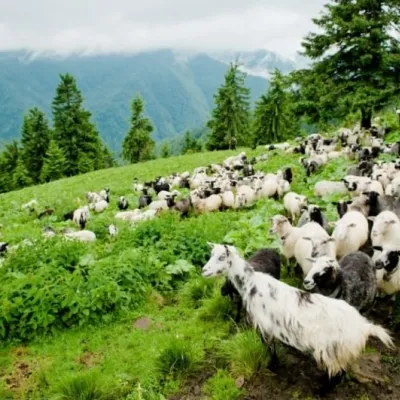 Cheese dairies & pasturesShepherding School on Mount Strymba, KolochavaKolochava1.2 km from Holy Spirit Church, KolochavaThe Kolochava Shepherding School is not a building with classrooms but a summer shepherds' camp (salash) on the slopes of Mount Strymba (1,719 m), one of the highest...
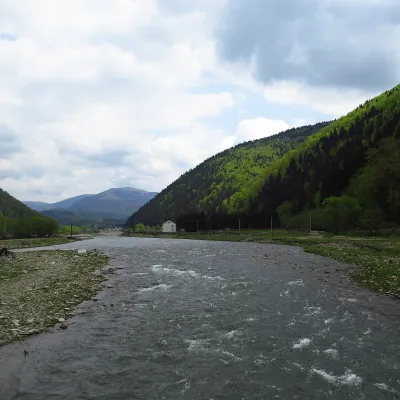 RiverTereblia RiverKolochava2.2 km from Holy Spirit Church, KolochavaThe Tereblia begins in the Inner Gorgany, where the Roztoka and Sloboda streams meet, and flows through Synevyrska Poliana, Synevyr, Nehrovets, Kolochava, Mereshor,...
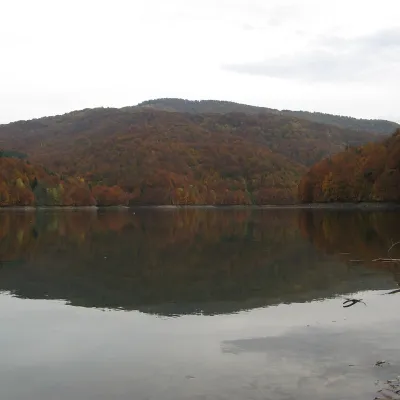 LakeVilshany ReservoirVilshany7.4 km from Holy Spirit Church, KolochavaThe Vilshany Reservoir, also called the Tereblia-Rika Reservoir, is a narrow mountain lake in the Tereblia valley between Vilshany and Mereshor, below Kolochava.
Craft nearby
All craft places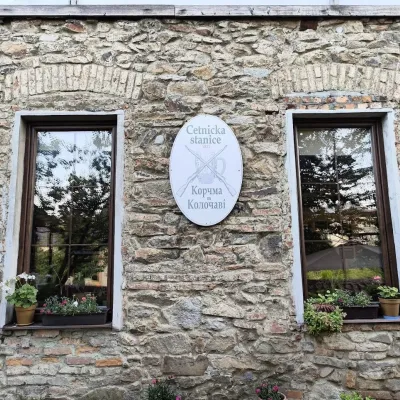 Koliby & Hutsul cuisineKorchma “Zhandarmska Uprava”, KolochavaKolochava1.6 km from Holy Spirit Church, KolochavaKorchma “Zhandarmska Uprava” (“The Gendarmerie Station”) is a family-run tavern in the centre of Kolochava, one of the best-known tourist villages in Transcarpathia.
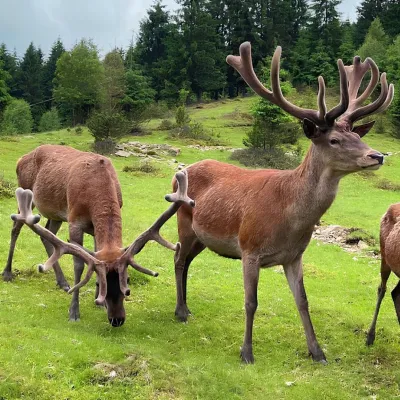 Wildlife parks & animal farmsBioPark Synevyr – Africa in the Carpathians, Synevyrska PolianaSynevyrska Polyana15 km from Holy Spirit Church, KolochavaBioPark Synevyr – Africa in the Carpathians is a hands-on animal park in the Rabachynka area near Synevyrska Poliana, in the valley of the Chorna river.
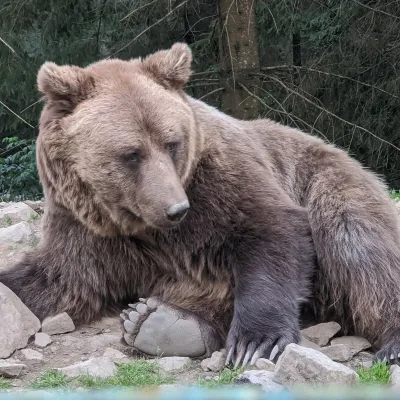 Wildlife parks & animal farmsBrown Bear Rehabilitation Centre, Synevyr National Park, Synevyrska PolianaSynevyrska Polyana15 km from Holy Spirit Church, KolochavaThe Brown Bear Rehabilitation Centre of Synevyr National Nature Park is Ukraine’s largest refuge for bears that have suffered from cruel treatment.
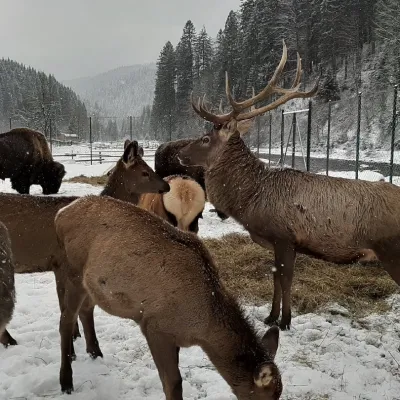 Wildlife parks & animal farmsWolf Valley Eco Park, Synevyrska PolianaSynevyrska Polyana16 km from Holy Spirit Church, KolochavaWolf Valley Eco Park (Dolyna Vovkiv) is a private animal park in Synevyrska Poliana, in the Mizhhiria area of Zakarpattia, where several kinds of wolves, red deer,...
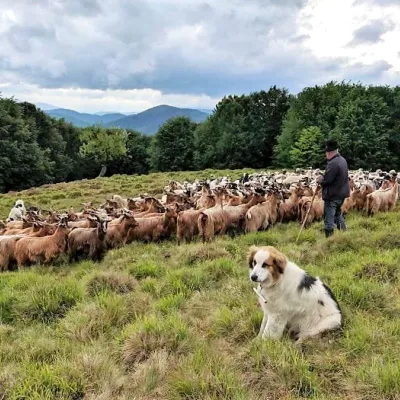 Cheese dairies & pasturesVivcharskyi Khutir Sheep Farm, Synevyrska PolianaSynevyrska Polyana17 km from Holy Spirit Church, Kolochava"Vivcharskyi Khutir" ("Shepherd's Homestead") is an ethno-centre and sheep farm in Synevyrska Poliana, near Lake Synevyr.
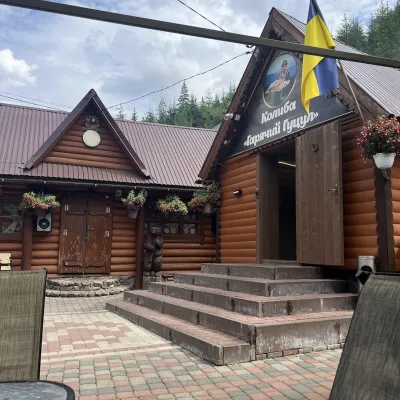 Koliby & Hutsul cuisineKolyba “Hariachyi Hutsul”, Synevyrska PolianaSynevyrska Polyana21 km from Holy Spirit Church, KolochavaKolyba “Hariachyi Hutsul” (“The Hot Hutsul”) is a cosy kolyba-museum in Synevyrska Poliana, on the road to Lake Synevyr.