Church of the Sacred Heart of Jesus, Ben
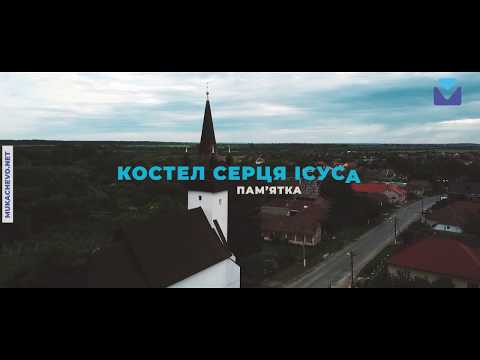
TheChurch of the Heart of Jesus is an architectural monument of national importance. It is located in the village of Bene of Berehove district of Zakarpattia region. The building is in satisfactory condition. The monument's protection number is 1110.
The first written mention of the existence of the religious building, which was located on the right bank of the Borzhava River, dates back to 1333. There is information about the payment of three monetary tithes by the priest Kelemen from the village of Bene. This is mentioned in the corresponding entry in the papal tithe register. There is an assumption that this was a different building, which was the predecessor of the modern church. The building was erected in the late 14th century. According to other sources, a Romanesque church was built in the village in the 15th century. One of the monographs of 1547 mentions a parish priest from the village of Bene, whose name was Antala. In 1567, the church building was damaged by a Tatar attack. In 1593, the Catholic church became a Reformed church. The building was further damaged in 1656-1657. In the 1670s, the church began to be restored, and in 1782 it was destroyed again.
Archaeologist Florisz Romer, artist and researcher Ferenc Schultz, and scientist Imre Genslmann examined the condition of the church building on September 23, 1864. Imre Genslmann's research, which was described in 1865, contains information about the presence of frescoes in the church building. Florisz Romer made a detailed description of the frescoes in 1874. The frescoes are also mentioned in a report made by the historian and ethnographer Tivodar Lehotskyi. The report is dated October 20, 1876. It states that there are frescoes under the lime layer on the north side of the church, and a partial image of them can be seen on the north side of the triumphal arch. The report contains information about the presence of wall paintings in the church in the past. The Ministry of Religion and General Education filed an appeal addressed to the Temporary Committee for the Protection of Monuments of Antiquity and Culture to determine the importance and significance of the religious building. This event occurred as a result of an application for assistance filed by the Reformed community. The assistance was needed for the restoration of the church. Funding was denied due to the church's ancient age and rough stylistic design. In 1886, a classification of Hungarian architectural monuments was made. Imre Henselmann, who carried out this project, classified the Reformed Church in Bene as a 3rd class monument.
On September 6, 1905, a priest named Peter Kisz asked the National Committee for the Protection of Monuments, Antiquities, and Culture to support the restoration of the church. He noted that it was unsafe to hold services in the church due to the emergency state of the building. The bell tower, ceiling, and flooring needed restoration. Deputy architect Otto Steglo presented a report on this issue on February 24, 1906. The report was accompanied by a drawing and several photographs. Otto Steglo's documents stated that the church had a horizontal wooden ceiling dating from the 15th century. The ceiling began to deteriorate and rot, and in three places it was supported by beams that had bent. There was a crack on the north wall of the nave. The report stated that the roof and rafters needed immediate restoration. The plan of mechanical engineer Jozef Pum and the budget of 2247 crowns were mentioned. The construction of a lower roof could have led to the loss of valuable architectural details. He sought to restore the shape of the roof that existed then, using wooden elements. On April 25, 1906, the report was discussed at a meeting. Otto Steglo's comments on restoring the roof shape were accepted. However, the Committee did not provide funding for the project. The reconstruction was carried out in 1906. The roof was replaced, and medieval elements were partially dismantled. In 1934 the interior of the church was changed. During this period, the decoration dating back to the 18th century was destroyed. The building was renovated, as a result of which the church lost its original local Gothic forms in which it was built. Tin was used to cover the roof and tower.
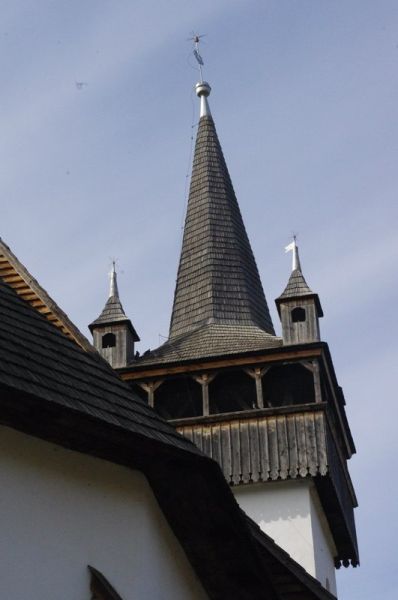
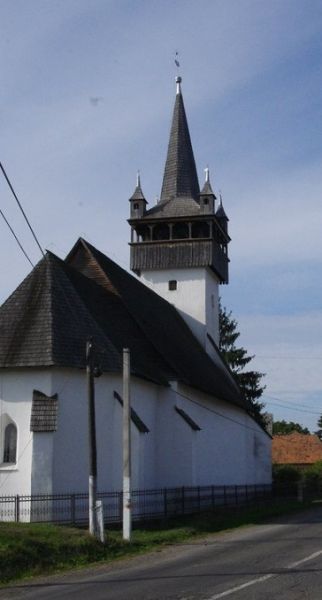
Reconstructions of the 19th century made it difficult to study the details of the construction and the time of their origin. In 1999, Hungary provided assistance for the restoration of the church building. The head of the restoration work decided to recreate the former architectural form by building a spire with four fials, a balustrade, and a gallery. The tin roof was replaced with shingles. As a result, the roof of the church was restored to its original shape, which was in the Middle Ages. The construction of the Gothic-style spire began. In 2001-2004, the church was renovated, the author of the project was the architect Robert Füllopp. The restoration was necessary because of floods that caused destructive effects. The work was supported by the Hungarian authorities. After the restoration, the church was plastered. The floor was replaced, and the decoration was restored. During this restoration, no detailed study of the walls was carried out. The current name of the current building is the parish church of the Heart of Jesus. The church has retained its main features and volume in the 21st century. The church has now been restored.
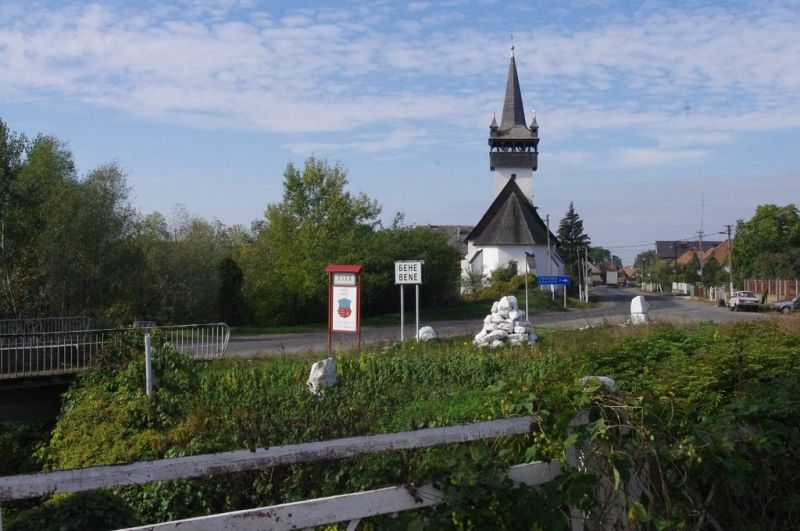
The church building is larger than the average size of structures built during the Middle Ages. It is located on the eastern edge of the village. It is built in the Gothic style of brick and rubble stone. The plinths, cornices, triumphal arch, and framing of the openings were created in one piece using carved stone elements. The features of the building indicate that it was used as a defensive structure. This is confirmed by the massive tower and loophole-like windows. Most of the walls of the church have small lancet windows, and the northern wall has no windows at all. The basilica has one nave and is reinforced by buttresses.
In 1593, the church was rebuilt due to the conversion of the inhabitants of Bene to the Reformed faith, which led to architectural changes in the church. In 1657, the tower spire and cross vaults built in the Gothic style were destroyed. In the 1670s, the church was reconstructed, which was necessary after its destruction. This reconstruction allowed for a combination of Gothic, Romanesque, and Baroque elements. The reconstruction of the 19th century caused changes in the architecture of the tower. Before the reconstruction, it looked like a Gothic spire; after the reconstruction, it acquired Baroque features with a decorative lantern in the center. The apse of the church is turned with the throne to the east. Its internal width is 6 meters. The apse ends with three octagonal faces. The nave has a rectangular shape and measures 8.05 meters by 16.30 meters. In addition to the nave, the apse is adjacent to the bell tower, which has three tiers. The structure of the bell tower is strengthened by buttresses. The walls of the bell tower on the ground floor are about 120 centimeters thick. The walls of the other elements - the triumphal arch, the apse, and the nave - are less wide, measuring 100 centimeters. The thickness of the western side of the nave is approximately 150 centimeters. Near the northern wall there are remains of the foundation of the sacristy, which was demolished after the church became Reformed. From the outside, the church is supported by buttresses. The diagonal supports are located at the breakpoints of the apse walls. The diagonal buttresses support the western horns of the bell tower and the nave. The longitudinal walls of the nave have no supports.
On the western side of the bell tower are the lower windows, which have a straight end. The same feature is inherent in the window on the east side and the lower opening on the south side. They are characterized by narrow openings and different sizes. On the highest tier of the bell tower, the windows to the west and south are lancet windows. The elements of the northern circular window are four semicircles. On the sides of the apse, located on the east and west, there are windows with lancet endings. There are also lancet windows on the south side of the nave. In 1906, the window structures, which were made of stone, were partially dismantled. A layer of plaster was applied to the framing elements. The lancet finial is typical of the southern and western medieval portals. In Hungary, such elements were typical in 14th-century construction. The narthex of the church is small in size and is a medieval element in the structure of the building. It has a lancet ending, which is similar to the forms found in the design of portals and windows. Many elements of the building are built in simple Gothic forms. This list includes the main cornice of the nave, the upper cornice of the bell tower, and the apses. The beginning of the triumphal arch is a prism. It is likely to date from the 14th century. There is speculation that the bell tower on the western façade was not built at the same time as the rest of the building. The bell tower's plinth differs from other architectural elements. The three windows with semicircular openings only confirm these assumptions.
The bell tower could have been completed even several decades after the main building was constructed. One of the southern windows of the bell tower bears a date of 1458, although experts do not believe that this can have an impact on the date of construction of the building. The openings and frames on the building make it possible to date the construction of the building to the second half of the 14th century. The windows located in the bell tower could have been previously located in the pediment. The structure of the church, architectural elements, and the size of the details allow us to speak about the similarity of the Reformed church in the village of Bene with the churches in Muzhievo, Marokpapa, and Vamoshat, which were built in the late 13th and early 14th centuries. There are a number of similarities with churches built in a later period, such as the religious buildings in Khust, Velyki Beregy, Chetov, Dyula, and Kissekeres. The date of the church's origin can only be definitively confirmed through archaeological research.
The Church of the Sacred Heart of Jesus looks like a real miracle against the backdrop of lush Transcarpathian nature. This white-stone Protestant church with a bell tower and a spire crowned with a star immediately attracts attention. It is even more interesting when you learn the local legend that the secret of Jesus' heart is kept here.
The name of the village is also very unusual. Bene means "good" in Italian. This is very similar to reality, the village is really good with itself. The fact is that the people living here are mostly ethnic Hungarians. Therefore, there is something to think about - how did the Hungarian village, once known as Dobroselo, get the Italian name.
Unfortunately, the older wooden version of the church has not survived to this day. The first mention of it is found in 1333. What can be seen in its place was built a little later - at the end of the 14th century. Of great interest are its small windows of the massive tower, which are very similar to loopholes, as well as small lancet windows. Apparently, the church also served as a defensive structure.
Currently, the restored Church of the Heart of Jesus, to which Hungarian craftsmen returned almost the original Gothic style, is in operation.
Accommodation around Church of the Sacred Heart of Jesus, Ben:


Which trails pass by Church of the Sacred Heart of Jesus, Ben?
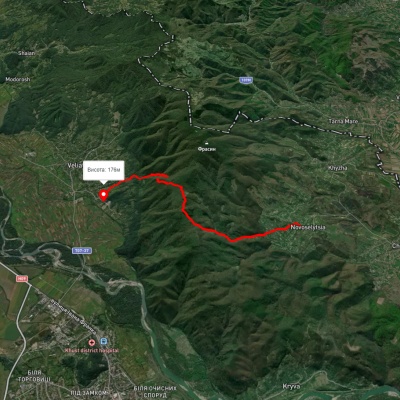
We suggest these hiking trails through or near Church of the Sacred Heart of Jesus, Ben: Pidhirne – Chorne Bahno – Kupinkuvate, Lukovo village, via Mount Buzhora to Svaliava, Novoselytsia – Smerekovyi Stone, Pylypets village, via Mount Hemba, Mount Stiy and Vovchyi village to Svaliava, Pyntia's Path, Sasivka village, via Mount Ivolove, Mount Stiy, Mount Velykyi Verkh, Shypit Waterfall and Mount Plai to Volovets

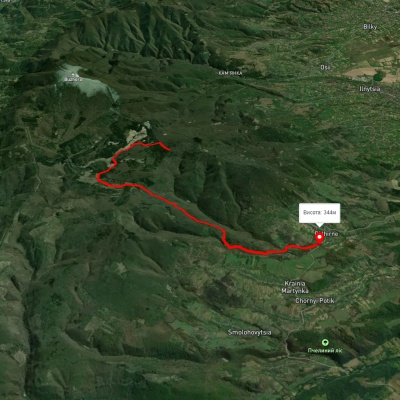
Pidhirne – Chorne Bahno – Kupinkuvate

Lukovo village, via Mount Buzhora to Svaliava
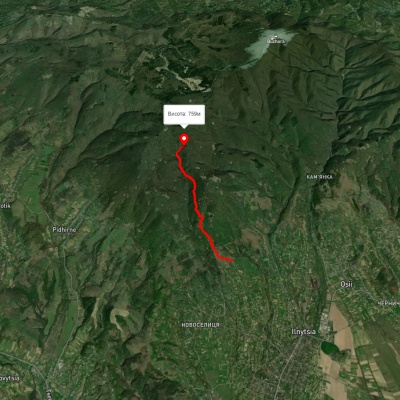
Novoselytsia – Smerekovyi Stone

Pylypets village, via Mount Hemba, Mount Stiy and Vovchyi village to Svaliava