Dniester canyon. Weekend on the oars.

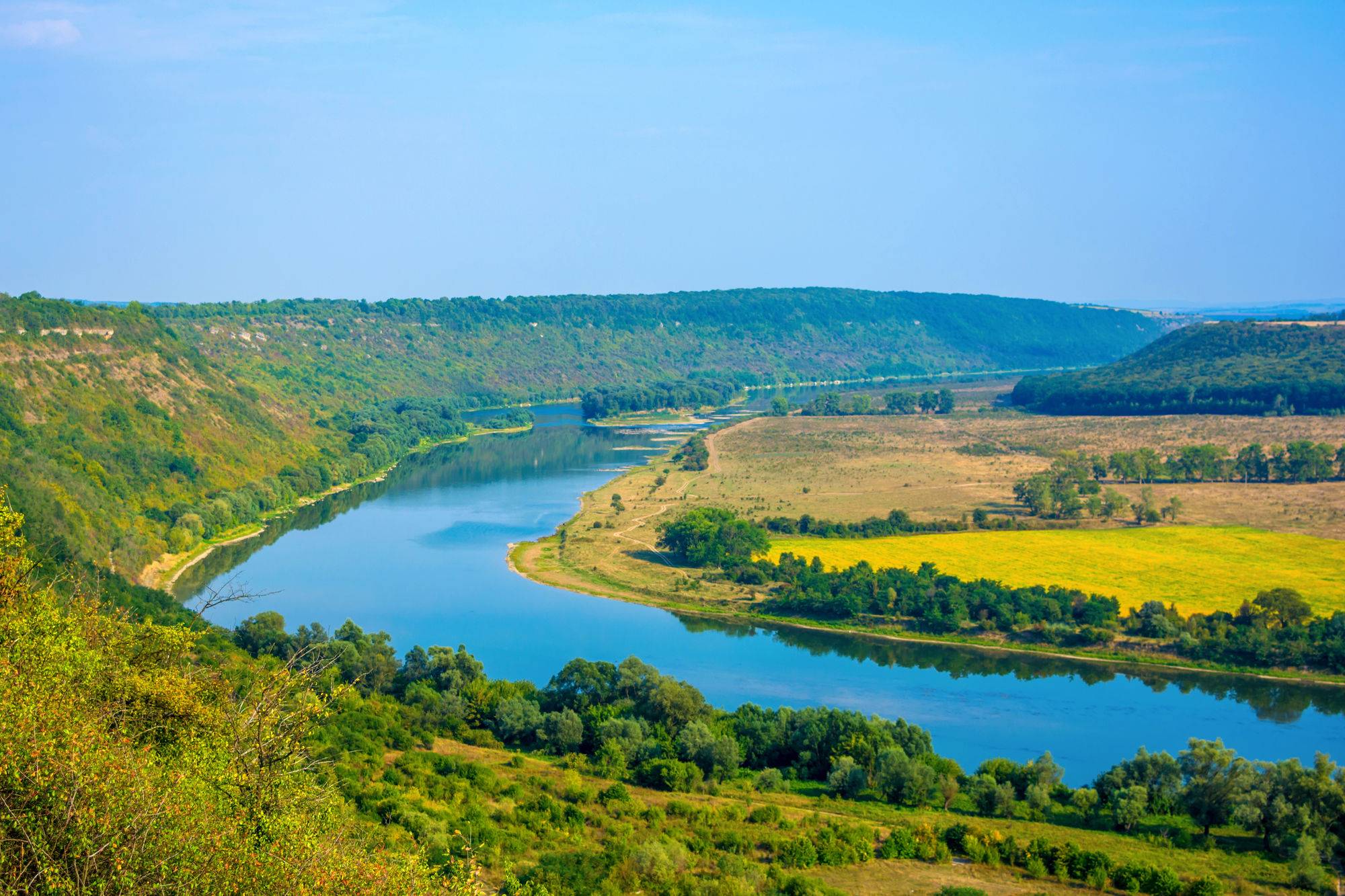
In fact, there are two Dniester rivers. We can see one from the bridge or from the shore. It's a river, except that it's bigger than the Bystrytsia. But there is another Dniester that you can see only during rafting. It is beautiful!
Water is never enough
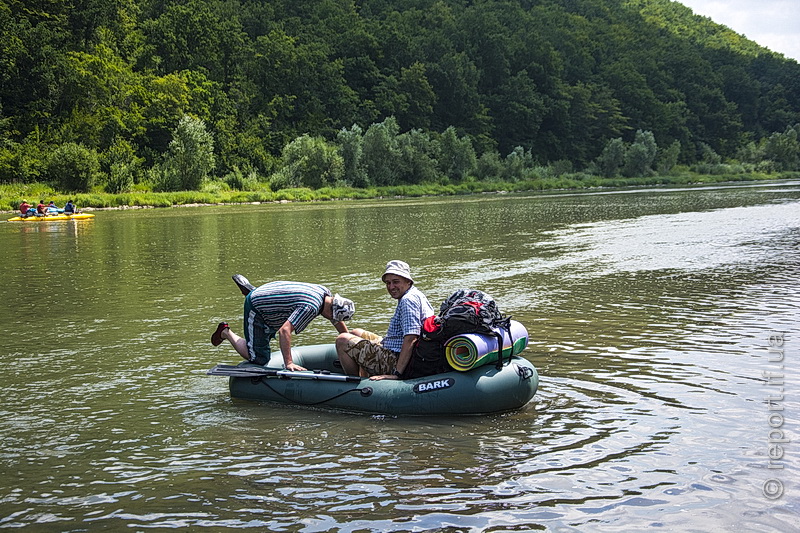
Two years ago, my friends and I organized an amateur rafting trip on the Dniester. We covered the stretch from Nyzhniv to Nezvyssk. This year we decided to continue the journey. We made two versions of the route: the minimum program was from Nezvyssk to Ustechko, the maximum was to swim to Zalishchyky.
The speed of travel depends on several factors. First of all, it is the fullness of the Dniester. This year, due to frequent rains, the water level was sufficient, but in 2015 we had to pull the boat several times to avoid tearing the bottom on stones. The type of boat is also important. Kayaks and canoes move much faster than boats or rectangular rafts. And a lot depends on how you swim. If you lounge around, drink beer, and fish from the side, it's fun, but slow. But if you row constantly, replacing each other on the oars, then the boat flies like a bird. Although, it's not a vacation, it's some kind of galleys. Therefore, it is worth choosing the golden mean.
Whether to take alcohol on a rafting trip is an individual question. If you don't know the right amount, an exciting trip on the first morning will be ruined by a hangover, and instead of admiring the beauty of the Dniester, you'll be looking for a village store with beer.
And before rafting, you should carefully study the weather forecast. If they promise rains, hail and storms, you'd better stay at home. Believe me, paddling in the rain is a lot of fun. And even if the forecast is sunny, take a raincoat or waterproof suit with you. It will definitely not be superfluous.
Not the Mississippi, but...
Starting from the bridge in the village of Nezvyssko, an hour later we saw the tower of an ancient castle on the right bank. In this section, the Dniester serves as a natural border between Ivano-Frankivsk and Ternopil regions, so the fortress turned out to be "ours." This is Rakivtsi Castle, which was built in the 1650s by the Galician sub-chancellor Dominik Benevsky. Although it is more correct to use the noun "remains" because local peasants used the castle stones for fences, barns, etc.
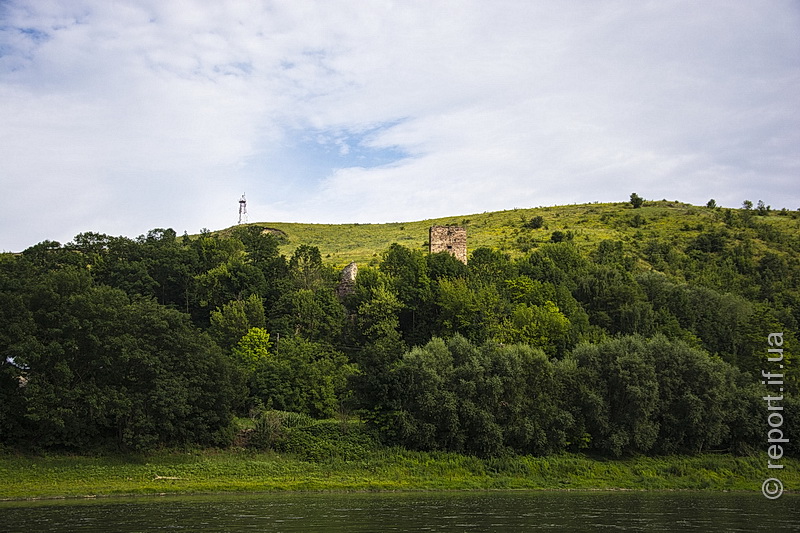
Nowadays, only the tower and a small fragment of the wall, which can be seen among the bushes, remain of the fortress. I wonder what Mr. Benevsky was guided by when he chose the site for the fortress. A mountain hangs over the fortress, from where you can see the entire castle yard in the palm of your hand - set up the cannons and shoot as if in a shooting range. Perhaps this location is explained by the presence of a water source, which was not on the hill? Nevertheless, the castle fought off the Cossacks and Tatars, but did not resist the regular Turkish army. During the Polish Civil War (the Bar Confederation of 1768), the fortress burned down and was never rebuilt.
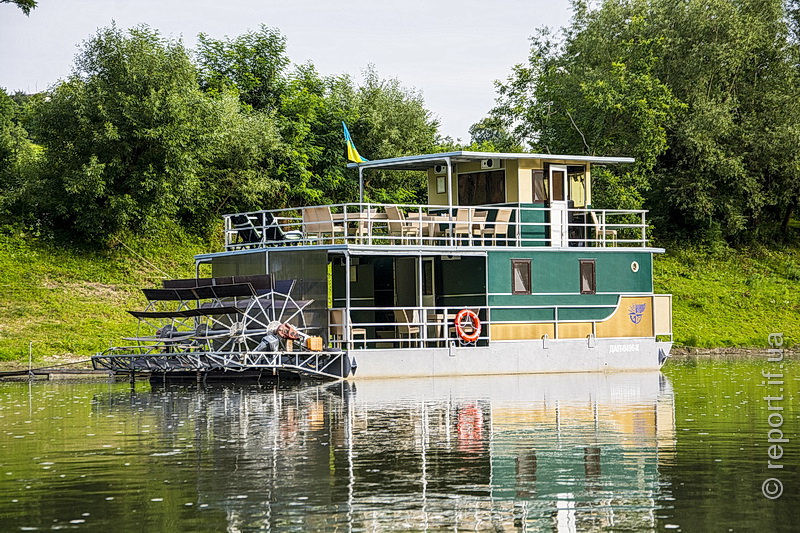
Passing the tower, we see a billboard on the shore: "Port Rakovets. Restaurant, shop, camping. Cold beer, kvass, ice cream, Carpathian cuisine, fish and meat dishes on the grill." If there is a port, there must be a ship. And there is! A few hundred meters away, a real steamboat with a paddlewheel sways on the water, a bit like a ship from a Tom Sawyer movie. The ship was made by Lviv inventor Yurii Shpitser, which is why it is called Yura. Since the Dniester is not the Mississippi, the boat has increased cross-country ability and a draft of only 30 cm. The dimensions are modest but sufficient: 14 meters wide, 5.6 meters long, and 12 tons in weight. It has two decks, several cabins for 10 passengers, a toilet and even a shower. All this is serviced by a team of three people: a captain, a sailor and a cook. Judging by the large grill attached to the ship's side, the cook has enough work to do.
Devonian gas pipeline
The Dniester Canyon is included in the list of the Seven Wonders of Ukraine for a reason. It has fantastic views, with hills on the sides sometimes reaching 200 meters in height, and stone slabs, which geologists call outcrops, can be seen. They can be used to read the ancient history of the Earth. For example, near the village of Beremiany, there is the Red Mountain, where 350 million-year-old red Devonian sandstones protrude in giant parallel strips. There is no shortage of living creatures - while at first we were enthusiastically photographing herons and hawks, on the second day of the rafting we began to perceive them as city dwellers - pigeons.
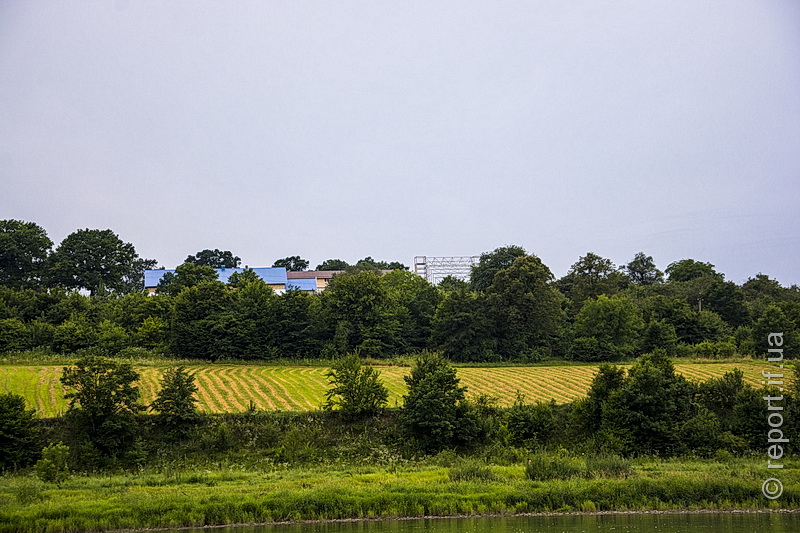
However, the most interesting thing is what people did. For example, in the village of Unizh, a metal structure resembling a radar can be seen from the water. In fact, it is a stage where the ArtPole festival is held.
Near the village of Khmeleva, the mountains are covered with pine forest. However, the trees there are twisted, many are dry and broken. Is it a storm or bad power?
In the next village, Lityachi, if guidebooks are not lying, there is a cave of a hermit monk. Indeed, a large stone block is clearly visible at the top of the mountain, but for some reason I didn't want to get out of the boat and go check it out.
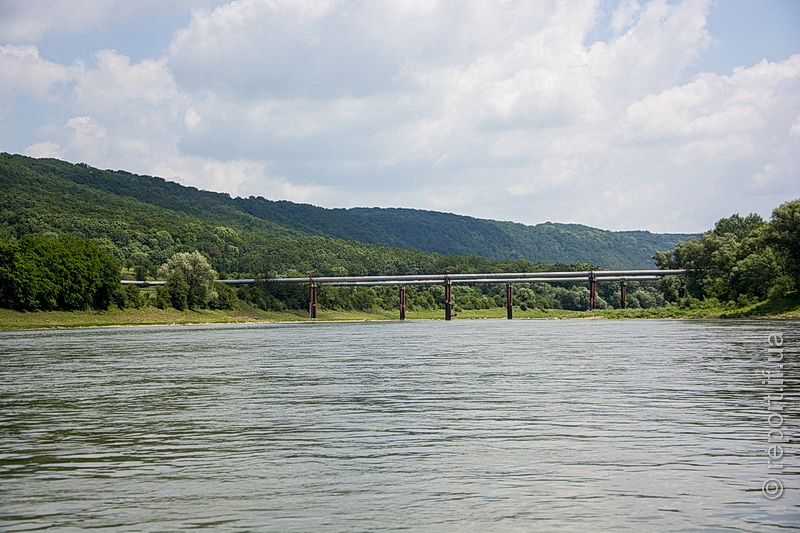
A little further across the Dniester, on high supports, two parallel strings of pipes are thrown over, on one of which someone left an anonymous confession: "I love you. Be my girl". This is the Urengoy-Pomary-Uzhhorod gas pipeline, built in 1982-1984. It is 4500 km long, 1420 mm in diameter, and pumps natural gas from Siberia to Europe. When you pass through, you don't smell gas...
Bridges, living and dead
Suddenly, a powerful stone terrace appears among the trees and a large building behind it. This is the children's camp "Pearl of Transnistria" in the village of Mykhalche. Unlike many Soviet sanatoriums, it is open for 200 children, and the cost of a voucher ranges from 2400 UAH (12 days) to 6000 UAH (21).
Behind the camp there is a large beach with a lot of cars and tents. There, groups of kids are barbecuing, swimming, and drinking-it doesn't look like they are from the neighboring camp. Horodenka is just a few kilometers away, and the residents of the district center go to the countryside on weekends.
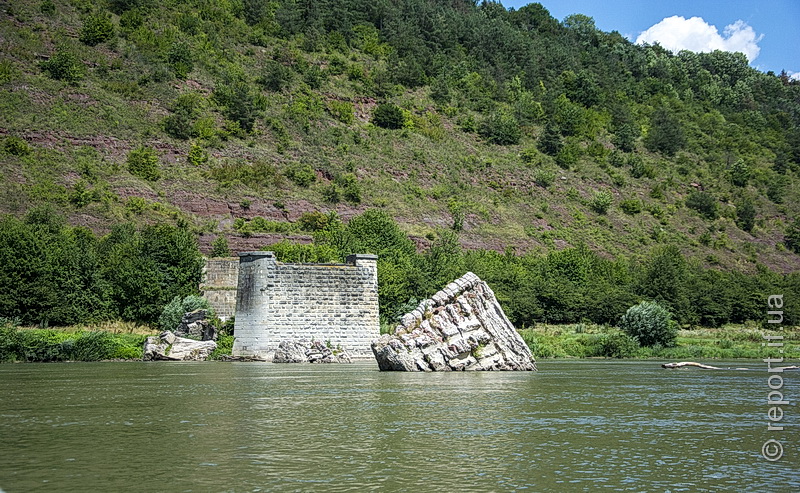
The ruins of the old bridge, whose stone pillars stick out of the water like broken teeth of some monster, struck me the most. They say it was built in the days of Poland, during the interwar period. Who destroyed it and why? I had to go online to find out. It turns out that the bridge was destroyed several times. First, the Poles did it in September 1939, right under the nose of a Soviet tank column. The Soviets repaired the crossing, but in 1941 they blew it up again when they were fleeing. Three years later, the Germans were fleeing and blew it up too. After the war, it was repaired, but the ice drift of 1970 severely damaged the supports. Soon a new bridge was built in a neighboring village, and the old one was... blown up in 1979, during the filming of the movie about the Banderites, The Crimson Shores. The movie is available on the Internet, and at the 63rd minute you can clearly see the structure blowing up.
Having sailed away from the ruins, you wonder where the bridge led, because there is a steep cliff right there. In fact, the road turned sharply to the right and led to the neighboring village of Ustechko. The architecture here is quite interesting - an abandoned old church, almost all the houses are two-story, with outbuildings below. This is probably because the banks are often flooded with water, and during the last flood in 2008, the then-President Yushchenko even promoted himself here in rolled-up pants.
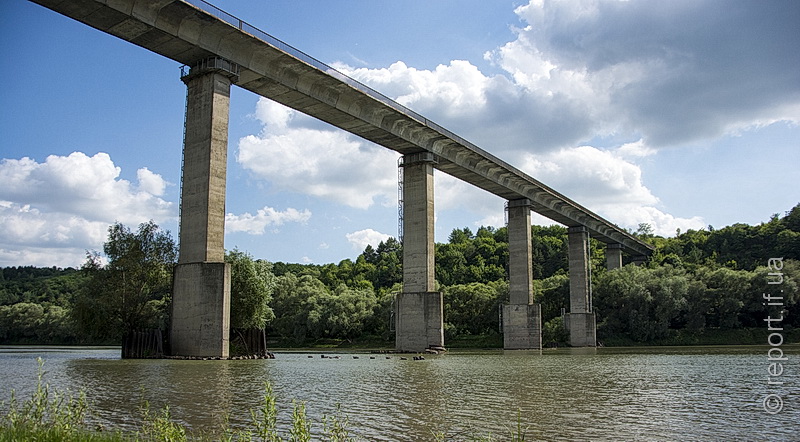
Finally, we see a beautiful concrete bridge built in 1977. It is the highest in the Carpathian region, 27 meters high and 403 meters long. It has no analogues in Ukraine, and only a few similar facilities were built in the entire USSR.
Our journey ends near the bridge, as the next step is remote villages, and this is the highway, after all. We return to Frankivsk and... plan the next stage of the rafting.
Photo by Mykhailo Monomakhov
Comments
You may also be interested in
All articles Unique and Mysterious Lake ZhurovlyneЖуравлине – унікальне та водночас таємниче озеро, яке надзвичайно багате на сірководень. Навколо нього розкинулась болотиста місцевість,...
 Kamianets Waterfall in the National Park "Skole Beskids"Гучні потоки Кам’янецького водоспаду, розташованому в Національному природному парку «Сколівські Бескиди», чути здаля. Завдяки такому...
 Voievodyn Waterfall in Sokolyh SkelyahВодоспад Воєводин розташований на однойменному потоці неподалік від села Жденієво на Закарпатті у межах «Соколових Скель»,...