Church of the Exaltation of the Holy Cross, Chernivtsi
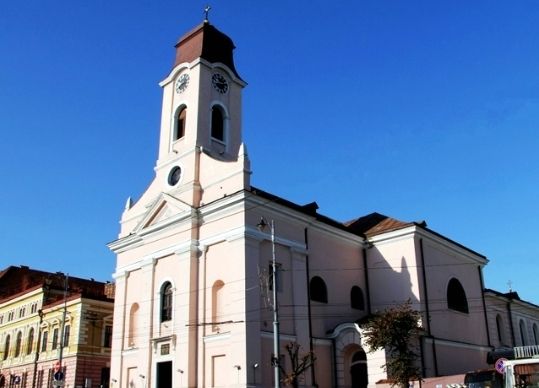
The center of the Roman Catholic community in Chernivtsi is the Church of the Exaltation of the Holy Cross. It is also one of the main architectural landmarks of the city. You should definitely visit the church, you will definitely like its interesting history and good preservation.
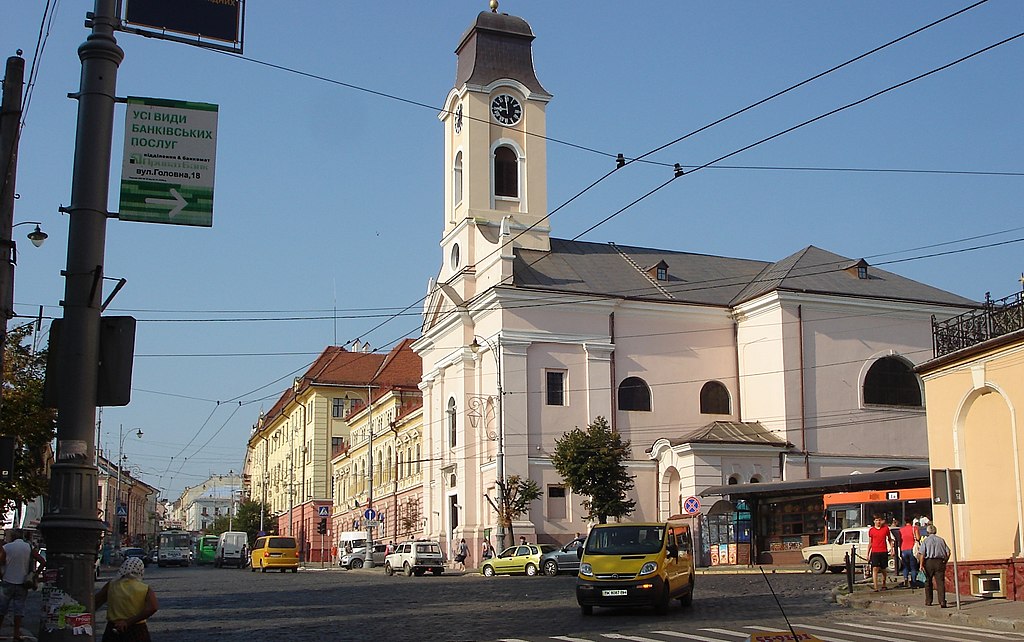
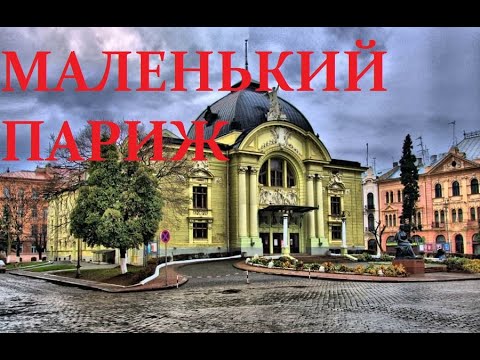
The Church of the Exaltation of the Holy Cross was one of the first stone buildings in Chernivtsi, which was built by order of the Austrian Emperor Joseph II during 1787-1814 in the style of classicism and is located in the center of the city on the former Holy Cross Square (now Beethoven Street), next to the Puppet Theater. There are also famous architectural monuments nearby: the ship house and the Governor General's house.
When Bukovyna was annexed to Austria, there were no Roman Catholic churches in the region. Two military chaplains, Prokop Muntz and Wenzel Keckert, arrived in Chernivtsi with the Austrian soldiers. The first holy mass was held in the wooden house of General Gabriel von Spleny, the first Austrian governor of Bukovyna, and was attended by only a small number of Roman Catholics.
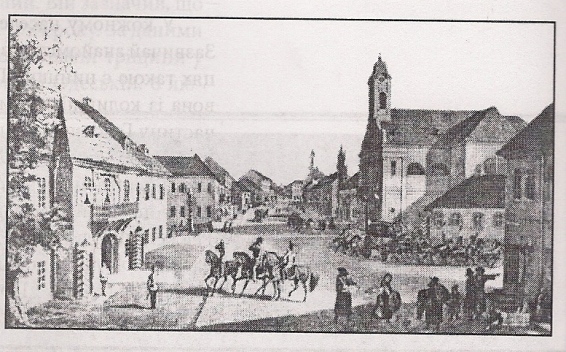
In 1778, the construction of the first church was completed in Chernivtsi, which became the prototype of the present Church of the Exaltation of the Holy Cross. It was a wooden church with a tower and was located on the square opposite the present church. The construction of the brick church lasted for a long period of time - 27 years, as flaws in its design were discovered, which resulted in the tower falling twice. Upon completion of the work, on July 29, 1814, the new church was consecrated and named the Church of the Exaltation of the Holy Cross.
The old wooden church was handed over to Protestants, and a cross with a stucco image of the Virgin Mary was installed on the square (the cross stood until 1950). Initially, in addition to Roman Catholics, it was used for worship by Greek Catholics and Armenian Catholics until they built their own churches. In 1861 the church burned down for unknown reasons. The entrance part was especially damaged.
In 1866, the church was restored, and then an organ was installed in the church, which immediately received two medals in the 70s of the nineteenth century. One in Vienna and the other in Paris as the best organ in Europe in terms of timbre. Even today, worship is performed to the sounds of the organ. For a long time, the Catholic Church with its high spire became the architectural dominant of Chernivtsi. The tower itself was used as an observation post for timely detection of fires. In 1818, a clock was installed on the church tower, which was replaced several times with a newer one. Especially for the Austrian emperor, a throne was built in the church, where he sat during the service. In the Church of the Exaltation of the Holy Cross, the emperor met with the Russian Tsar Alexander during his visits to Chernivtsi.
TheChurch of the Exaltation of the Holy Cross was built on the prototype of a Roman church in the Jesuit style with its characteristic painting, applied arts of the church, and sculpture. This three-nave basilica consists of horizontal and vertical volumes. Its main facade is crowned with a bell tower and chimes. The vault of the central nave is supported by powerful pillars. The interior of the building has many Baroque elements, the wall paintings are filled with stylized floral motifs symbolizing the tree of life, and the presence of seven altars in the Neo-Gothic style is simply impressive. There are also stained glass windows and oil paintings of the ceiling, which are of great artistic value. For a certain period of time, this church with a high spire began to dominate the architecture of Chernivtsi, and its tower was used as an observation post. By the way, there are several other churches in Chernivtsi, including the Church of St. Michael and the Church of St. Anna.
In 1861, the church building suffered from a large fire, which damaged the entrance part the most. Five years later, the shrine was restored and an organ was installed, which later received two medals in Vienna and Paris as the best organ in Europe. The organ is still used for worship today. The last reconstruction of the building was carried out in 1910, when the spire roof was replaced by a domed roof (1909-1910), and since then the church has not changed its appearance.
Surprisingly, throughout its history, the church has functioned for its intended purpose, which helped preserve its interior. Sacred items are kept here, which came here after the Soviet government closed other churches. For example, in the 1960s, icons, liturgical books, and sculptures of saints from the Jesuit Church of the Sacred Heart of Jesus were transferred here. On the side wall of the Church of the Exaltation of the Holy Cross is the oldest sundial in western Ukraine, which was given to the church for safekeeping by a monastery in Austria. Today, as in the past, this clock also shows Vienna time. In 2014, on the occasion of its 200th anniversary, the church was renovated, a solemn service was held here, and at the same time it was granted the status of a small basilica.
Today, the Church of the Exaltation of the Holy Cross in Chernivtsi is active, considered the first brick church in the center of Chernivtsi, belongs to the Roman Catholic diocese, and is an architectural monument of local significance. While in the city, be sure to visit another building by the famous Josef Hlavka (the author of the Metropolitan Residence) - the Armenian Church of Saints Peter and Paul.
The main decoration of the church is the preserved interiors that will take you back to the 19th century. The exquisite decorative elements of the Vozdvyzhensky Church will not leave you indifferent.
The church is located at 2 Beethoven Street. If you are walking into the city from the train station, you will definitely pass by it. Chernivtsi is conveniently accessible by train from Kyiv, Lviv, and Odesa.
Opening hours: the church is always open. We recommend visiting in the daytime.
Chernivtsi is the capital of Bukovyna. It is one of the most beautiful and pleasant Ukrainian cities. There is one of the most beautifulrailway stations in the country, theChurch of St. Paraskeva of Serbia, the Church of the Exaltation of the Cross, the ship house, the City Hall (every day at 12:00 a trumpeter plays the melody "Marichka" from the tower), the Art Museum, then Kobylyanska Street, the German Folk House, the Armenian and Assumption Church (the oldest stone Ukrainian Greek Catholic Church in Chernivtsi), the Theater Square and the Kobylyanska Theater. Kobylianska Theater Square and Theater, Jewish People's House, Chernivtsi University (included in the UNESCO World Heritage List), Turkish Square (Chernivtsi has been a part of Turkey, Modova, Romania, Austria-Hungary, the USSR, Rus, and Ukraine), and a large rover,cozy streets and cobblestones, the so-called Drunken Church, Nazariy Yaremchuk's house, then another house-ship, two houses with the same number (Olha Kobylianska lived here), the house where Volodymyr Ivasyuk lived, the pink church - the Cathedral of the Holy Spirit.
Chernivtsi sights
- St. Nicholas wooden church (from 1607, restored in 1954);
- stone Church of St. George on the Bitterroot (1767 in the Baroque style);
- wooden Trinity Church in Muggles (one thousand seven hundred and seventy-four), moved in 1874 to Kłokuchka;
- wooden Assumption Church on Kaleczanka (1783);
- City Hall with a two-story, 45-meter-high Empire-style tower (1843-1847, architect A. Mykulych), now the City Council;
- Ukrainian Greek Catholic Church (1825-1830 in the Baroque style);
- Byzantine-style cathedral (1844-1864, architect Roll);
- Church of St. Paraskeva in the pseudo-Romanesque style, completed in 1662 (architect A. Pavlovsky);
- residence of Bukovyna metropolitans - since 1956 one of the buildings of Chernivtsi University);
- Armenian Gregorian Church (1869-1875, architect J. Hlavka);
- Chernivtsi University building (1874-1875);
- Jesuit church in the Neo-Gothic style (1893-1894);
- Railway station (1898-1903) in the Art Nouveau style;
- the City Theater (1904-1905, architects F. Fellner and G. Helmer) in the Viennese Baroque style with Art Nouveau elements (now the O. Kobylianska Music and Drama Theater), and others.