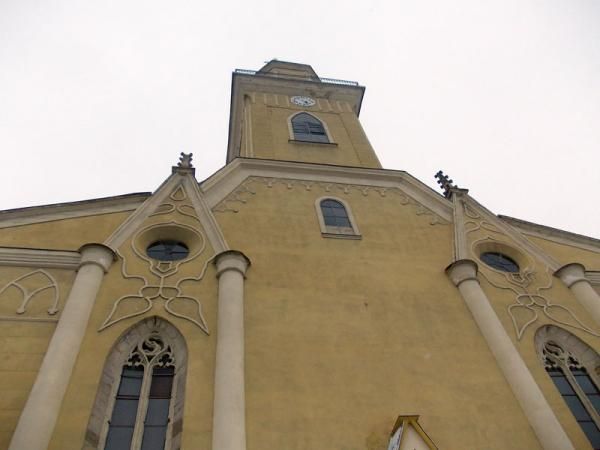
Church of the Exaltation of the Holy Cross, Berehove
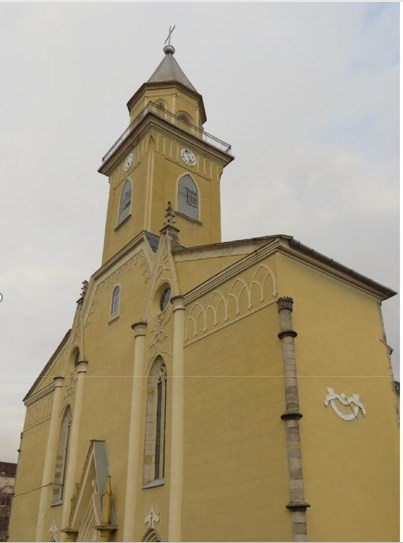
TheBerehove Church of the Exaltation of the Holy Cross is a parish Catholic church in the center of Berehove, which is considered one of the oldest stone buildings in Transcarpathia, an architectural monument of national importance (No. 173).
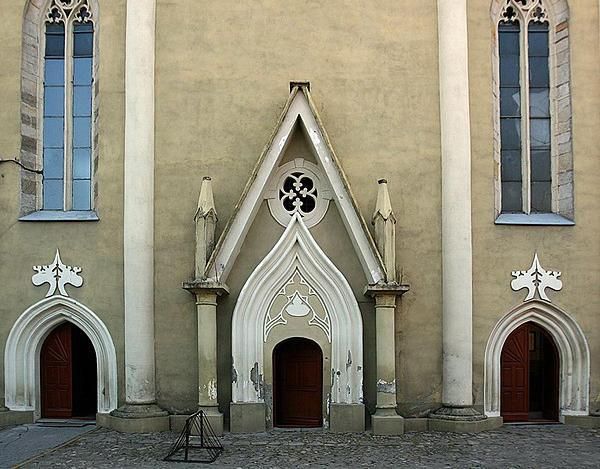
The massive, brick and plastered three-nave basilica, covered with cross vaults, has large choirs. The majestic building of the general type is divided into naves by six columns. The walls, reminiscent of their medieval defensive purpose, are additionally surrounded by 14 stone buttresses. The church retains traces of the transitional stage from Romanesque to Gothic style, but unlike most medieval stone buildings in Transcarpathia, the facades of this church are richly decorated. The main façade, divided by four semi-columns, is decorated with ornaments. The northern portal has preserved its Romanesque sculptural decor and is distinguished by ancient embedded capitals decorated with stylized human heads and a reclining lion. The southern portal, which is more richly decorated, is distinguished by four large and two small rollers, and its architectural and artistic solution, according to experts, reflects the influence of Gothic buildings in Eastern Slovakia.
The Church of the Exaltation of the Holy Cross in historic Berehove is the most significant architectural monument not only in the village but also in the entire Transcarpathian region. Its deep roots go back to the first decades of Christianity in Russia. According to a preserved inscription in one of the window frames, the church was built in 1100. Built in the Romanesque style, the church was destroyed by the Tatars in 1241 and rebuilt in 1418. The Church of the Exaltation of the Holy Cross in Berehove was first mentioned in 1247.
The church has a magnificent architecture made of a mixture of several styles. It has Romanesque features, Baroque elements and a prominent Gothic style. Such a wide range of styles is associated with a number of reconstructions and destructions of the church, due to the military history of the area, raids by Tatars and other rebel armies.
In 1519, the church received the status of a cathedral. In 1565, the church building suffered considerable damage from Hungarian Protestants, and in 1657, the church was almost destroyed by Polish troops during the war of the Transylvanian prince György Rákóczi II for the Polish throne. On July 17, the Polish troops of Prince Jerzy Sebastian Lubomirski entered the defenseless city, whose population took refuge in the cathedral. The soldiers surrounded the church with brushwood and set it on fire. Almost everyone died. The cruel prince ordered to write on the smoke-black wall in Latin: "Vicem pro vice reddo tibi, bone vicine!" ("An eye for an eye, I have paid my debt, good neighbor!").
Soon the repaired church was damaged for the second time. In 1686, it became the scene of battles between Austrian troops and rebels led by the famous Ilona Zrinyi. The Kurucs (participants of the anti-Habsburg struggle in Hungary), having made a raid from the besieged Mukachevo castle to Berehove, surrounded the Habsburg soldiers who tried to hide behind the walls of the church, and set fire to the dismantled wooden huts. Not only the soldiers died, the fire engulfed the entire city, and the roof of the church collapsed and the walls cracked. After those terrible years, the church stood in ruins for more than a century and a half. Several attempts were made to restore it, but there was a lack of money and agreement on what the revived church should look like.
Reconstruction began in 1839. The construction work was paid for by Count Schönborn (with funds obtained from heavy taxes of the local population). At that time, another octagonal tier with a high hipped top was added over the multi-tiered square bell tower with clock faces to all sides of the world, surrounded by a wide, spacious observation platform (i.e., it served as a watchtower), and a new chapel was added to the southern façade of the church. On November 1, 1846, the cathedral was consecrated in honor of the Exaltation of the Holy Cross. The architect Albin Tischler, who supervised the work, gave the church a Gothic shape, as the residents wished. However, experts note the presence of elements of the Romanesque style in some details. The portal (entrance), located between the sacristy and the sanctuary, was moved from the church in Muzhiyeve destroyed by the Liubomyr raiders to the one in Berehove. In 1899, the church was enriched with an organ made by the Budapest firm of the Rieger brothers.
In 1900, another reconstruction took place, which is considered to be rather unsuccessful.
In 2002, the external reconstruction of the shrine was carried out. A memorial plaque to the founder of the city, Prince Lampert, was installed on the wall of the building.
Today, the parish church of the Exaltation of the Holy (Honorable) Cross is run by representatives of the respected Jesuit monastic order of the Mukachevo Diocese of the Roman Catholic Church in Ukraine, and Vicar Antal Michaelis was appointed rector of the church. Services are held in Hungarian.
Inside the church, special attention should be paid to the iconostasis, made in the Baroque Gothic style, and the rich wall decor, describing episodes of the church's history, as well as the sundial in the form of an arc with Roman numerals, a hallmark of the old building, which continues to indicate Central European time for the 12th generation of parishioners.
Nearby, you can appreciate the beauty of St. Mary's Church, located in the village of Verkhniy Koropets.
Accommodation around Church of the Exaltation of the Holy Cross, Berehove:


Which trails pass by Church of the Exaltation of the Holy Cross, Berehove?
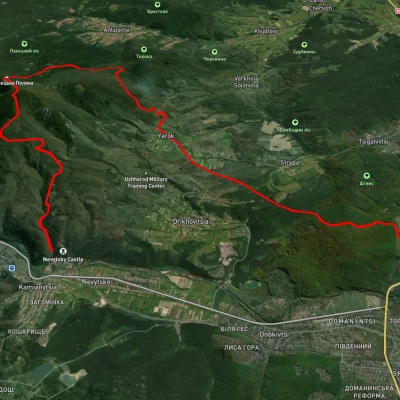
We suggest these hiking trails through or near Church of the Exaltation of the Holy Cross, Berehove: Carpathian Metro hiking route, Lukovo village, via Mount Buzhora to Svaliava, Pidhirne – Chorne Bahno – Kupinkuvate, Kamianytsia village – Antalovetska Poliana – Kamianytsia village, Kamianytsia village, via Antalovetska Poliana and Yarok village to Uzhhorod, Yarok village, via Antalovetska Poliana to Nevytske village


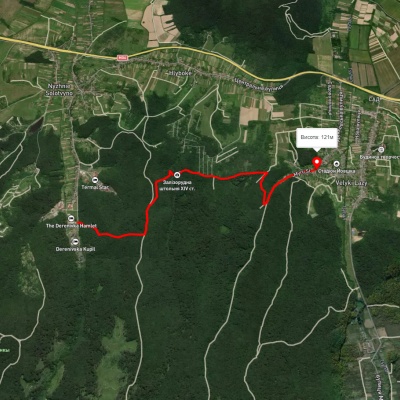
Carpathian Metro hiking route

Lukovo village, via Mount Buzhora to Svaliava
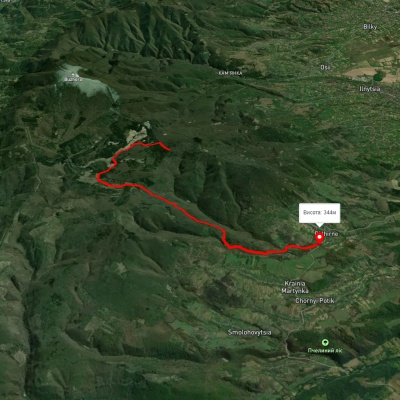
Pidhirne – Chorne Bahno – Kupinkuvate
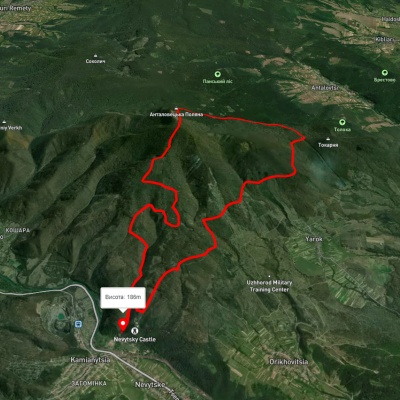
Kamianytsia village – Antalovetska Poliana – Kamianytsia village