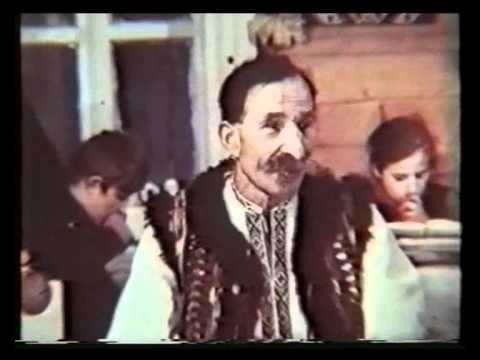
Richka
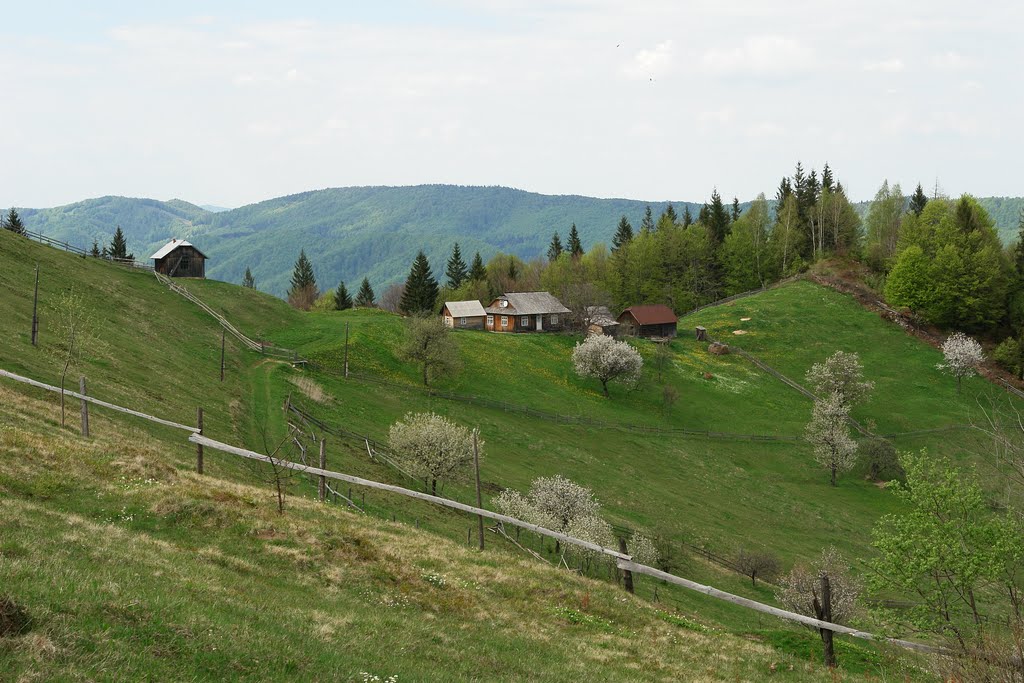
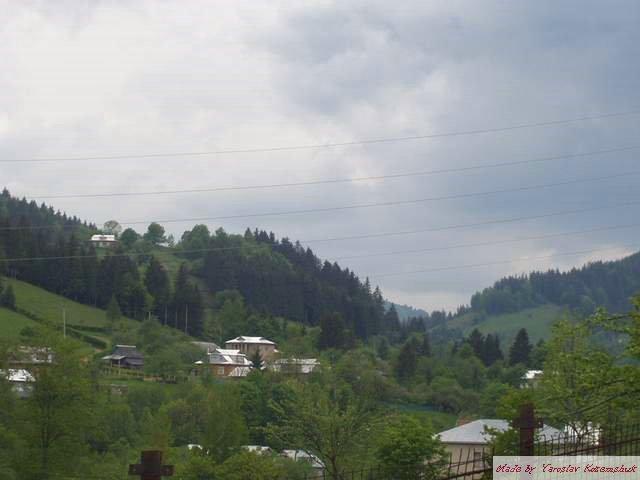
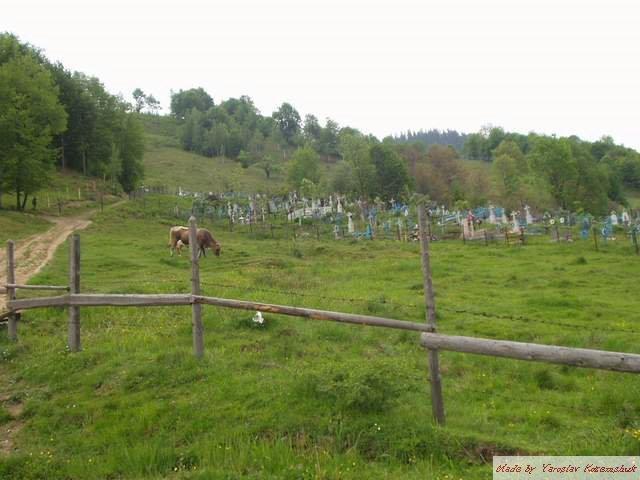
Rika is a village in Kosiv district, Ivano-Frankivsk region. It is an ancient center of Hutsul folk art. The village lies at 560 meters above sea level and is located on an area of 15 kilometers and stretches along the steep valley of the River stream (Prut basin), 15 km west of the city of Kosiv and 45 km from the Zabolotiv railway station. The first mention of the village of Richka as a settlement dates back to 1660. This settlement belongs to the Rika village council of the Kosiv district of Ivano-Frankivsk region. Territorially, the village of Richka borders on the villages of Sokolivka, Yavoriv, Sheshory, Brusturiv, and Shepit. Visually, the village boundaries are defined by the Brusnyi, Bukovets, and Kichera mountains. Forest tracts: Lysychnyk, Debeslivka, Mazivka, Ivankove. Peaks on the territory of the village: Bukovets (1059 m), Brusnyi (965 m), Kychera (942 m), Heha (806 m), Semenovo (747 m). There are outcrops of Neogene rocks on the Brusnyi and Semenovo ridges. There are 16 settlements in the village: Potaynyk, Prypir, Bodnarevo, Ryzhi, Bukovets, Pidbukovets, Drotskmany, Hrymaly, Marly, Serednie, Kichera, Bisi, Pidbrusnyi, Brusnyi, Tuni, Shevelivka.
As for the origin of the name of this settlement, according to legend, centuries-old forests were rustling on the territory of the village 400 years ago, and there were meadows on the tops. The owner of these meadows was a rich man named Mytskan. He decided to settle his son above the river. Over time, a village emerged, and houses were built along the river. That's how the name of the village of Richka appeared. The village of Richka is located on both sides of the river Richka. The similar name of the settlement and the main reservoir of the village indicates not that people lived here "without imagination", but that our ancestors sought harmony with nature, understood the importance of water as a life-giving source, so they reflected this in the names.
The first school in the village of Richka was built in 1875 and had one classroom. Until then, education was held in the house of Petro Onufriyovych Mytskan. In 1958, a seven-year school was opened in the center and three elementary schools in the villages of Kichera, Prypir, and Ryzhi. In 1976 a secondary school of I-III levels was opened. During the Polish rule, there was a reading room "Skala" in the village. In 1946 the village library was established. The talented youth of Rika village participated in the dance and drama clubs. The village youth staged plays: "Stolen Happiness," "Talentless," and "Satan in a Barrel."
The art of artistic woodworking is especially widespread. The unique colors of wood inlay can be traced back to the family dynasties of the village of Richka. Among the most famous craftsmen are Marko Mehedyniuk, Mykola Medvidchuk, the Yakibiuk brothers, the Toniuk, Kishchuk, Hrymaliuk, and Shatruk families. The range of products is mainly household items and wall decorations. Common techniques for decorating wood products included inlay with mother-of-pearl, non-ferrous metal, beads, and various types of wood.
Marko Mehedyniuk's work influenced the formation of the style features of the entire Rivne school. Several pieces of his rich heritage have come down to us. His works are kept in many museums and were once exhibited in Vienna, Prague, and Bucharest.
There are also masters of cooperage wooden utensils decorated with burnt floral and geometric ornaments (Ivan Hrymaliuk), wood carvers using inlay, intarsia, and chiseled bells (Marko Megedyniuk, Ilko Kishchuk, M. Medvidchuk, Mykola Pityliak, Yakiv Toniuk, Dmytro Toniuk, F. Yakybyuk, Ivan Abramovych, M. Bilyak, and others) and mosyazhnyky - engraving and inlay on metal (Ivan Tynkaliuk, V. Medvidchuk, Ilko Kishchuk).
Ornaments of artistic burning were used to decorate household items. An example of this is the work of the famous master Ivan Hrymaliuk. In the Hrymaliuk family, the art of cooperage combined with artistic burning became a hereditary profession. His works were very popular, exhibited in different cities of Ukraine and exported to many countries.
The village of Rika is also a center of artistic metalworking. Masters of mosaic art Marko Megedyniuk, Mykola Medvidchuk, Ivan Tynkaliuk, and Mykhailo Medvidchuk left a significant artistic heritage here. The range of their products includes buckles, brooches, buttons, pendants, stationery, scales, hatchets, and decorative metals used to decorate leather goods.
Natives of the village of Richka, such as T. Megedyniuk, Stepan and Ivan Piteliak, Mykola Medvidchuk, and Ilko Kishchuk, contributed to the development of the art of leatherworking in the Hutsul region.
In the village of Rika, they also make artistic products of cheese toys (A. Hrepyniak), flutes, and clothing - caps, stocks, and belts. The craftsmen of Rika once united in two workshops of the Hutsulshchyna Production and Art Association in Kosiv. Nowadays, most of the craftsmen of Riky have the title of master of folk art and are members of professional art unions.
There is a museum of Hutsul art in the village.
The Church of St. Basil the Great and the bell tower of 1896. The church is wooden, with oil paintings of the 19th century preserved on its walls. The bell tower is brick, plastered, with five arched openings for bells. It belongs to the OCU. The rector is Archpriest Volodymyr Levytskyi. The church in Rika is a typical example of a building of the Hutsul school of folk wooden architecture.
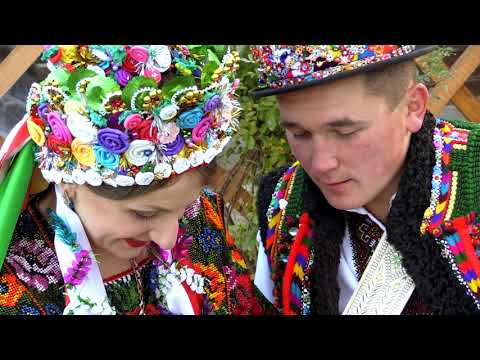
The village of Richka is indeed worthy of praise: the majority of the population has found themselves in artistic production, having inherited it from their ancestors. The village makes cheese toys, flutes, and traditional Hutsul clothing. The residents of Rika are hospitable hosts who are ready to take in a tourist for the night. By the way, the village is located 18 kilometers away from the village of Kryvorivni, which is also rich in natural scenery.
Traveling
As for the natural conditions, the village of Richka is famous for its recreational opportunities, as it is located in a beautiful mountainous area. You can go for many walks from the village. For example, the road to the valley of the River stretches for about three kilometers. Here, the traveler can see a magnificent pass between Stara Hora and Semenova, and even further on, beautiful streams flow, which once had mills and tartars. This pass continues along the hills of Mount Bukovets. Then you can continue to the River Bukovets (1060 m). This distance is approximately 3.5 kilometers and takes two hours to cover. The road here passes by the church, where it crosses to the other side of the river and you can swim to Mount Zvar.
Then you can continue walking to Mount Brusna (965 m). This road stretches for about 4.5 kilometers and takes two and a half hours to cover.
Chorny Grun is the highest mountain in the Igrecki Ridge, which rises 1382 meters above sea level. This road is ten and a half kilometers long and can be covered in 5 hours. It leads through River Bukovets with access to the village of Snidavka. And then it goes through the Chorhovatyi stream to the pass between Ternyshora and Mlaky, which are located at the mouth of the Chorhovatyi and Bezulka rivers. And from this pass, through Mlaki, it goes to the frame of the Igretsky Ridge and through this frame it passes to the Black Grun.
A walk to Shendrivka Mountain (1377 m) is also interesting. It is located in the Igretsky Ridge, and it takes about five hours to cover a distance of eleven kilometers. Further interesting walks can be made to the village of Sheshory. This road is approximately eleven kilometers long. It leads to the village of Sheshory through Brusnyi.
A trip to the village of Brustur is also very interesting. This road is five kilometers long and can be covered in two hours. There are three different roads to get here: one of them leads through Serednyi, the other through Nyzhnye Pole, and the third through Hyprovata. It's a good idea to take a walk from here to Yavoriv, which is not far away - only five kilometers and can be easily covered in one hour. This road passes through the pass between Voronezh and Borsuchne and leads to the church in Yavoriv. A slightly longer walk can be taken to the village of Kryvorivni, which is about 18 kilometers away and will take at least 7 hours to cover.
It's also not a short distance to Verkhovyna, but the road is pleasant and rich in natural scenery. This road stretches for 23 kilometers and can be covered in eight hours. It passes through Shandrivka, then goes to Bukovets, and even further to Bila Kobyla. And from there it converges through Pryslup, near Vinnytsia, to Iltsi Horishni. This walk is also rich in the fact that it gives you the opportunity to recognize the spires of the Hordievsky group.
The majority of the population of the village of Rychky is engaged in artistic crafts. It is hard to find a family in the village that does not carve or burn wood. There is a museum here where you can get information (and see his works) about the most famous carver of the past, Marko Megedyniuk (1842-1912), who was the first in Hutsul region to use bead inlay on wood. The museum also has works by other carvers: F. Yakibiak (1877-1959), Y. Toniuk (1903-1957), V. Bilak, the Kishchuk brothers - Ivan, Mykola, and Vasyl - and many others. The village has a carving branch of the Kosiv Industrial and Artistic Association "Hutsulshchyna".
Ivan Hrymaliuk, a master of artistic burning, lives in Rika. Ivan Hrymaliuk's father was a cooper, and since childhood Ivan helped his father decorate wooden utensils, such as konovky, harkyky, milk jugs, salt shakers, etc. This burning is done with the help of pysanky-iron samples that are heated on a fire and then applied to wood, on which the burned element of the pattern remains. Iron used to be scarce, so there were not enough pysanky.
Ivan Hrymaliuk made new tools and his products began to attract attention with patterns never seen before: "sun", "crescent", "leaves", "rouge", "half rouge", "curve". The tree came to life, the simple ornament reflecting the rich beauty of the Hutsul world. Thus, Ivan Hrymaliuk is the inventor of new tools for burning, and he has opened a new page in the Hutsul art of wood burning.
The religious community uses the church of St. Basil. The church holiday is January 14 (St. Basil the Great). The church is entirely wooden and is an example of the Hutsul school of folk wooden architecture; oil paintings of the XIX century have been preserved on its walls. The church bell tower is brick, plastered, with five arched openings for bells.
Monuments of history and culture: Vasylivska church of 1836; chapel built in 1848 in honor of the abolition of serfdom; monument to the villagers who died during World War II (1970).
Folk crafts of the village of Richka
The village of Richka, founded in 1694, is a colorful Hutsul village, where most of the folk crafts that have been practiced for many centuries in a row have been preserved to this day. In the Hutsul region, the profession was passed down from father to son, and each one continued the family business, improving it. Of course, during the Soviet era, folk crafts were put under the rug, so to speak, but now they have been restored, because despite working on collective farms, the villagers continued to teach their children traditional Hutsul crafts.
The most famous craft in the village of Rika is, of course, carving, because it even has its own carving school. But nowadays, carving is an art, while earlier it was a means of feeding their families for the village craftsmen. That's why they tried to make their products more beautiful so that they would be better bought. Nowadays, the Richkivska school is famous for its craftsmen who came from famous dynasties of carvers. Their products are beautiful and elegant, with unique decorations and inlays.
There are also many craftsmen in the village who make wooden utensils. Nowadays, these are mostly wall decorations, but locals often buy such dishes for everyday use, especially shepherds who keep cheese in wooden plates. For tourists who come here, such dishes are very interesting as souvenirs, because the village craftsmen use artistic burning to decorate wooden dishes. Such dishes are extremely beautiful and environmentally friendly.
Another craft that was widespread in the village and is still widespread today is artistic metal processing. The masters of this craft make all kinds of small jewelry, such as buttons, belt buckles, stationery, and much more. Such products are usually used to decorate wooden and leather goods. Such decorations make them complete, reliable and beautiful.
There are many other craftsmen in the village, but their products are not so well known on the souvenir market. They work for their fellow villagers and for the residents of the surrounding villages. But tourists who come here are happy to buy their products as souvenirs because they are of high quality and beautiful. The village is now experiencing a revival of its folk crafts. People are returning to their usual professions, which their ancestors have been doing for centuries. If you are spending your vacation in the Carpathians, you should visit the village of Richka to see the picturesque nature and beautiful products of folk artists.
The village of Richka is very interesting because here you can find houses that are more than a hundred years old. But it's not a house museum, people still live in these houses. Of course, young people build houses using the latest technologies, but older people are happy with what they have. That's why the village resembles a museum, and everyone who comes here for the first time can't believe that there are still such houses. There is also a chapel in the village of Richka, which was built in 1848 in honor of the abolition of serfdom. It was a very significant event for the peasants because they finally got their freedom. In addition to the chapel, the village has St. Basil's Church, which was built in 1836 and is also a cultural monument of the Kosiv district.
There are also many masters of folk art in the village of Richka, because after the collapse of the USSR, Hutsulshchyna is probably the place where all folk crafts were really revived, and the culture here has remained intact despite the propaganda of the Soviet government. That's why you can buy the products of craftsmen directly from their workshops, and be sure that it is really a work of art and not a cheap fake.
The village of Richka is a great place to spend your vacation in the Carpathians. There are friendly hosts, picturesque nature. This is really a place where you can relax and also be culturally and aesthetically enriched.
History and interesting facts of the village of Richka
Sometimes there are interesting coincidences and wordplay, when phrases, although true, can be a little funny. The village of Richka has its own similar phrase when talking about the geographical location of the village. The village of Richka is located on the bank of the river Richka, but this is not a joke, but the geographical location of the village. But do not think that the first settlers who settled here had too little imagination, it's just that since ancient times, local people have always sought to live in harmony with nature.
The village of Richka was founded in 1694. A wealthy lord who owned these picturesque places decided to settle his son here, and his peasants came with him and also built their own houses along the river. Gradually, the village began to grow, and because in the beginning all the houses were built around the river Rika, the village was also called Rika, because the houses followed the riverbed, repeating its bends.
Despite the peaceful life, the events that took place in the surrounding villages did not bypass the village of Rika either. The villagers supported the Oprishka movement, and later, during the Second World War, they supported the UPA soldiers who stood up to defend these lands. The terror of the NKVD did not escape the village, and dozens of villagers were executed and repressed. Because of even the slightest manifestation of patriotism, a man could have changed these beautiful lands into the taiga in Siberia. After all, the Soviet government wanted to eradicate patriotism and turn the entire population of the great empire into one gray mass that would not even recognize God but obey only the great leader.
In the village of Rika, folk art was very well developed, and when the USSR collapsed, such folk crafts as artistic woodworking began to revive here. The love of art and the secrets of the profession are passed down from grandfather to grandson in the village, so folk art simply reappeared in the world, because the masters have always lived here. Everyday objects and wall decorations made by local craftsmen are pleasing to the eye with their balance and completeness. There are no unnecessary decorations on these products, as in some schools of carving, and they are not too simple, the masters of the village of Rika have a special sense of completeness and the ability to make a perfect product.
In addition, the village has a fairly well-developed infrastructure for green tourism, so you can have a great vacation in the Carpathians. The village of Richka is always happy to welcome guests, because hospitality, understanding and mutual assistance are the folk customs of the village of Richka. Here, people are always happy to welcome guests, and guests always return home satisfied.
Rika School of Artistic Woodworking
One of the famous centers of folk art in the Hutsul region is the picturesque village of Richka. The most common types of folk art among the craftsmen of Rika were artistic processing of wood, metal, leather, horn and weaving. The secrets of the craftsmanship of the River craftsmen were passed down from generation to generation, which led to the creation of the peculiarity of the handwriting of certain masters, and later the whole dynasties of the Megedyniuks, Hrymaliuks, Kishchuks, Toniuks, and Shatruks.
Marko Mehedyniuk (1842-1912) was the founder of the Rivne school of woodcarving. The master's assortment of products included hatchets, crosses, plates, trinities, sticks, etc. One of his most famous works was a plum cross made for the Austrian Emperor Franz Joseph. This cross is now in the emperor's private chapel. M. Megedyniuk's works were repeatedly exhibited at various exhibitions, namely
- at the agricultural and industrial exhibition in Krakow, he was awarded a bronze medal for his cymbals decorated with patsyorky and copper wire;
- at the Kolomyia exhibition in 1912. M. Megedyniuk received a gold medal for his carvings. Also, his works were exhibited at the "Exhibition of Home Crafts" in Kolomyia.
The family of Yakiv Toniuk (1903-1958) made a significant contribution to the development of artistic woodworking. He started making woodworking products at the age of 19. Together with his wife Mariia Ivanivna (1906-2005), Yakiv Toniuk made counters, cigarette holders, frames, aubergines, etc. He passed his skills and experience to his son V. Toniuk (1928), who improved the technological methods of manufacturing products and compositional schemes of decor. In his  products, V.Y. Tonyuk combined elements of carving and inlay. The assortment of his products includes: counters, frames, aubergines, plates, kolaches, wine sets, chessboards, as well as crosses, paternities and kyotas. V.Y. Toniuk's works were exhibited at many exhibitions and are kept in private collections and funds of museums in Kosiv, Kolomyia, Ivano-Frankivsk, Lviv, Ternopil and Kyiv. V. Toniuk has been a member of the Union of Artists of Ukraine since 1962, Honored Master of Folk Art, awarded the Order of the Badge of Honor (1986); bronze medal of VDNKh in Kyiv (1980). Kyiv (1980); bronze medal of VDNKh, Moscow (1987). Moscow (1987). The carving traditions of the Toniuk family are continued by their son Yakiv (1959) and grandson Mykhailo (1987).
The Kishchuk family made an equally significant contribution to the development of artistic woodworking. Mykola Kishchuk was the most famous master of inlaying wooden products. He learned his craft from his older brother Ivan. M.Z. Kishchuk made aubergines, barrels, plates, caskets, frames, sugar bowls, candlesticks, vases, counters, albums, etc. M.Z. Kishchuk is a member of the Union of Artists of Ukraine. His works have been exhibited at various exhibitions in Ukraine and abroad, many of them are kept in private collections and museums, and his works can be found in the private collection of his family. M.Z. Kishchuk's nephews, M.O. Kishchuk and D.O. Kishchuk, continue the family traditions of the Rivne school of inlay.
Hnat Shatruk (1886-1946) made a significant contribution to the development of the constructive aspects of artistic woodwork. He made boxes, frames, chests, furniture, and various household items. He passed on his technological secrets and skills to his children, namely: V. Shatruk (1910-1984), M. Shatruk (1912-2000), P. Shatruk (1921-1977), M. Shatruk (1915-1997), M. Shatruk (1925-1997), and L. Shatruk (1928). In addition to making household items, H.V. Shatruk and his sons Mykola, Mykhailo, and Lukian were engaged in the construction of Hutsul houses. The most famous representatives of the family are M. Shatruk and L. Shatruk. The peculiarity of their work was the production of composite wooden products, in particular, six- and octagonal boxes, Easter baskets, anniversary cups, albums, candlesticks, paternoster, crosses, flowerpots, and frames, which were decorated with inlay of various types of wood, mother-of-pearl, beads, and metal wire.
Shatruk's works were exhibited at many all-Ukrainian exhibitions and are kept in many private collections in Ukraine, France, the USA, and Canada. For his significant contribution to the development of culture, L.G. Shatruk was awarded bronze medals and numerous diplomas.
Today, Mykhailo Shatruk's grandson continues the family traditions of artistic woodworking.
Hrymalyuk I.Y. is an Honored Master of Folk Art and a participant in numerous all-Union, regional and international exhibitions: USA, Canada, Bulgaria, Poland, Great Britain. His works are kept in many museums in Ukraine, Russia, Belarus, and Estonia.
The origin of the Rivne school of cooperage is associated with the Hrymaliuk family. Ivan Hrymaliuk (1904-1989) took over the craft from his father, and from the age of 14 he worked independently. He made decorative utensils (konovky, garchyky, berbenytsi, barrels, chamfers, horns, salt shakers, cezbry, milkers, baskets, twins, paskivtsi, spooners, counters, buckets, butter churns, scoops, captives, vases), and souvenirs. I. Hrymaliuk became most famous as a master of artistic burning, which he used to decorate Bodnar products. Today, his grandson Ivan continues the cooper's traditions.
Nowadays, the museum-workshop of the Honored Master of Folk Art of Ukraine Ivan Hrymaliuk is open.


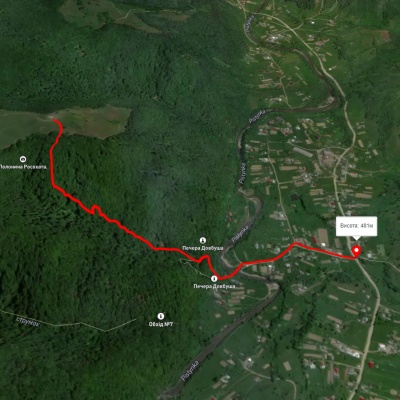
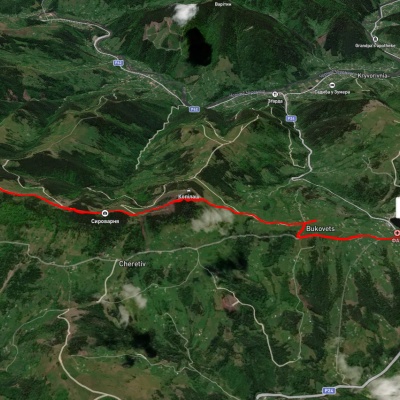
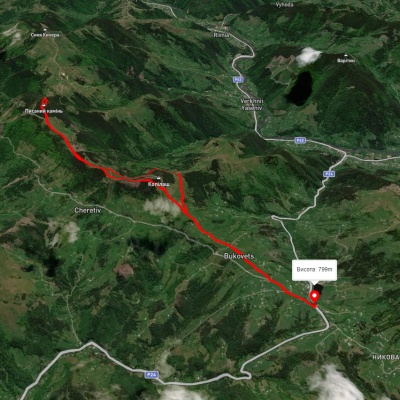
Which hiking trails pass through or near Richka?
We suggest these hiking trails through or near Richka: Sheshory – Rosokhata, Pysanyi Kamin – Bukovets village, Bukovets village – Pysanyi Kamin – Bukovets village, Kosmach village, via Mount Rotylo, Mount Hrehit and Mount Bila Kobyla to Bukovets village, To Dovbush Chambers, Opryshky Road