Sviatoyursky Monastery, Chervonohrad
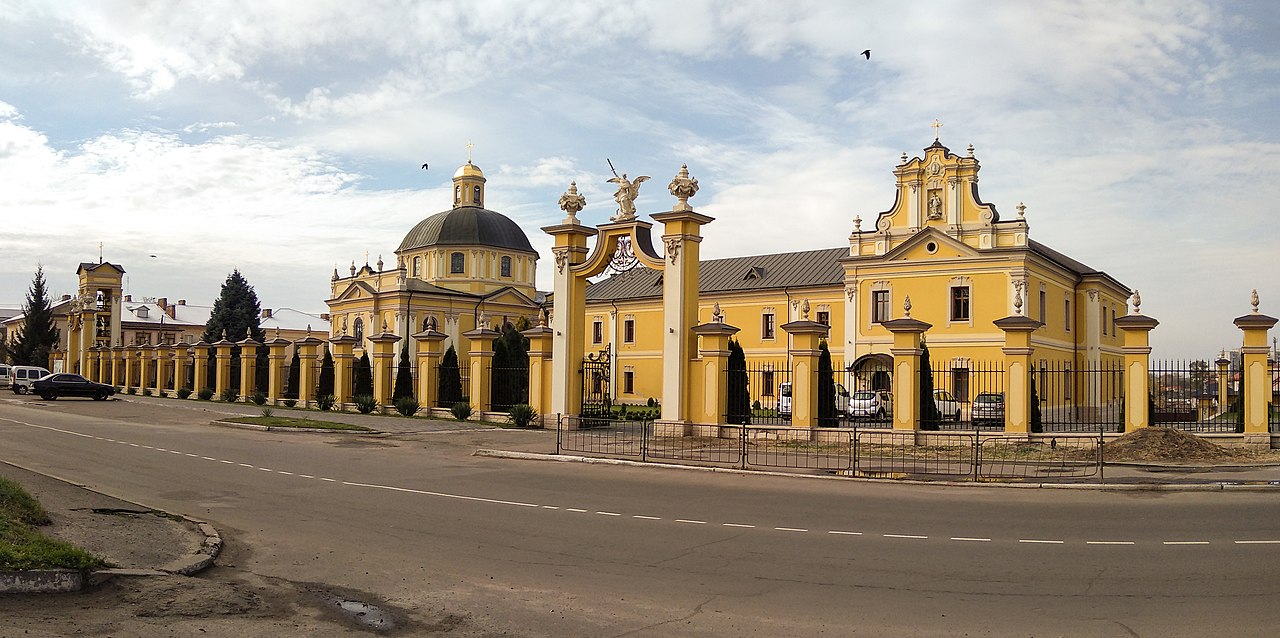
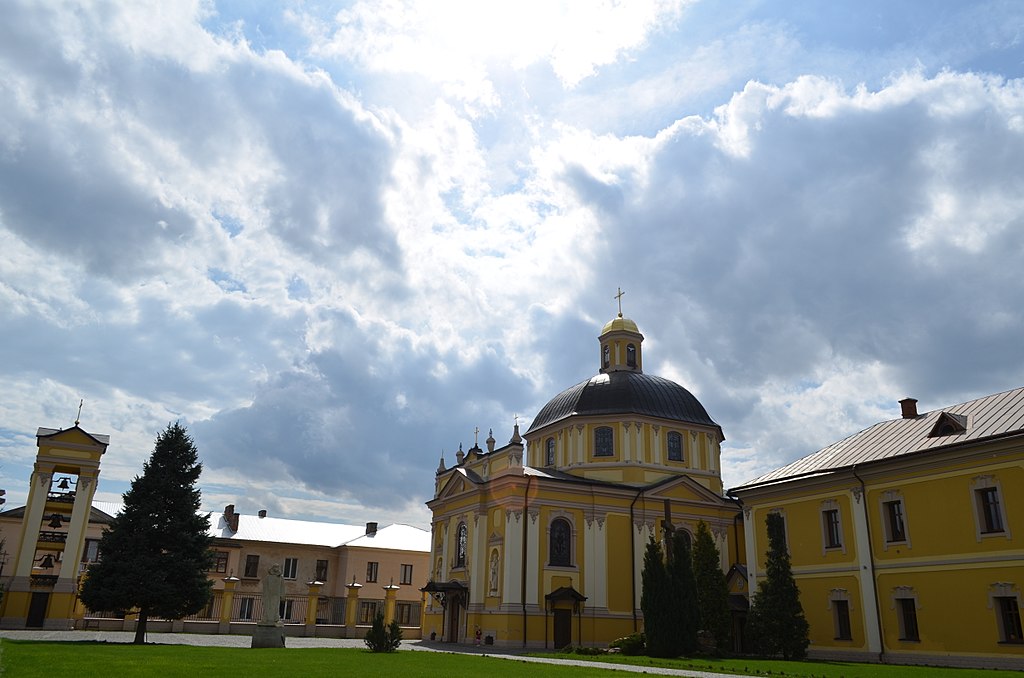
TheSt. George's Monastery of the Basilians in Krytynopol (now Chervonohrad) is a monastery of the Order of St. Basil the Great of the Ukrainian Greek Catholic Church in Chervonohrad, Lviv region. The patron saint of the monastery is St. George the Great Martyr. The monastery church houses a miraculous icon of the Blessed Virgin Mary called the Christinopil Icon. The monastery church of St. George and the cells have the status of architectural monuments of national importance in Ukraine, with protection number 1335.
At the beginning of the eighteenth century, the Ukrainian community of Chervonohrad (then Krytynopil) was relatively small, and for its spiritual needs it had only one small wooden church, which was in disrepair and eventually burned down in a fire. In its place, the then ruler of Krytynopol, Franciszek Salesius Potocki, built a new brick church, which was small, had no dome, and instead of an iconostasis, there were three altars-a large one and two side altars in honor of St. Nicholas and St. Josaphat.
The pastor of the church at that time was Fr. Ilya Bilyansky (or Bulyansky), who performed his duties in an extremely careless and unsatisfactory manner, and also demanded from his parishioners more money for church services than he was entitled to, in particular, once at Easter he demanded a quarter of the Easter cakes he had consecrated. Complaints against the priest reached Franciszek Potocki, who excommunicated him from the parish in 1762. Potocki planned to establish a house for missionaries of the Order of St. Basil the Great in Krytynopol, and in the same year he asked Maximilian Ryl, Bishop of Belz and Holm, to transfer the administration of the parish to the Basilians. On March 4, 1763, the bishop granted permission, in July of the same year the project of the monastery was approved by Fr. Ipatii Bilynskyi of Pochayiv, and on September 6, Franciszek Potocki signed the foundation charter of the new monastery. At the request of Archimandrite Josaphat Vysotskyi of Zhovkva, Potocki added the Volsvynskyi and Horodyshchenskyi monasteries to the newly established monastery in Krytynopol. On December 25, 1764, the abbot of the Volsvynsk monastery, Father Theodosius Hryhorovych, arrived in Krytynopol with four Basilian monks-they became the first residents of St. George's Monastery, and Father Theodosius became its first abbot.
The first buildings of the monastery, which were located near the old church of St. George, were wooden; later they were dismantled and the building material was used to construct new stone structures. Interestingly, the monastery chronicle of 1888 states that during the next repair work, a wooden beam with an inscription carved on it was found in the refectory wall: "The Lord bless this house and those who live in it - This temple was created on May 26, the 26th day of the year of God A.D. 1713." According to Oksana Yasynetska, a researcher of the history of Krytynopol, this may be evidence that the Basilians, who arrived in the city only at the end of 1764, may not have been the first monks to live on this site.
On June 1, 1768, there was a fire that damaged the church and wooden monastery buildings. Franciszek Potocki decided to build a new, larger church and monastery for Basilian monks on the site of the old St. George's Church. Potocki donated 20,000 zlotys for the construction, and Archimandrite Josaphat Wysocki donated the same amount. The name of the author of the monastery's project is unknown: the monastery chronicle mentions only the fact that there were three projects, two of which were authored by an unknown French architect, probably the one whom Franciszek Potocki invited to Krytynopol in 1770 to inspect the site for the future monastery. According to one version, it could have been Pierre Rico de Tirregelli, who designed the palace in Christynopol, or the Lviv architect Jean Dudefil. The author of the third project could be Matvii Poleiovskyi or Ihnatii Fesinger.
The cornerstone of the new church was laid on October 15, 1771. The stone contained a recess for a bottle with a note testifying to the beginning of construction and, according to the tradition of the time, coins of all denominations available at the time. On the sides of the stone were painted the four Evangelists, the coats of arms of the Basilian Order and the Potocki family, and an inscription in Latin: "In the year of our Lord 1771, on September 4, old style, the cornerstone was happily laid on the church of the OCWC."
The construction work was supervised by Czech Johann Kasper Zelner (Ivan Selner), assisted by his son Joseph. To speed up the construction, the monks built a brickyard and also used building materials from an old dismantled church. In the summer of 1772, they began to build the walls of the church, because on July 3, another bottle with parchment, similar to the one in the cornerstone, was walled into the wall behind the altar, and the place where the bottle was placed was marked with a brick with a cross on it. In the same year, 1772, the monastery cells, which were to be located on the north side of the church, were solemnly laid, and on October 20, construction work began. Interestingly, the new church had a non-standard layout with a large altar facing west, which contradicted the canons of the time, but Franciszek Potocki demanded that the church facade face the square. Another feature of the new monastery was its construction in several stages: the monks inhabited the new cells gradually, as they were built.
Almost simultaneously with the beginning of the construction of the monastery premises, on October 22, Franciszek Salesius Potocki, who had been seriously ill lately, died. His brain and entrails were buried in the church chapel. Shortly before his death, on October 16, Franciszek Potocki made a huge donation to the monastery - 6,000 ducats and 108,000 zlotys, wishing to beg for forgiveness of his sins. Franciszek's 20-year-old son Stanisław became the hereditary founder of the monastery. At first he had little interest in church affairs, but later he showed some interest in the construction and even made some adjustments to the church's decoration.
The chronicle lists July 1, 1774, as the official day of the church's completion, when the last stone on the lantern vault was consecrated, although roofing work continued after that. The day before, on June 30, a cross was placed on the dome. The bell for the church was made by Lviv craftsman Theodore Poliansky, craftsman Shimon Stringel installed a metal balustrade, and artist Sokolowski painted the dome. The construction of the monastery was officially completed in the fall of 1775.
The newly created Krystynopilskyi Monastery became an important religious center; for a long time it was the main, and eventually the only, monastery in the Nadbuzhanskyi region. A number of local village churches were subordinated to the monastery: the village of Novyi Dvir (since 1765), the village of Kliusiv (since 1776), and the village of Parkhach (since 1820). The Basilian monks were active in missionary and catechetical work. On June 23, 1773, they founded the religious brotherhood of St. Onufriy, which received the right to receive pardons from the Pope.
The monastery was famous for its relics. The most famous of these was the miraculous Christynopil Icon of the Mother of God, which was presented to the monastery in 1764 by its first owner, Stanisław Kostka Sadowski, a marshal in the court of Franciszek Potocki. In 1765 it was installed on the main altar of the church, and in 1777 it was decorated with a new silver casing decorated with gilding, pearls, gems, and Bohemian glass. Fr. Ignatius Binkowski made a copy of this icon, which he hid in the monastery archives, so it is not known for certain whether the icon currently kept in the monastery is an original or a copy. In addition to the miraculous icon, other relics were kept in the monastery: the relics of St. Onufriy, donated to the monastery by Franciszek Potocki, parts of the relics of St. Basil the Great, the holy martyr Josaphat Kuntsevych, the founder of the Basilian Order, the patron saint of the church, and a part of the Cross on which Jesus was crucified.
The monastery also had a large library, which was founded by Franciszek Salesius Potocki, who donated 500 zlotys to buy books. The basis of the library was made up of manuscripts from the monasteries of Volsvyn and Horodyshche. The pearls of the library were the 12th-century Horodyshche (or later Krystynopil) Apostle, the 12th-century Horodyshche or Buchach Gospel, and the 1484 Horodyshche monument. In addition to the riches of the library, the abbot of the monastery, Fr. Kornelii Sochynskyi, in 1766 started and kept a chronicle until his death called "The Chronicle of the Monastery of Krytynopil from the year 1766," which is now an invaluable source of historical information about the monastery, Krytynopil, and the Potocki family. Unfortunately, as of the beginning of the twenty-first century, most of the incunabula have been lost.
In the last third of the eighteenth century, probably in 1789, the monastery cells were expanded by adding a wing. In 1797, the monastery buildings were damaged by fire.
In 1794, a Polish school and a hospital were opened at the monastery, where the monks treated the poor free of charge.
At the beginning of the nineteenth century, with the gradual decline of Christynopol, St. George's Monastery also fell into decline, a process that coincided with the general crisis of the Basilian order. In 1882, the order was reformed, and in 1887, St. George's Monastery joined the reform. Missionary and catechetical activities were resumed, and a number of church societies were created, the largest of which was the brotherhood of the Apostleship of Prayer, or the Sweet Heart of the Sorrow, which was established in 1892 and attracted about 10,500 members over the next ten years. In the same year, 1892, the Congregation of the Sisters Servants of the Immaculate Virgin Mary was founded under the leadership of the monastery in Krytynopil, which became the first active women's congregation in the Ukrainian church. In 1910, a women's society of the Myrrh-Bearing Sisters was also founded at the monastery.
On February 15, 1885, the Basilians organized a public reading room for the townspeople from the Prosvita Society, which also hosted popular science lectures and a folk choir. In 1888, Basilian theological studies were resumed in the monastery, which, with a short interruption during the First World War, lasted until 1945. In 1911, the Prosvita reading room moved to a building restored by the Basilians opposite the Bernardine monastery; in addition to the reading room, it housed a theater, a cash desk, and a small shop.
With the revival of the St. George's Monastery, the monastery buildings were also restored. Thus, in 1888, the cells were expanded again. In the last third of the nineteenth century, the Church of St. George was also restored: in 1874, the artist Feliks Zablotskyi from Krytynopol gilded the altar and painted the presbytery, in 1883 he re-arranged the side throne of St. Nicholas and made a new cross, and he also painted icons for the thrones. In 1893, a new iconostasis was installed in the church by the Jesuit monk Sahadyn, and the icons for the iconostasis were painted by the Lviv artist Karol Gaimrot.
In 1892, Andrei Sheptytsky took his monastic vows in the monastery of Czestochowa, and later taught theology at the Basilian studios at the monastery. In 1902, Pope Leo XIII granted St. George's the right to have holidays for all major feasts in honor of the Virgin Mary and for the feast of St. Onufriy, whose relics were kept in St. George's Church. In 1906, from November 14 to December 1, the first chapter of the Order of St. Basil the Great after its reform was held at the monastery, and on August 6-14, 1909, the second chapter was held.
On May 28, 1909, the image of the Holy Apostle Peter was transferred as a gift from the Basilian Fathers of the St. George's Monastery of Christynopil to the newly built Church of the Holy Apostles Peter and Paul in Sokal.
During the First World War, the Basilian monks of St. George's took care of the wounded, widows, and orphans.
During the Second World War, a German hospital operated in the monastery, so the Basilians asked the abbot of the neighboring Roman Catholic Bernardine monastery, Father Jerzy Biletsky, to provide the premises of the Church of the Holy Spirit for their services, and despite the difficult Ukrainian-Polish relations of the time, Father Biletsky did not refuse the Basilians.
After the Second World War, for some time Krystynopil was under the rule of the newly created Polish People's Republic. They tried to deploy police in the monastery, which at that time was home to nearly 20 monks, but the abbot refused, arguing that the monastery was protected by the Vatican's concordat with Poland, under which Poland undertook to respect the rights and property of the Greek Catholic Church on its state territory. In 1946, the Polish authorities nevertheless forced the Basilians to transfer part of the monastery buildings to the needs of the Polish army. That year, the Ukrainians of Krytynopol were forcibly deported to the Soviet Union. At that time, only three priests remained in the monastery-Father Volodymyr Kovalyk, Father Josaphat Romanyk, Father Arsen Kulybaba, and a monk named Yakint Pylyp-the rest left for the West in 1944. The parish of St. George's shrank to a few dozen people. In the same year, Father Kovalyk left for Poland, and in 1947 he was followed by Father Romanyk, Father Kulybaba, and Brother Philip, who had been evicted from the monastery, and who managed to take the icon of the Mother of God of Crystynopol, church utensils, and the monastery's large library. The monastery virtually ceased to exist.
In 1951, on the basis of a Soviet-Polish intergovernmental agreement, Krytynopil was transferred to the USSR. After the establishment of Soviet rule in the city, the monastery was liquidated, and the monastery premises were first used by the police, then by the school of mechanization and the main post office, and in 1980 a branch of the Lviv Museum of the History of Religion and Atheism was opened in the former church, and an art gallery was opened in the monastery cells. Although the monastery did not officially function, some Basilian priests, such as Marian Chornega, Damian Bohun, Markian Kohut, Ignatii Yantukh, and others, conducted religious activities underground.
In 1959, the central dome of the church was restored according to the design of architect Ihor Starosolskyi.
In November 1989, the church and some of the monastery's premises were returned to the Basilians, and the first liturgy was celebrated on the Feast of the Presentation of the Blessed Virgin Mary. In 1990, the monks were given the rest of the monastery buildings. Fr. Marian Chornega became the first abbot after coming out of the underground. In this monastery, Fr. Markian Kohut, a church writer, creator of numerous akathists, and longtime political prisoner, worked and created.
On April 7, 1994, the miraculous icon of the Mother of God of Krytynopil, which had previously been kept in Warsaw, returned to the monastery. In the same year, 1994, the monastery founded a theological lyceum for young men.
It operates under the parish of St. George:
- The Apostolate of Prayer (360 members), which actively participates in various prayers and meetings;
- "The Marian Wife and the Altar Wife;
- A catechetical Sunday school run by the Sisters of the Servants of the Immaculate Virgin Mary;
- Two church choirs.
In 2009, the parish hosted an international rosary pilgrimage with the participation of three bishops led by Kir Mykhailo Koltun. The 20th anniversary of the UGCC's emergence from the underground was also celebrated. On this occasion, commemorative certificates and medals were made and presented to those who fought for the legalization of the UGCC on the Arbat in Moscow in 1988 and for their heroic work in the underground.
Since 2020, Fr. Jeremiah Rybakov, OSBP, has been the abbot of the monastery. The monastery is home to 6 priests, 1 deacon and 2 brothers. The priests of the monastery serve, in addition to the local parish, also the parishes in the villages of Bendiuga and Mezhyrichchia.
The ensemble of the monastery combines features of late Baroque and classicism.
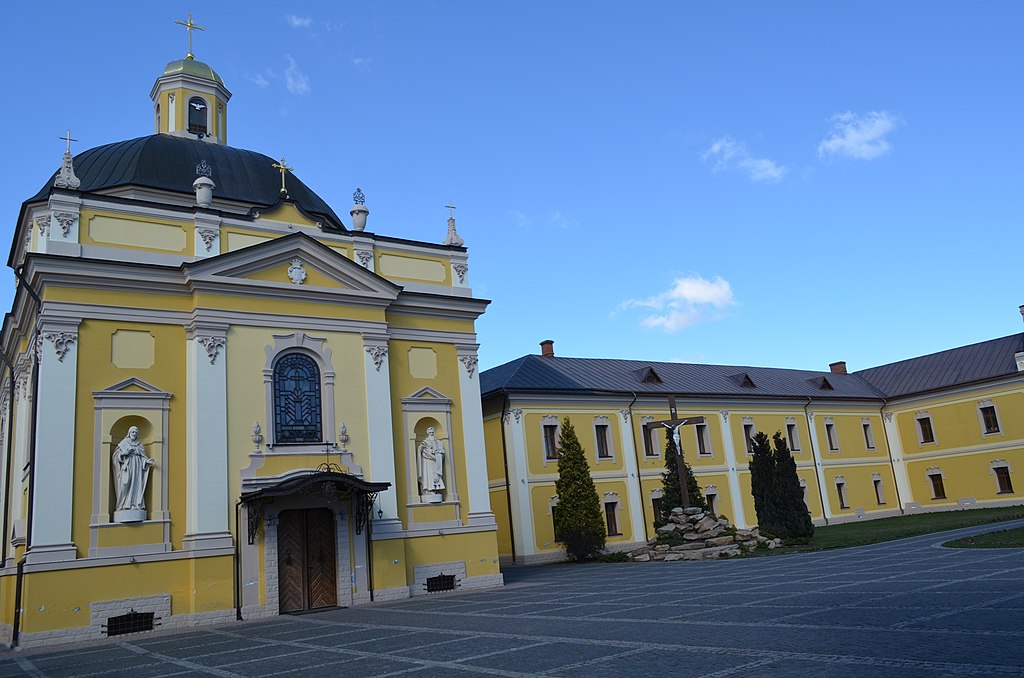
The Church of St. George is built of stone, rectangular in plan, oriented east-west, and consists of three volumes. The main volume is covered with an elliptical dome on a low octagonal drum with a crown, while the narthex and the eastern part are covered with a gable roof. The main façade is symmetrical, with the central axis accentuated by a risalit crowned with a triangular pediment and a portal. On both sides of the risalit are niches-exedra with statues of saints. The façade is crowned by an attic with decorative stone flowerpots. The walls of the church and the drum are divided by pilasters of the Tuscan order.
On the northeast side of the church is a two-story, brick, L-shaped cell building. The interior layout is of the corridor type. Only the northeastern façade has decorations in the form of flat blades and baroque window moldings, while the other façades are not decorated.