Romanian People's House, Chernivtsi
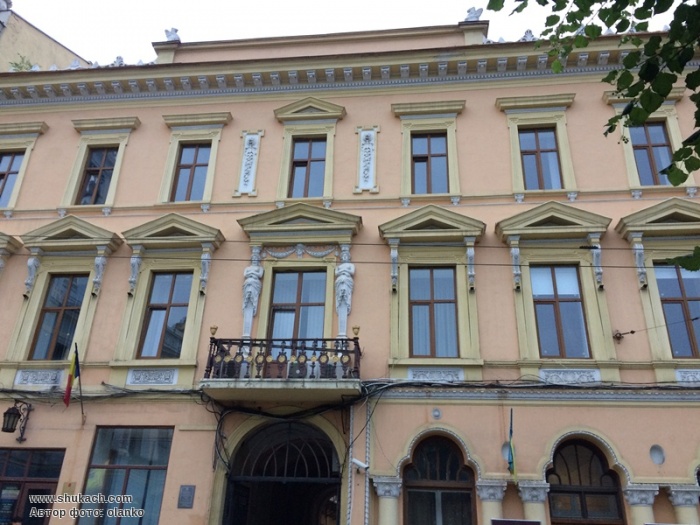
The Romanian People's House in Chernivtsi was a building that became the center of Romanian cultural and social life in Chernivtsi and Bukovyna from the late nineteenth century. The Romanian community of Bukovyna began to take care of its national and cultural life during the revolutionary events of 1848. Its leaders, among whom Eudoxius Gurmuzaki stood out, held a large national meeting in Chernivtsi on May 20, 1848, with the participation of representatives of all social strata, which adopted a memorandum to the Austrian emperor and the Vienna Parliament with a number of demands for ensuring their national and cultural development.
Soon after, they also realized the need to create a printed organ that would express the national interests and needs of Bukovinian Romanians. This task was taken over by brothers Gheorghe and Alexandru Gurmuzaki, who from October 1848 to September 1850 published the Romanian political, religious, and literary newspaper Bukovina, presenting materials in both Romanian and German. Throughout the entire period, from 1865 until 1944, the Society of Romanian Culture and Literature of Bukovyna was the engine of the movement for the national and cultural revival of Bukovinian Romanians. It published newspapers, calendars, brochures, organized cultural events, theater performances, participated in the opening of Romanian schools, and provided scholarships and places in the boarding school it owned for students from poor families.
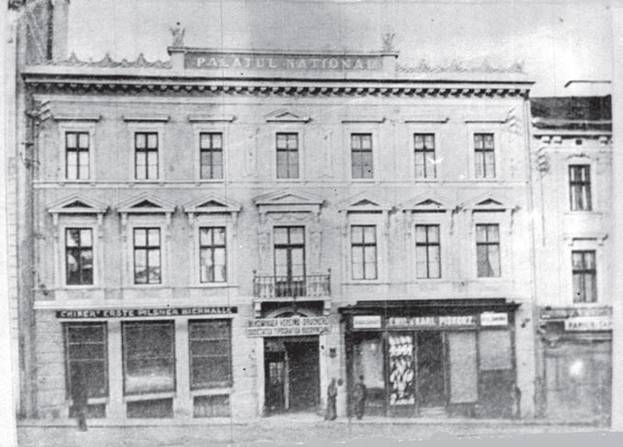
The Romanian People's House was closely connected with the activities of the Society of Romanian Culture and Literature in Bukovyna, which was actually its founder. In 1897, this society bought the well-known Weiss Hotel on Ringplatz Square (now Central Square). All the cultural and charitable societies of the Romanian community gradually moved into this building.
Well-known public and political figures of the Society of Romanian Culture and Literature in Bukovyna, such as D. Bejan, S. Pushkariu, A. and G. Gurmuzaki, and I. Nistor contributed to the revival and development of Romanian culture in Bukovyna and the founding of other societies such as Junimia, Academy of Orthodoxy, Dacia, Bukovyna, Moldova, Society of Romanian Women, Armonia, Arboroasa, and Academy of Orthodoxy, Along with the Society of Romanian Culture and Literature of Bukovina, academic societies founded by Romanian students of the Franz Josef University in Chernivtsi after its opening in 1875 were particularly prominent in the field of national and cultural education of the masses.
From the very beginning of the existence of this higher education institution, the Department of Romanian Language and Literature was established, with Ion G. Sbiera as its first head. In 1912, the university also opened the Department of History of Southwestern Europe, where Professor Ion Nistor taught. In 1864, the first tour of the Romanian theater company (Fani Tardini) took place in Chernivtsi. After the establishment of the Society of Romanian Culture and Literature, performances by Romanian theater groups in Bukovyna became regular. In 1925, the Romanian National Theater was established in Chernivtsi, featuring famous actors. To provide the theater with the necessary personnel, the Conservatory of Music and Drama was opened in 1924 in the capital of Bukovyna.
After the collapse of Austria-Hungary in 1918 and Bukovyna's incorporation into Romania, the architecture of the time attempted to apply the architectural styles characteristic of royal Romania as widely as possible. At this time, the question arose of a new building for the influential Romanian Society of Culture and Literature, as the premises of the old Weiss Hotel, where it had been located since the late nineteenth century, did not meet the requirements of the times.
The administration of Bukovyna, represented by Minister Delegate Iancu Flondor, allocated the society a plot of land on the corner of Alexandri Square (formerly Elezaveta Square, now Teatralna Street) and General Zadik Street (now Vatutina Street). Officially, the right to this plot was granted only in 1921, after the society handed over its old premises to the school inspector of Bukovyna. Due to the very favorable and prestigious location of the construction site, there were many people willing to buy it. One of them was a university. For almost 15 years, the ownership of the site passed from the Society of Romanian Culture and Literature to the university and vice versa. The final point in this conflict was put to rest by the Chernivtsi Court of Appeal, which, in its decision of April 27, 1935, recognized the Society as the sole and legal owner of the land plot.
As early as 1921, the Society commissioned a design for the building from the famous architect Duil Marc. And if not for the endless litigation, on which the Society spent almost two million lei, the city would have a much better and more monumental building today, the plan of which is preserved in the Society's report for 1922. In 1935, it became apparent that the society was unable to build not only a building based on Marcu's luxurious design, but also a much simpler one. The Metropolitanate of Bukovyna and the Orthodox Religious Fund, the richest institutions in the region, offered to help. A contract for the construction and use of the building was signed between Metropolitan Vissarion Puyu of Bukovyna and the head of the Foundation, Hryhorii Nandrysh. It stated that the Society would provide a land plot, and the Orthodox Religious Foundation would allocate the necessary amount of money for the construction. The two parties agreed to build a Palace of National Culture in Chernivtsi, which would serve both the Society and the Religious Fund, according to the shares they would own. Construction was to begin in the spring of 1937 and be completed on November 11, 1938.
The tender for the construction was won by a well-known construction firm from Bucharest, the House of Tiberius Jeremiah. The construction site was consecrated on July 4, 1937, and the cornerstone of the new building was laid on October 26 of the same year. It should be noted that the Palace was not built as planned in the contract. According to the new design by Horii Kriange, the new building was to consist of a central block located on Oleksandri Square (now Teatralna Square), three blocks on General Zadik Street (now Vatutina Street), and one block on Universytetska Street. Together, they were supposed to form a continuous complex of buildings. However, due to lack of funds, only the central block was built, which was divided into two parts - commercial and cultural.
The premises are registered to two owners:
- The cultural part, namely the ground floor with a lobby and a concert hall, the first floor with a meeting room and a reading room, the second floor with offices, the third floor with a reading room and a library, and the fourth floor with the library's storage, belonged to the Society.
- The commercial part belonged to the Orthodox Religious Foundation and consisted of the following premises: a shop and restaurant in the ground floor, and hotel rooms on the floors. Central heating equipment was located in the basement, and there was an observation terrace on the roof from which one could see the entire city.
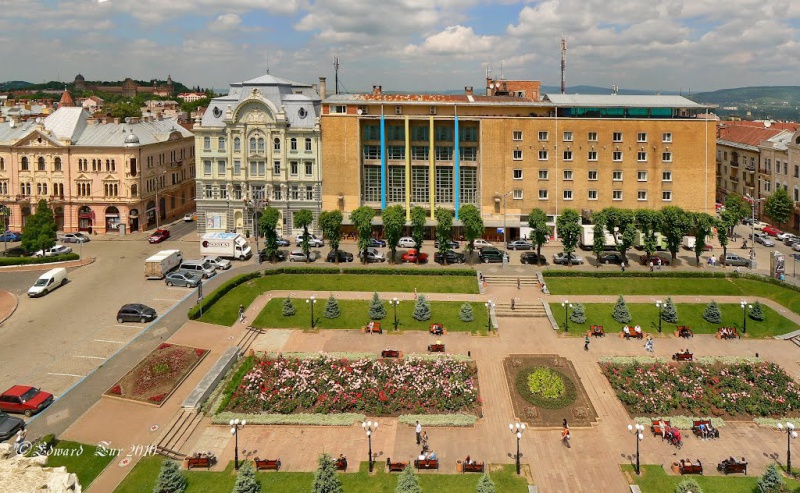
The palace was completed in early 1940, although the company moved in only in May, when all minor defects were completely corrected. Only an elevator remained to be installed. On June 28, 1940, Soviet troops entered Chernivtsi and the building was transferred to various institutions.
After the outbreak of war between Germany and the Soviet Union in 1941, Northern Bukovyna was again occupied by Romania. The Romanian People's House continued its prewar activities. In November 1942, King Mihai, his mother Queen Elena, and Deputy Chairman of the Council of Ministers Mihai Antonescu visited the building. During the retreat of German troops to the west in 1944 and their short stay in Bukovyna, the commercial part of the new Romanian House building was occupied by the German command.
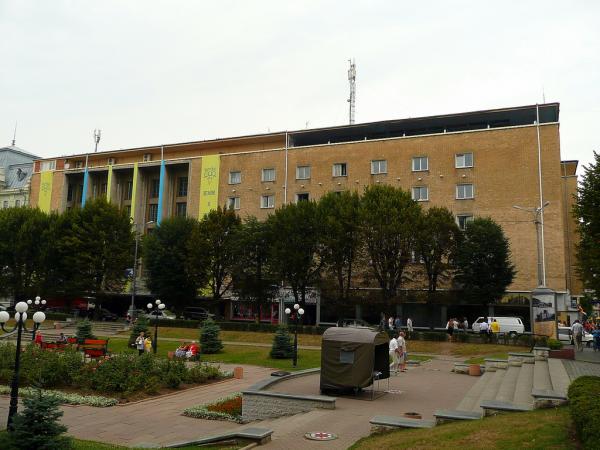
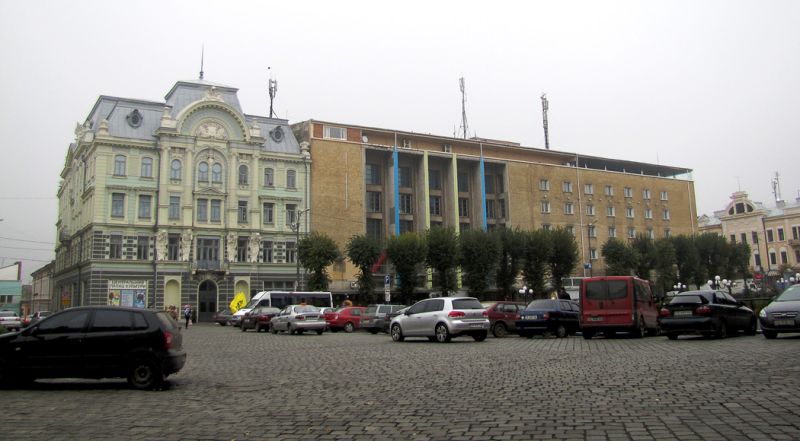
After the return of the Soviet Army in 1944 and until the proclamation of Ukraine's independence, the building housed the garrison Officers' House. After the declaration of Ukraine's independence in 1991, the premises of the Officers' House (Palatsul Kultural) were leased to various commercial structures. Most of the building that housed the Romanian House until 1940 (6 Central Square) belongs to the Chernivtsi Regional Court of Appeal, and the Romanian Society named after M. Eminescu is located on the ground floor.
Chernivtsi is the capital of Bukovyna. It is one of the most beautiful and pleasant Ukrainian cities. There is one of the most beautifulrailway stations in the country, theChurch of St. Paraskeva of Serbia, the Church of the Exaltation of the Cross, the ship house, the City Hall (every day at 12:00 a trumpeter plays the melody of "Marichka" from the tower), the Art Museum, then Kobylianska Street, the German Folk House, the Armenian Church and the Assumption Church (the oldest stone Ukrainian Greek Catholic Church in Chernivtsi), the Theater Square and the Kobylianska Theater. Kobylianska Theater Square, Jewish People's House, Chernivtsi University (included in the UNESCO World Heritage List), Turkish Square (Chernivtsi has been a part of Turkey, Modova, Romania, Austria-Hungary, the USSR, Rus, and Ukraine), and a large rover,cozy streets and cobblestones, the so-called Drunken Church, Nazariy Yaremchuk's house, then another house-ship, two houses with the same number (Olha Kobylianska lived here), the house where Volodymyr Ivasyuk lived, the pink church - the Cathedral of the Holy Spirit.
Chernivtsi sights
- St. Nicholas wooden church (from 1607, restored in 1954);
- Stone Church of St. George on the Bitterroot (1767 in the Baroque style);
- wooden Trinity Church in Muggles (one thousand seven hundred and seventy-four), moved in 1874 to Kłokuchka;
- wooden Assumption Church on Kaleczanka (1783);
- City Hall with a two-story, 45-meter-high Empire-style tower (1843-1847, architect A. Mykulych), now the City Council;
- Ukrainian Greek Catholic Church (1825-1830 in the Baroque style);
- Byzantine-style cathedral (1844-1864, architect Roll);
- Church of St. Paraskeva in the pseudo-Romanesque style, completed in 1662 (architect A. Pavlovsky);
- residence of Bukovyna metropolitans - since 1956 one of the buildings of Chernivtsi University);
- Armenian Gregorian Church (1869-1875, architect J. Hlavka);
- Chernivtsi University building (1874-1875);
- Jesuit church in the Neo-Gothic style (1893-1894);
- Railway station (1898-1903) in the Art Nouveau style;
- the City Theater (1904-1905, architects F. Fellner and G. Helmer) in the Viennese Baroque style with Art Nouveau elements (now the O. Kobylianska Music and Drama Theater), etc.
Location on the map
Comments
Places to stay nearby
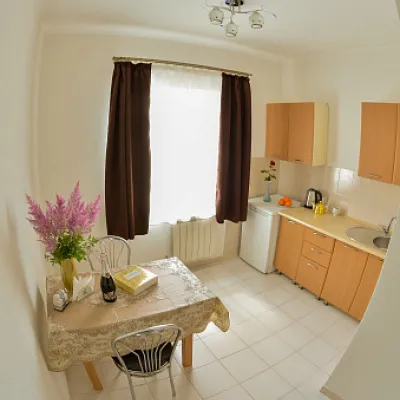 Hostel"Grand Hostel" Chernivtsi Prutska, 241.2 km from Romanian People's House, ChernivtsiParkingWi‑FiTransferNearby: Armenian Church 1.5 kmHouse-ship 900 m
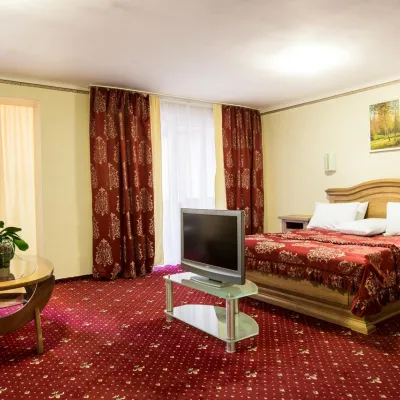 HotelHotel "Bukovyna" Chernivtsi ****1.8 km from Romanian People's House, ChernivtsiPoolSaunaSPANearby: Armenian Church 1.3 kmSoborna Square 1.4 km
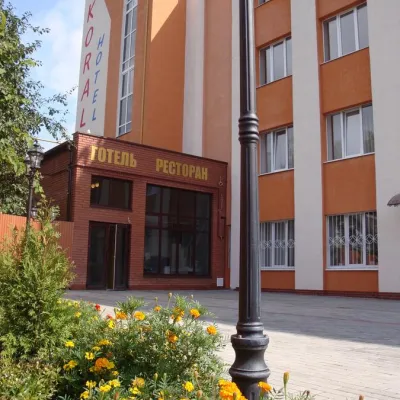 HotelHotel-Restaurant Complex "Koral" Chernivtsi3.3 km from Romanian People's House, ChernivtsiSaunaBBQParkingNearby: Armenian Church 2.8 kmSoborna Square 3.2 km
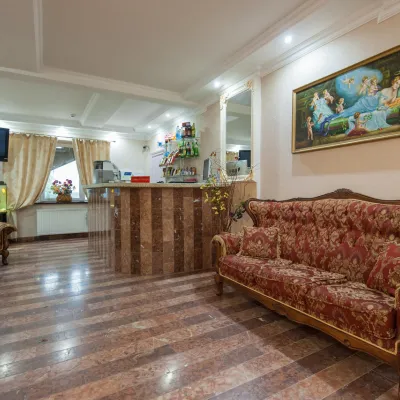 HotelHotel "LeoTon" Chernivtsi3.8 km from Romanian People's House, ChernivtsiParkingWi‑FiTransferNearby: Armenian Church 3.2 kmSoborna Square 3.4 km
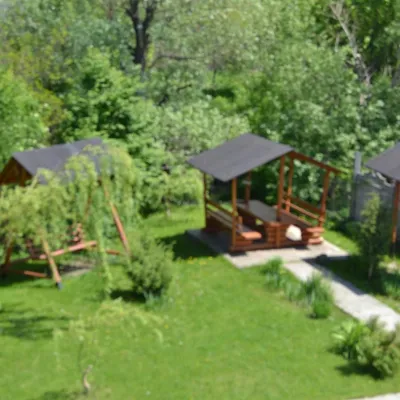 HotelHotel "Pride" Mykulychyn9.1 km from Romanian People's House, ChernivtsiHotel "Pride" is located in the village of Mykulychyn, 9 km from Chernivtsi and 41 km from the "Myhovo" resort.Nearby: St. John's Church 1000 mChurch of St. John of Dukla 5.4 km
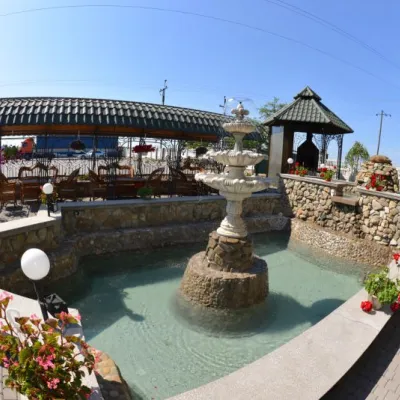 HotelHotel "Kolvik" Mamaivtsi12 km from Romanian People's House, ChernivtsiBBQKidsNearby: Assumption Church 2.2 kmChurch of St. John of Dukla 2.2 km
Nearby attractions
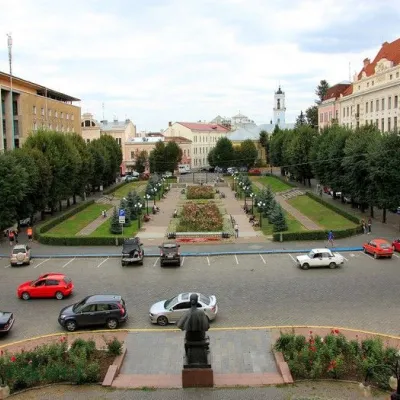 ArchitectureTheater Square in Chernivtsiunder 1 km from Romanian People's House, ChernivtsiOne of the favorite vacation spots for residents and visitors of Chernivtsi is undoubtedly Teatralna Square.
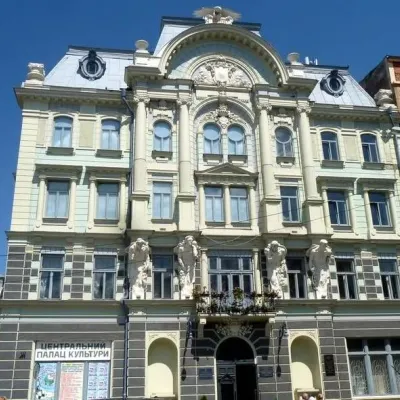 ArchitectureJewish People's House, Chernivtsiunder 1 km from Romanian People's House, ChernivtsiThe Jewish People's House in Chernivtsi is a building built in the early twentieth century by the Jewish religious community that became the center of Jewish cultural...
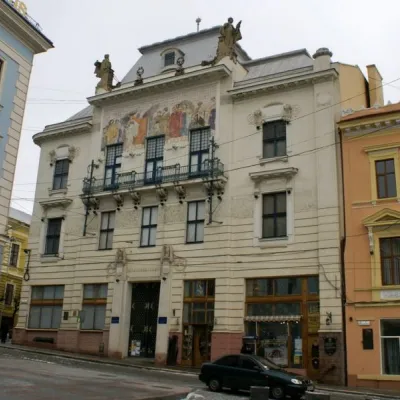 MuseumArt Museum, Chernivtsiunder 1 km from Romanian People's House, ChernivtsiOne of the best museums in Bukovyna today is the Chernivtsi Art Museum. Visiting it, you will be able to get acquainted with the art and folk art of the region,...