Church of the Nativity of the Blessed Virgin Mary, Nyzhnyi Verbizh
The Church of the Nativity of the Blessed Virgin Mary is a wooden church in the village of Nyzhnii Verbizh , Kolomyia district , Ivano-Frankivsk region, built in 1756-1808. It is an outstanding monument of architecture and monumental art. On June 21, 2013, at the 37th session of the UNESCO World Heritage Committee held in Cambodia, the Church of the Nativity of the Blessed Virgin Mary, along with other wooden churches in the Carpathian region, was included in the UNESCO World Heritage List. It was built at the expense of one of the local residents, H. Semeniuk, who, according to folk legend, wanted to pray for his sins in this way. The construction of the church took about 20 years.
The cruciform church is one of the recognized masterpieces of wooden architecture of the Hutsul region. The first tier of the temple is painted in dark red color with small splashes of white near the windows and side log cabins. An image of the Blessed Virgin Mary has been preserved above the main entrance. There are practically no windows in the church. A wide paved path leads to the main entrance to the church.
The temple organically complements the beauty of the surrounding landscape, while simultaneously giving it fabulousness and grandeur. In the 90s of the 20th century, the church building underwent a large-scale reconstruction. The temple has somewhat lost its original appearance, which is especially noticeable in its roof. During the reconstruction, the old shingle roof and domes were replaced with galvanized tin. Even after the work, the church has not lost its attractiveness and unique Western Ukrainian style.
Currently, the church is open to the public and awaits connoisseurs of outstanding architectural structures of ancient culture and history that has lasted for centuries.
The Church of the Nativity of the Blessed Virgin Mary is located in the western part of the village on a hillside. According to legend, the present-day Church of the Nativity of the Blessed Virgin Mary was built for opryshkivsky money by Hryhorii Melnyk, who lived for 114 years and was buried right next to the church.
"His Majesty, the Austrian Emperor Ferdinand," wrote the Gazeta Lwowska in 1812, "awarded Hryhorii Semeniuk with a gold medal for merit in connection with the construction of the church.
The epigraph on the grave reads:
"B + P / here rests G.B. / Hryhorii Semeniuk / Melnyk / benefactor and pro- / visor of this church / lived 114 years / and died in 1822." There is a donor inscription above the portal of the church, which also reads that "this church was built by the old co-vicar Hryhorii Semeniuk and other vicars in the year 1788 IAWI MCA MAI DIA 3."
The donor's inscription in front of the entrance names Hryhorii Semeniuk and "other pharmacists" and indicates two dates - 1788 and 1808 (IAWI). The first date is obviously the year of the church's planting, the second, with such a detailed specification, is probably the date of its final decoration and consecration.
Local ethnographers Mykhailo Lasiychuk and Ivan Ludchak believe that construction of the church began in 1756.
According to researcher Nadiia Babii, the Church of the Nativity of the Virgin Mary in the village of Nyzhnii Verbizh does not belong to the typological group of Hutsul wooden structures, but rather repeats the forms of sacred buildings of Podillia and Slobozhanshchyna. We will consider Babiy's arguments below.
An article in the Uriadovyi Kurier newspaper of June 23, 2009, reported that the Ministry of Culture and Tourism of Ukraine, together with the Polish Center for Research and Documentation of Historical Monuments, is working on the project "Sacred Architecture of the Borderlands," which involves a census of sites in both countries to include them in the UNESCO World Cultural Heritage List. Among the candidates are wooden churches in western Ukraine built in the Hutsul style. However, the Polish-Ukrainian commission has already expressed its reservations about some wooden monuments that have been subjected to natural interference during repairs and additions.
This concerns the five-domed wooden Cathedral of the Blessed Virgin Mary in the village of Nyzhniy Verbizh in Ivano-Frankivsk region, covered with tin over almost the entire surface instead of the old shingles, which "is an example of Hutsul architecture." The same information was widely covered in the news of the TV channels "Inter", "1+1" and others. A similar statement: "The church clearly corresponds to the canons of the Hutsul church" was reported in an interview with the Department of Culture of the Ivano-Frankivsk Regional State Administration for the Vezha TV channel on December 24, 2009, in connection with a meeting on the preparation of a joint cross-border nomination "Wooden Churches of the Ukrainian and Polish Carpathians" held in Lviv. The above mentioned church is included in the State Register of Immovable Monuments of Ukraine under 825-M-Decision of the DEC of 18.06.1991, No. 112.
These media sources point out the need for a comprehensive study of the monument and its certification.
In fact, the same repeated emphasis on the "Hutsul type" of church required some clarification of the definitions.
It is necessary to note and point out the role of the media in promoting the values of ethno-design, to find out the features of the planning and spatial systems used in the construction of the Church of the Nativity of the Virgin Mary in the village of Nyzhniy Verbizh. Also, to consider the historical facts concerning the construction and the founder, which influenced the appearance of the church of the five-domed structure in the region.
The passport of the monument was drawn up by the State Scientific and Restoration Administration of Ivano-Frankivsk Oblast in August 2009; the information concerns mainly the measurement characteristics and external description, and construction materials. This article contains neither a refutation of the statement about the "Hutsul type" of the church nor evidence for any other ethnographic type. Despite the large amount of special domestic and foreign literature on Ukrainian folk sacred construction, the geographical proximity of the Church of the Nativity of the Virgin Mary in the village of Nyzhniy Verbizh to the well-known backstage and ethnographic centers of Kolomyia and Kosiv, this monument has remained out of the attention of professional researchers for unknown reasons, and no art historical analysis of the monument has been conducted so far. The only publication about the church is of a local history nature.
The first respected researcher of Ukrainian wooden construction of Galician antiquity was the historian and ethnographer Y. Holovatsky, who launched the first wave of scientific works that introduced the world to the existence of valuable sacred objects. The wooden sacred architecture of Ukraine is widely represented in such documentary works as History of Ukrainian Architecture (1956), Essays on the History of Architecture of the Ukrainian SSR (1957), and History of Ukrainian Art (1966-1970). Most publications on Galician wooden churches were made by A. Lushpynskyi, D. Shcherbakivskyi, M. Holubets. D. Antonovych, and V. Sichynskyi. Later, works by H. Logvyn, P. Yurchenko, P. Makushenko, and I. Mohytych were published. The last decade can be marked by the publication of many monographs devoted to the problems of wooden construction in Ukraine, the development of general issues of the genesis of the development of the Ukrainian church in a particular region, statistics and the structure of the Greek Catholic and Orthodox churches within the Rzeczpospolita by Polish researchers.
Interest in the study of wooden churches is not waning today. Everyone who wrote about Ukrainian church architecture noted the amazing variety of works. As J. Taras rightly noted, "the main mistake in studying the sources of Ukrainian wooden sacred construction was the one-sidedness of methodological approaches to this problem, which forced us to constantly defend Ukrainian wooden sacred construction from outside encroachments and did not allow us to show its positive, creative influence on our neighbors."
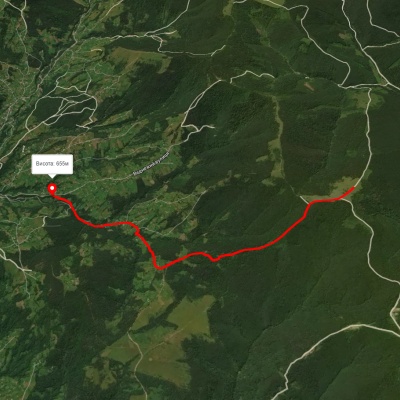
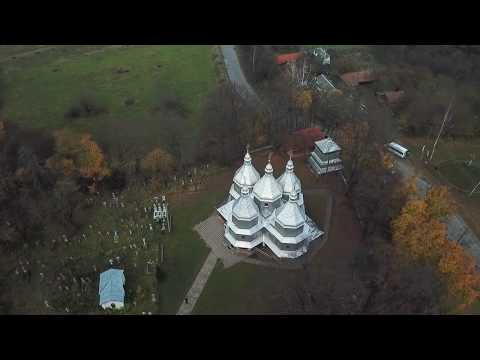
According to a measurement drawing at the level of the church's foundation, the church is a central cruciform structure with five domes placed on the middle cross and the crosspieces. The plan of the building is formed by the intersection of two rectangles (19.622 m longitudinally and 16.432 m transversely), which have faceted ends on all four sides. The church has three tiers. The two lower tiers are log cabins, the upper third is an octagonal tower covered with tent domes with interceptors and cupolas with openwork crosses. The central tower is somewhat taller, with four rectangular windows cut through the top, and is placed on the median cross through the "kutas." The side towers also have one small rectangular window with a bowed end. The height of the towers with the dome is 11.5 m, which is about half of the height of a long log house. The lower beam is traditionally demarcated by a wide railing placed on the exposed crowns of the log house. The second tier has two larger rectangular windows on the edges of the log house. The central entrance is on the south side, due to topographical features. The church has rectangular chapel and annexes to the building. The log cabins and towers have a noticeable slope of the walls toward the middle in order to increase the height of the tops in the interior. Apparently, in the 1900s, three quarters of the church were covered with zinc tin covered with coinage of low artistic value. The interior has a three-tiered gilded Baroque iconostasis with images of high artistic quality, and the side towers have magnificent wooden Baroque altars made in the Latin style with gilded Corinthian columns. The interior painting is modern and traditional, made with oil paints. A four-sided, three-tiered bell tower of log construction with an openwork gallery and a four-sided tent was erected near the church. The shape of the bell tower is squat, quite characteristic of the Hutsul region and the territories of the border zone of the seventeenth century, where the village of Nyzhnii Verbizh is located."
Local historians Mykhailo Lasiychuk and Ivan Ludchak provided information about the beginning of the church's construction in 1756, when the tyrant brought 24 craftsmen down from the mountains, and the community from Kniazhdvor brought timber. As we can see, only Hryhorii Semeniak is mentioned by name in the mentioned artifacts, which should indicate that he was the main financier of the construction. The interviewed respondents also refer to him as the treasurer of the opryshky's band. Along with Semenak the miller, historical sources contain evidence of another person, Mykhailo Maliarchuk, who was married to the daughter of a Verbizka miller. It was this Maliarchuk-miller who in 1742 appeared before the Stanyslav city noble court for his ties to Oleksa Dovbush, where he answered that he was from the village of Rudky and studied at a Russian school "and so, going to one and then another school, he reached Verbizh and began to study painting for a year with a painter....."
Even a brief inspection of the Verbizh church building suggests that it is an extraordinary monument of sacred architecture, not typical of this region. There are no five-domed churches anywhere else in the region, such as Pechenizhyn, Kniazhdvir, or Kolomyia, or in the Ivano-Frankivsk region in general. It seems that the fact of Maliarchuk's Podillia origin and his painting education may have played a key role in the recruitment of the building's rear.
By definition, a five-domed church is a sacred structure that is built over the volumes of five domes (dome) placed crosswise on the axes (four on the cornerstones, the fifth main one in the middle). 3 Pavlo Alensky's descriptions show that in the mid-seventeenth century a type of tall wooden cross church with five domes already existed in eastern Podillia, Podniprovia, and the Left Bank. There were such churches in Uman, Pereiaslav, and the Hustyn Monastery. V. Shcherbakovsky was one of the first to use this term. Volodymyr Zalozetskyi believed that the tradition of five-domed churches in Ukraine was interrupted, and he traces the five-domed type of church to the modern times in Ukraine from the Baroque through the restored church of 1613. Assumption Church in Kyiv in Podillia. According to Dragan, "the type of wooden five-tiered church must have an old tradition in Ukraine dating back to princely times, for only from the old, unbroken tradition could such a widespread five-tiered church in Ukraine have come. In the West, the five-domed type is very rare. In particular, Ukraine's western neighbors do not have such cross churches at all."
Five-domed wooden churches in the Hutsul region were built quite rarely, more often in cities, and less often in large villages. A five-story church could not be as widespread as a three-story church, because while a small three-story church could be afforded by a small village, a large five-story church could only be afforded by a larger and wealthier town or a wealthier founder. According to a visitation in 1740, the famous five-story church in the village of Ispas (now the village of Hirske, Kosiv district) was built after 1624 and dismantled in 1811. All other buildings in the second half of the 17th and 18th centuries have rectangular frames with octagonal drums, planted on a tetrahedral one visible from the outside, equal to the size of the log house or slightly reduced due to the hall: The Church of the Assumption, 1843, in the village of Korshiv, Kolomyia district; or the octagon of the central top has a tetrahedral base, and the octagons of all other tops do not have an externally visible tetrahedral base: the Church of the Virgin Mary, 1686, in the village of Rozhniv, Kosiv district.
The same researcher, analyzing the monuments of sacred construction of the Hutsul region, notes that among the plans close to the equilateral cross, with a slight reduction of the side ramens, two types can be identified: a) with a rectangular ending of the ramen; b) with three faceted ramens - the rectangular ending of the log house is always on the side of the church entrance. The plans with faceted endings of all four ramens, which are grounded, do not have a vertical development of log cabins and tops, as observed in the research monument. Instead, churches with names with structural characteristics were widespread in neighboring Podillia (Church of the Assumption of the Virgin Mary in Yaryshiv village, 1768), as well as in Pokuttia, Podniprovia, and Slobozhanshchyna (Church of the Holy Trinity in Korolivka village, 1716, Chernihiv region), Church of the Intercession of the Blessed Virgin Mary in Romny, 1664, Church of the Presentation of the Blessed Virgin Mary, 1761. 3 of the closest churches to the plan of the Nyzhnyi Verbizkyi church are the Church of the Nativity of the Blessed Virgin Mary in Khodoriv, 1768.
The appearance of faceted endings of log cabins, as well as the transition of the central square into an octagonal one, are associated by all researchers of eighteenth-century wooden architecture with the influence of the Baroque style on folk construction. Another researcher says the same thing:
"Baroque architecture, by its main artistic means, namely light and shadow in the refracted squares, changed the rectangular spaces of the church into octagonal ones." The influence of the same style direction also caused spatial changes in the design of churches - their high opening."
As a result:
"all five domes seem to be hanging in the air, floating on an unattainable height, creating the illusion of an amazing lightness of beauty due to the height of the open space of the tops."
Thus, as it has been proved, the Church of the Nativity of the Virgin Mary in the village of Nyzhnii Verbizh does not belong to the typological group of Hutsul wooden structures, but rather repeats the forms of sacred buildings of Podillia and Slobozhanshchyna. The church is characterized by its complex construction and impressive size, which required a lot of money for construction. The construction of the church and its interior has distinct features of the Low Baroque, such as faceted creases in all four frames of the structure, a wide porch and a duplicating profiled cornice of the second tier that enriches the light and shadow effects; octagonal towers of the building; a distinct tapering of all o6's upwards, which adds grace and pyramidal characteristics to the building and brings the illusion of lightness and high-rise opening of spaces to the interior. Inside the church, the spaces flow into each other through the gaps at the level of the second tier, further modeling the light and shadow effects. The personality of the church's founder is interesting in view of his affiliation with the Oprishkiv movement of this region and its Baroque culture and requires a separate study. The possibility of including the monument in the UNESCO World Heritage List puts it among the most outstanding structures created by mankind. The only pity is that despite the prospects that open up for the village in this case, instead of contributing to the restoration of the old church and the renewal of its shingle roof, the community is already building a new stone church nearby.
Nadiia Babii's analysis of the scientific literature suggests the relevance of further studying the processes and consequences of the cultural and spiritual interactions between ethnographic traditions and the personality of the founder, which had a peculiar effect on the sacred culture of the region.
Another problem that should be noted is that no one has ever explained to people what an architectural monument is and what attitude they should have toward it, emphasizes Volodymyr Herych, director of the historical and cultural reserve in Zhovkva and head of the working group that worked on the submission of Ukrainian churches to the UNESCO list. Theological institutions do not pay attention to the history of arts and culture, so priests have no idea of the value of the churches they preside over. Scholars have found that most priests dream of a new large church, and are ready to destroy a small old church. The clergy have to explain that neither modern brick nor metal-plastic can build a better one, so it is important to preserve what our descendants have left us.
Accommodation around Church of the Nativity of the Blessed Virgin Mary, Nyzhnyi Verbizh:


Which trails pass by Church of the Nativity of the Blessed Virgin Mary, Nyzhnyi Verbizh?
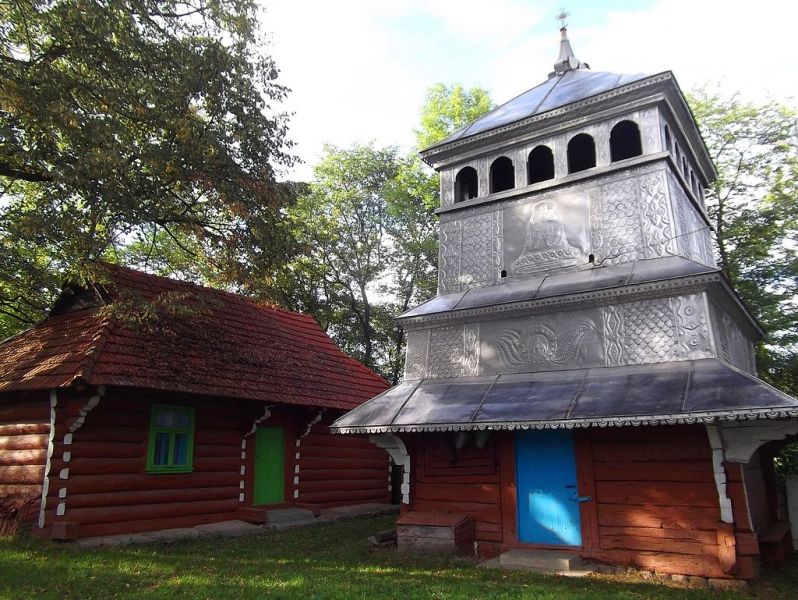
We suggest these hiking trails through or near Church of the Nativity of the Blessed Virgin Mary, Nyzhnyi Verbizh: Sheshory – Rosokhata, Opryshky Road, Kosmach village, via Mount Rotylo, Mount Hrehit and Mount Bila Kobyla to Bukovets village, Mykulychyn village, via Mount Khorde and Mount Rotylo to Kosmach village, Medvezhyi tract – Mount Kuratul, Pysanyi Kamin – Bukovets village



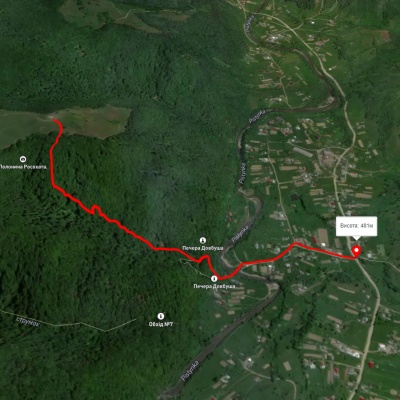
Sheshory – Rosokhata
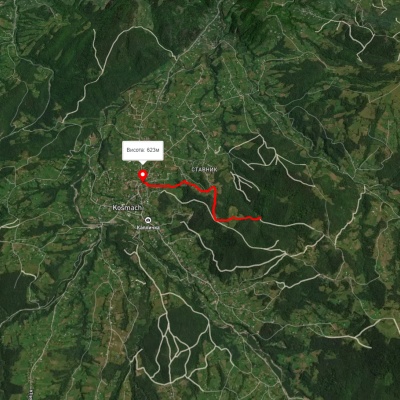
Opryshky Road
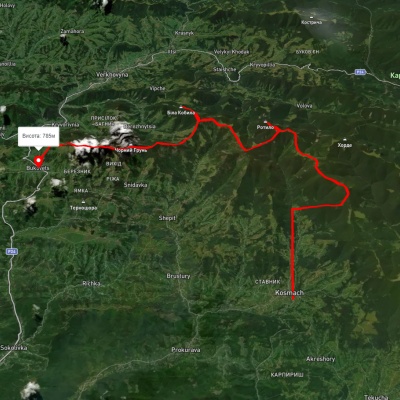
Kosmach village, via Mount Rotylo, Mount Hrehit and Mount Bila Kobyla to Bukovets village
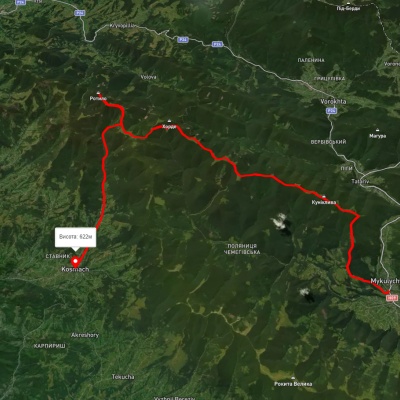
Mykulychyn village, via Mount Khorde and Mount Rotylo to Kosmach village