House-ship (Shifa), Chernivtsi
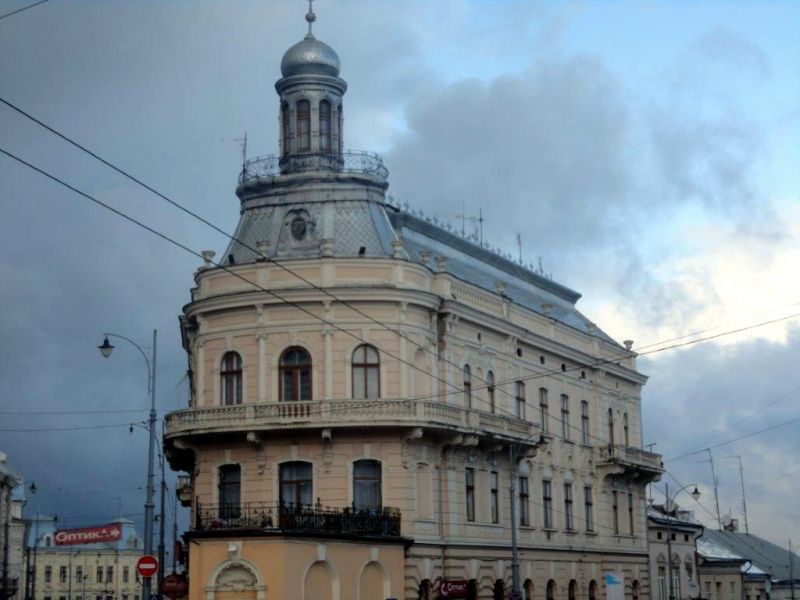
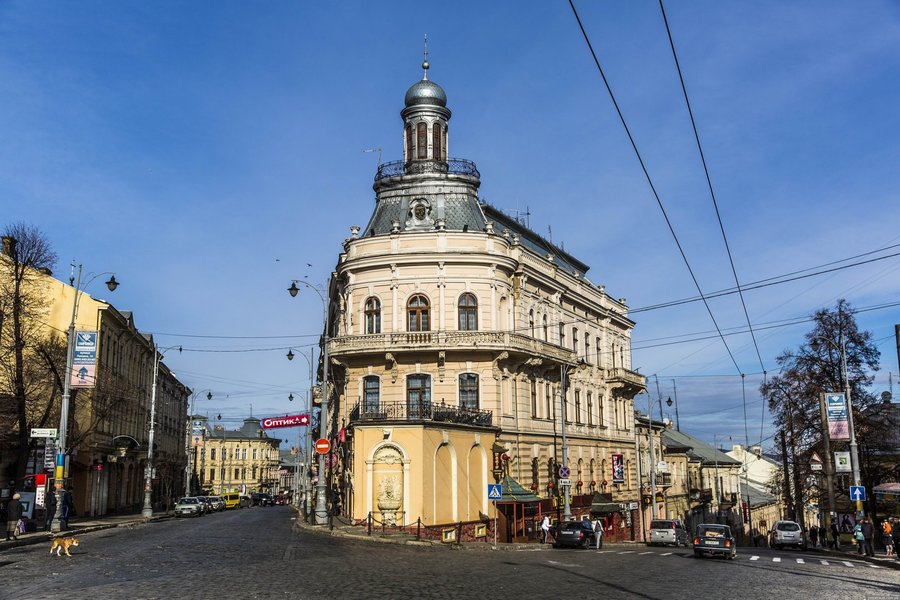
Theship house is a highlight of all Chernivtsi's architectural monuments, located at the intersection of Holovna and Sholom Aleichem streets. This is one of the first stone houses built in the late nineteenth century, which is still called in the old fashioned way - "shifa", which means "ship" in German. The house does resemble a ship. The narrowed façade, which looks like a ship's bow pointing south, the deck on the second floor in the form of a spacious balcony, and a small tower resembling a mast certainly create an interesting image of a shipbuilding masterpiece in the minds of residents and visitors alike and arouse interest in its history.
The ShipHouse in Chernivtsi was built in an eclectic style in the late nineteenth century, according to other sources in the early twentieth century, by Chernivtsi architect Elias Papst. One of the most famous architects of the time, Julius Bochner, is considered to have built the building. The house is located near two churches, the Church of the Exaltation of the Holy Cross and the Church of St. Paraskeva.
This original building, which dominated the architecture of the entire neighborhood, has another name, the Schiff House, which means "ship house" in German. And not without reason. There were times when this meeting place was more popular than the square near the City Hall. However, this is not the only thing the ship is famous for. It is always interesting to touch the history and learn how this masterpiece was "born." There are several legends. Of course, only a person who is truly in love and enchanted with the sea can realize an idea related to it. So, once upon a time there were two brothers who were engaged in the seafaring business. However, as the years passed, they had to finish conquering the vastness of the sea. It was then that they decided to settle in a house that would remind them of their glorious past. Of course, such a dream had to be realized! So they traveled halfway across Europe in search of a suitable place. And it was in Chernivtsi that they found what they were looking for. It was here that their house-ship could "emerge" from the waves of the mountain. The architect, whose name has been buried by history, also did a good job. The house itself does not feel like it was built on a hill. It is decorated with bizarre sculptures, and the bow of the ship has a lion's head with water flowing from it. In Romanian times, this was the only place where you could drink drinking water for free. On the balcony deck there were two steering wheels, near which the brothers would recall the past days every morning, holding them and looking into the distance. Another story of the appearance of this masterpiece is connected with the fact that a popular tavern "Zum Goldenen Shiff" ("Under the Golden Ship") was located nearby, and the house itself was built in the last years of the nineteenth century.
There is also a more plausible version that the house-ship was built in honor of the infamous Titanic ship. At the time, Chernivtsi was a developed European city, and it is known that tickets for the legendary ship could be purchased at its ticket offices, and that there were also Bukovynians among the Titanic's passengers. It was in the early twentieth century that the first wave of emigration from Western Ukraine to the United States, Brazil, and Canada began. Many mysteries are associated with the sinking of the Titanic, the largest ship of the time. Some believe that a fatal Egyptian mummy was being transported on board, and there are also suggestions that the ship's demise was predicted 14 years before its construction. In this regard, after 1912, the construction of house ships began in Europe, which was shocked by the terrible tragedy, and we can also see it in the main city of Bukovyna.
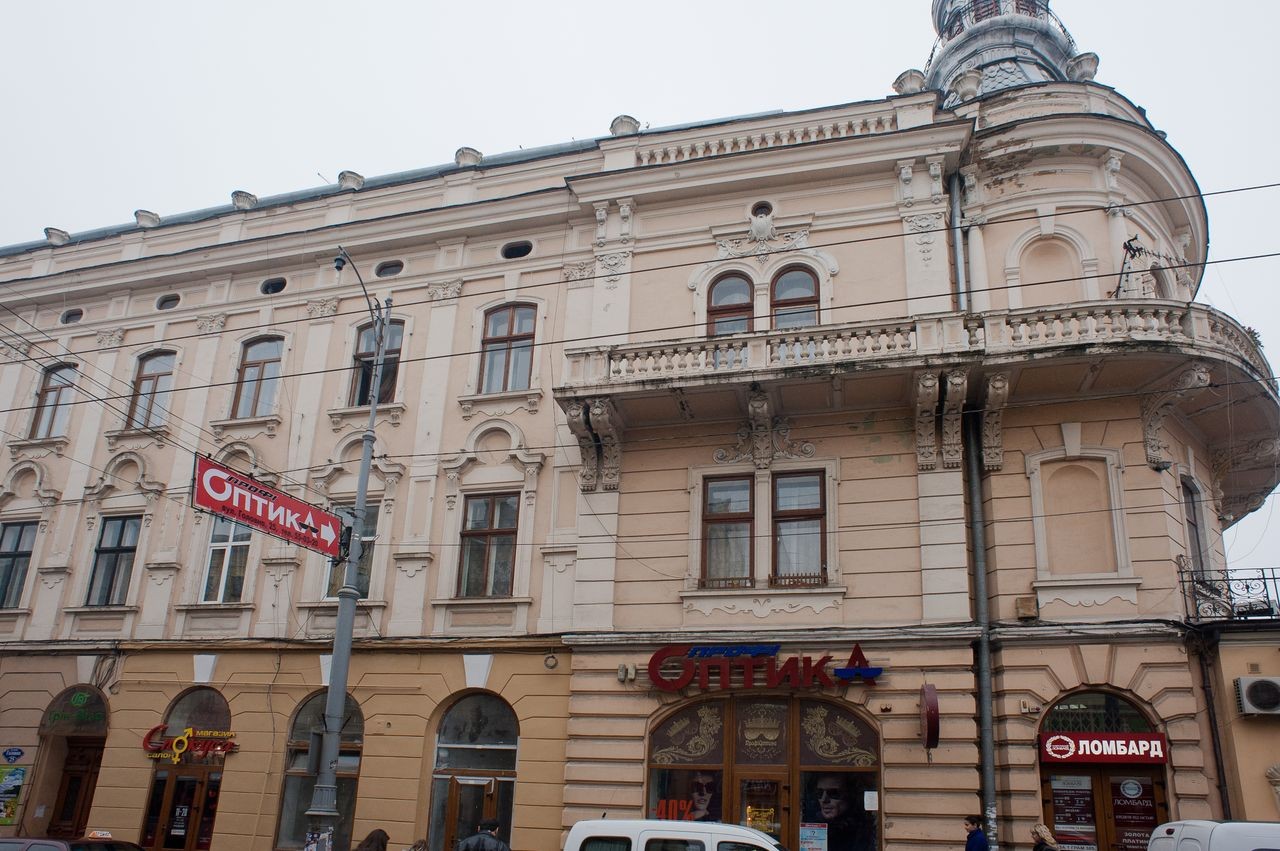
The majestic house-ship in Chernivtsi does not belong to any architectural style. This unusual ship-shaped building is topped by a tall lantern tower that symbolizes a mast. Its narrowed facade faces south. The bow is decorated with a lion's head, and around the perimeter there are mythical creatures - griffins, symbolizing vigilance. In the past, drinking water used to flow from a fountain in the shape of a lion's mouth in the bow. The images of dolphins and seaweed also remind us of navigation. The second floor resembled a ship's deck with a bridge, steering wheel, and rudder. According to historical data, the Shifa house was built for Moses Schlefer, a Chernivtsi merchant and landlord of Jewish origin. In general, the unusual building in the form of a ship causes surprise and amazement among tourists and travelers.
This house also survived the difficult Romanian and Soviet times. The destructive storm of the then-politics damaged the facade of the house, some decorative elements disappeared, and the lion was put in a brick cage. A billboard was put up on it. The lion was released on the centenary of Lenin's birth. Now it was possible to drink water here again. Few people know, but people gossip that a wealthy merchant hid his wealth from the authorities in the ship's cellars. It is said that they are still waiting for their owner, but only the one who guesses the secret of their hiding place will be able to find them.
The Shifa residential building in Chernivtsi is part of the Hauptstrasse architectural complex (the Main Street ensemble), is distinguished by the extraordinary nature of its forms and is an architectural monument of local significance. The building is currently being restored. The ship continues to fascinate everyone who cares. This liner has been traveling for centuries from the past to the future, remaining a hallmark of the city. Two more old houses are worth seeing nearby: the Governor General's House and the so-called Colonel's House. Both buildings are much older, dating back to the late 18th century.
Chernivtsi is the capital of Bukovyna. It is one of the most beautiful and pleasant Ukrainian cities. There is one of the most beautifulrailway stations in the country, theChurch of St. Paraskeva of Serbia, the Church of the Exaltation of the Cross, the ship house, the City Hall (every day at 12:00 a trumpeter plays the melody of "Marichka" from the tower), the Art Museum, then Kobylianska Street, the German Folk House, the Armenian Church and the Assumption Church (the oldest stone Ukrainian Greek Catholic Church in Chernivtsi), the Theater Square and the Kobylianska Theater. Kobylianska Theater Square, Jewish People's House, Chernivtsi University (included in the UNESCO World Heritage List), Turkish Square (Chernivtsi has been a part of Turkey, Modova, Romania, Austria-Hungary, the USSR, Rus, and Ukraine), and a large rover,cozy streets and cobblestone streets, the so-called Drunken Church, Nazariy Yaremchuk's house, then another house-ship, two houses with the same number (Olha Kobylianska lived here), the house where Volodymyr Ivasyuk lived, the pink church - the Cathedral of the Holy Spirit.
Chernivtsi sights
- St. Nicholas wooden church (from 1607, restored in 1954);
- stone Church of St. George on the Bitterroot (1767 in the Baroque style);
- wooden Trinity Church in Muggles (one thousand seven hundred and seventy-four), moved in 1874 to Kłokuchka;
- wooden Assumption Church on Kaleczanka (1783);
- City Hall with a two-story, 45-meter-high Empire-style tower (1843-1847, architect A. Mykulych), now the City Council;
- Ukrainian Greek Catholic Church (1825-1830 in the Baroque style);
- Byzantine-style cathedral (1844-1864, architect Roll);
- Church of St. Paraskeva in the pseudo-Romanesque style, completed in 1662 (architect A. Pavlovsky);
- residence of Bukovyna metropolitans - since 1956 one of the buildings of Chernivtsi University);
- Armenian Gregorian Church (1869-1875, architect J. Hlavka);
- Chernivtsi University building (1874-1875);
- Jesuit church in the Neo-Gothic style (1893-1894);
- Railway station (1898-1903) in the Art Nouveau style;
- the City Theater (1904-1905, architects F. Fellner and G. Helmer) in the Viennese Baroque style with Art Nouveau elements (now the O. Kobylianska Music and Drama Theater), and others.