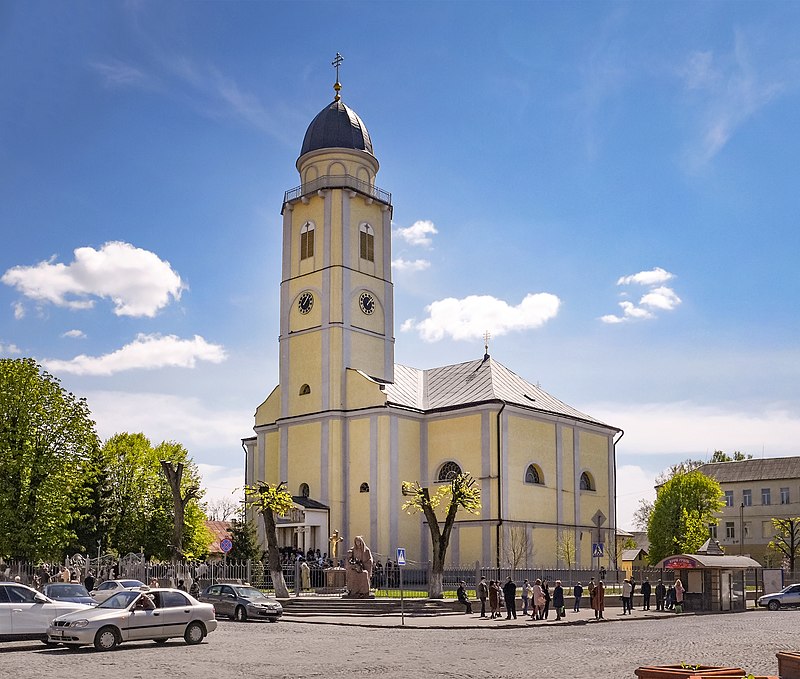
Assumption Cathedral, Mukachevo
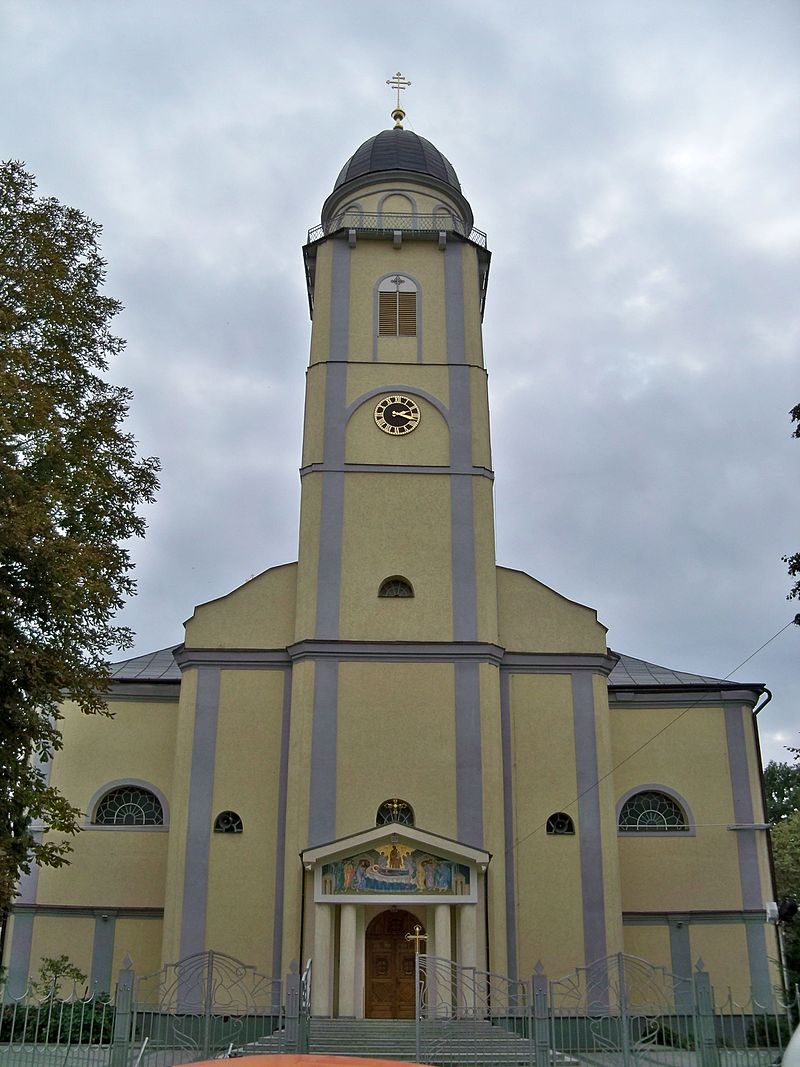
TheCathedral of the Assumption of the Blessed Virgin Mary is a functioning Greek Catholic church in Mukachevo, the conciliar cathedral of the Mukachevo Greek Catholic diocese. The bishop comes to the church on the second day of all major Christian holidays. Mukachevo was the center of the Greek Catholic diocese until 1780, when Bishop Andriy Bachynskyi moved his residence to Uzhhorod.
The Cathedral of the Assumption in Mukachevo is a symbol of the unbreakable Greek Catholic faith. It was built over 50 years by the community and was completed thanks to the outstanding Transcarpathian educator V. Dovhovych.
When the question of reconstruction of the Mukachevo monastery arose in the mid-18th century, on September 13, 1752, the Hungarian court chancellery, on behalf of Empress Maria Theresa, allocated two thousand gold pieces to Bishop Manuel of Olszawa, to which it later added another 1500 guilders, for the construction of a new bishop's residence on a plot of land donated by Count Schönborn. The cornerstone was laid in 1753, but the bishop planned a building that was too large and was not completed until his death in 1767. In the same year, Bishop Ivan Bradacz, Olszawa's successor, hastily completed four rooms in the unfinished building.
In 1800, during the episcopate of Andriy Baczynski, the idea arose to rebuild the unfinished episcopal house into a church. On February 22, 1804, Bishop Baczynski signed the documents for the transfer of the building to the community. Workers dismantled the interior walls, but due to lack of funds, the work stopped. The community appealed to the city authorities several times in vain, and in 1830 filed a complaint with the committee administration that the majority of the population in Mukachevo was Greek Catholic, but the city authorities belonged to another denomination and would not even provide wood for the roof of the church. Construction began thanks to the efforts of a zealous priest, scholar, and builder, Vasyl Dovhovych, who secured a subsidy and implemented the reconstruction plan. On September 8, 1829, the foundation of the sanctuary was laid on the south side of the building, and the foundation of the tower was laid on the north side.
In 1834 the church was covered with a roof. Bishop Oleksii Povchii also helped with money and materials. In 1837, the curator Vasyl Balla asked the local authorities for help with money and materials to make the tower, which was not yet finished, taller. It was decided that the tower would also serve as a fire station for observation, for which the bellman would receive a separate salary. The tower was to be 21 fathoms high and required 35 tons of iron. The priest at the time was Ieronymii Haidu. Subsequently, the work stopped, and during the Hungarian Revolution of 1848 the church was used as a warehouse. The construction was completed under the priest Ioan Deshko.
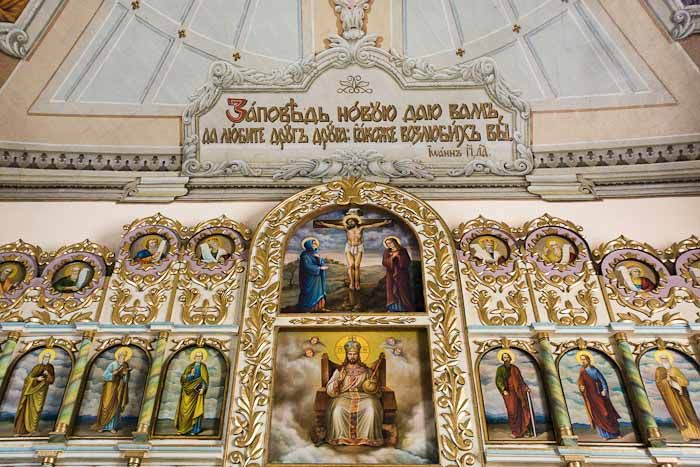
In the 1850s, Emperor Franz Joseph allocated 6300 forints from the religious fund to complete the construction of the church. On August 27, 1859, Bishop Vasyl Popovych consecrated the church, which could accommodate 2000 worshippers. The tin-covered tin chancel was equipped with a gallery for observations. The human-sized prefigurative images on the white gilded iconostasis were painted by the famous Uzhhorod artist F. Vydra. In 1863-1867, a rooflight was built on the site of the dismantled old stone church.
Upon completion of the construction, the second stage began: raising funds for interior decoration and the purchase of necessary items. The funds came from the emperor (1300 forints), the bishop's fund, the Bobovyshche parish priest Mykhailo Lykhvarchyk (100 forints), Count Schönborn (200 forints and materials worth 500 forints), and 100 forints from the city. Bishop Vasyl Popovych and landowner Petro Chersky also contributed, providing altars and bells cast in Przyszew, chandeliers, and other items.
The clock for the tower was made in Munich. The altar image and icons for the iconostasis, which cost 5,000 forints, were painted by the artist Miklovshi (Mykhailo Zmiy-Mykloshyk), and the walls were painted with biblical scenes by the diocesan painter Julius Kornylo-Fentsyk and the painter Andriy Miklovda in 1892-1893.
In this work, the priest was supported by Ivan Lukach, Ilya Morynets, Mykhailo Hrabar, Yosyp Pastelii, the chief curator Augustyn Popovych, and the auxiliary priest Bertolon Halaktovych. The painted church was consecrated by Bishop Julius Firtsak on October 3, 1894.
After the advent of Soviet rule, in 1947, the Church of the Assumption of the Blessed Virgin Mary was subordinated to the Moscow Orthodox Patriarchate. In Mukachevo, priests Yevheniy Dulyshkovych, Mykhailo Mykula, Oleksandr Ilnytsky, and Stepan Tyvodar were repressed. The latter two died in concentration camps.
In 1992, the church was returned to the Greek Catholics. The Orthodox believers moved all the decorations to the new Orthodox church. After the transfer of the church in the fall of 1993, the cathedral was completely empty, even without radiators, and vandalized - car tires were set on fire inside. The only thing that survived was the central cast chandelier from 1905, which was black with soot and seemed to have no value.
The restoration of the church continued in the 1990s. In 1996, its walls were strengthened.
Father Joseph Lovska has been the rector since the end of February 2001. Since 2002, he has been a parish priest.
In 2002, when a large piece of plaster fell from the ceiling of the church during a service near the parishioners, he launched a major overhaul. According to him, in the 1950s, the Orthodox owners made repairs in which the plaster was covered with oil paints, which caused it to "sweat" and gradually fall off.
During the restoration, the inside was rewired, plastered, iconostasis, painted, and the floor was re-laid; the roof and facade were restored. The restoration lasted until 2009. In 2010, the iconostasis was consecrated. The paintings in the church, the design of the iconostasis, and the icons were painted by artists of the Association of Sacred Art of Lviv under the direction of Master of Iconography Sviatoslav Vlach in the Neo-Byzantine style.
Today it is a functioning Greek Catholic church. The renovated building houses a copy of the Shroud of Turin, a part of the Cross of the Lord from Rome, and a copy of the icon of the Blessed Virgin Mary of Mukachevo.
The Assumption Cathedral is located on the corner of Pushkin and I. Fedorov streets, near the central square of Mukachevo. Trains from Lviv and Kyiv regularly run to the city. In addition, you can get there by shuttle buses from the capital, which go through Lviv.
Accommodation around Assumption Cathedral, Mukachevo:


Which trails pass by Assumption Cathedral, Mukachevo?
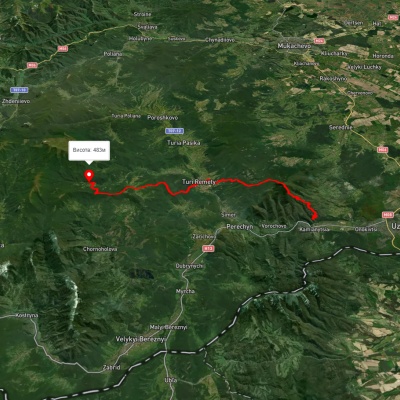
We suggest these hiking trails through or near Assumption Cathedral, Mukachevo: Lukovo village, via Mount Buzhora to Svaliava, Pylypets village, via Mount Hemba, Mount Stiy and Vovchyi village to Svaliava, Kamianytsia village, via Antalovetska Poliana to Turi Remety village, Polianska Huta village – Runa polonyna – Polianska Huta village, Lumshory – Nevytske Castle, Perechyn village, via Antalovetska Poliana to Kamianytsia village



Lukovo village, via Mount Buzhora to Svaliava

Pylypets village, via Mount Hemba, Mount Stiy and Vovchyi village to Svaliava
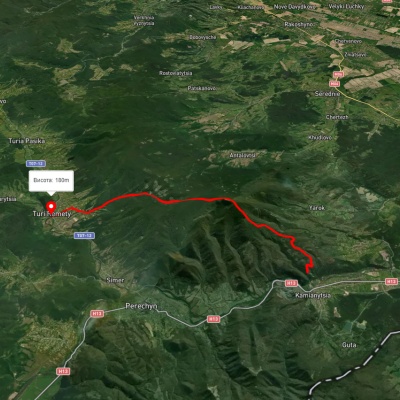
Kamianytsia village, via Antalovetska Poliana to Turi Remety village
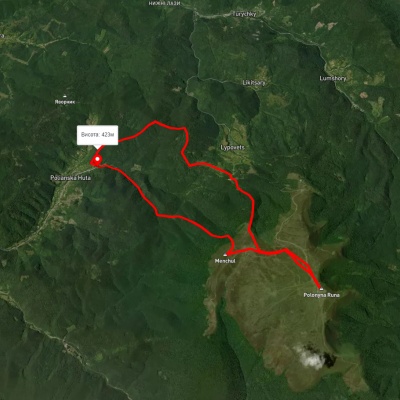
Polianska Huta village – Runa polonyna – Polianska Huta village