Khotyn
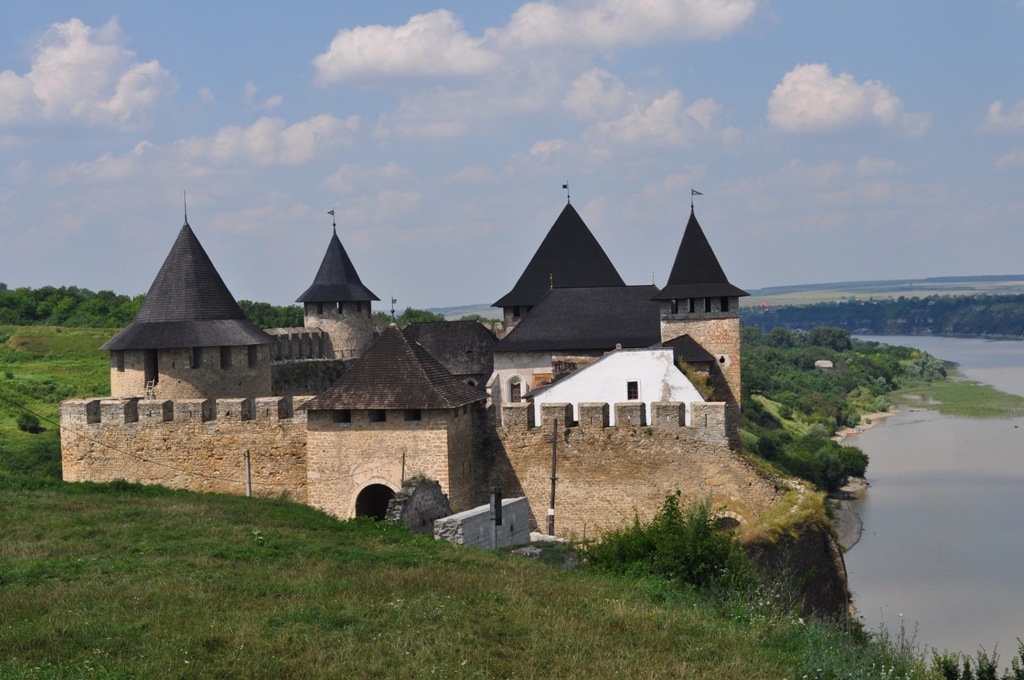
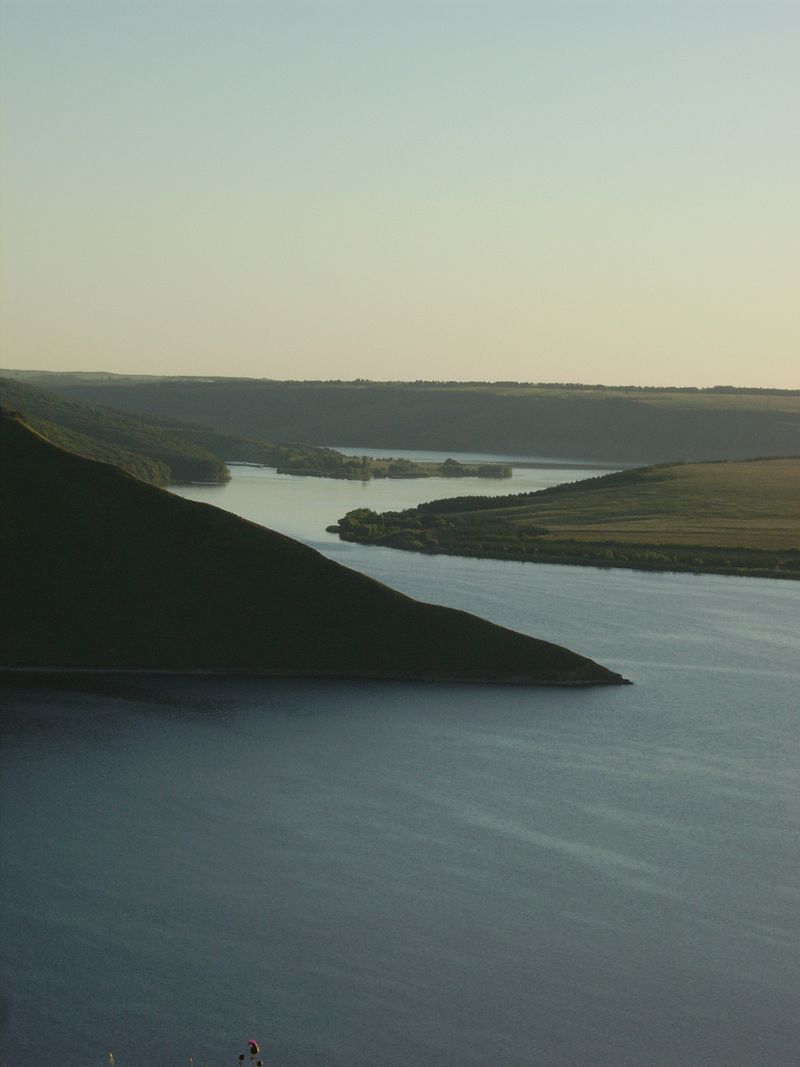
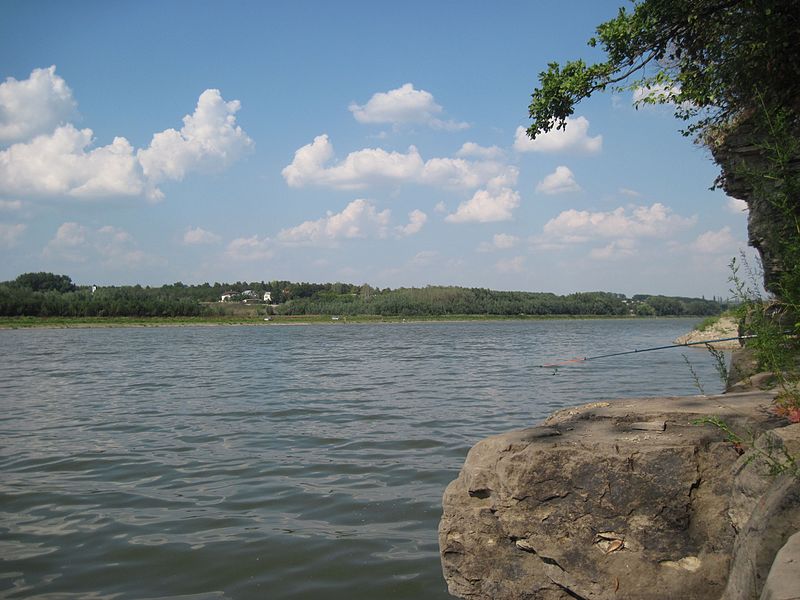
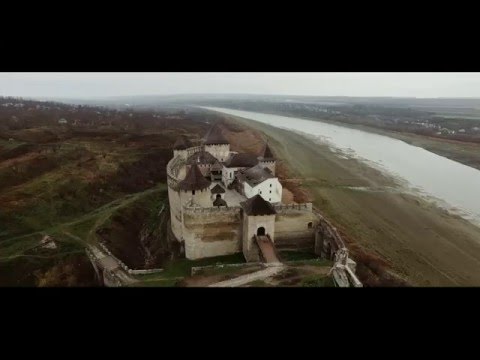
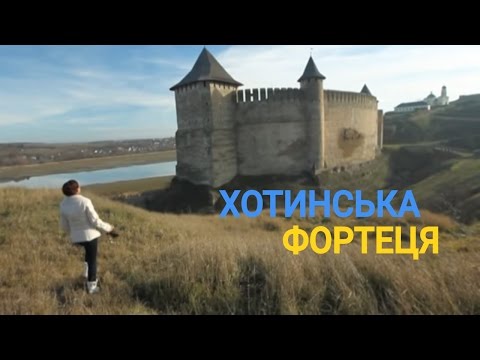
Khotyn is a city in Ukraine, the center of Khotyn district in Chernivtsi region. It is located on the right bank of the Dniester River. It is known for the fortress of the XIII-XVIII centuries, which has survived to this day. The Varnitsa River, a right tributary of the Dniester, flows near the town. There are two different versions of the city's name. According to the first one, the name comes from a legendary Dacian leader named Cotizon. The second version is more popular with guests and residents of the city: the name is derived from the word "to want". Indeed, at all times, the city, which was located in a favorable location at the intersection of trade routes, and in the future - on the borders of different states, has always been a dream for various conquerors. That's why Khotyn has long been one of the most fortified settlements in the region.
In 1826, the city of Khotyn was granted a coat of arms: a silver three-towered citadel in a golden field, accompanied at the top by a silver equal-armed cross above two crossed sabers, symbols of the defense of the region from enemies. On the front tower there is a crescent on the pole, and on the pole of both extreme towers there are bunting. The flag of the city was adopted on March 21, 1996. The author of the flag is V. Denysenko.
Due to its favorable strategic location, Khotyn played a significant role in the history of Ukraine, Moldova, Poland, Turkey, and the Russian Empire. Initially, it was a small wooden fortress built by the Eastern Slavs on the site of an ancient settlement that protected them from numerous conquerors. An unfortified village existed next to it and simultaneously with it. On its territory, archaeologists have discovered the remains of semi-humble dwellings with stoves, kamianky, dating back to the IX-X centuries, and at a depth of 1.2-1.4 m, a cultural layer of the VII-VIII centuries was discovered.
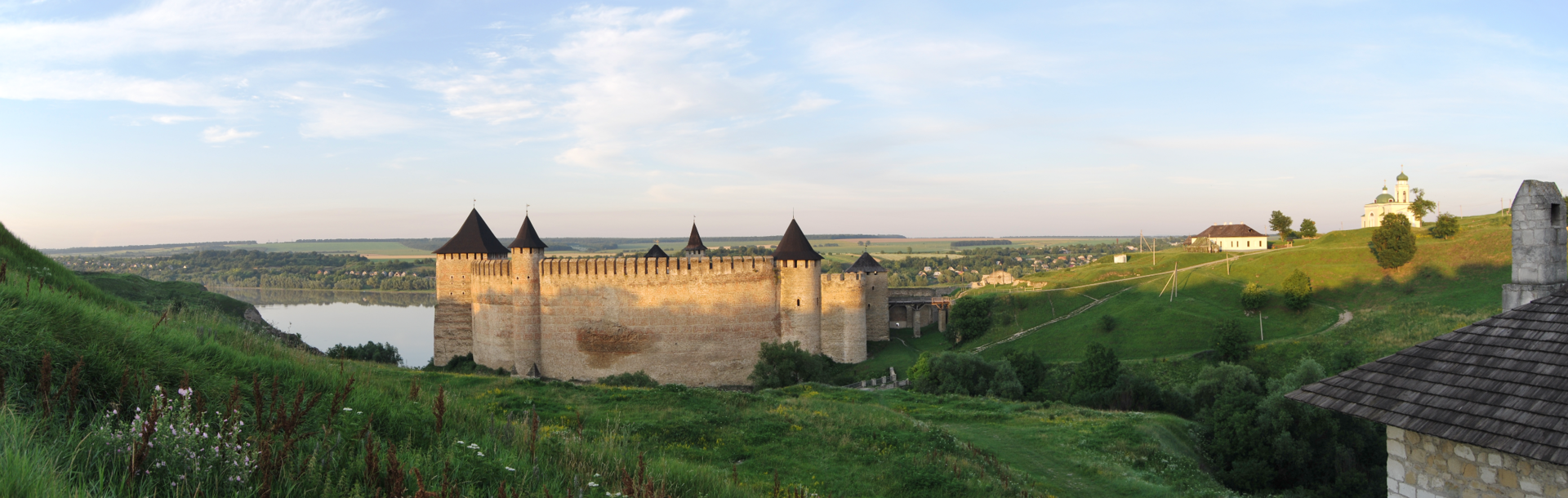
From the tenth century Khotyn was a part of Kyivan Rus, and later - of the Galicia-Volyn principality. Due to its strong fortress and favorable location, Khotyn became a center for the development of crafts and trade, which in turn contributed to the flourishing of the city's culture and economy. This, in particular, is evidenced by the handwritten Khotyn Gospel of the 14th century. In those days, Khotyn hosted the largest fairs in the Moldavian principality, which were attended by merchants from different countries of Eastern and Western Europe. The city was an important customs point in the European-Asian trade. In the second half of the sixteenth century, the Khotyn fair brought a huge amount of money to the Moldovan treasury - 10,000 gold pieces per year.
From the end of the twelfth century, a land with a semi-autonomous status began to form in the south of the Galician principality of the Galicia-Volhynia state. After the Mongol-Tatar invasion, ties with the Galician-Volyn lands weakened, leading to their actual separation in the early fourteenth century and the recognition of the supremacy of the Golden Horde. In the middle of the fourteenth century, the decline of the Golden Horde, on which the region was dependent, began. In 1349, the Kingdom of Poland captured the Kingdom of Galicia. At the same time, a new state, the Principality of Moldavia, was formed on the lands in the basin of the Moldova River.
On the southern border of the Kingdom of Galicia, the land of Shipyn emerged as an almost independent administrative-territorial unit with its own self-government, for which the Kingdom of Poland, the Kingdom of Hungary, and the Principality of Moldova fought fiercely. Jan Długosz first documented the first mention of the Shipyn land in 1359 in connection with King Casimir's campaign in Moldova. The approximate boundaries were described in a charter of 1412. The general administration of the land was carried out by the Voivode. The Khotyn fortress was the center of the Khotyn volost ("dierzhava"), which was governed by the starosta ("dierzhavets").
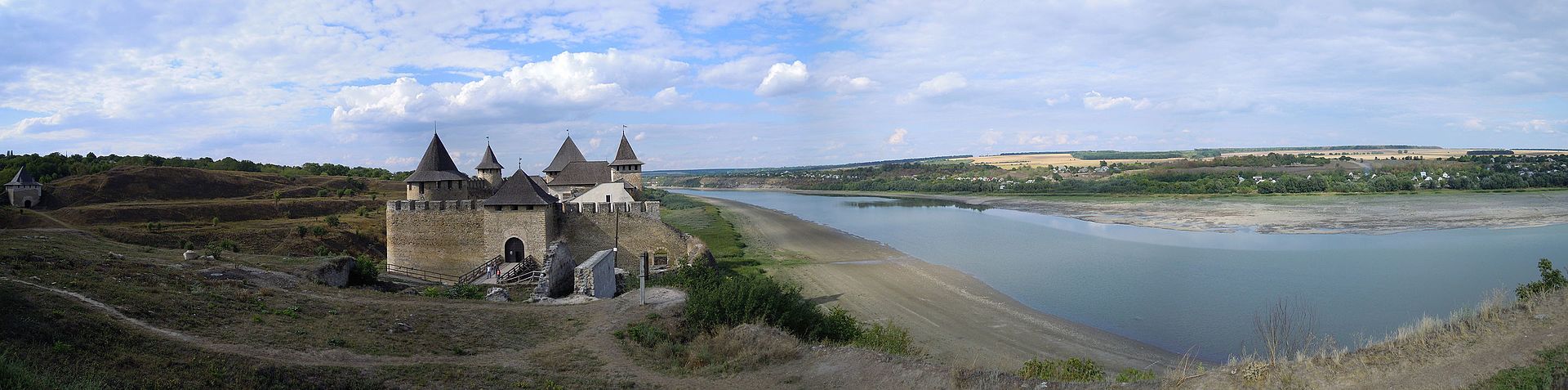
In 1373 Khotyn became part of Moldova. During the XV-XVI centuries Khotyn fortress was the capital of Multan, the residence of Moldovan lords. Voivode Stefan III the Great significantly expanded the fortress borders. A wall 5 meters wide and 40 meters high was built. Deep cellars were dug in the fortress itself, which served as quarters for soldiers. It is mentioned in the "List of Russian towns" at the end of the 14th century ("On the Dniester Hoten") and in the charter of Moldovan voivode Oleksandr of October 8, 1408. In the sixteenth century it was for some time under the rule of Poland, then again of the Moldavian principality (in vassalage to the Turks), and in the eighteenth century the Khotyn district was directly incorporated into the Ottoman Empire.
After the decline of the Moldavian principality, the city and the fortress passed into the hands of the Turks. They further strengthened the defensive power of the fortress, but the local population never put up with the new enslavers. The Zaporizhzhia Cossacks often acted as assistants in this struggle. This was the case in 1563, when the Cossacks, led by the legendary Dmytro Vyshnevetskyi (Baida), occupied the fortress and began negotiations with the Moldovan master about a joint campaign against Turkey. Due to the betrayal of the Moldovan boyars, the Cossack detachment was defeated, and Dmytro Vyshnevetskyi was executed in Constantinople.
In 1615, Polish troops occupied Khotyn. After the Battle of Cetzorsky in 1620 between Poland and Turkey, during which Polish troops were defeated and the great crown hetman Stanisław Żółkiewski was killed, Khotyn became the main outpost of defense against the Turkish invasion. In September and early October 1621, the walls of the Khotyn fortress were the scene of the famous Battle of Khotyn, which glorified the Zaporizhzhia Cossacks led by Hetman Petro Konashevych-Sahaidachny and became a turning point in the history of the Ottoman Empire. During the Khotyn War, the Polish-Lithuanian army of the Lithuanian Grand Hetman Jan-Karol Hodkiewicz (35,000 soldiers) and the Zaporizhzhia army of Hetman Petro Sahaidachny (40,000 Cossacks) repelled numerous attacks by the 200,000-strong Turkish-Tatar army. In September, the Cossacks under Sahaidachnyi's leadership repeatedly carried out bold night raids and counterattacks, causing panic among the Turkish troops. On September 24, Hetman Khodkevych died in the fortress from a wound and subsequent blood poisoning, and Stanisław Lubomyrski took over the defense. The successful actions of the Cossacks and skillful maneuvers of Polish troops gradually eroded the Turkish forces. Osman II was completely at a loss. On September 28, he decided to give a general battle. On October 9, 1621, Sultan Osman II was forced to conclude the Khotyn Peace with representatives of the Polish-Lithuanian Commonwealth.
Throughout the seventeenth century Khotyn passed from hand to hand, owned by Polish kings and Turkish feudal lords, and liberated by the Zaporizhzhia Cossacks on several occasions. During the liberation war of 1650-1653, Bohdan Khmelnytskyi's troops were stationed in Khotyn.
On November 11, 1673, crown hetman Jan III Sobieski, led by a 30,000-strong Polish-Lithuanian-Cossack army, defeated a 40,000-strong Turkish army in Khotyn. The decisive moment of the Battle of Khotyn in 1673 was the attack of the hussars of the voivode Jablonowski. Only a few thousand Turks escaped death or captivity. It was only in the early eighteenth century that the Turks managed to finally gain a foothold in Khotyn and the fortress. After the reconstruction of 1712-1718 (with the participation of French engineers), it became the most powerful node of Ottoman defense in eastern Europe.
Although in the XVIII-XIX centuries the fortress gradually lost its defensive significance, battles continued to rage under its walls. In 1739, they entered Khotyn after defeating the Turks in the Battle of Stavchany, in which Ukrainians, Russians, Georgians, and Moldovans bravely fought their enemies. The great Russian scholar and poet Mikhail Lomonosov, admiring the courage of his compatriots, wrote "Ode to the Victory over the Turks and Tatars and the Capture of Khotyn in 1739." In 1769-1787, the Russians stormed the Khotyn fortress again.
In 1778, the city was besieged by Austrian troops under the command of Prince Frederick and Russian troops under the command of General Soltykov's son. The city was under siege for 4 months and 8 days. On September 19, 1778, the city with the commandant Osman Pasha surrendered. Osman Pasha and others were allowed to take all their people and all their belongings out of the castle, fortress, and city. All this was taken away on 2700 carts. Soltykov invited Osman Pasha to his house for lunch. Osman Pasha was the husband of Helena, Sofia Kljavone's sister. Sofia Klyavone was then in a relationship with Soltykov. After the city surrendered, it had 16,857 inhabitants.
On October 1, 1778, Austrian and Russian troops entered the city. The city was empty and significantly destroyed. The suburb of Constantinople had been burned down by the Ottoman Pasha even earlier. This is how the Saxon prince Frederick of Saalfeld described the city at the time. The Khotyn fortress is in the shape of a quadrangle, 1800 by 730, and has four gates. The gates were called: Water Gate, Istanbul Gate, Bendery Gate, and Korokhova Gate. Inside the castle are the Pasha's palace, a mosque, a Turkish bath, many shops, and 40 different houses that could accommodate 800 people. The town is located above the fortress and is surrounded by a hornbeam palisade up to the fortress itself. One suburb was called Constantinople, and the other, near the gate that led to the road to the Trenches, was called Rumla. Between the two suburbs was the garden of Osman Pasha, which extended beyond the palisade. A small stream that flowed into the Dniester divided the city and the fortress into two parts. The city was built up with wooden houses. There were 7000 soldiers at the fortress, and Osman Pasha and the janissary aga Druruoglu lived there at the time.
After the Russo-Turkish War of 1806-1812, Khotyn was officially annexed by Russia and became the county center of the Bessarabian province. Retreating, the Turks almost completely destroyed Khotyn. In 1832 a new church of St. Alexander Nevsky was built on the territory of the fortress. In 1856, the Russian government canceled the status of Khotyn Fortress as a military facility. During the nineteenth century, the town itself was built on a flat plateau according to a regular plan. According to the 1897 census, Khotyn had 18126 inhabitants.
After the reform of the 1860s, the first industrial enterprises appeared in Khotyn. There were several water mills. In the early twentieth century Khotyn had 3 breweries, 10 distilleries, 4 tobacco factories, a sawmill and brickyard, and 2 printing houses. The town had two hospitals with 45 beds, a pharmacy, 2 two-class county schools (for men and women), 2 one-class men's schools, and one private school.
In 1918, 5 states claimed the borderland of Khotyn: Russia, Ukraine, Moldavian People's Republic, Austria-Hungary, and Romania. On November 10, 1918, Khotyn was occupied by the troops of the Royal Romanian Army. Repression and terror began. But Khotyn residents did not submit to the new occupiers. In January 1919, an anti-Romanian uprising broke out. Power in more than a hundred villages passed into the hands of the Khotyn Directorate, headed by Y. I. Voloshenko-Mardariev. The Directorate, supported by the people, decided to expel the Romanians from their land and regain their freedom. For 10 days, the participants of the Khotyn uprising fought fierce battles with the royal troops. However, when the invaders broke into Khotyn on February 1, they massacred the population. Every day, the occupiers led hundreds of people to the ruins of the Khotyn fortress, from where no one returned. For 22 years, Khotyn was the county center of Romania.
During the Second World War, Khotyn was under Romanian occupation (July 6, 1941 - April 4, 1944), and later became part of the Ukrainian SSR. The war events brought about significant changes in the national composition of the population: 72% are Ukrainians, 16% are Russians, 8% are Jews, and 4% are Romanians (in 1930, the figures were 15%, 37%, 38%, and 9%, respectively).
In the center of the city there is a park-monument of landscape art of local importance - "Khotynskyi Park", and at 34 Kutuzova Street - a hydrological natural monument "Khotynske". The town borders on the Khotynskyi National Nature Park[ office at 69 Olimpiyska Street] and the Podilski Tovtry National Nature Park. On the northeastern outskirts of Khotyn, near the Khotyn Fortress, there is a landscape reserve of local importance, the Khotyn Fortress.
Historical and cultural monuments
- The city has the State Historical and Architectural Reserve "Khotyn Fortress". More than 50 films have been shot on its territory. Among them: "The Rising Hawk, D'Artagnan and the Three Musketeers, Taras Bulba, The Black Arrow, The Lion's Tomb, All's Fair in War, The Little Mermaid, The Tale of Ivanhoe, and more.
- There are more than 20 historical monuments in Khotyn that are registered with the state.
- The town has a military cemetery where 4910 Russian soldiers who died in World War I and 47 participants of the Khotyn uprising of 1919 are buried.
- On the castle grounds there was a church of St. Nicholas, according to legend, built by a Greek princess. Later, the Turks turned it into a mosque. In 1621, there were 2 churches near the castle walls: one wooden and one stone.