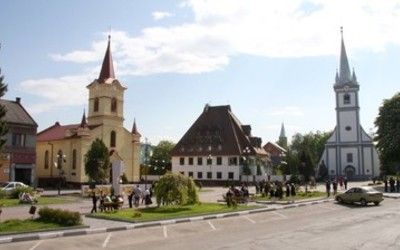
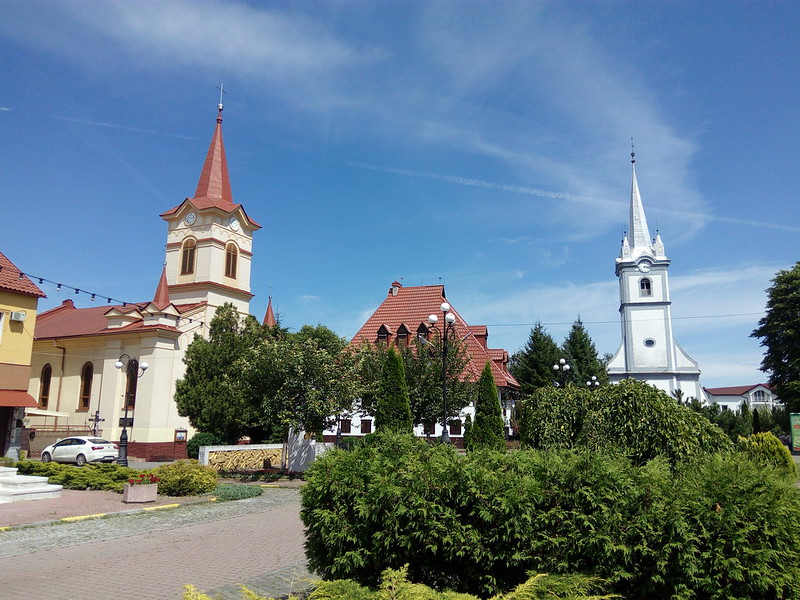
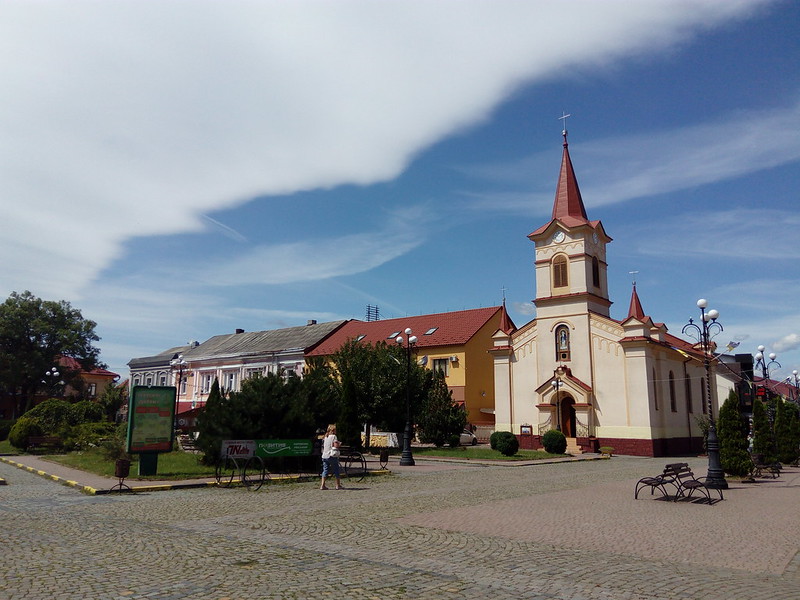
Church of St. Stephen (Istvan), Tyachiv
The Roman Catholic Church of St. King Istvan (Stephen) was built in 1780. The clock on the church's tower is not real, but painted. This feature is typical for many churches in Zakarpattia. Traditionally, the churches here were decorated with clocks not only to tell the parishioners the time, but also to remind them that one of the clocks would be the last one for each person. If the community did not have enough money for an expensive bell, the parishioners were "scared" by a painted dial. In the 1940s, the church was closed, and resumed worship only in 1988.
The district center is the town of Tyachiv (9-4 thousand inhabitants), located in the lowlands of a deep river valley on the right bank of the Tysa River, along the fairway of which the state border with Romania passes. Tyachiv has been known since the XIII century, and since 1329 it has been classified as a royal city. After the suppression of the anti-feudal Hungarian uprising (1514), in which the townspeople took an active part, Tyachiv, like many towns in Zakarpattia, was classified as a rebel town and looted.
The main architectural attractions of Tyachiv are located on the central square. This is a spectacular Reformed church built in the XV century on the foundations of a church that had stood here for more than two centuries. Apparently, the religious building originally belonged to Catholics and was repurposed at least a century later, in the 16th century, when the ideas of the Reformation became widespread in Western and Central Europe. The Reformatory Faro (church manor) was founded next to it in the late twentieth century. Its central four-story stylish building involuntarily attracts the eye, standing out among the gray buildings of the center.
The last years of the life of the famous Hungarian painter Szymon Hollósi (1857-1918) are associated with Tyachiv. From 1886 he was the head of the Munich Art School and from 1904 he regularly came to Tyachiv for plein air with his students. Before the outbreak of the First World War, he moved his studio here (the house where he lived has been preserved) and painted a number of paintings in Tyachiv that are now kept in the National Gallery in Budapest. A modest but expressive monument to S. Hollosy is erected near the Reformed Church.
In 1946, after the annexation of Transcarpathia to Soviet Ukraine, a small part of Tyachiv, located on the left bank of the Tisza River, was ceded to Romania. In 1961, Tyachiv became a district center. In Soviet times, Tyachiv had a factory of artistic products, a brick and canning factory, a bakery, and a consumer services plant.
To add a comment you can: login or register.
Accommodation around Church of St. Stephen (Istvan), Tyachiv:


Nearby hiking trails near Church of St. Stephen (Istvan), Tyachiv:
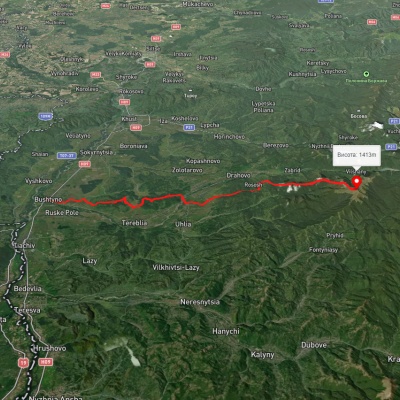
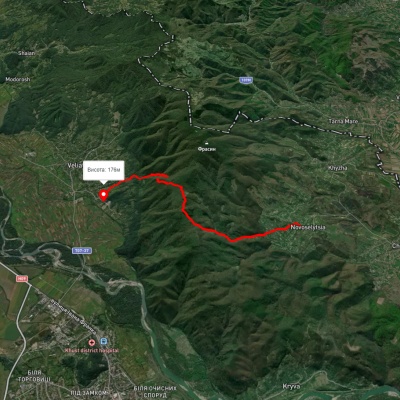
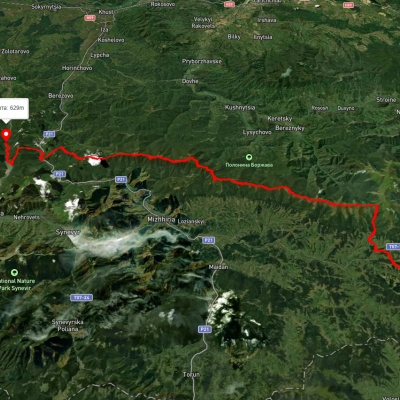
Which trails pass by Church of St. Stephen (Istvan), Tyachiv?
We suggest these hiking trails through or near Church of St. Stephen (Istvan), Tyachiv: Bushtyno, via Zanivka tract to Mount Manchul, Pyntia's Path, Skotarske village, via Borzhava polonyna and Palenyi Hrun polonyna to Vilshanske reservoir, Vovchyi village, via Mount Stiy, Mount Zhyd-Mahura, Pryslip Pass, Kuk polonyna, Mount Korytyshche and Shyroke village to Nyzhnii Bystryi village, Skotarske village, via Borzhava polonyna and Palenyi Hrun polonyna to Nyzhnii Bystryi village, Mount Topas, via Mereshor village to Kolochava village