Church of St. Paraskeva, Oleksandrivka
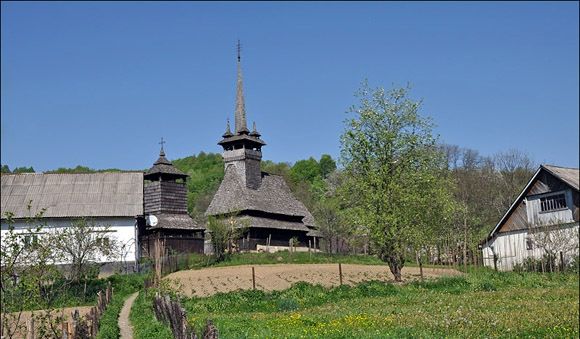
St. Paraskeva Church is a true adornment of the village Oleksandrivka (formerly known as Shandrovo), located in the Khust district of the Transcarpathian region, a national architectural monument (No. 220). The cult building crowns the wide surface of the hill and stands out with a clear silhouette against the backdrop of low mountains.
In appearance, the church resembles the churches of the Maramureș Gothic style from Sokyrnytsia, Krajnykove, and Danilovo, but it has some distinctive features. Here, verticality is not so pronounced, and a balance is found between the vertical line of the tower with a spire and the horizontal lines of the nave and altar.
According to local legend, the first church stood in the area of Potik, and the current one is the second. It is also known that the church was moved within the village. According to the Lviv researcher Andrii Kutnyi, the lower beams of the church date back to the 15th century, and the main structure was completed in April 1753, according to the inscription on the southern facade above the overhang. In 1751, two years before the restoration, or possibly the relocation, the church was described as: "wooden, with a tower in very poor condition, soon to collapse... Dedicated to St. Paraskeva."
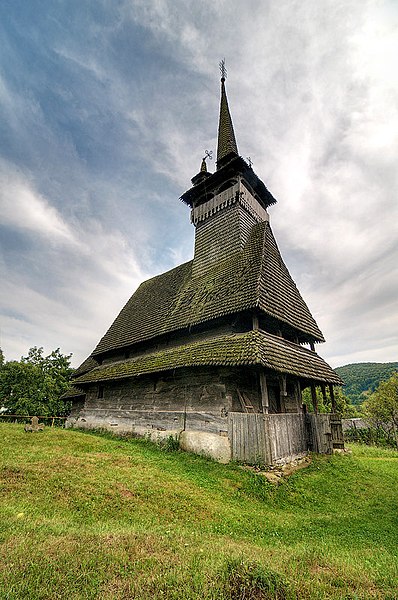
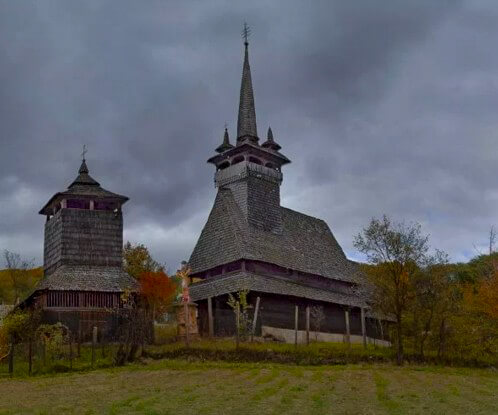
The overall composition of the forms of the Oleksandrivka church is similar to those in Danilovo, Krajnykove, and Sokyrnytsia, but at the same time, it has its unique features. Here, verticality is not so pronounced, and a balance is found between the vertical line of the tower with a spire and the horizontal lines of the nave and altar. The structure wisely crowns the wide surface of the hill and stands out with a clear silhouette against the backdrop of low mountains. The village houses are almost invisible, and new buildings do not disrupt the patriarchal picture, unchanged for several centuries. The church is a two-log, three-part structure, with visible wall inclinations towards the center. The oak logs are set on powerful foundations measuring 9.2 m in length and 34–65 cm in cross-section. The overhang embraces all the logs. On the main facade, there is an open porch (unlike the Gothic churches in neighboring villages). Above rises a tower of frame construction with four turrets at the base of the spire. In front of the main facade of the church stands a frame, two-tiered bell tower of exquisite proportions, covered with a tented roof.
The church is a two-log, three-part structure, with visible wall inclinations towards the center. The tower with four finials at the base of the spire rises above the western log. On the main facade, there is an open porch with an arched gallery. In the Oleksandrivka church, one can see rich, the most complete, and best-preserved wall paintings, executed in 1779 by the master Stepan Terebelytskyi, and paintings by folk masters. This is reported by the inscription on the western wall of the nave. Once, the women's section with a flat ceiling was separated from the nave with a high arched vault by a log wall with an open portal. In the mid-19th century, the passage was enlarged. The altar log is separated by a four-row iconostasis of the 18th century.
Perhaps the oldest among them is the church of St. Paraskeva in the village of Oleksandrivka, which bears clear signs of the builders' style of the 15th-16th centuries, although it is first mentioned in a note by the Mukachevo bishop Olshansky in 1751.
In 2002, partial restoration of the church was undertaken by the Lviv Institute of Archaeology, but due to lack of funding, the project was suspended.
The village Oleksandrivka (Rus. Aleksandrovka, Hun. Ósándorfalva, Sl. Šandrova) is located in the Khust district of the Transcarpathian region of Ukraine. Its old name is Shandrova. It is situated 22 km from the district center - Khust and 15 km from the Sokyrnytsia railway station on the Korolevo - Velykyi Bychkiv line.
The first mention of Oleksandrivka in historical documents dates back to 1390. It has long been famous throughout Transcarpathia for its brine springs, which were used instead of food salt. In the 15th-19th centuries, rock salt was mined manually in the village. To this day, wooden shafts of the mines have been preserved.
Oleksandrivka is one of four compactly located villages of Khust region - Sokyrnytsia, Krajnykove, Danilovo, Oleksandrivka, where unique Gothic wooden churches have been preserved.
Accommodation around Church of St. Paraskeva, Oleksandrivka:


Nearby hiking trails near Church of St. Paraskeva, Oleksandrivka:
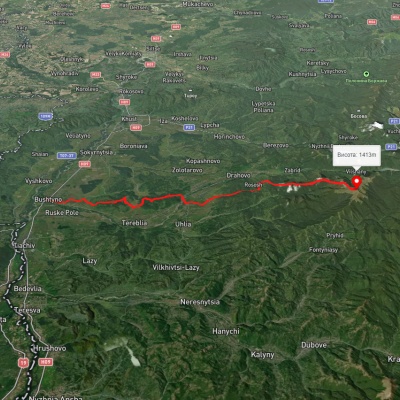
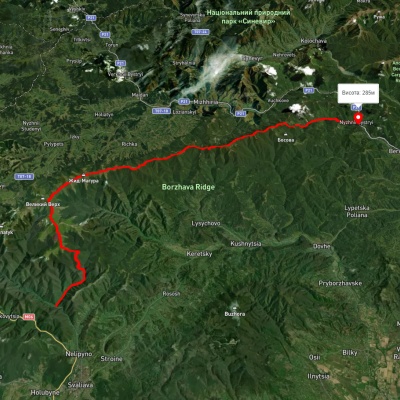
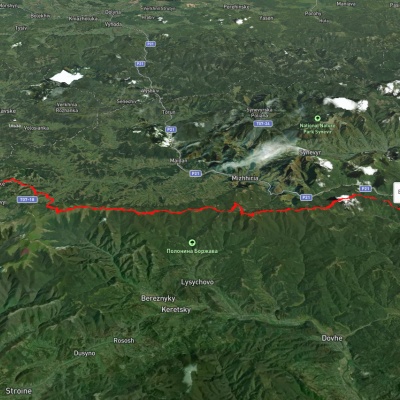
Which trails pass by Church of St. Paraskeva, Oleksandrivka?
We suggest these hiking trails through or near Church of St. Paraskeva, Oleksandrivka: Bushtyno, via Zanivka tract to Mount Manchul, Vovchyi village, via Mount Stiy, Mount Zhyd-Mahura, Pryslip Pass, Kuk polonyna, Mount Korytyshche and Shyroke village to Nyzhnii Bystryi village, Skotarske village, via Borzhava polonyna and Palenyi Hrun polonyna to Nyzhnii Bystryi village, Pyntia's Path, Skotarske village, via Borzhava polonyna and Palenyi Hrun polonyna to Vilshanske reservoir, Carpathian Tourist Trail