Church of St. Elijah, Chinadiyovo
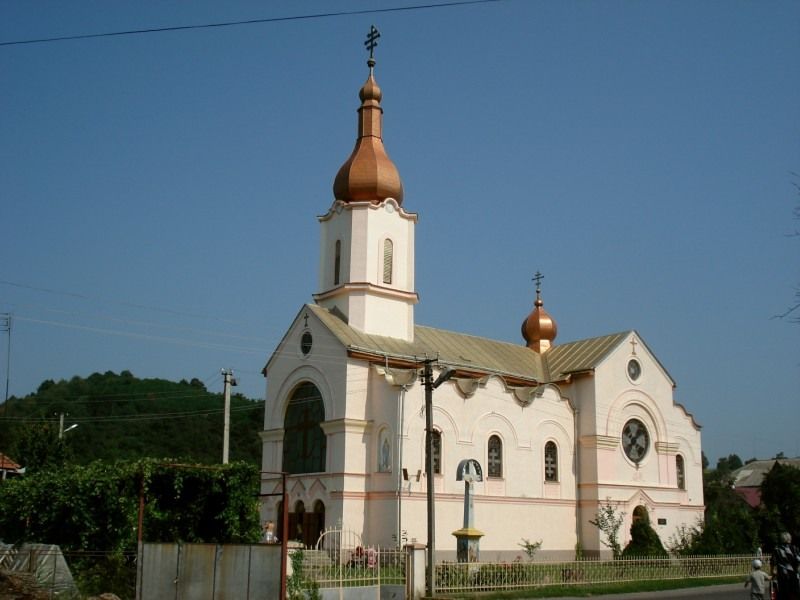
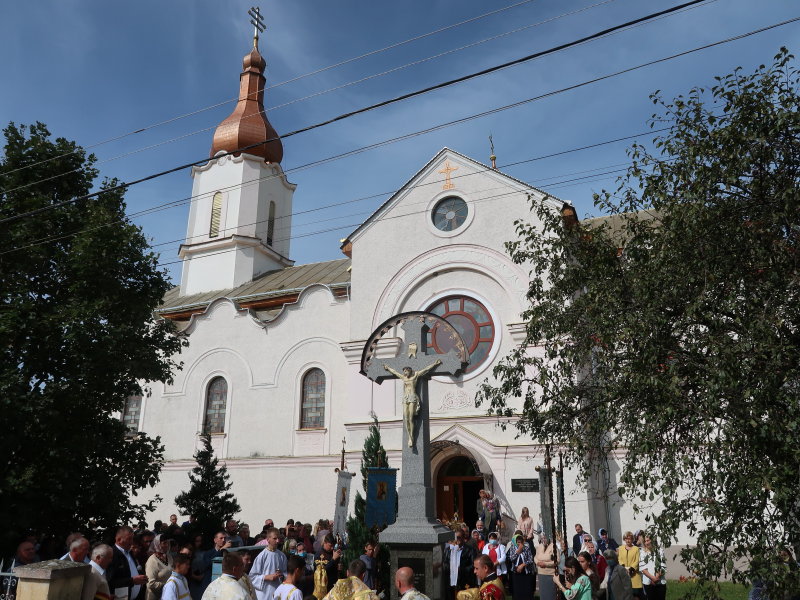
The Greek Catholic Church of St. Elijah is located in the village of Chynadiyevo in Zakarpattia. The church is a cult ancient building. Tourists and believers are attracted here not only by its beauty, but also by a mysterious relic kept in the church.
The villagers had the opportunity to build a new church back in 1900, when, as they recall, Count Schönborn married his daughter and on this occasion offered to build a church or a school as a gift to the village. The village chose a school because the old church could still accommodate the faithful.
The new church, built by the efforts of the people-friendly priest Yulii Durko (1891-1974), belongs to a new generation of stone churches of the late nineteenth and early twentieth centuries-large (577 square meters) and more elaborately constructed than the churches of the nineteenth century.
The previous clergyman, Ivan Izydor Mustianovych, began raising money for the new church and collected 6500 Czechoslovakian crowns. Julius Durko, who came to Chynadiyevo on March 15, 1931, together with his curators Vasyl Kohut and Ivan Sirutko, went to every villager regardless of their faith and collected 30,000 crowns. They also sold the farmer's vegetable garden for 36825 crowns and the farmer's land "Berezynka" for 18,000 crowns (the priest was allocated another land).
Curators, entrusted by the community to raise money for the church, went to different parts of the then Czechoslovakia and collected 200 thousand crowns. (Interestingly, the largest amount of money, 80 thousand, was collected in Moravia.) The state allocated part of the funds, and thus they received the necessary 500 thousand crowns.
It took a long time to decide where to build the church. Initially, the community wanted to buy a plot near the People's House, but the Latorica company that owned the land set a very high price. Some advised building on the site of the old church, but most decided to preserve the ancient monument. Then Fr. Durko allocated a part of his land, to which he added a part of his garden and the deacon Vasyl Vasko. Since the site was quite low, about 2000 cubic meters of clay and gravel had to be poured. The main stone was dedicated by Archdeacon Fr. Yurii Leshchyshyn, and the sermon was delivered by a priest from Ryapid, Fr. Yevhen Bellovych. Mykola Bubriak was the village elder at the time, and then Ilya Skyba. The plan of the church and calculations were made by Uzhhorod engineer Emilian Egreshiy, and the construction was headed by Czech Hanus Reisinger, a civil engineer from Tyachiv.
They began construction on August 15, 1932, and tried to complete the building that year, but the wet autumn and early frosts in November, as well as the financial crisis that swept the world in 1932, prevented them from doing so.
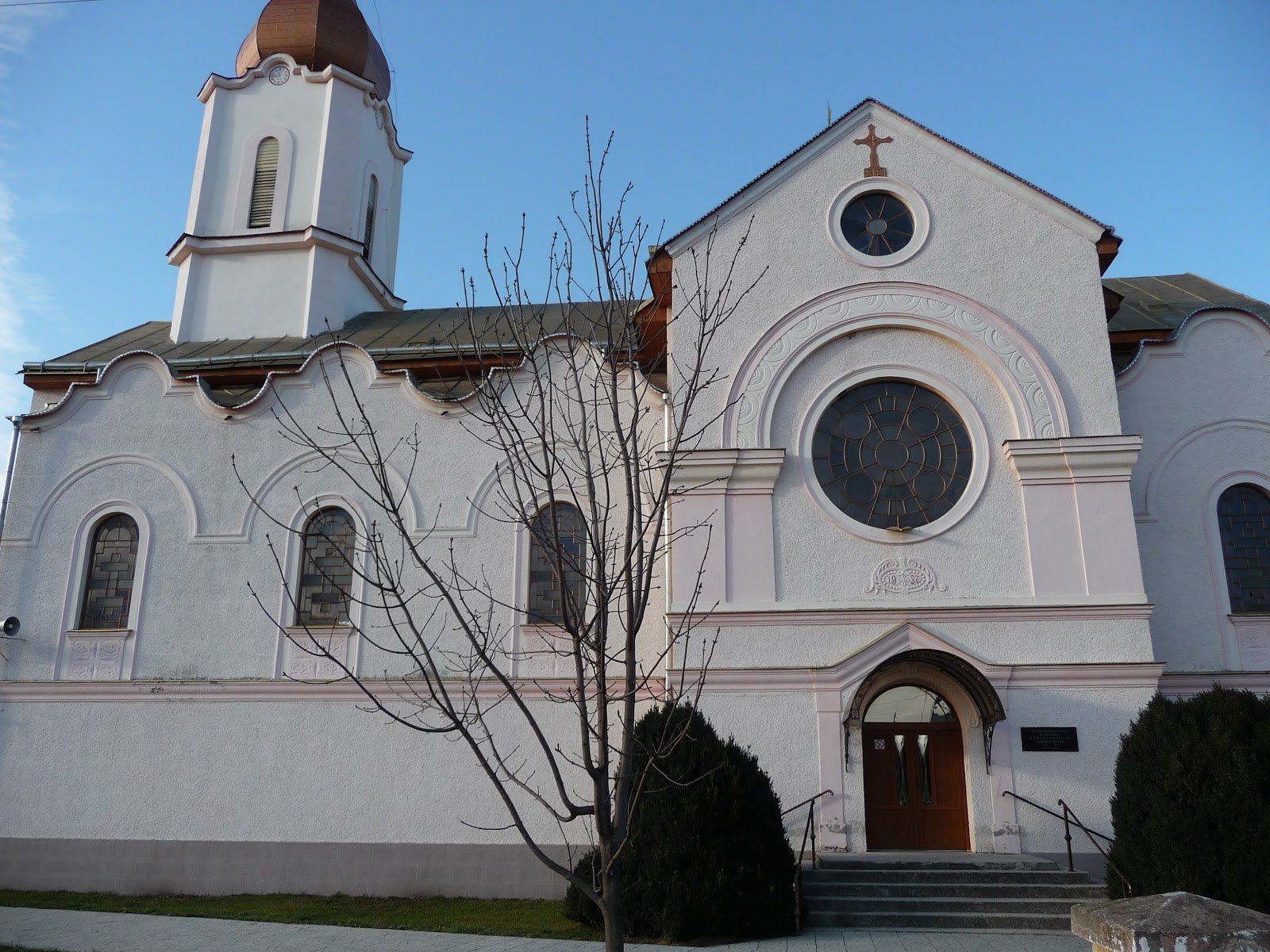
The church was built of brick on a 2-meter-high plinth, set on a 1-meter-deep foundation. The length of the building is 34.7 m, and its greatest width is 17 m. Two rows of columns divide the nave into three parts and also support the roof. Reinforced concrete pillars and belts form a strong frame. Metal window frames and a metal fence were made by a resident of the village of Bubriak, nicknamed Matadii. The iconostasis was moved from the old church, but since it was smaller, it was completed by local craftsmen Ivan Khalyavka and Mykhailo Skyba. The latter also made doors, pews, and other carpentry. The bells were bought with money earned by the villagers in America. One bell bears the name of the donor, Mykola Bubriak. The church was dedicated by Bishop O. Stoyka on the feast of St. Elijah in 1937. The interior was painted by artist O. Selivanov in 1955-1956, and in 1994 he updated his work.
The old church was taken over by a small Roman Catholic community of local Germans and Hungarians. With the advent of Soviet rule, St. Elijah's Church was handed over to the Orthodox, and an ethnographic museum and art gallery were opened in the old church. The priest Yurii Durko was forced to convert to Orthodoxy under threat of imprisonment, and this tormented him for the rest of his life. In the early 1990s, St. Elijah's Church was returned to the Greek Catholics, and the Orthodox moved to Mykolaivska.
The church was originally built in the Gothic style, but subsequent repairs and reconstructions changed it. Now you can see features of Art Nouveau, Baroque and Classicism. In 2002, not far from Chynadiyevo, Mukachevo woodcutters were cutting down trees and came across a beech log that they could not split. After many attempts, they threw it and it split by itself. Imagine their surprise when they saw the image of a cross on the inside of both halves. At first they were frightened, but then they decided to give one half to the Orthodox Church in the village of Berestove and the other half to the Church of St. Elijah in Chynadiyevo. This relic is worth seeing with your own eyes.
Accommodation around Church of St. Elijah, Chinadiyovo:


Nearby hiking trails near Church of St. Elijah, Chinadiyovo:


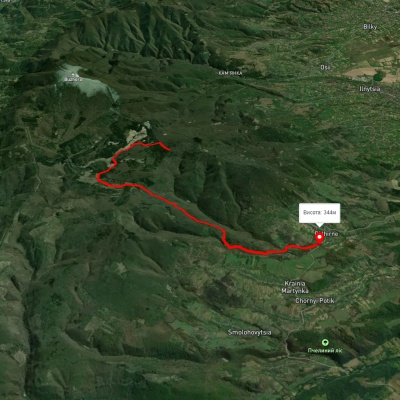
Which trails pass by Church of St. Elijah, Chinadiyovo?
We suggest these hiking trails through or near Church of St. Elijah, Chinadiyovo: Lukovo village, via Mount Buzhora to Svaliava, Pylypets village, via Mount Hemba, Mount Stiy and Vovchyi village to Svaliava, Pidhirne – Chorne Bahno – Kupinkuvate, Polianska Huta village – Runa polonyna – Polianska Huta village, Turia Poliana village, via Voievodyn Waterfall and Runa polonyna to Lumshory village, Turia Poliana village – Voievodyn Waterfall