Church of the Assumption of the Blessed Virgin Mary, Novoselytsia
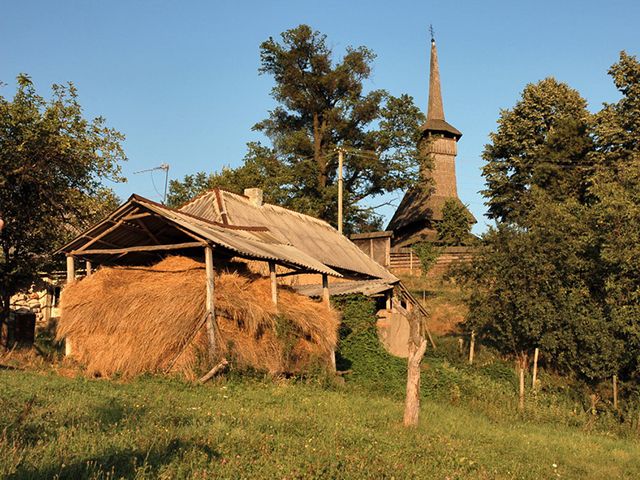
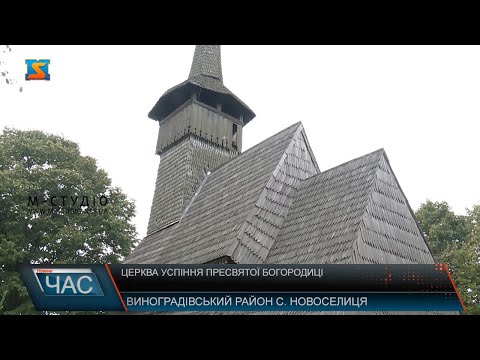
The Church of the Assumption (built in the mid-17th century) is located in the center of Novoselytsia, a small village in the Zakarpattia region. Its full name is the Church of the Assumption of the Blessed Virgin Mary. The church belongs to the small architectural masterpieces of the Gothic style, a monument of Ukrainian folk architecture and painting, an architectural monument of national importance (No. 181). The uniqueness of the church is that it is the smallest wooden church of the Gothic style in Transcarpathia. Its proportions are considered ideal.
In the village of Novoselytsia, on a hill in the center of the village, there is the Church of the Assumption of the Blessed Virgin Mary. It is a wooden church of perfect proportions, perfectly integrated into the panorama of the village. When the church was built, only 14 families lived in the village. Although there is an inscription in the Babynka that reads "this church was built by Kochalovych in 1669," the famous Ukrainian art historian and architect Hryhorii Logvyn claims that the church was built in 1654-1656, because it was already being painted in 1662 (this is evident from the cryptic inscription under the "Last Judgment").
The church served as a stronghold and defender of the original national traditions. It is small in size but majestic with exquisite architectural forms and wall paintings. The church became a part of the treasury of Ukrainian folk art. In terms of style, the monument belongs to the group of Transcarpathian wooden churches of the Potyssia region, which fully express the spirit of Gothic architecture.
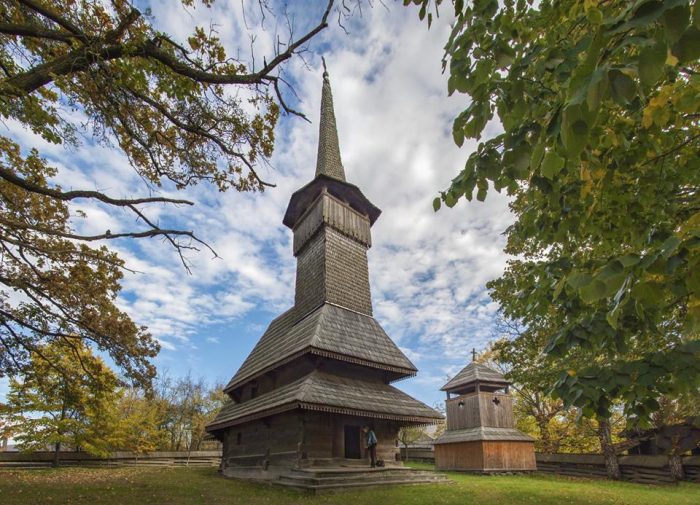
Mykhailo Syrokhman wrote this about the church: "In the village, which was first mentioned in the records of 1619, by a happy coincidence the first village church, one of the most outstanding monuments of Ukrainian church building, has been preserved. The Church of the Assumption of the Blessed Virgin Mary is an architectural ideal. It has perfect proportions and fits perfectly into the panorama of the village. In addition, it fully reveals the possibilities of wood as a material, and the material is vertically arranged in an amazing way and takes the form of an arrow, a flying structure, somehow tied to the earth's surface. It is the smallest Gothic church and at the same time the lightest and most dynamic. All parts of the church are beautifully proportioned and textured: the equally wide log cabins of the narthex and nave, covered with a common steep roof and covered with a cupola, the small altar log cabin under a high roof, the slender tower with a high spire tip that gives the church an unrestrained vertical sound. Perhaps the secret of perfection lies in the size of the oak walls, the proportions of the parts, and the angles of the roofs and the dormers."
In July 1944, Dr. Mykola Dudash, Bishop of the Haidudoroh Greek Catholic Eparchy and Apostolic Administrator of the Mukachevo Eparchy, appointed Fr. Ivan Matejko as pastor in the village of Novoselytsia, where he performed pastoral work until the so-called self-dissolution of the Greek Catholic Church and its ban in Transcarpathia.
And today, more than three centuries later, the church is admired for the skill of its ancient architects, the perfection of its lines and forms. Artists from Lviv restored the ancient wall paintings, and village craftsmen built a new wooden fence and steps.
Nowadays, no services are held in the building, as the church has been a museum since 1960. In 1990, the building was awarded the title of "People's Museum," and Natalia Vamosh is the museum's director.
In the summer of 2007, restoration work was carried out in the church. In 2008, thanks to an EU grant, the roof shingles were replaced with new ones. The only condition the Europeans had for the materials was that they had to be authentic.
TheChurch of the Assumption of the Blessed Virgin Mary is made of wood, wide oak beams fastened with buzzard locks, without a single nail, and solid linden boards decorated with carvings in the form of sunflowers. The joints of the beams are sealed with paper or wooden planks. The height of the oak walls is 224 cm, and the width of the narthex is 110 cm. The temple is very small, 14 meters long, with equally wide log cabins of the narthex and the nave, covered by one roof. The wall between the narthex and the nave with a doorway (136 cm) is blank. The eastern part, which is narrower and lower, is also rectangular in plan, covered with a separate roof that merges with the eaves above the bend of the main log house. The tower above the Babinets, square in plan, is crowned with a high spire with an apron resting on a pier decorated with a vertical shawl with a cutout. All roofs and walls of the tower are covered with oak shingles. The 54-cm-wide door jambs have a brilliant ornamental composition of solar signs - sunflowers, cloves, and ropes. The height of the front door is 127 centimeters. The door leaves are carved from a solid linden log.
The entire church is covered with oak wedges, which gives a peculiar texture to the roof planes. The lower row of shingle has figuratively carved ends that create an interesting lace of light and shadow on the wide log beams.
The church is lit from below by small windows and later cut windows above. The window panes have been preserved in their ancient form - round glasses framed by oak slats. Initially, the church had windows 33 cm high; they were replaced with 50-55 centimeter windows in 1893.
Lviv architects H. P. Kruk and I. R. Mohytych restored the church in 1979-1980, and artists H. P. Druziuk, L. S. Skop, N. A. Skrentovych, and N. I. Slipchenko deserve thanks for the painting that was saved in 1979-1981.
To the northwest of the church stands a wooden frame, rectangular in plan, two-tiered bell tower, a monument of the 18th century. The height of the bell tower is 25 meters. The oak frame structures in two tiers are vertically sheathed with boards. The lower tier is extended. The hipped end of the bell tower and the roof extension are covered with shingles. Oval voice boxes (one on each side of the bell tower) are cut into the roof of the upper tier. Originally, the bells were located in the quadrangular tower of the church. They were very heavy, and the tower swayed along with the spire. Then the villagers decided to build the bell tower separately. To this day, three bells are kept here.
The main treasure of the church is its seventeenth-century wall painting, which has partially survived to this day. The mural was made on the oak beams of the church. A glue and chalk primer was applied to the beams, on which paints were applied. The murals were made using the technique of glue painting.
The murals are characterized by a variety of styles and a folk interpretation of religious painting. It is organically combined with the architectonics of the church, which together creates a unique ensemble. The walls and vaults of the central volume were painted in the second half of the seventeenth century by artists of the Galician school of painting and in the eighteenth century by local Transcarpathian artists.
The paintings were commissioned by individual villagers. The central composition "The Rite of the Lord" (prayer) was painted in 1673 by artist Ioan Ivankov on the request of Yura Ivanyshyn. In 1673, the "Last Judgment" on the north wall of the church was commissioned by Yura Petryshyn, the icon "St. Nicholas with the Life" was painted in 1776 by Franciszek Malyar at the request of the Yatskanych brothers, and the "Passion" was painted by Andrii (his surname has not been preserved). One of the books was bought for the church by Ivan Svitlyk. On the eastern wall of the church there is a mural of the Crucifixion and the Apostles' row. The wall paintings have significant artistic value. Thus, the Mother of God is the embodiment of boundless maternal love; her face shows meekness, care, grief, and humility. She foresees the suffering that her son and she are destined to experience. Mary clutches the baby tightly to her, as if afraid to part with him, but still goes forward, carrying her son.
The gilded iconostasis is decorated with magnificent carvings. It depicts a whole series of paintings "The Twelve Feasts of Jesus." In the early nineteenth century, a new Rococo iconostasis was installed, which had a very negative impact on the wall paintings. The church's architecture, painting, and carvings are among the most striking works of the seventeenth-century Transcarpathian school of Ukrainian art.
There is a legend about why the church is located in the center of the village on a hill. Once upon a time, a lady was passing through the village. She was carrying two bags of gold. It is not known where a great wind came from. Nothing could be seen around her. The lady was very frightened and whispered: "Lord, help me to get out of this danger, stop this evil. And for your mercy, God, I will build a church on this place as a sign of gratitude." And as soon as she thought that, everything around her became quiet and stopped. The sun appeared in the sky. The lady remembered this place and started looking for workers to build the church.
There is also another legend in the village about the famous opryshok Pintya. Pintya was passing through the village and saw that a church was being built. He took an ax and started working. He didn't work for long, because he was called to a campaign. He stuck his axe in the iconostasis so that when he returned he could continue working. The giant died, but the ax remained. People say that every year it rises higher and higher. And when it is visible to everyone, then Pintya will return to the village.
Another legend is related to the attacks of the Turks. When the Turks came, killing everyone on their way, the villagers fled the village and hid in the neighboring forests. However, one did not make it. Then a large linden tree grew near the church, and he hid in a large hollow in it. The invaders, having taken everything they could, finally decided to burn the church. They put straw or hemp on it and set it on fire. And the man from the hollow exclaimed: "Oh, God, what are you doing?" Then the enemies ran away from the church without looking back, thinking that they had angered the local powerful God. The villager got down from the tree and put out the flames.
It is said that during one of the attacks of the Turks, the villagers decided to hide the church bell by burying it near the village. When the Tatars left, they began to dig up the bell, but never found it. "The earth has taken the bell," people decided. After that, in the place where it was buried, the bell is heard once every 7 years.
Accommodation around Church of the Assumption of the Blessed Virgin Mary, Novoselytsia:

Which trails pass by Church of the Assumption of the Blessed Virgin Mary, Novoselytsia?
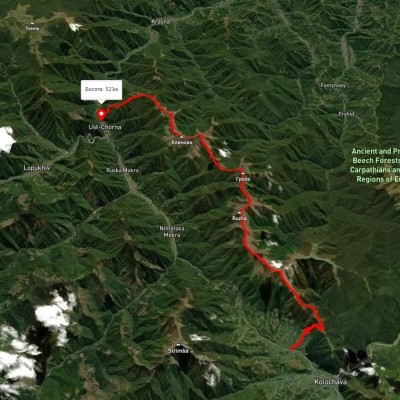
We suggest these hiking trails through or near Church of the Assumption of the Blessed Virgin Mary, Novoselytsia: Dubove village, via Mount Apetska, Mount Dohiaska, Mount Stih and Mount Blyznytsia to Kvasy village, Dubove village – Mount Apetska – Dubove village, Bushtyno, via Zanivka tract to Mount Manchul, Transcarpathian Tourist Trail, Kolochava village, via Mount Syhlianskyi, Mount Klymova and Mount Ruzha to Ust-Chorna village, Synevyr village, via Mount Nehrovets, Mereshor village, Krasna ridge, Ust-Chorna village and Svydovets ridge to Kvasy village



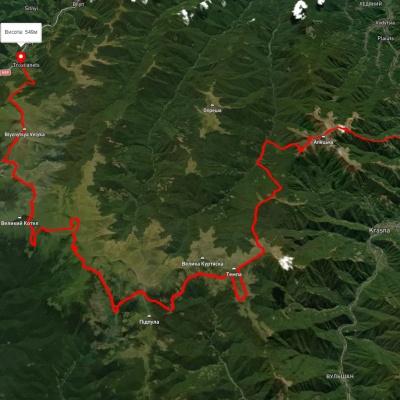
Dubove village, via Mount Apetska, Mount Dohiaska, Mount Stih and Mount Blyznytsia to Kvasy village
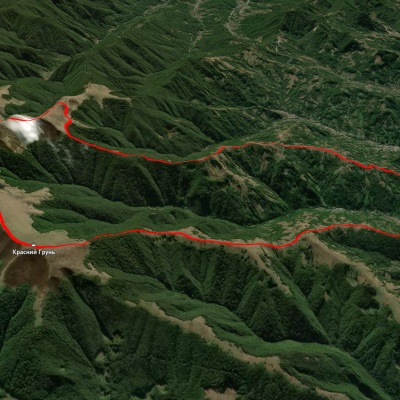
Dubove village – Mount Apetska – Dubove village
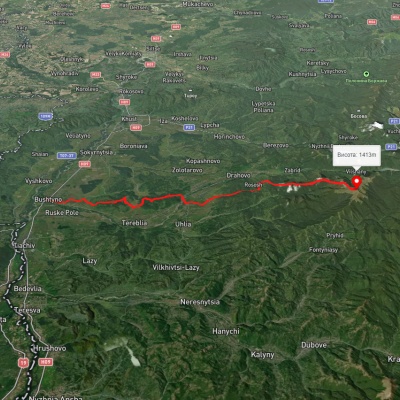
Bushtyno, via Zanivka tract to Mount Manchul
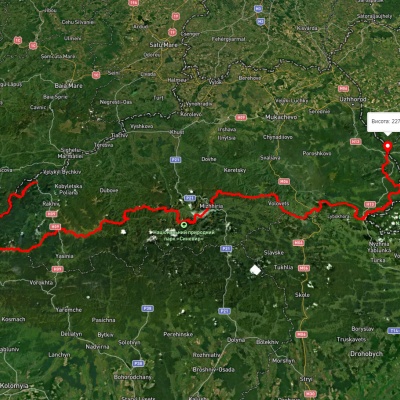
Transcarpathian Tourist Trail