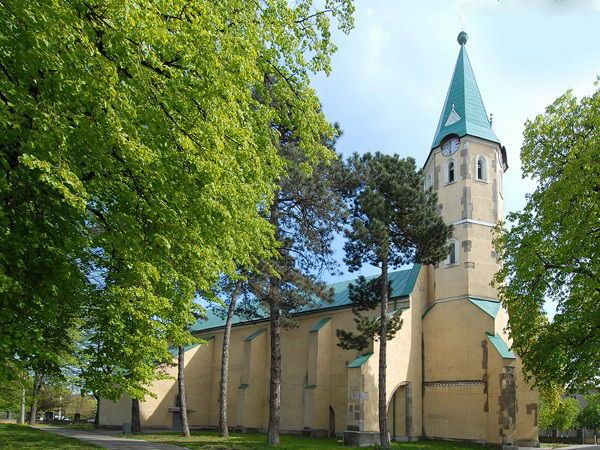
Church of the Ascension, Vynohradiv
TheChurch of theAscension is an architectural monument of national importance (protection number 175). The building is located at 12 Myr Street in the city of Vynohradiv , Vynohradiv district , Zakarpattia region. The local parish was founded in the XIII century, and the modern Gothic brick church is believed to have been built in the XIV-XV centuries. In the XVI-XVII centuriesthe church was rebuilt (for some time it belonged to Protestants). In 1863, the parish was restored, and in the seventeenth century it was moved to a newly built Franciscan shrine. In 1902, the shrine was painted and a sharp spire was installed on the tower instead of the Baroque one.
It is a stone, one-nave building with fortified buttresses. Previously, it served for defense purposes for Vynogradiv, and its three-tiered bell tower served as a watchtower. The church has been rebuilt many times during its existence. In the 18th century, the church was reconstructed, after which it acquired its present appearance.
The Church of the Ascension was built in the style of minimalism. The stucco coat of arms above the entrance, fragments of ornamental fresco painting, stone carvings in the Gothic style, Romanesque and Gothic portals located on the northern and southern facades ... all this has been preserved in its original form.
In 1262, the city of Vynohradiv and its inhabitants, along with privileges, received from the king the right to personally elect a parish priest. There is mention of a man named Vida who was a priest in 1277. From various documents dating from the late 13th century to the early 14th century, it is known that the parish in Vynohradiv was directly subordinated to the Archbishop of Esztergom. Sources dating back to 1320, 1321, and 1329 mention the parish priest Peter and the church in Vynohradiv, which was dedicated to the Blessed Virgin Mary. In 1320, the vicar of the Berezko-Maramarosko-Uhochany zhupa received an order from the bishop of Esztergom to defend the rights of the priest Peter, whom the townspeople wanted to dismiss. They wanted another person to take care of the church. In 1329, the appearance of a priest named Bertalan is known. The priest Peter initiated a case against Bertalan, which was submitted to the Esthers Archbishop Chanad Telegda in 1337. At the end of the 14th century, Baron Peter Perenyi became the patron of the parish. In 1419, the parish priest was also named Peter, but it was a different person, not Peter Pereni. In the same year, the church building received a certain amount of money from the chaplain of Rzeszow, Pala, but it is not known how it was used. It could have been used for repairs or maintenance of the building. In the 15th century, a painting was commissioned for the church by the artist Gashpar. The exact purpose of the order is not known, but it could have been required due to the reconstruction or repair of the building. The first mention of the parish church in chronicles dates back to 1450. After that, the priest Shabeshten Madi is mentioned. In 1545, there was already a law in force, according to which both the parish priests and the priest of the village had to post their soldiers to defend the territory. In the early 16th century, about 20 monks took care of the church. In 1556, it was partially destroyed and became the property of Franciscan monks.The Reformed faith spread through the town thanks to the Pireni family. Since 1540, they have been influential in the church. In 1747 the church was rebuilt. In 1748, an embossed coat of arms, which belonged to Bishop Barkoczi of Eger, appeared above the main portal of the building. This could have been due to the transfer of the church to Catholicism. In the 18th century, the interior of the church was rebuilt. There are references to the next reconstruction in the 19th century. In 1864, drawings concerning the church were made by Ferenc Schultz, who accompanied the founder of scientific archaeology in Hungary, Floris Romer, and the scientist Imre Genslmann, on their trip to explore the church. In 1880, it was planned to reconstruct the building, but it was not realized. In 1900, Viktor Myshkovsky prepared a series of drawings of the church on behalf of the National Committee for the Protection of Monuments of Antiquity and Culture. The building acquired its modern appearance in the early 20th century. In the 1970s, restoration work was carried out, during which portals in the Gothic and Romanesque style were discovered on the facades of the building. In 1998, the building was transferred to the Roman Catholic Church.
The building is oriented to the east. It is located on the site where the main town square used to be. The walls and carved structural elements are mostly preserved in their medieval state. During the reconstruction in the 18th century, square pilasters were added to the apse and nave. Brown stone was used to create the hewn structural elements. In addition to stone, brick was used. The plan of the nave was rectangular in shape. On the east side it was connected to the apse. The apse is only slightly narrower than the nave. A square-shaped sacristy adjoins the northern wall of the apse. The building is surrounded by a cement plinth. A stone plinth can be seen near the sacristy, which could belong to the original structure. Rectangular stone was used to build the buttresses. There is a possibility that before the reconstruction they were completed with drip mouldings and vice plates, but the details of the structures are unknown. The buttresses support the horns of the apse and parts of the southern wall.
The apse walls have several sections. Some of them have no windows, while others have one window each, which has a sufficient width, a lancet ending, and a flared profiled glyph. The windows on all the walls have similar arrangement and details. There is no decorative frame ornamentation in the Gothic style. It did not exist in the second half of the 19th century. There is a possibility that the window and portal were built at the same time or were elements of a single structure.
The western wall of the sacristy contains a window that was built after the construction of the other elements. There are no openings on the north side. On the east side, there is an opening that has similar outlines to the window structures of the abyss. The glyph has similar profiling and a lancet ending. However, its dimensions differ because it is smaller than the windows of the apse. Three quads can be seen on the east wall, which is evidence that the entire sacristy was built of them. To reinforce the northern and southern walls of the nave, two buttresses were placed, each with one ledge. Their parameters are similar to the buttresses of the apse. The buttresses divide the wall into parts, but the distance between them is not equal. There are also buttresses near one of the nave's horns. The one to the south has a single ledge. This buttress could have been built in the 19th century. There are three sections in the southern wall of the nave with openings in them. The openings along the edges contain windows with a simple glyph that has a slanted shape. They are also characterized by a lancet ending. The north wall of the nave, which is divided by buttresses, also has several openings. They are similar in size and location. They are located at the same distance from each other. They may have their original shape, and the window sills were replaced later. The material used to make the windows is different from the material used to construct the entire building. On the eastern side of the three windows, traces of a bricked-up window structure with a boxed end are visible. The glyph of this window was perpendicular to the entire wall plane. On the north side of the façade there is a portal with a semicircular ending. The tower is located in front of the western façade. It has several tiers. The lower ones are square in shape, and then the tower has eight corners. An unfinished coat of arms in the Baroque style can be seen on part of the building. The tower's cap, which has survived to this day, could have been built in the early 20th century. Baroque pilasters divide the nave into four segments. The remains of a spiral staircase have been preserved in the attic. There are also elements of a medieval vault in the same room. The peculiarities of the arrangement of some elements indicate that after the construction of the original building, the nave also had four sections. The three-tiered bell tower of the church was previously used as a watchtower. The interior of the building has features typical of Catholic churches.
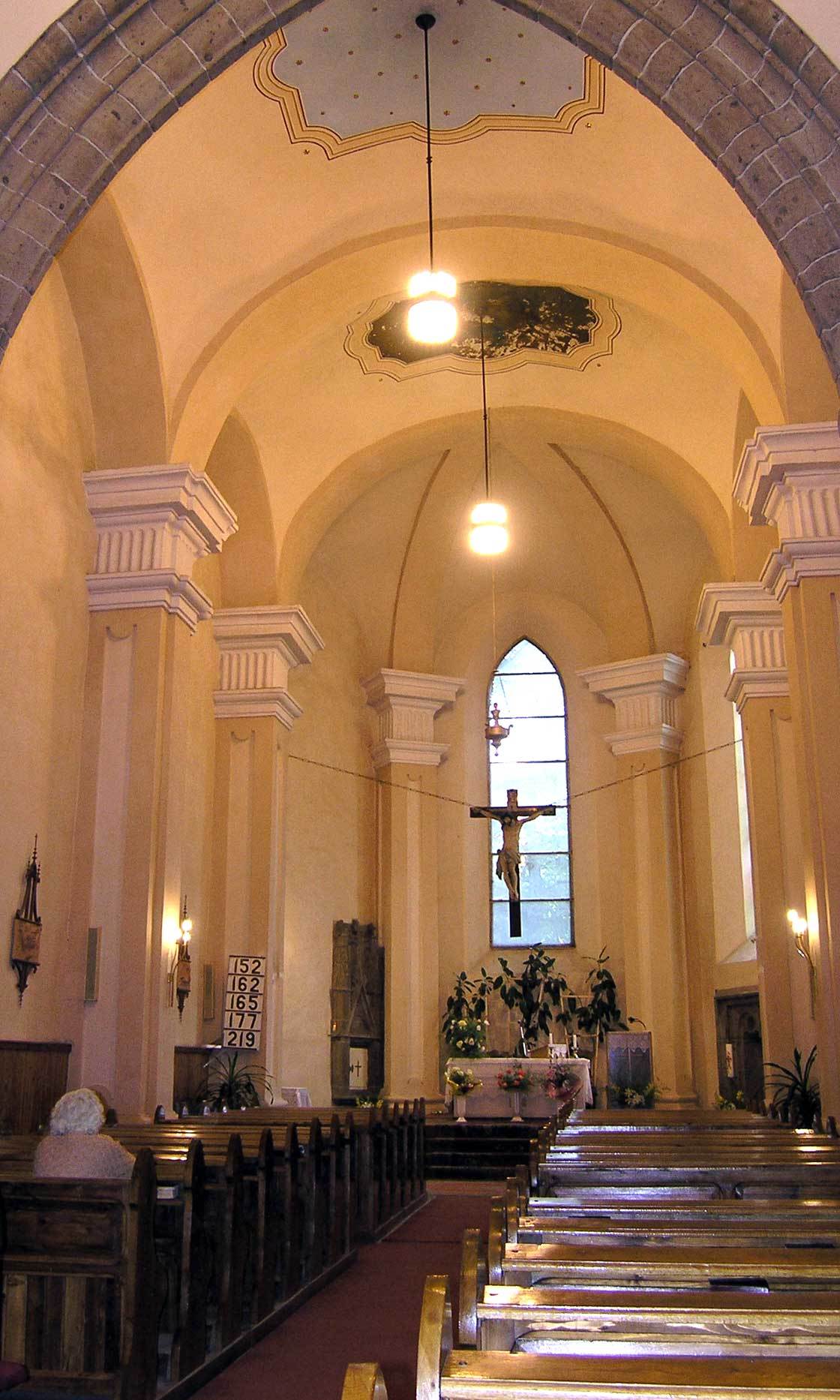
The triumphal arch has a lancet ending. It serves to separate the apse from the nave. There are rollers on the sides of the arch. On one of the sides of the triumphal arch are elements of the altar fence that was once used. Research suggests that the altar enclosure used to have only one wall. These remains are its small fragments. The findings could be fragments of the wall that was once the eastern side of the altar enclosure. In front of it was an arcade structure that corresponded to the corridor type. To preach sermons, the priests had to climb the altar fence. The southeastern wall of the apse contains a three-tiered sedilia. In the middle of the sedilia are three semicircular arches. They have modern complementary elements. The pastofarium is located nearby. It has three cornices with a similar profile. The sail vault serves to cover the sacristy. Some elements of the building contain remnants of paint that could have remained from ancient times.
Additional research is needed to determine the period of construction of the church. The north wall of the nave contains the earliest architectural elements. The material used to make them is significantly different from that used to make other elements. The apse was built later. It is a complete structure built in the same style. The same stone was used for its construction, and the profiling of the carved elements was quite similar. The southern portal of the nave was built in the 16th century. The Gothic building has vaulted ceilings. The combination of individual elements of Romanesque and Gothic architectural styles is reflected in fragments of ornamental fresco painting.
Today, the church is active. Visiting the Catholic Church of the Ascension will be really interesting for all visitors to the city. The parish is served by the Franciscans (theOrder of the Friars Minor), and the nuns of the Congregation of the Franciscan Sisters of Mary the Missionary work there.
Accommodation around Church of the Ascension, Vynohradiv:


Which trails pass by Church of the Ascension, Vynohradiv?
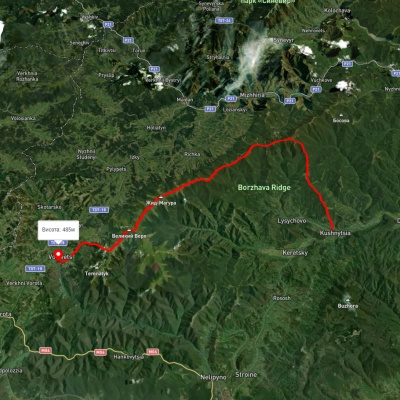
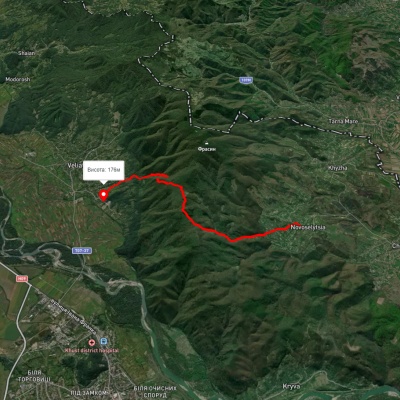
We suggest these hiking trails through or near Church of the Ascension, Vynohradiv: Pyntia's Path, Lukovo village, via Mount Buzhora to Svaliava, Novoselytsia – Smerekovyi Stone, Pidhirne – Chorne Bahno – Kupinkuvate, Kushnytsia village, via Kuk polonyna, Mount Shyrokyi Verkh, Mount Zhyd-Mahura, Mount Velykyi Verkh and Mount Plai to Volovets, Kerechky village, via Mount Stiy, Mount Velykyi Verkh, Mount Hemba and Mount Zhyd-Mahura to Rychka village



Pyntia's Path

Lukovo village, via Mount Buzhora to Svaliava
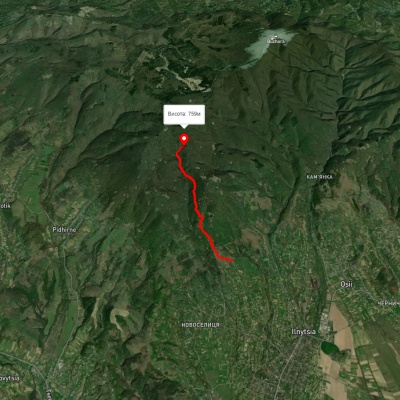
Novoselytsia – Smerekovyi Stone
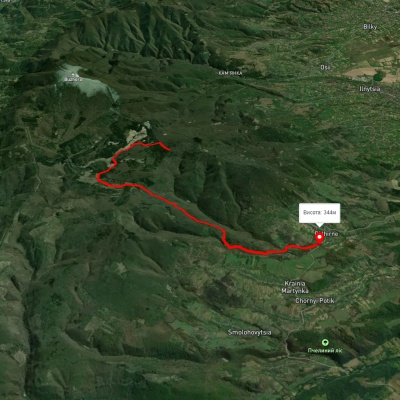
Pidhirne – Chorne Bahno – Kupinkuvate