Church of the Annunciation of the Blessed Virgin Mary, Kolomyia
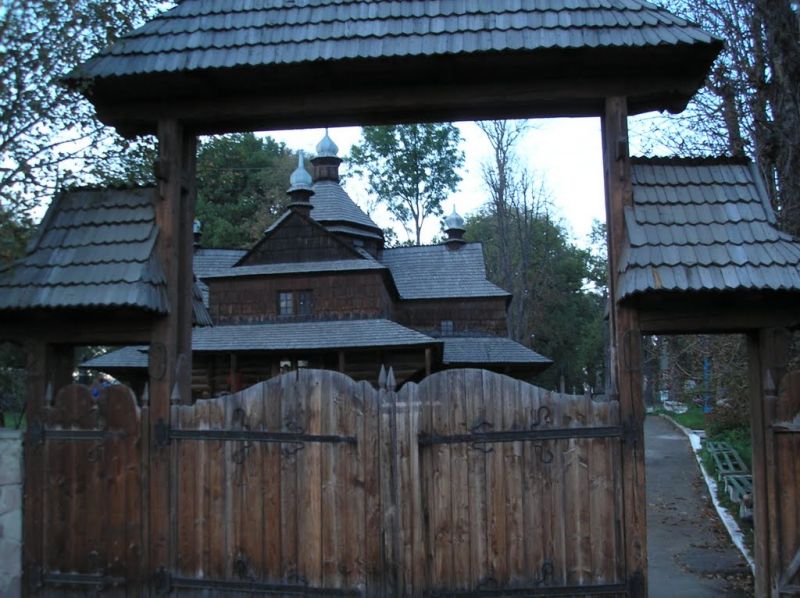
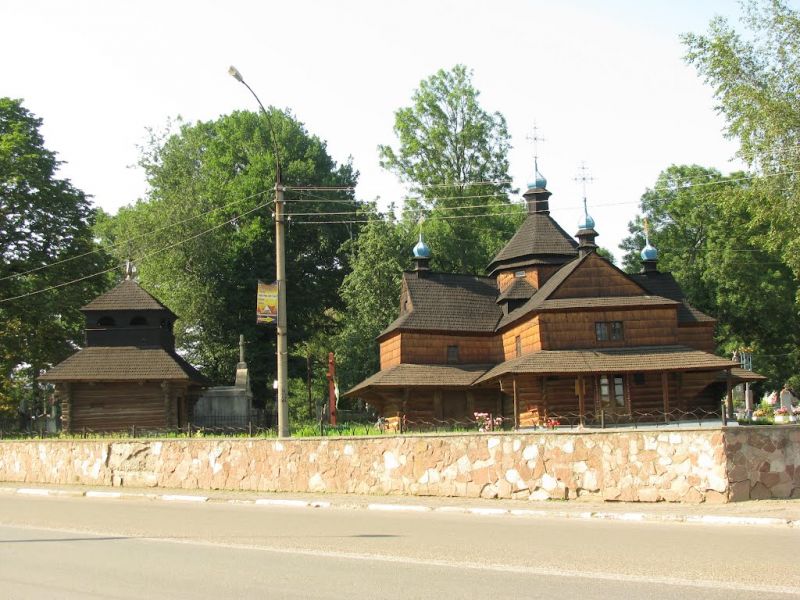
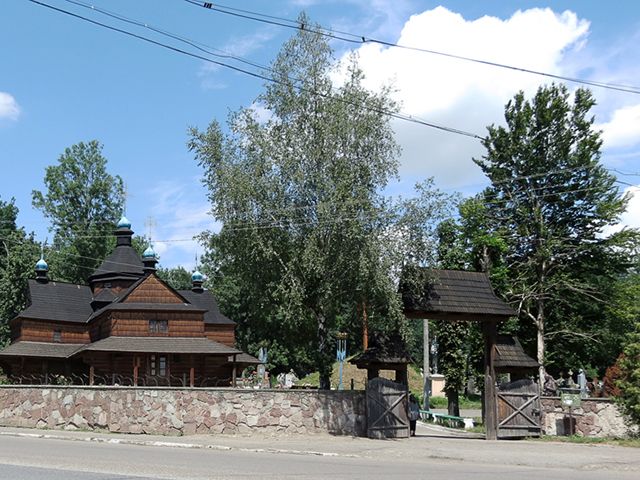
The Church of the Annunciation of the Blessed Virgin Mary is a functioning wooden church in Kolomyia, an architectural monument of national importance under the protection number 233/1 at 2 Karpatska Street. It is one of the best examples of Hutsul sacred construction.
The Crown Metric of 1522 contains information about visits to churches in several deaneries, including Kolomyia. This was the first indirect mention of the existence of an Orthodox parish in Kolomyia. In 1530, the Kolomyia starosta Otto of Hodcha gave permission to found the monastery of St. Archangel Michael. According to the lustration of the Kingdom in 1565, there were 4 Orthodox priests in Kolomyia, and in 1579 there were six. During the Turkish attack of 1589, Kolomyia was completely burned down, and its inhabitants were killed or taken prisoner. After that, the city was moved to a new location. A new monastery of the Annunciation of the Blessed Virgin Mary was founded in Kolomyia, which in the middle of the seventeenth century belonged to the Maniavsky skete. The "Triodion of the Flowers" printed in Lviv in 1663 contains an inscription about its transfer to the Kolomyia monastery by the abbot of the Lviv monastery of St. John the Theologian.
In Shematyzmy of the Stanislav diocese, in the 1920s, the parish priest Oleksandr Rusyn dated the church's construction to 1587, although the previous church was built that year in the old town cemetery of Monastyroky. The date of its construction, 1709, is preserved on the lintel of the southern door of the present-day Babynets. It was probably built by a craftsman from Sniatyn. The oriented three-tiered building consisted of a square nave with a dome, narrower narthexes, and an altar under gable roofs. A feature of the church was the archaic location of the entrances to the narthex and the altar in the southern walls. In the acts of visitation of 1742 and 1745 it was noted that due to the loss of rights the monastery was abandoned in 1732 and a few years later was transferred to Fr. The monastery had the Church of the Annunciation of the Blessed Virgin Mary and a refectory church without an iconostasis or any sort of altar. Nearby were two huts and a bell tower with 3 bells. The monastery grounds lay outside the city and were surrounded by a rampart to the north, and bounded by a stream to the west and south. They had gardens, vegetable gardens, and fish ponds.
In the 1753 visitation act, the church was called an ancient church with an altar, throne, and antimension with relics. The wooden cross on the throne is painted. A special feature of the building is the presence of one southern entrance to the narthex and the altar. The bell tower with 3 bells and the church are covered with shingles. In 1765 the church was renovated. When assessing the church's property in 1804, Father Theodore Baczynski noted that it was built on oak foundations of hewn fir wood with a new shingle roof. The church was valued at 250 rynski, the bell tower at 25 rynski, and the parish church of St. Archangel Michael of Kolomyia at only 43 rynski, and the branch Epiphany church at 95 rynski. The next mention of the church comes from 1839, as a branch church of St. Michael's parish. The parish priest, Fr. Ivan Ozarkevych (1837-1854), on the foundation of Hryhorii Lechnyk and Mykhailo Loivoniuk, rebuilt it (1845) into a baptistery. The reconstruction was probably carried out by the famous craftsman Ivan Raviuk from the village of Kolomyia, who built more than 18 churches. Two wings were added to the nave from spruce logs on oak foundations on a stone foundation, with an altar in the northern wing, an altar with a narthex and choirs, and the southern wing became the dominant one. They were covered with gable roofs with blind octagonal lanterns with tops. The church was surrounded by a large pediment.
Simultaneously with the reconstruction, a new Rococo gilded four-tiered iconostasis was installed (the date 1800 on the icon "The Last Supper"), which probably came from the dismantled church of St. Michael or Epiphany in Kolomyia. It is curved toward the altar and has no locum tenens icons. The feast day row is formed by six oval icons (each with two feast days) and the central "Last Supper". The Apostolic Row contains 6 icons with two Apostles and the central icon of the Bishop with the Virgin Mary and John the Baptist standing before him. The Prophetic Row consists of 12 oval icons and the central God the Father. The icons of the iconostasis date from the late eighteenth century. In the nineteenth century, the icons were rewritten by the painter Theophilus Kopystynskyi. In the 1944/45s, under the pastor Fr. A. Rusyn, the interior was covered with ornamental oil paintings by Ksenia Kichura and Zhygmont Orikhovsky.
After the Second World War, the church was first mentioned in scientific works by H. N. Logvin. In the early 1960s, the church was removed from the register of monuments and closed. But thanks to the intervention of H. N. Logvyn, in 1968 it was included in the National Register of Monuments of Ukraine under No. 233. It was restored in 1980, and the iconostasis was restored between 1980 and 1982. In 1983, a museum of Easter egg painting was opened in the church. On February 8, 1990, the church was transferred to the church community. In 2018, the church was returned to the Greek Catholics.
To add a comment you can: login or register.
Accommodation around Church of the Annunciation of the Blessed Virgin Mary, Kolomyia:


Which trails pass by Church of the Annunciation of the Blessed Virgin Mary, Kolomyia?
We suggest these hiking trails through or near Church of the Annunciation of the Blessed Virgin Mary, Kolomyia: Sheshory – Rosokhata, Opryshky Road, Kosmach village, via Mount Rotylo, Mount Hrehit and Mount Bila Kobyla to Bukovets village, Mykulychyn village, via Mount Khorde and Mount Rotylo to Kosmach village, Medvezhyi tract – Mount Kuratul, Nimchych Pass – Protiate Kaminnia
Photos
Map
The nearest routes
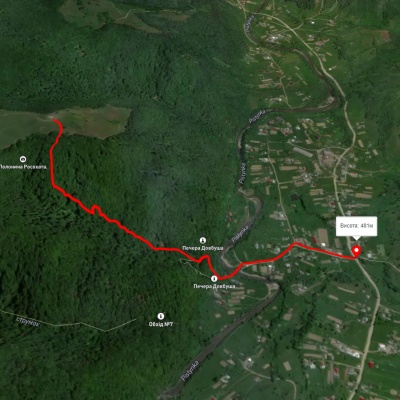
One-day routes
Sheshory – Rosokhata
Length: 1.6км
Total ascent: 61м
Total descent: 253м
Min. elevation: 464м
Max. elevation: 680м
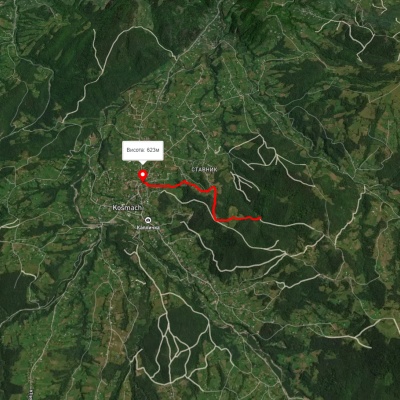
One-day routes
Opryshky Road
Length: 2.5км
Total ascent: 77м
Total descent: 157м
Min. elevation: 625м
Max. elevation: 762м
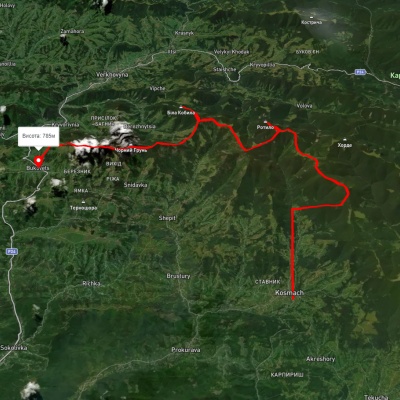
Three days or more
Kosmach village, via Mount Rotylo, Mount Hrehit and Mount Bila Kobyla to Bukovets village
Length: 40.2км
Total ascent: 1739м
Total descent: 1561м
Min. elevation: 612м
Max. elevation: 1461м
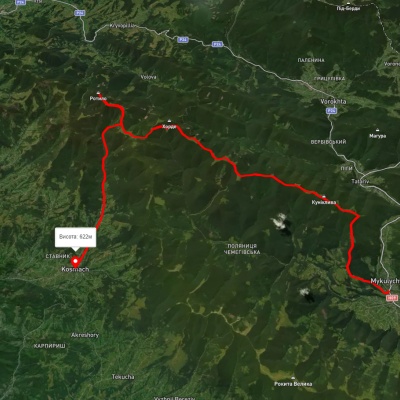
Three days or more
Mykulychyn village, via Mount Khorde and Mount Rotylo to Kosmach village
Length: 39.7км
Total ascent: 1591м
Total descent: 1567м
Min. elevation: 592м
Max. elevation: 1448м
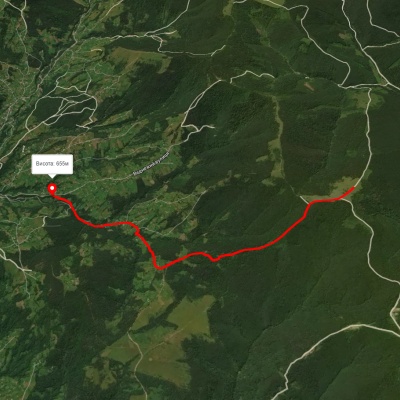
One-day routes
Medvezhyi tract – Mount Kuratul
Length: 5.6км
Total ascent: 100м
Total descent: 559м
Min. elevation: 648м
Max. elevation: 1112м
