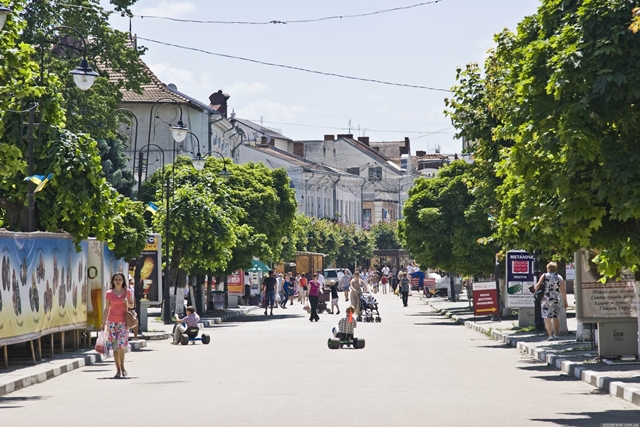
Chornovil Avenue, Kolomyia
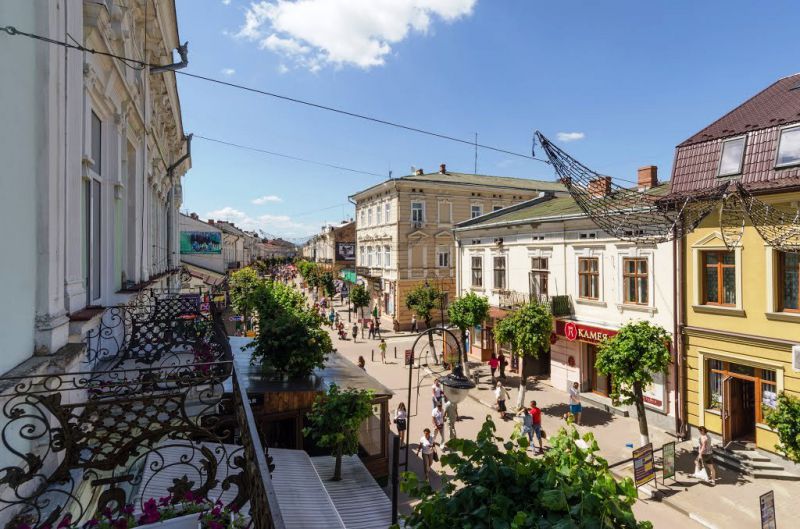
The main pedestrian street in Kolomyia. Just like in Ivano-Frankivsk, the main Chornovil Avenue in Kolomyia is popularly known as the "hundredth street". It's a popular walk for Kolomyia residents and tourists. There are many houses on Chornovil Avenue that were built in the late 19th and early 20th centuries. There is also a monument to Ivan Franko and the most famous object in Kolomyia, the Pysanka Museum, which we have already mentioned. The street starts from the Renaissance Square, opposite the town hall, and leads to Sichovykh Striltsiv Street. its length is up to 600 meters.
None of the city's streets was as affected by the changes in political systems as the central one, and this influence was reflected in its names: Jagiellonianska (until 1928), Pilsudski (1928-39), Lenin (1939-41), Hetman Mazepa (1941), Havptstrasse (Main, 1941-44), Lenin again (1944-90), since 1990 - Renaissance Avenue, since 2001 - Chornovil Avenue.
The avenue has long been the seat of the ruling class of Kolomyia, and all the houses built then were owned by the aristocracy. Sometimes administrative buildings were built next to residential premises, such as the starosta or the post office, but most owners mostly rented their premises to private individuals, both for housing and for offices and shops. The ground floors housed private shops and deposits, mostly owned by Jews and Poles, as well as various craft workshops, breakfast rooms, and restaurants, which were nationalized by the Soviet authorities in 1939-40. As one of the most lively arteries of the historic center, under all systems, whether it was called the "A-B line" or "stometrivka" or "corso", it was a favorite place for walks and business meetings for both young and old Kolomyia residents.
The vast majority of the buildings are from the mid-19th and early 20th centuries, and their facades partially lost their architectural decoration in the 1950s due to unprofessional attitude to the renovation of the historic center. Perhaps that is why the new unpretentious buildings that have subsequently appeared in the historic center are not so sharply discordant with the protected area.
- Buildings 1 and 3 form a single complex with buildings 12-15 on the Renaissance Square, so the second floors of these buildings were occupied by the Belle Vue Hotel, later the First Class Hotel and the Cita Coffee House, and the ground floors were occupied by shops.
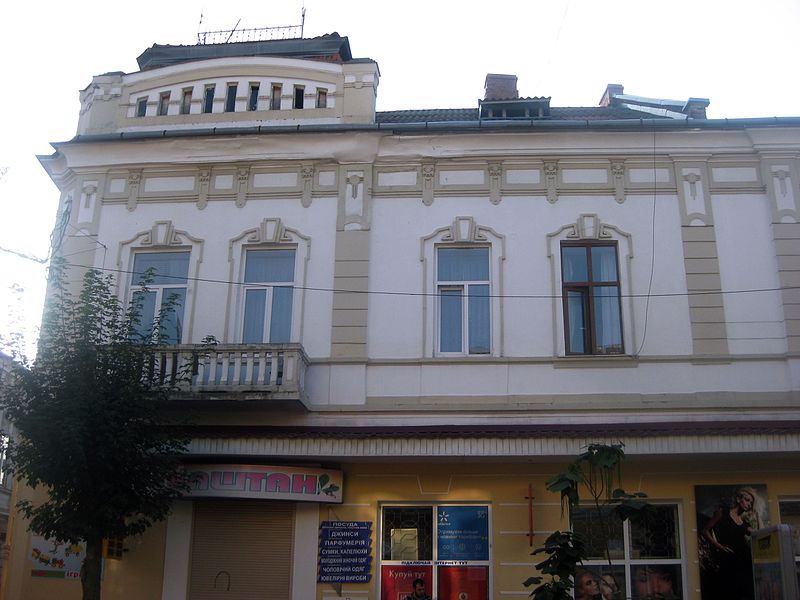
- House number 2. In the 1910s it housed a warehouse of Jacob Silber's metal products, in the 1930s a haberdashery shop of Leocadia Schubert, a warehouse of spare parts for technical devices of Karol Szuba (second floor); before the Second World War it was the site of a local Polish Masonic lodge. In the 1970s it was a shop called "Vutiuba" (Shoes), since 1994 it has been a shop of the Kashtan State Enterprise.
- House number 4. In the 20s of the twentieth century, it was the "Produktsiya" trading house, which offered "oil, gasoline, machine oils, soap, candles, and Sloboda brine."
- House number 5. In the 1890s, there was a hotel called the European Hotel, where a watch warehouse and Wilhelm Adel's workshop were opened in July 1891. Later the hotel was renamed the Bristol Hotel, owned by Bager Haim in the 1920s. The hotel had a restaurant (in 1931 Regina Wasner took over the management of the restaurant) and breakfast rooms. At the same time, the building housed S. Teichberg's workshop and hat warehouse. In the 1930s, there was a shop called Seide Landman and Sons, which offered fabrics and scarves; a shop and butcher shop owned by Ivan Stadnichenko. In 1941-42, the premises of the courtyard housed the editorial office of the magazine Volia Pokuttya (1941-42), an organ of the Kolomyia District Administration and the OUN (b) leadership (editor-in-chief Y. Khrystych), as well as the office of the Last News (1941), a supplement to Volia Pokuttya. In 1942, a professor of the Kolomyia Gymnasium, translator, playwright, and publisher Dmytro Nikolyshyn and his family temporarily lived on the second floor of the building; the city printing house (director O. Kichak) was located on the ground floor in the courtyard rooms. Members of the local leadership of the OUN (b) gathered in the offices of this institution. In the 1945-50s, the editorial office of the organ of the Kolomyia City Committee of the All-Union Communist Party of Bolsheviks, the Red Flag, worked there. Now the building houses the Berizka shop and the Yavir business enterprise (since 1994).
- House number 6. The building belonged to the Zalichkovy Partnership (20s of the twentieth century). On October 1, 1922, the Kolomyia branch of the state "Bank of the Regional Economy" was opened here, which was later moved to 48 Teatralna Street. In the 20s and 30s, the Bank of Pokutska Land also operated here. In addition, in the first half of the twentieth century. the first floor was occupied by a warehouse of herring and pickled fish by Moise Reicher (1913), a bureau and workshop of agricultural machinery by the Plez Brothers (products included wooden plows, iron mills for cleaning grain, chaff mills, etc.); Valeria Baraniuk's sweets and fruit shop Pomoryanka, Franciszek Pankiewicz's bicycles, printing presses, and technical supplies, and Antonii Stadnichenko's meat products. In the courtyard there were large warehouses of oil, candles, and various lubricants. Now it is a bakery shop and residential premises.
- House number 8. It was built in 1914. In the period between the two world wars, it was a mechanical workshop for knitting and weaving by the Reisel brothers, a store of so-called "colonial goods" by Bernard Zhabinsky (wines, cognacs, champagne, rums, coffee, tea, cocoa, southern fruits, canned fish), and a hairdresser's shop by Ivan Baraniuk. Today it is a residential building.
- House number 16. In the 1930s, the second floor housed Mykhaylyna Hnatkovska's photography studio and a sewing and typewriter shop. In 1941-1944, it housed the Ukrainian police. Now it houses a savings bank, a currency exchange office of the Aval Bank, and the Pivnyk cafe.
- House number 21. At the beginning of the twentieth century, it was a coffee shop called "Royal"; later in the 1920s it housed a restaurant and a hotel owned by Jan Berg. At the same time, it housed Teofil Haletskyi's hairdressing salon, the offices of an urban planning firm and the head of a mill construction firm, Frieda Brandes, and K. Witosławski's Opika pharmacy. Now it is a hairdresser's shop.
- House No. 23. In the first half of the twentieth century, the Salamander shoe store, Antoni Novotny's hairdressing salon, the radio equipment warehouse and photography studio of A. and M. Senkowski, and the office of the Royal Steam Brewery were located here. On the second floor is the apartment of Dr. N. Krumholz. In the 1970s, it was the Sputnik store of the Voyntorg.
- In the 20s of the twentieth century, the only Catholic hotel "Fritz" with breakfast rooms, a restaurant, and a comfortable veranda for social gatherings was located there; a chemical and bacteriological laboratory; the "Lecturer" bookstore, which, among other services, provided school textbooks for use; and F. Neheles' art studio. A former doctor of Viennese clinics, Dr. Jakob Sirota, lived in the house and received patients. Now it houses the children's cafe "Skazka" and the "Surprise" business enterprise, the city state archive on the second floor, and the "Photoceramics" business enterprise in the courtyard.
- House number 30. Before the First World War, the Austrian lancers used the building for their own needs, organized industrial and art exhibitions several times, later housed a military warehouse, and after the 1920s the Mars Cinema and the Ognivo workshop. In 1939-41, the cinema was renamed after S. Kirov, in 1941-44 it was renamed after the German Victoria, in 1944-90 it was renamed after S. Kirov again, and since 1990 it has been the Dzherelo children's cinema.
- House No. 32. It was built in the 1860s. Until 1939 it housed the Kolomyia starosta. In 1939-41 it was occupied by Soviet military structures, in 1941 by the Hungarian gendarmerie, and later by the German military department. In the 1944-50s, it was the investigative department of the Stanislavsk Oblast Ministry of Internal Affairs. Later it was the city children's hospital and polyclinic, now the administrative building of the Kolomyia Territorial Medical Association.
- House number 43. Since 1903, it has housed Henrik Rottenberg's Gambrinus restaurant with separate rooms for social gatherings, as well as a warehouse of Harlig and Rottenberg's haberdashery goods; in 1939, the editorial office of the Chervonyi Prapor newspaper; in 1941-44, the German Corner restaurant (headed by D. Kvasniuk); in the Soviet period, the Tea Room, Dining Room No. 6, and Ukrainian Dishes. Now it is a coffee shop, bar, and shop "GalPrut" of the Prut agricultural factory.
- House number 55. Until 1939, it was the Copernicus Polish School; in 1939-41, 1944-48, it was the Kolomyia Pedagogical School; in 1941-44, it was the Lesya Ukrainka Ukrainian School (director - V. K. Kulak). In 1948-53, it was the school No. 2 (girls' school); from 1953 to 1991, it was the city executive committee's office; in June-October 1990, it was the editorial office of the Kolomyia Bulletin; after 1991, it was the Kolomyia State Joint Tax Administration and Social Security Service.
Vyacheslav Chornovil Avenue is a living artery of the historical part of Kolomyia, a place for walks and business meetings, where every second person is a politician, if not a philosopher. One of the oldest names of the present-day Chornovil Avenue is Yahaylonska Nyzhnia (the street was named by the Poles in honor of their king Władysław Jagiełł, who granted the city Magdeburg Law in 1405 and later arrived here in 1411). This is a traditional place of residence for the aristocracy, with living quarters on the second floor. In the ground floor there were offices, shops, warehouses, and various craft workshops, mostly owned by Jews and Poles, which, however, were nationalized by the Soviet government in 1939-1940.
Thus, in building No. 2, which is now the Kashtan shopping center, a local Polish Masonic lodge operated before World War II. In the late nineteenth century, the complex of buildings overlooking the modern Renaissance Square housed the Galicia Hotel and Restaurant. During his student trip to the Hutsul region in August 1884, Ivan Franko stayed here, and for the last time he saw his former fiancée Olha Roshkevych. The townspeople of the interwar period of the twentieth century remembered this house for the performance of a newly fashionable black jazz band. Today, the first floor is occupied by the bustling Kolomyianka shopping center, named after the Brezhnev era, when it seemed that there would never be an end to shortages, patronage, and queues. The second floor was the former home of the City Torg, and the Medical Club with a cinema hall operated nearby. In the morning hours, the street near the deli becomes a continuation of the market, where peasants sell gardens, vegetables, forest gifts such as berries and mushrooms, the first spring flowers, bryndushky, as well as the last, autumn chrysanthemums, and in winter Christmas didukhs. With varying degrees of success, the spontaneous vendors are dispersed by patrolling policemen, every day, at any time of the day. Above this pile, you can see various beggars, beggars, annoying salesmen, the ubiquitous gypsies, street singers... At noon, the street with its many stalls is filled with cheerful but always hungry students, business employees of neighboring offices with their disheveled girlfriends. On the threshold of the evening, the main street is occupied from its beginning to its end by youth groups of various movements, trends, and views: skaters, rollers, musicians, parkourists, punk rockers, strange Buddhists with their tambourines, extreme cyclists, and occasionally tourists.
In 1890, the European Hotel, later the Bristol Hotel, was located in House 5. At the beginning of the German occupation, the premises of the courtyard housed the city printing house and the editorial office of the Volia Pokuttya magazine, an organ of the Kolomyia District Government and the OUN (b) leadership. The perimeter of the second floor is still connected by a continuous balcony from which you can enter the apartment; Dmytro Nykylyshyn, a professor at the Kolomyia Gymnasium, translator, playwright, and publisher, temporarily lived here. After the war, the old foundation was used by the new government to house the Chervonyi Prapor newspaper. Since then and until now, there has been an extensive network of cellars under the building, now abandoned, cluttered, and non-functional, from which it was possible to enter deeper underground passages.
The stucco molding on apartment building No. 8 indicates that it was built in 1914. A workshop for the manufacture of saddles and horse harness was located in the corner two-story building at number 11, built in 1909, according to the date on the front door, with the initials of the owner. The block opposite was partially demolished as an emergency and rebuilt after the war. In its old sector, number 16, in the 1930s, the second floor housed the artistic photography studio of Mykhailyna Hnatkovska, a well-known Ukrainian artist of light painting. During the German occupation, the Ukrainian police, headed by Max Mykytyuk, an underground OUN activist who was shot by the Gestapo in the Sheparivskyi forest, lived here. On the opposite side, through an old massive door, we enter the art studio of Valeriy Didorak, whose original sculptures are known far beyond the city. Further in the courtyard is a "rival company" that is hidden in a bizarre outbuilding made of scrap material, old window and door frames, with fragments of plaster figures of saints scattered around: their limbs, heads, torsos. The illusion of unreality is complemented by the owner of the house, a completely gray-haired old man who looks like a gnome and has a smile of the blessed. On the territory of a few meters, the "master" "creates" and lives without a residence permit, without a room, without light, without household and family heat. He tells us that he used to be a champion of the Union in some kind of weightlifting sport, and his wife "...does not get out of Italy". Now he sculpts cheap forms of saints, which are occasionally ordered by old ladies for their chapels.
In the corner house No. 24, the first floor was occupied by a restaurant and a coffee shop, the largest fashion store in Pokuttia, and a hat and cap workshop. In 1920, the owner Kleffe opened the Warsaw Coffee House. In 1937, the new owner, Marhynyuk, changed the sign to Polonia. In Soviet times, it was a second-rate restaurant called Trembita, and later a dietary canteen until the mid-1980s. Now the signs are changing faster than we get used to them. More recently, there is a Trading House with an incomprehensible abbreviation "DC". Only stucco masks of lions above the windows remain of the former luxury, and a sculpture of the Virgin Mary, a gift from Ivano-Frankivsk architects for the X Hutsul Festival of the Year in 2000, is installed on the attic. Next in the row is the newest "creation" of Kolomyia architects, the Vodoley shopping center. In the early 1970s, it was a culinary and restaurant establishment in the Hutsul style with the euphonious name "Cheremshyna", with a bar, a dining room, a gastronomic department, a summer cafe terrace, and, of course, a restaurant, all of which were of the first class. In the process of privatization and subsequent clumsy reconstruction, not only the name and appearance, but also the very purpose of the building was lost.
The wide windows of the current "Vodoley" offer a beautiful panorama. It was the destruction of an older building that resulted in the formation of a spacious square, decorated with the world's largest Ukrainian Easter egg, a museum and a hotel of the same name, which is a bright business card of Kolomyia in the modern era of independence. It was here in mid-June 1880 that Ivan Franko spent his "black week" in an old building that does not exist today. In that hotel of Gebrei Hirm called Bukovyna, the poet wrote the story "At the Bottom". Today, from the height of his years, his bronze forehead faces in that direction, to the time of his turbulent youth. We are talking about the monument to Franko in the park near the former Dzherelo cinema. The idea and sculpture were created by the famous Kolomyia painter, teacher, and poet Vasyl Andrushko.
During the Second World War, a number of buildings where our Pysanka now stands were severely damaged and later completely dismantled. During the postwar clean-up days, the rubble was dismantled by students from Kolomyia schools. Later, a square was built on this site, where, according to the plans of the city's Soviet architects, a pompous monument to Joseph Stalin was to rise...
At the turn of the century, the enterprising Jew Rottenberg opened the Gambrinus restaurant in the solid building that is now the Gal-Hirut, and the Sotka cafe, which overlooks Chornovil Avenue. The spacious, cool beer hall allowed for a large amount of meat and meat products to be stored here, and in times of war it served as a shelter from danger. Under the brick vault of the basement, you can still see a secret entrance to an even deeper dungeon. Nearby is an ancient water pump, which saved many lives in case of epidemics or invasions. The Soviets, who came to our region in the fall of 1939, organized the editorial office of the newspaper "Chervonyi Prapor" in the house. During the German occupation, the new owner, Dmytro Kvasniuk, restored the old glory of the entertainment venue, which was called the German Corner. It was under its windows in 1943 that the district starosta and military commandants received a parade of volunteers from the Galicia Rifle Division. The county saw off the recruits to the train station and from there to Lviv, where Ukrainian youth from all over the Krai Kommissariat were going to be trained in Germany. Under Soviet rule, the tradition of holding loud demonstrations was not abolished, nor was the location of the tribune for representatives of the city's authorities. Everything took place here, under the same walls where one could quench a thirsty womb with a glass of Zhyhulivske beer made in Kolomyia in the then Buffet No. 6. Hop lovers called it simply "the six," with a hint of various KGB spies who could recruit a drunken customer right at the tables.
Nearby, in the park, a univtsi, the progenitor of the living legend of the region, the sotnya Myroslav Symchych, is frozen in stone. The ensemble is completed by a similar house of the old Bavarian-Swiss style "brusse-ga-us," which after World War II housed a watchmaking workshop, then the headquarters of the Volunteer People's Guard, and now the Union of Political Prisoners. Since its construction, the last house in the row, No. 55 has been a Polish, Ukrainian, and then a Soviet school, since 1953 it has been the office of the city executive committee, and since the early 1990s it has been a social security office. On the corner wall there is a plaque that reminds us of March 28, 1969, when Kolomyia celebrated the 25th anniversary of the "liberation." Military parades were a common occurrence that took place every year on this central street, which was named after Lenin. No one could have imagined then that the time would come when everything would undergo radical changes, and that new generations would grow up who would know little about those times...
Accommodation around Chornovil Avenue, Kolomyia:


Which trails pass by Chornovil Avenue, Kolomyia?
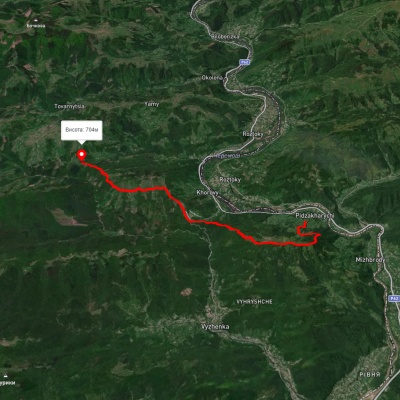
We suggest these hiking trails through or near Chornovil Avenue, Kolomyia: Sheshory – Rosokhata, Opryshky Road, Kosmach village, via Mount Rotylo, Mount Hrehit and Mount Bila Kobyla to Bukovets village, Mykulychyn village, via Mount Khorde and Mount Rotylo to Kosmach village, Nimchych Pass – Protiate Kaminnia, Medvezhyi tract – Mount Kuratul


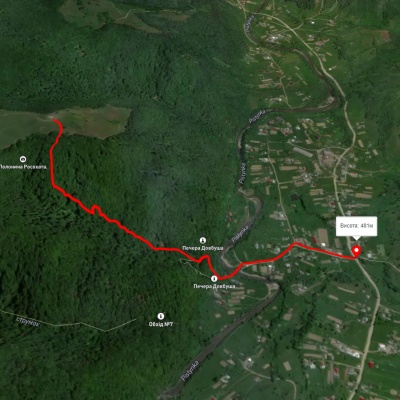
Sheshory – Rosokhata
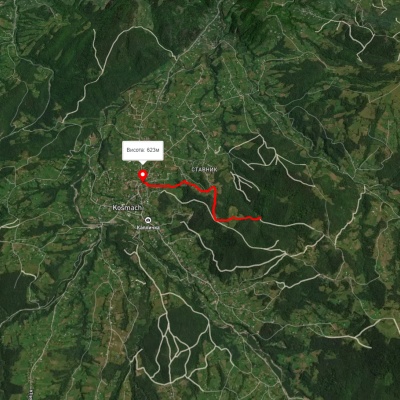
Opryshky Road
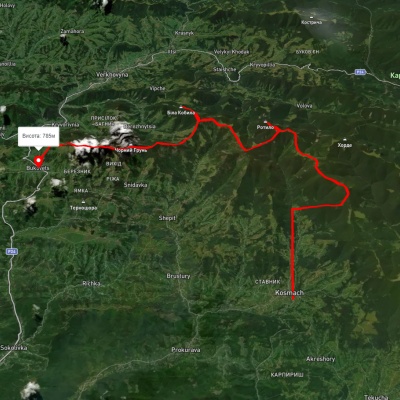
Kosmach village, via Mount Rotylo, Mount Hrehit and Mount Bila Kobyla to Bukovets village
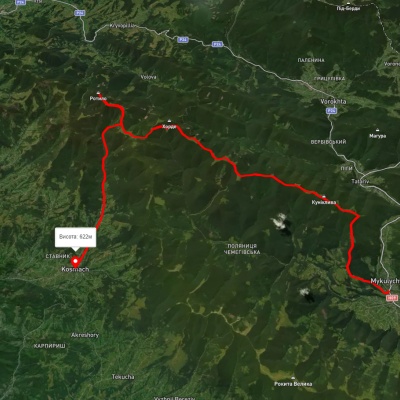
Mykulychyn village, via Mount Khorde and Mount Rotylo to Kosmach village