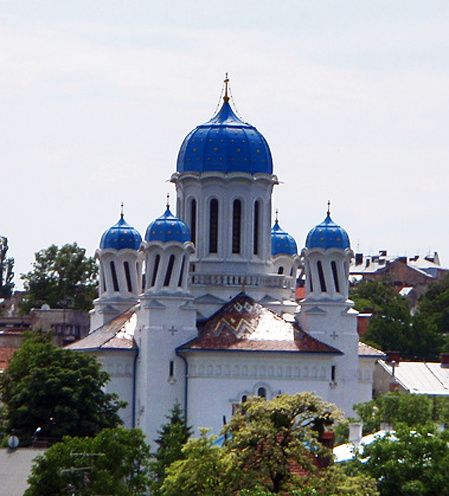
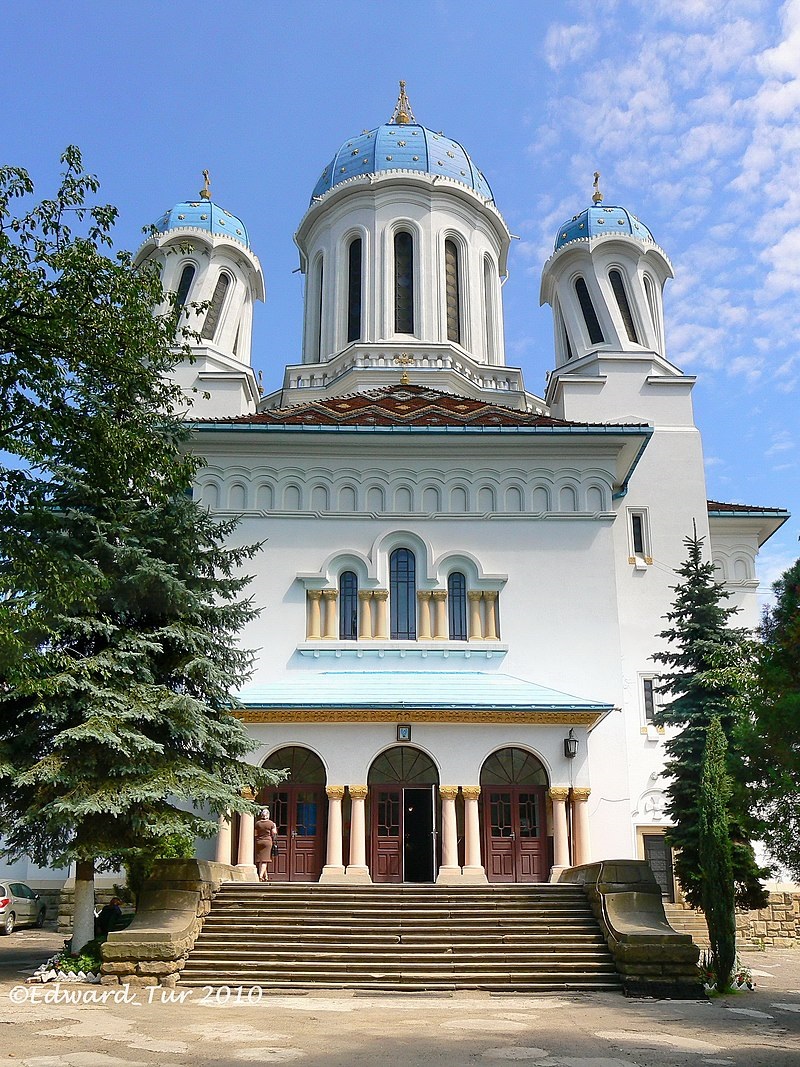
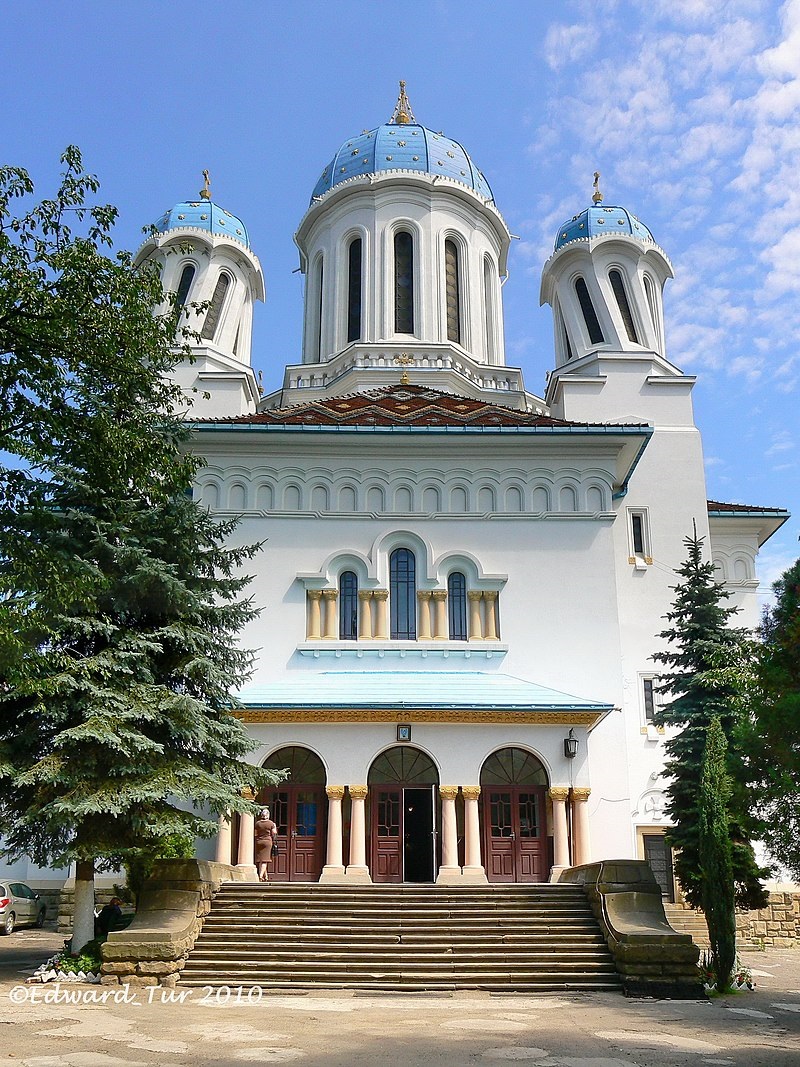
St. Nicholas Church is an Orthodox church in Chernivtsi, built in the 1930s, an architectural monument of local significance. It was built in the Romanian Neo-Romanesque style and is used by parishioners of the Ukrainian Orthodox Church of the Moscow Patriarchate. St. Nicholas Cathedral was built in Chernivtsi during the Romanian period of Bukovyna (1919-1940).
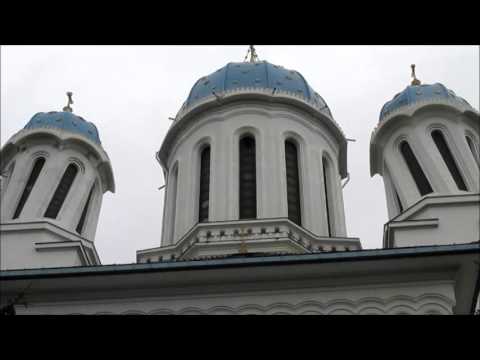
It represents the Romanian Orthodox Romanian national tradition in Bukovyna, being built in the Romanian Neo-Romanesque style. The connection with Romanian religious architecture is indicated by the original "twisted" domes of the church. The church is modeled after one of the masterpieces of Romanian medieval architecture: the Orthodox Assumption Bishops' Cathedral in the Romanian city of Curtea de Arges, the final resting place of Romanian kings. The Cathedral of St. Nicholas is the only Orthodox church in Chernivtsi that has not interrupted services.
The cathedral is open to the public from 6.00 to 22.00 seven days a week. The construction of St. Nicholas Cathedral began in 1927, when the Bukovyna Metropolis actively began to build Orthodox churches in rumunized Chernivtsi. In addition to St. Nicholas Church itself, the Trinity Church on Zolochivska Street, the Church of Peter and Paul on Storozhynetska Street, and the Church of St. Peter and Paul in the Chernivtsi suburb of Horecha were built at that time.
With such active and ambitious architectural plans, the metropolitanate was even forced to create a special department to design churches.
St. Nicholas Church was designed by the architects Walter Stübchen-Küchner, Joseph Letner, and Virgil Ionescu.
As with the construction of the Armenian church, the construction of St. Nicholas Church encountered financial difficulties, which led to the process being suspended for 10 years and resumed only in 1937. At the same time, the construction project underwent some changes made by the architects Radizhevsky, Ionescu, and Oleksandr Ivanov, the chief architect of the Bukovyna Metropolis.
The construction process went much faster and was completed in two years (1939).
The main construction work was carried out by the local company Granit.
After that, a competition was announced for the iconostasis, which was won by the Bucharest artist Paul Molda (icon painter) and the sculptor Grigore Dumitrescu-Lovendal, who performed the woodwork.
Thirteen stained-glass windows were made by another Bucharest resident, artist Kirovich, and the frames for them were built by Wilhelm Svidersky from Chernivtsi.
The fence was also made by a Chernivtsi resident, Oleksandr Mankovskyi, according to the design of architect Virgil Ionescu.
Two bells, weighing 948 and 592 kilograms, were brought to the church from Transylvania. They were made by the company of Friedrich Henig. The vocal cords of the church were first heard on November 2, 1938, in the bell tower, which was built under the direction of Chernivtsi resident Theodore Ogonovsky.
The church had to be built on a rather limited plot of land, densely surrounded by urban development, near three other churches (the wooden St. Nicholas Church, the Armenian Church of the Holy Apostles Peter and Paul, and the Greek Catholic Assumption Cathedral). Another problem was the orientation. The designers wanted to make the main entrance to one of the most important arteries of Chernivtsi, Ruska Street. But such a turn would have forced the altar to be oriented to the north, which contradicted church canons, according to which it should face east.
A non-standard decision was made, like many other things in this church: the main entrance was made to Ruska Street, and the altar was oriented to the east, as it should have been (it is to the right of the entrance).
The church is cross-shaped in plan: there are pentagonal apses to the east and west.
The main entrance has an open porch with columns and an arcade, which is typical for Romania. The interior of the church has a similar arcade.
The church was consecrated on December 6, 1939.
This cathedral was one of the few churches in Chernivtsi that was not closed under Soviet rule and where church services were not interrupted.
Thanks to this, the original interior of the Bukovyna church of the first half of the 20th century, including the ancient different iconostasis and stained glass windows under the domes, has been preserved.
The relics of the Holy Martyrs, icons, a bronze panicle, candlesticks, and other church utensils have also survived.
The cathedral continues to function normally today.
Nearby is the spiritual consistory of the Bukovyna Diocese (the residence of the Bukovyna Metropolitan of the UOC-MP). The main attention of tourists is drawn to the unusual shape of the twisted domes of the small domes.
According to legend, the craftsmen who built the church could not finish the construction. Whatever they built in a day would fall apart by morning. One day, the senior master had a dream that a sacrifice had to be made and then they would be able to finish the church. The craftsmen decided that whose wife would be the first to bring lunch would be the one to be walled into the church. The first to bring lunch was the wife of the senior master. He asked her to stand against the wall as if to joke, saying, "We're going to wall you up. She supported the game, and they bricked her up for real. The woman started screaming, but it was too late. The craftsmen gritted their teeth and worked until nightfall, and they finished the building. In the morning, they saw that the church had not collapsed, but its domes were twisted, as if in pain and torment.
Chernivtsi is the capital of Bukovyna. It is one of the most beautiful and pleasant Ukrainian cities. It has one of the most beautifulrailway stations in the country, theChurch of St. Paraskeva of Serbia, the Church of the Exaltation of the Cross, a house-ship, the City Hall (every day at 12:00 a trumpeter plays the melody of "Marichka" from the tower), the Art Museum, then Kobylianska Street, the German Folk House, the Armenian Church and the Assumption Church (the oldest stone Ukrainian Greek Catholic Church in Chernivtsi), the Theater Square and the Kobylianska Theater. Kobylianska Theater Square, Jewish People's House, Chernivtsi University (included in the UNESCO World Heritage List), Turkish Square (Chernivtsi has been a part of Turkey, Modova, Romania, Austria-Hungary, the USSR, Rus, and Ukraine), and a large rover,cozy streets and cobblestone streets, the so-called Drunken Church, Nazariy Yaremchuk's house, then another house-ship, two houses with the same number (Olha Kobylianska lived here), the house where Volodymyr Ivasyuk lived, the pink church - the Cathedral of the Holy Spirit.
Chernivtsi sights
- St. Nicholas wooden church (from 1607, restored in 1954);
- stone Church of St. George on the Bitterroot (1767 in the Baroque style);
- wooden Trinity Church in Muggles (one thousand seven hundred and seventy-four), moved in 1874 to Kłokuchka;
- wooden Assumption Church on Kaleczanka (1783);
- City Hall with a two-story, 45-meter-high Empire-style tower (1843-1847, architect A. Mykulych), now the City Council;
- Ukrainian Greek Catholic Church (1825-1830 in the Baroque style);
- Byzantine-style cathedral (1844-1864, architect Roll);
- Church of St. Paraskeva in the pseudo-Romanesque style, completed in 1662 (architect A. Pavlovsky);
- residence of Bukovyna metropolitans - since 1956 one of the buildings of Chernivtsi University);
- Armenian Gregorian Church (1869-1875, architect J. Hlavka);
- Chernivtsi University building (1874-1875);
- Jesuit church in the Neo-Gothic style (1893-1894);
- Railway station (1898-1903) in the Art Nouveau style;
- the City Theater (1904-1905, architects F. Fellner and G. Helmer) in the Viennese Baroque style with Art Nouveau elements (now the O. Kobylianska Music and Drama Theater), etc.