St. Nicholas Church, Berehomet
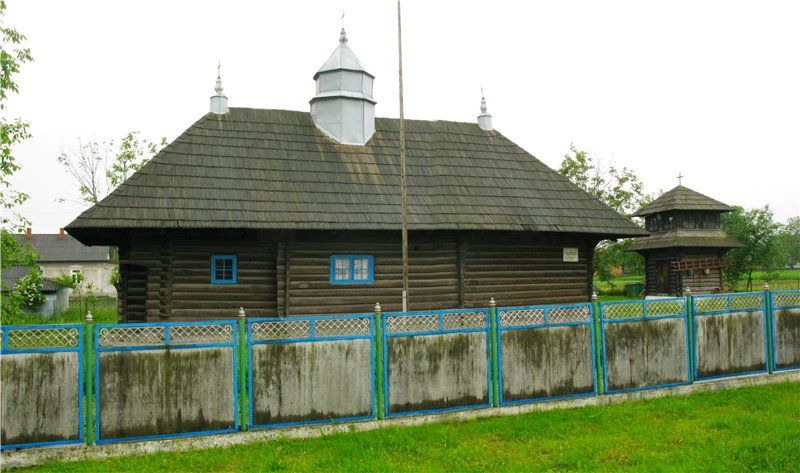
In the village of Berehomet (the one on the Prut River) there is a unique wooden architectural monument of national importance - St. Nicholas Church. Its archaic forms and style of construction clearly show us how devoted the inhabitants of Bukovyna were to their own established traditions. Similar hut-style churches have been preserved in Chernivtsi and the Hertsaiv district. Now the church is functioning, and services are held regularly.
The official date of the church's construction is 1786 (1781 according to other sources), although scholars and local historians believe that this is only the year of construction. It has been proven that the church's narthex dates back to the second half of the 17th century. This is proved by the preserved part of the painting in the narthex.
The Church of the Transfer of the Relics of St. Nicholas is a wooden church, an example of a wooden "house" type church in the village of Berehomet, Kitsman district, Chernivtsi region.
The St. Nicholas Church in the village of Berehomet is the most valuable example of the "house" type of church in the Kitsman region. The form, it turns out, in this case is much more archaic than the date. According to scientists, the Babynets of the church is older, dating from the second half of the seventeenth century. The researchers believe that there is a preserved tempera painting dating from the seventeenth century, and they even compare it to the famous mural of the Drohobych Church of St. George.
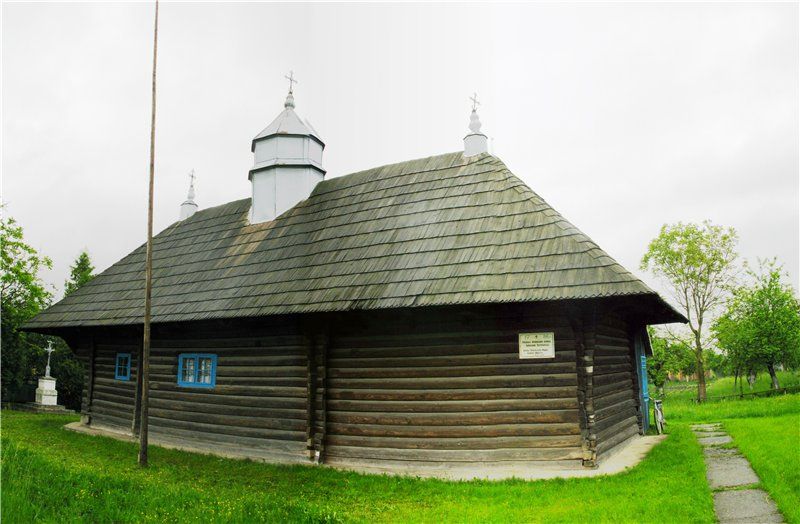
The church was built similarly to Hutsul huts from longitudinally sawn timbers with the bulges facing outward. Only the considerable height of the log cabins and a more proportional ratio of details distinguish it from the ancient examples of "hut" churches found in Chernivtsi and the Kitsman district. The church consists of three log cabins of almost equal width; the nave is covered by a low internal octagonal tent. Above the high tetrahedral roof covered with shingles are three decorative crosses, the central one being double and much larger than the others. In the interior of the church, the iconostasis attracts attention, especially the royal gate. Its openings are decorated with carvings consisting of large stems of vines that, when bent, form an expressive pattern. The medallions depict the Annunciation and the four evangelists. On the northern side of the nave hangs a late seventeenth-century vicarage icon of St. Nicholas, whose face resembles the Bukovinian elders of good looks. The pale green and red-pink tones of the saint's clothes are incredibly well combined with the silver background of the ornament and the gilded rich carvings of the columns of the frame.
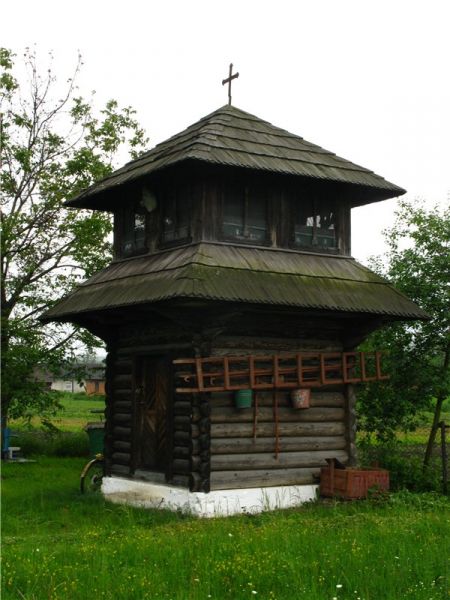
To the southwest of the church stands a wooden square two-tiered bell tower. The bell tower is wooden, two-tiered, and square in plan. The first tier is log with a roof, the second is an open gallery. The bell tower ends with a low hipped roof.
The wooden church of St. Nicholas dates back to 1786 (according to other sources, 1781), although this is most likely the year of its reconstruction. The bell tower was also built in the eighteenth century. In the 60s of the nineteenth century one could see the ruins of the crypt of the church's founders. According to church tradition, they were called ctitors. They were usually local landowners. A stone with an inscription in Romanian is attached to the wooden wall.
Despite the small size of the church, there were choirs for singers inside. Yurii Fedkovych called Vasyl Shkraba, the clerk of Berehomet, one of the best singers in Bukovyna. His son Vasyl continued his traditions. In the 80s of the nineteenth century, Metropolitan Moraru, whom Yurii Fedkovych called the greatest Ukrainian eater, ordered that Slavic inscriptions on the walls be replaced with Romanian ones.
St. Nicholas Church is located in the center of the village. The distance from Berehomet to Chernivtsi is only 22 kilometers. There are regular buses from Chernivtsi, including those to Ivano-Frankivsk or Kolomyia. It is convenient to get there by car - the village is located on the H-10 Ivano-Frankivsk-Chernivtsi highway. If you prefer to travel by rail, the electric train to Kolomyia stops in the village.
Openinghours: the church is open only during Sunday and holiday services.
Berehomet is an urban-type settlement. The Seret River flows through the village. There is a mountain called Stizhok near the river. According to one theory, the name Berehomet comes from the German word Berg (mountain). According to another version, the name Berehomet comes from the fact that the Seret River "throws its banks". Today the population of the village is 7741 people.
Berehomet has several landmarks associated with the life of the noble Vasylko family (Mykola Vasylko, a politician who devoted most of his life to defending the rights of Ukrainians in the Austrian Empire). The most striking building, the Vasylkiv Castle, which existed in the early twentieth century, has not been preserved in its original form. At 12 Tsentralna Street, the former summer residence of the Vasylko family (now the village hospital) has been preserved. In 1890, Mykola Vasylko founded the Berehomet Arboretum. It covers an area of 1 hectare and is home to 54 species of trees and shrubs. The pearl of the park is two golden larch trees.
Accommodation around St. Nicholas Church, Berehomet:


Nearby hiking trails near St. Nicholas Church, Berehomet:
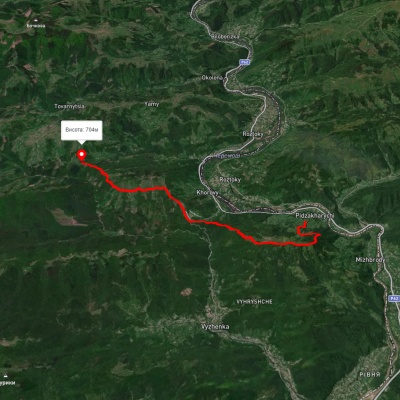
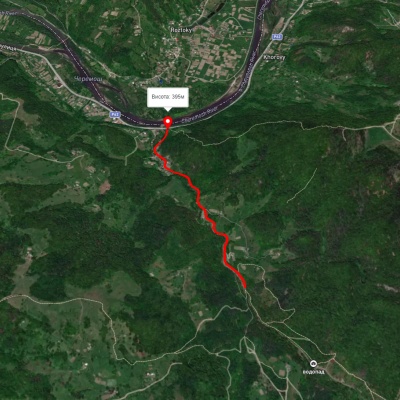
Which trails pass by St. Nicholas Church, Berehomet?
We suggest these hiking trails through or near St. Nicholas Church, Berehomet: Nimchych Pass – Protiate Kaminnia, Smuharski Waterfalls