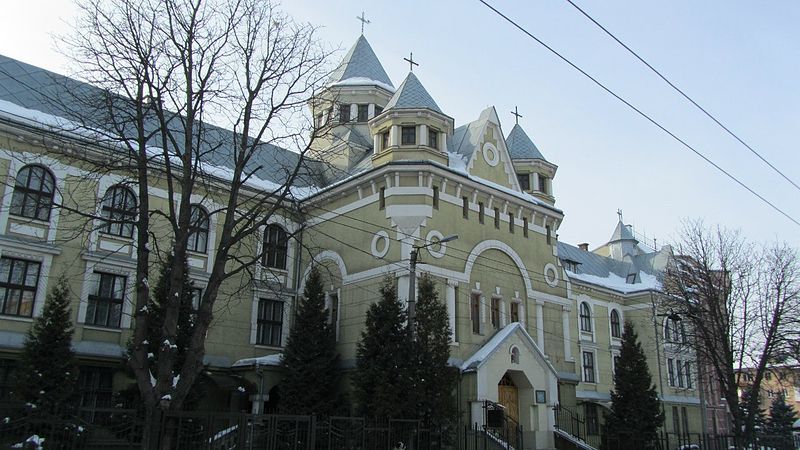
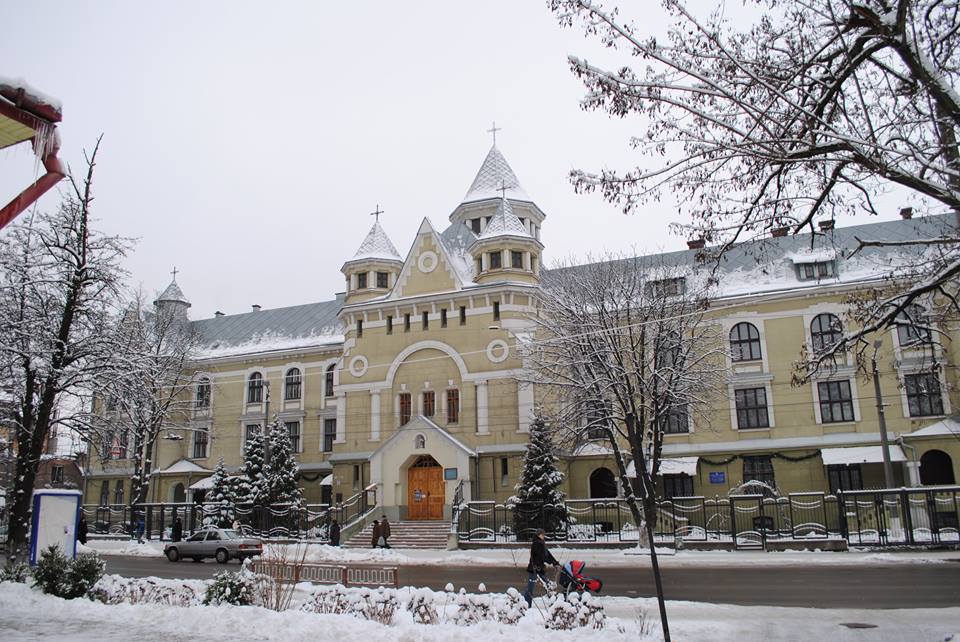
St. Joseph's Monastery of the Basilian Sisters, Ivano-Frankivsk
The Order of St. Basil the Great is the oldest international order in Eastern Catholic churches, with roots dating back to the fourth century. The history of the order is associated with the name of St. Basil the Great, Archbishop of Caesarea Capadocia, a prominent church father and lawmaker of Eastern monasticism. He entrusted his own sister, St. Macrina, with the leadership of the first nunnery and wrote rules for them. They became known as the Basilian Sisters.
In 1899, a Polish railroad engineer, Oleksandr Osostovych, donated his small house on Zabolotivska (Vasylianok) Street to the Greek Catholic chapter. In memory of his Ukrainian wife, Kornelia, and his 18-year-old daughter, Maria, who died prematurely, he asked that a women's educational institution be established there. Soon after, nuns of the Basilian Order arrived and opened the "Mary Institute" there. Its students went to regular schools, while at the "institute" they learned housekeeping, music, and dancing. Piano lessons cost 10 crowns per month, and dancing - 12. Three nuns headed by Anna Teodorovych took care of the students.
In 1907, courses began to operate there, which two years later received the status of a private teacher's seminary for girls, as well as a four-grade elementary school. There was also a boarding school for girls from other cities. What is a teacher's seminary? In the past, to become a primary school teacher, one did not need to graduate from a university - after primary school, it was enough to study for four years in a seminary.
Then the sisters, who were running out of space, decided to build. The project was designed by the famous Lviv architect Ivan Levynskyi and his student Oleksandr Lushpynskyi. Money was raised by the entire community, with a significant contribution from Bishop Hryhorii Khomyshyn of Stanislaviv, and even Emperor Franz Joseph I donated a thousand crowns.
In 1909, the foundation house where the Sisters lived became their property. The Sisters began to work on the development of the school. In April 1911, at the initiative of Bishop Hryhorii Khomyshyn, construction began on a new multifunctional complex that included buildings for educational, residential, and religious purposes. The right wing of the monastery building, intended for educational institutions, was completed by May 1912. The Sisters immediately moved there. However, only the left wing was built-a third of the projected one-because they lacked money. However, even this U-shaped three-story building could not be compared to the modest house of Osostovych. The first floor housed a teacher's seminary, an elementary school, and a conference room; the second floor housed the Mary Institute; and the third floor housed a monastery, a chapel, and a novitiate. At the time, it was one of the most modern new buildings in Stanisław, equipped with central heating and water supply systems.
During the First World War, the monastery of the Basilian Sisters became an orphanage. The American Red Cross mission operating in the city provided important assistance in this work, setting up kitchens and shelters for war victims, helping them with clothing and medicines. With its support, the monastery organized a kitchen and an orphanage for neglected children. The sisters thanked God not only for their self-preservation, but also for a new sphere of service to their neighbors. During 1915-1916, the nuns carried out the burial in Maizly.
The nuns managed to complete the work only in 1938. At that time, under the direction of Stanislaviv builder Mykhailo Hrytsak, the central volume, which housed the monastery church of the Sacred Heart of Christ, and the right wing were built. Experts highly appreciate the building and claim that it is the only example of the "Ukrainian style" in the architecture of prewar Stanislaviv.
In the interwar period, the institution continued to operate a teacher's seminary, and in 1933 a parallel enrollment in a private gymnasium began. The teaching staff there was excellent. For example, the headmaster Mykola Lepkyi, the writer's brother, was a well-known teacher, and the music teacher Yaroslav Barnych was the author of the famous hit song "Hutsulka Ksenia" and four operettas. However, the gymnasium did not have time to make a single graduation, because the war prevented it.
...On November 12, 1947, the monastery was surrounded by soldiers. The courageous nuns barricaded themselves inside. Then the brave soldiers stormed the place, ramming a tank through the gate. The 30 women were brutally thrown out into the street, and the abbess, Yosyfa Isopenko, was sentenced to 10 years in the camps. Before that, the nuns were forbidden to teach and were "sealed in" - in 1945, a teacher training school was opened in the house. One of its graduates was the Shevchenko Prize winner, our fellow countryman, editor-in-chief of Zhovten magazine, and writer Roman Fedoriv.
Later, the Soviets housed a school for Komsomol activists and an agricultural college. The church was divided into two floors by an artificial ceiling. In 1983, the right wing of the building was occupied by the Ivan Franko Regional Library. The colored stained-glass windows were made by the artist Mykola Yakovyna, later the first head of the regional organization of the National Rukh and the head of the regional council of the first democratic convocation.
In 1993-1995, the building was gradually returned to the Vasylianists, who thoroughly renovated it. The iconostasis in the church was created by artist Mykhailo Halak, and the altar icons by Vasyl Stefurak. Now it is the monastery of St. Joseph. Ivan Bondarev, Mykhailo Holovaty Photo by Ihor Hudz Postcard from the collection of Zenoviy Zherebetsky.
Renewing their ancient tradition and responding to the signs of the times, the Sisters opened a private Catholic school named after St. Basil the Great in 2002, which still exists today.
The Sisters work in the church, sewing vestments, catechizing, landscaping, decorating the church, and performing daily household duties.
However, the most important duty is prayer, which is the source of apostolic life. After all, only Jesus gives the true light that the world cannot give; He gives wisdom and strength to live in the truth so as not to lose that valuable seed of faith and devotion from which the Kingdom of God is born and spreads on earth.
Accommodation around St. Joseph's Monastery of the Basilian Sisters, Ivano-Frankivsk:


Which trails pass by St. Joseph's Monastery of the Basilian Sisters, Ivano-Frankivsk?
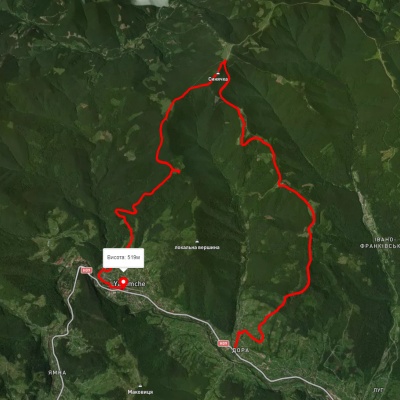
We suggest these hiking trails through or near St. Joseph's Monastery of the Basilian Sisters, Ivano-Frankivsk: Pasichna village, via Maniava village, Maniava Waterfall and Mount Velyka Syvulia to Bystrytsia village, Maniava village - Monastyretska polonyna, Dora village, via Mount Syniachka, Pereslip Pass, Turshuhuvata polonyna and the Yavirnyk ridge to Yaremche, Dora village, via Mount Syniachka and Pereslip Pass to Yaremche, Dora village, via Mount Syniachka and Chornohorytsia polonyna to Yaremche, Dora village, via Mount Syniachka and the Chornohorytsia ridge to Yaremche


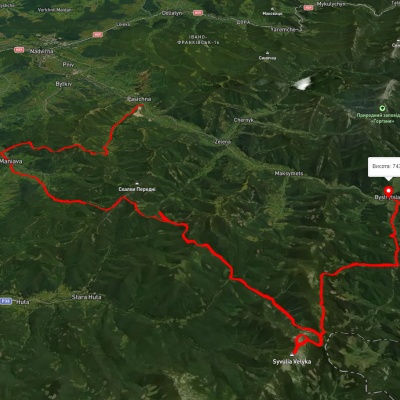
Pasichna village, via Maniava village, Maniava Waterfall and Mount Velyka Syvulia to Bystrytsia village
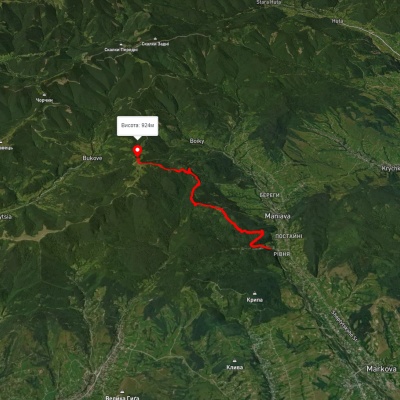
Maniava village - Monastyretska polonyna
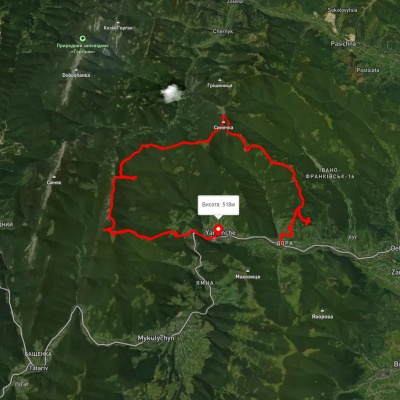
Dora village, via Mount Syniachka, Pereslip Pass, Turshuhuvata polonyna and the Yavirnyk ridge to Yaremche
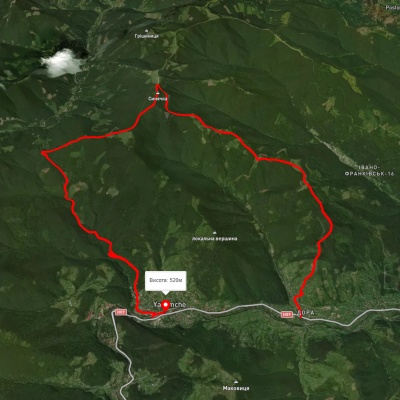
Dora village, via Mount Syniachka and Pereslip Pass to Yaremche