Church of St. Onuphry, Busk
TheChurch of St. Onufriy is a wooden religious building located in the historic suburb of Voliany in the northwestern part of the small ancient town of Busk, surrounded by high ramparts. A casual traveler will not notice the one-story church from the road. The temple is included in the register of architectural monuments of national importance under the protection number 1342/1. It is a functioning church of the Ukrainian Orthodox Church of the Kyiv Patriarchate.
The landmark pointing the way to the church is an amazing chapel carved in the trunk of a thousand-year-old dried oak tree. This giant, reaching six meters in girth, is fastened with metal hoops. The dry trunk is covered by a roof, which protects the image of St. Onufriy, decorated with artificial flowers and Ukrainian towels, from the weather.
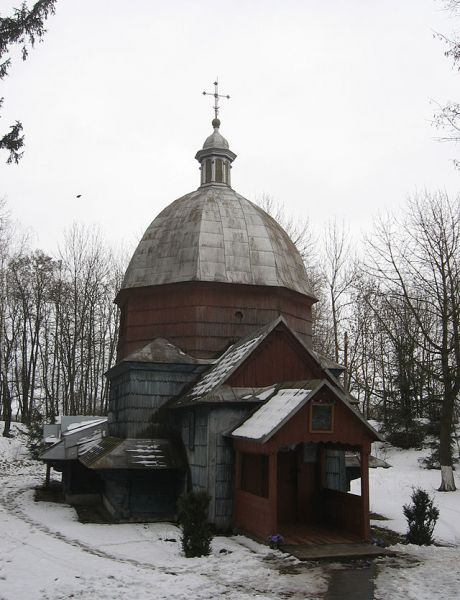
The church was built in 1680 in the suburb of Voliany (today B. Khmelnytskoho Street) on the site of an ancient settlement surrounded by ancient ramparts. In the first half of the eighteenth century, a five-tiered iconostasis with Baroque carvings was made. In 1905 the church was renovated, and the following year wall paintings were added to the interiors. In 1970, restoration and renovation works were carried out according to the project of Ivan Mohytych. In 2009-2010, the church was renovated, after which the temple received a modern appearance.
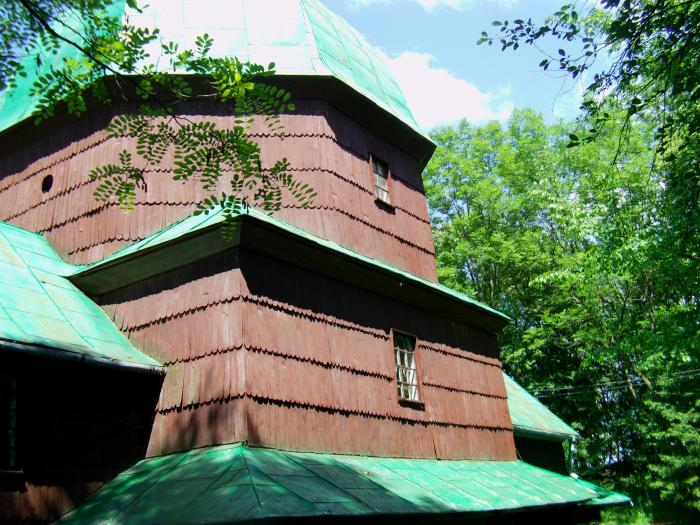
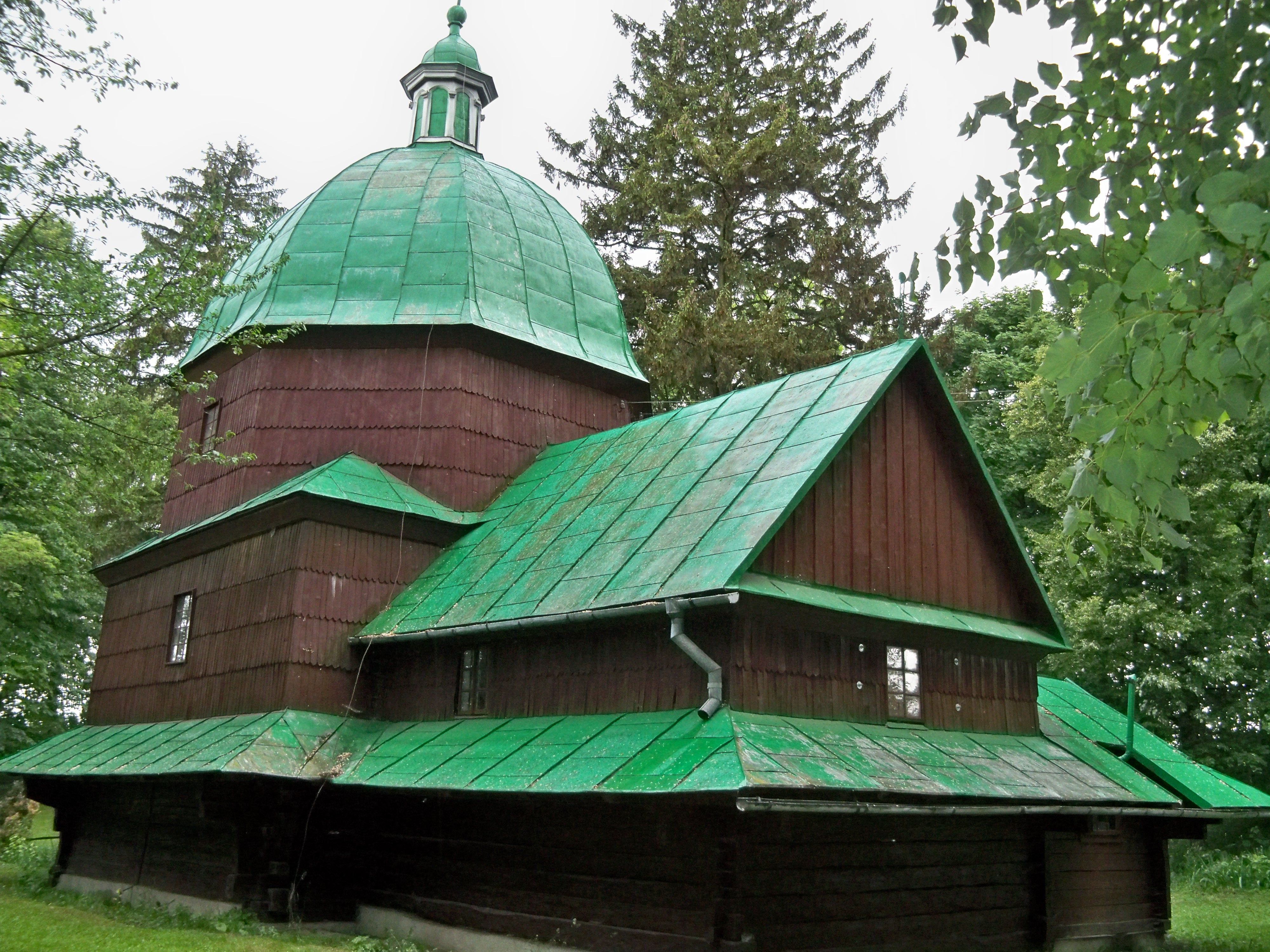
The church was built according to the canons of folk architecture of the Galician school. It is a wooden two-storeyed church. The square nave is crowned with a large octagon, which in turn is covered with a helmet-shaped dome with a lantern and a cupola. The central log house is adjoined to the east by a lower rectangular log house, which houses the altar part of the church. On the western side, the nave is adjoined by a pews with an open porch, separated by an arched cutout. The nave and the altar are surrounded by a canopy. The choirs are located in the central log house above the archway.
To the northwest of the church, at the site of the settlement's rampart break, there is a wooden bell tower built in the eighteenth century. The building is a square two-tiered (four on four) frame structure.
The site of the church that exists today used to be an ancient settlement, the southern rampart of which still drops off steeply to a tributary of the Western Bug. The church was built in 1642, although there is information that it was erected in 1670 on the site of the Basilian monastery burned by the Cossacks in 1654.
Another object of the temple complex is the bell tower, installed on the site where the entrance to the ancient city used to be. The two-tiered bell tower, which appeared in the late 18th century, reaches a height of thirteen meters. The bell tower is included in the register of architectural monuments of national importance under the protection number 1342/2.
The church itself is hidden in a recess in the hill. The fifteen-meter-high church, built of pine on an oak foundation, dates back to the 17th and 18th centuries. The pride of the three log churches - stepped five-tiered iconostasis, made in the middle of the 18th century. The craftsmen who worked on the creation of the carved altar partition, created it in the Baroque style. The amazing painting that decorates the church walls was made much later - in the early 20th century.
The wooden church was repaired more than once. In 1905 it was repaired. In 1970, restoration work was carried out (architect I. R. Mohytych). After the renovation in 2009-2010, the church received a different appearance, primarily due to the color of the roofs. The wooden stepped five-tiered iconostasis of the first half of the XVIII century with carvings in the style of the developed Baroque.
On January 10, 2021, employees of the Department of Architecture and Urban Development of the Lviv Regional State Administration and deputies of the Lviv Regional Council visited some of the objects that are proposed to be restored (wooden churches-monuments in the villages of Volia-Homulets (1756), Zarudtsi (1787), Zabolottsi (1746), Polyany (1903) and the city of Busk (1680). A regional comprehensive program for heritage preservation, tourism development, cultural support and promotion for the next 3 years is being developed.