Church of the Exaltation of the Holy Cross, Mykytyntsi
In the distant past, the village of Barvinkove was located on this site in the Kosiv district of Ivano-Frankivsk region. There was once a Pole who had significant merits before Jagiello. In 1375, Polish King Jagiello granted him the city of Rohatyn along with several villages, including Mykytyntsi. From Rohatyn, a lady came to Mykytyntsi with her horse Mykyta Karpiak. Mykyta was accompanied by two servants, Valikhnovskyi and Kaminskyi. From that time on, the village was called Mykytyntsi in honor of Mykyta the horseman. Before that, they say, it was called Barvinkove. This event took place in 1375. A lady built a manor house in the village and gave her servants large plots of land, about 80 hectares each. Valikhnovskyi - to the west of the road, Karpiak - to the east of the road, and Kaminskyi - across the river. These names are still present in the village today. In 1784 , the Exaltation of the Holy CrossChurch stood here , later it was rebuilt into a bell tower.
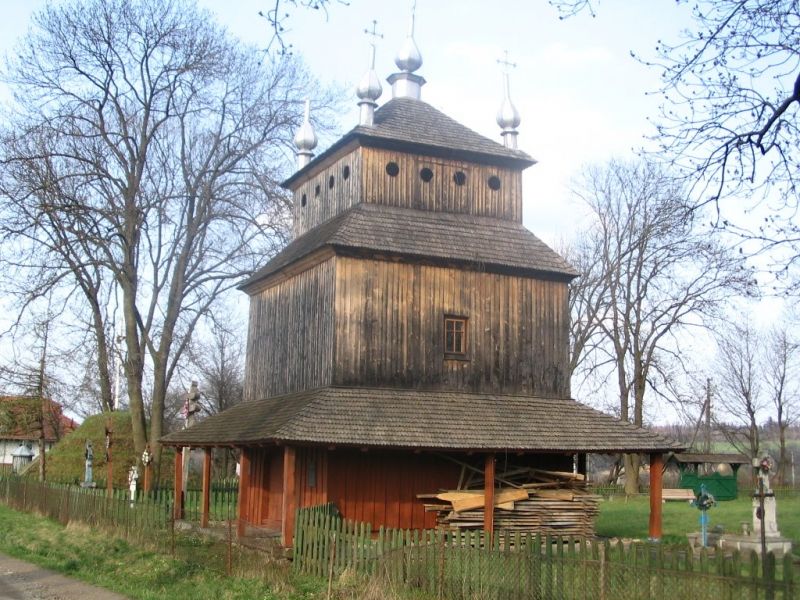
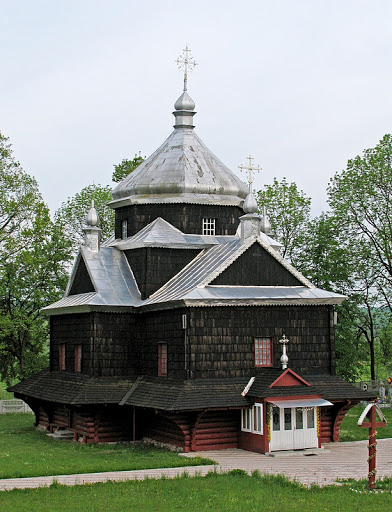
The new wooden Church of the Exaltation of the Holy Cross was built in 1859. This religious ensemble is an architectural monument of national importance. It is related to the Ukrainian Greek Catholic Church. The church holiday is celebrated on September 27. The Church of the Exaltation of the Holy Cross is one of the oldest and most beautiful in Kosiv district, it is a kind of standard of the typical Hutsul school of folk wooden architecture.
The church is cross-shaped and has one dome. From the northern and southern edges of the temple are adjacent to the miniature chopper. The main portal has a porch on carved columns. Previously, the entire structure, except for the dome, was covered with shingles. The parishioners covered the top with tin. The church's decoration includes 19th-century murals (tempera). On the west side of the church there is also a bell tower made of wood with a tent-like top with three tiers.
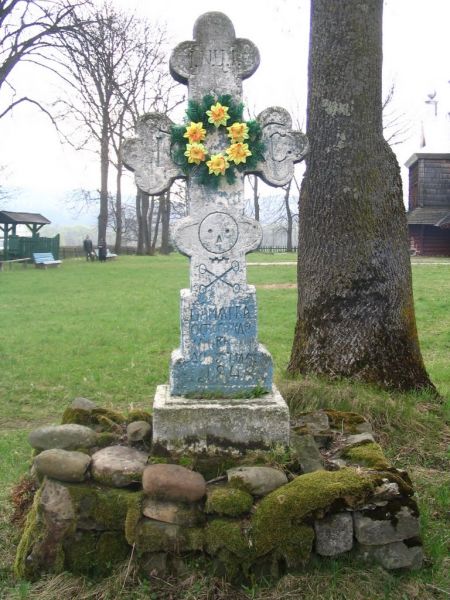
In 1848, not far from the Church of the Exaltation of the Cross, a stone cross was erected in memory of the abolition of serfdom.
According to the Lviv local historian A. Schneider (V. Stefanyk LNL, Manuscripts Department, f. 144, op. 3, folio 13 (1), p. 234). 234) Since 1375 Mykytyntsi enjoyed the rights of a town; in 1416 these rights were confirmed by a special privilege.
- There are two churches in the village: The Greek Catholic Church of the Exaltation of the Holy Cross and the Orthodox Church of the Archangel Michael.
- Stone cross commemorating the abolition of serfdom - 1848
- The coat of arms of the local community in 1859 - in the seal field there is a peasant walking behind a plow drawn by a horse; above is an eight-pointed star (the print is preserved in the collection of documents of the nineteenth-century Lviv local historian A. Schneider: V. Stefanyk Lviv National Library, Manuscripts Department, f. 144, op. 7, fol. 7, pp. 190, 243).
- Monument to Taras Shevchenko (1989) by sculptors Halyna and Volodymyr Rymar..... During the unveiling, national flags were raised freely for the first time in Kosiv region
- Monument to the fallen during the Second World War - 26.06.1968.
- A cross erected by the UGCC community in honor of Ukraine's sovereignty on July 16, 1991.
- A cross erected by the UAOC community in honor of Ukraine's independence on September 27, 1991.
- The symbolic grave of the "Fighters for the Freedom of Ukraine" in 1991. In the ranks of the UPA, 15 villagers died in Soviet prisons and concentration camps. Dozens of villagers were convicted or deported by Soviet repressive authorities.
- A memorial plaque was erected in 1993 in honor of Yakiv Holovatsky (1814-1888), a writer, scholar, and public figure, a member of the "Russian Trinity" who lived and worked as a priest in Mykytyntsi in 1842-1846.
- On May 14, 1994, a cross was erected at the site of the death of UPA centurion Y. Dolishnyak-Bilyi at the hands of the NKVDists.
- On September 27, 2019, a monument to Yakiv Holovatskyi (1814-1888), a writer, scholar, and public figure, a member of the "Russian Trinity" who lived and worked as a priest in Mykytyntsi in 1842-1846, was unveiled.
- On July 18, 2004, the hideout of the UPA centurion Y. Dolishnyak, pseudonym Bilyi, was reconstructed.
Mykytyntsi is located on both sides of the Pistynka River, which flows into the Prut near Kolomyia, in a lowland, so it is not for nothing that they sing that "Mykytyntsi is in a pit, in Mykytyntsi there are girls like painted." From the very beginning of its existence, the village belonged to the Kosiv district of Kolomyia. The southern part of the village borders on Pistyn, a town that was a part of Old Poland, Austria, and New Poland.
The eastern part of the village borders the state forest, where people used to pack firewood, clean the forest, and collect brushwood in the days of Austria and Poland. In winter, twice a week, and in summer, once a week, the villagers received firewood allotments. The territory of such fishing stretched to the main road leading from Kryvobrody to Kosiv.
The northern part of the village borders on Spas Horishnyi, and the western part on the realms of Stopchatov, the village of Borysivka, and the Verbizkyi forest. Until 1939, this forest belonged to the village of Verbizh. The entire territory of Mykytyntsi, together with the land belonging to it, covers 786 hectares. Its length from north to south and from west to east is approximately the same, about 3.5 km. Polonynsky lands occupied more than 600 hectares.
Accommodation around Church of the Exaltation of the Holy Cross, Mykytyntsi:


Which trails pass by Church of the Exaltation of the Holy Cross, Mykytyntsi?
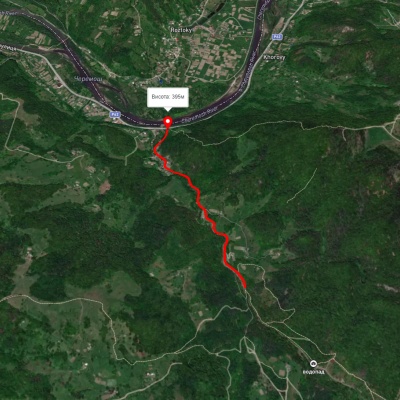
We suggest these hiking trails through or near Church of the Exaltation of the Holy Cross, Mykytyntsi: Sheshory – Rosokhata, Nimchych Pass – Protiate Kaminnia, Pysanyi Kamin – Bukovets village, Bukovets village – Pysanyi Kamin – Bukovets village, Smuharski Waterfalls, Kosmach village, via Mount Rotylo, Mount Hrehit and Mount Bila Kobyla to Bukovets village

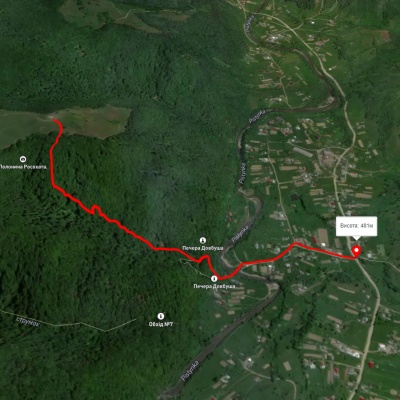
Sheshory – Rosokhata
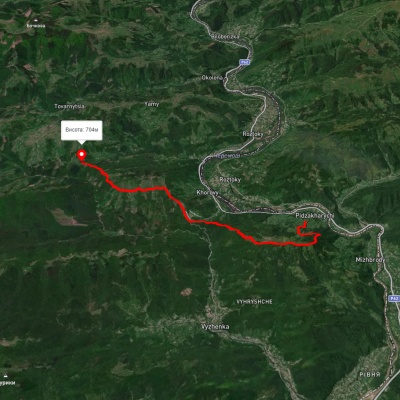
Nimchych Pass – Protiate Kaminnia
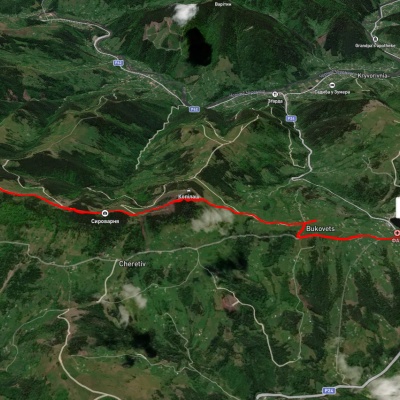
Pysanyi Kamin – Bukovets village
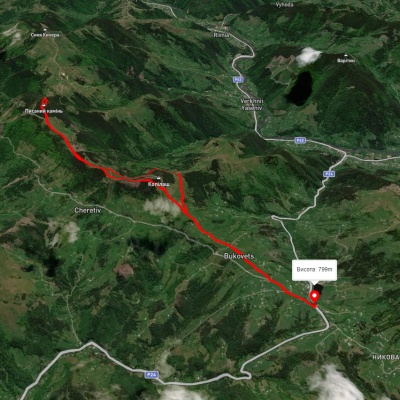
Bukovets village – Pysanyi Kamin – Bukovets village