Ukrainian People's House, Chernivtsi
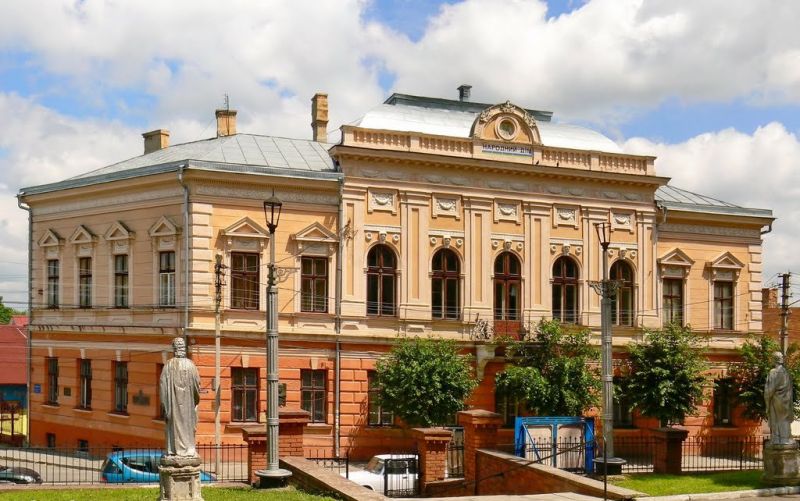
TheUkrainian People's House in Chernivtsi, a Ukrainian house built in the late 19th century by the Ukrainian association Narodnyi Dim, became the center of Ukrainian life in Bukovyna. It was destined to play an important role in the revival of the Ukrainian language and identity before the First World War, and to carry out nation-building activities during the period of formation and consolidation of Ukrainian independence. The Ukrainian People's House building has been owned by the Ukrainian People's House Society for over 125 years, and is a historical monument protected by the state.
The idea to found the Ukrainian People's House Society was announced in 1875 at a meeting of the Ruska Besida Society. On January 22, 1884, the provincial government, signed by the president of Bukovyna, Baron Alesani, registered the charter of the Ruskyi Dom Narodnyi society, the fourth Ukrainian society in Bukovyna after Ruska Besida (1869), Ruska Rada (1870), and the Soyuz (1875) student society, under the number 499.
The task is set forth in the first paragraph of the Charter: "The purpose of the society is to support and defend the material and moral interests of Ukrainians in Bukovyna." The means of achieving this goal was to be "the construction of a 'People's House' with a theater sala in Chernivtsi" and "the placement in it of Bukovynian-Ukrainian societies that contribute to the development of the Bukovynian-Ukrainian people...".
In February 1884, a constituent assembly of the People's House society was convened, at which Professor Jerotheus Pihulyak was elected chairman and teacher Omelian Popovych was elected scribe. Among the founders and members of the Narodnyi Dom were well-known Ukrainian public figures of Bukovyna Sydir Vynnytskyi, Teofil Drachynskyi, Volodymyr Zalozetskyi, Volodymyr Yasenytskyi-Kornych, Volodymyr Filipovych, and others. Immediately after the foundation of the society, the question of building their own house arose. At first, they rented premises from Ruska Besida and others. In October of the same year, an appeal was circulated among local Ukrainians and a fundraising drive for the society's own building was launched.
The newspaper Bukovyna (the first issue of which was published in January 1886) appealed to the Ukrainians of the region that other nations of the region-Poles, Germans, Jews, and Romanians-were trying to unite and build their own national houses, but Ukrainians were looking at this matter with some indifference." Nevertheless, the funds were raised, albeit slowly. Students of Ukrainian descent helped to raise funds during their vacations. Mayor Antin Kokhanovsky and Metropolitan Arkady (Chuperkovych) of Bukovyna donated funds for the construction of the People's House. Ukrainian academic artists Justyn Pihulyak and Mykola Ivasiuk agreed to paint a picture for auction in favor of the Ukrainian House. Yurii Fedkovych donated his best dramatic works.
After Yerotey Pihulyak, the society was headed for a short time by Father Yerotey Fedorovych. In 1886, Sidir Vorobkevych became the head of the society, and his deputies were Sidir Vynnytskyi and Hilariy Okunevskyi. Thanks to the efforts of the group, the Narodnyi Dim society managed to acquire and build its own house in a short time. They purchased two houses on Petrovycha Street and two plots of land there. One house had 19 rooms, the other had 5. The buildings were slightly rebuilt, and in 1888 the society and the Bukovyna newspaper moved into their own premises.
At the beginning of the 1896-1897 school year, with the opening of a Romanian gymnasium with Ukrainian parallel classes in Chernivtsi, the People's House opened a boys' bursa in its premises. On January 12, 1897, the Austrian Emperor Franz Joseph issued a decree allocating 6000 gold roubles from the state lottery proceeds to the People's House in Chernivtsi. In 1899, the premises of the People's House were rebuilt. At that time, the People's House Society had 159 founders, including 73 teachers, 26 government officials, 21 priests, 12 women, 9 professors, 6 owners, 4 doctors, three burghers, one community, and four societies. The Narodnyi Dim Society already had a two-story building.
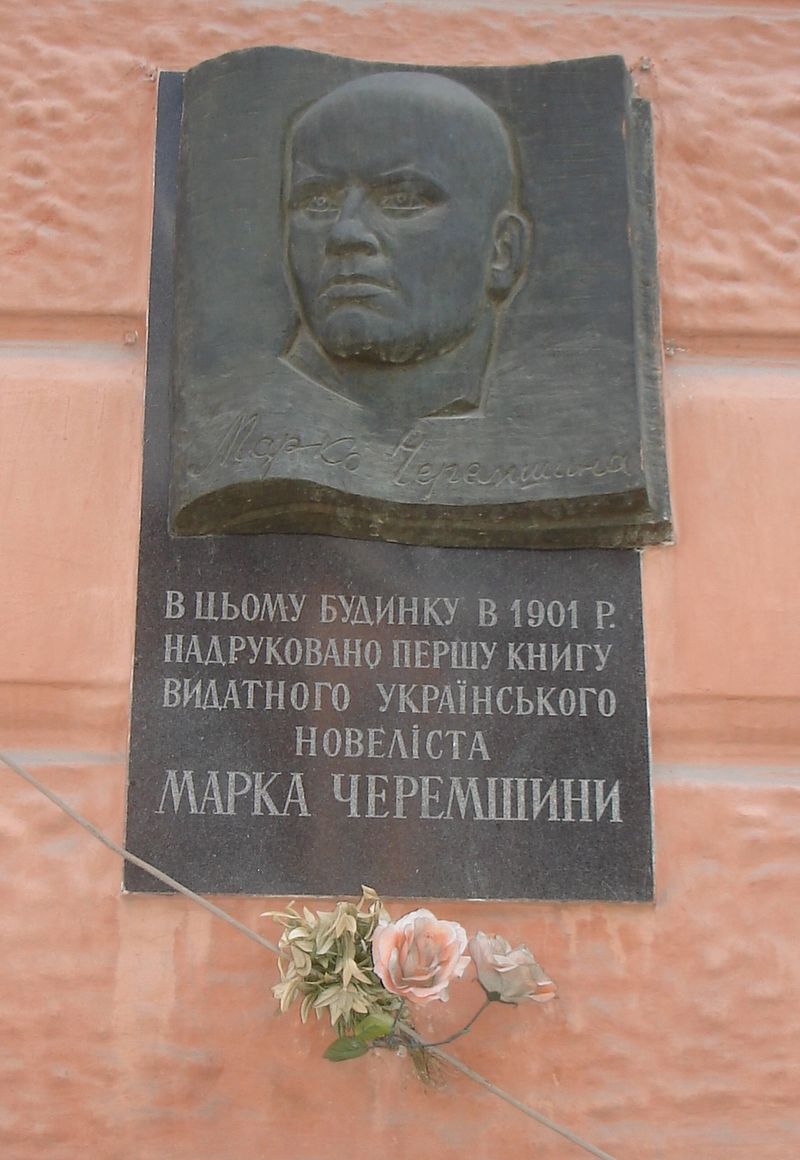
Before the First World War, almost all Ukrainian societies were located in the premises of the Narodnyi Dim. On June 2, 1907, Mykola Vasylko, an ambassador to the Austrian parliament and a prominent Ukrainian, was named an honorary member of the society. Mykhailo Hrushevsky, Ivan Franko, Lesya Ukrainka, Hnat Khotkevych, Vasyl Stefanyk, Volodymyr Vynnychenko, and others visited the Narodnyi Dom. The first book of the prominent Ukrainian novelist Mark Cheremshyna was published here, and in 1913 the great Ukrainian writer Ivan Franko gave a reading of his own works here. The paintings of the assembly hall on the second floor belong to the outstanding Ukrainian painter Augusta Kokhanovska.
The events of 1918 also affected the Ukrainian People's House, which at that time became the center of the Ukrainian national movement. On September 23, the Ukrainian Cassino Society (headed by O. Popovych) resumed its activities in the People's House, the board of which consisted of future members of the Ukrainian National Council and members of the Ukrainian government of Bukovyna. As the seat of the Bukovyna delegation of the Ukrainian National Council, later the Bukovyna Regional Committee, the People's House became the real center of the Ukrainian national movement in Bukovyna.
In the evening of October 12, the People's House hosted a meeting of Ukrainian intellectuals from all parties in the Ukrainian Cassino, which elected O. Bezpalko as the main referent for the next day's bourgeois veche and approved the draft resolutions he had prepared. The bourgeois veche began at 3 p.m. in the great hall of the People's House on October 13 under the chairmanship of O. Popovych in the People's House, where a resolution was adopted in support of the right of Bukovinian Ukrainians to self-determination and a quota of delegates to the Ukrainian Constitution in Lviv was determined. On October 24, the first meeting of the Bukovinian delegation of the Ukrainian National Council is held at the People's House, and the delegation is named the "Bukovinian Regional Committee."
On October 28, a meeting of Ukrainian students of the University of Chernivtsi was held in the great hall of the People's House, expressing support for the establishment of the Ukrainian state and protesting against Romanian encroachments on the entirety of Bukovyna.
On November 03, the Main Assembly of the Bukovinian Veche was held in the People's House, where its resolutions were read and approved for the first time; because several thousand participants could not fit in the hall, they filled the entire courtyard of the People's House and the adjacent part of Petrovich Street. Ukrainian members of the Austrian parliament spoke from the steps in the courtyard, informing people about the events in Lviv and making proposals to annex the Ukrainian-populated parts of Bukovyna to Eastern Galicia, to jointly form a Western Ukrainian independent state, and to recognize the State Secretariat in Lviv as our government. At the same time, Ukrainians gathered in the hall of the Musical Society (organized by the Ukrainian National Democratic Party) and in the Workers' House (old theater) (organized by the Ukrainian Social Democratic Party). Subsequently, thousands of Ukrainians marched under national flags, joining the participants of the other two meetings, from the People's House along Petrovycha and Ruska streets, through Rynok Square and Gymnasiumna Street to Elizabeth Square, which was completely blocked by demonstrators. Here, after short speeches by O. Bezpalko and M. Spynul, the participants of the Bukovynian Veche approved its resolutions, proclaimed "hurray" in honor of the independent Ukrainian state, and ended the veche by singing the hymn "Ukraine has already risen."
"The People's House is teeming with people, and all the work that is being done here is in full swing," O. Popovych recalled. From November 2, 1918, the headquarters of Ukrainian military volunteers who patrolled the streets of the city and tried to contain anarchy in Chernivtsi was located here. They brought to the People's House the property confiscated from the looters from military warehouses, forming a much-needed food supply for the new Ukrainian government. Starting on November 3, Chernivtsi residents and military personnel began to come to the People's House en masse, demanding that their affairs be restored. On November 4, the last Austrian mayor of Chernivtsi, A. Minkusch, came to the People's House for an evening meeting of the BCC with a proposal to create an interethnic city guard. Given the huge number of administrative matters that the BKK had to deal with, a permanent government bureau headed by M. Lytvynovych began operating in the People's House on November 5.
At an extended evening meeting of the BCC in the People's House on November 5, it was decided to begin the transfer of power the next day, to name candidates for the highest government posts, and to approve the text of the "Universal to free citizens of all nationalities and classes in the region." At 11:30 a.m. on November 6, representatives appointed by the Regional Committee, headed by small (10-15 soldiers under the command of a Ukrainian officer) military units, left the People's House to go to the most important regional institutions, fulfilling the task entrusted to them to take over power in those institutions and appoint Ukrainian commissioners for each of them. At a meeting of the BCC on November 7, 1918, it was decided to return the name Ukrainian National Council to the governing body of Bukovinian Ukrainians.
On November 11, 1918, power in Bukovyna passed into Romanian hands, Romanian troops entered Chernivtsi, the premises of the People's House were searched, and it was forbidden to use it without the permission of the military.
This lasted until 1920.
When Soviet rule came to Bukovyna in 1940, the Ukrainian People's House was closed. In 1944, after the return of Soviet power to Chernivtsi, the building of the People's House was transferred to the NKVD club, and then, according to Resolution No. 61 of the Chernivtsi City Council of February 5, 1945, "as built with funds raised among the peasants and intellectuals of Bukovyna," it was allocated to the Teacher's House. Later, it also housed the House of Amateur Art, the Board of the Regional Writers' Union, and the Chernivtsi Regional Center for Folk Art.
The initiator of the resumption of the Ukrainian People's House in 1990 was Volodymyr Staryk, a well-known cultural, public, and political figure in Bukovyna. In March 1992, the chairman of the Chernivtsi City Council, Viktor Pavliuk, handed over the keys to the vacated rooms of the People's House to the first chairman of the restored Ukrainian People's House in Chernivtsi, Roman-Ivan Zavada.
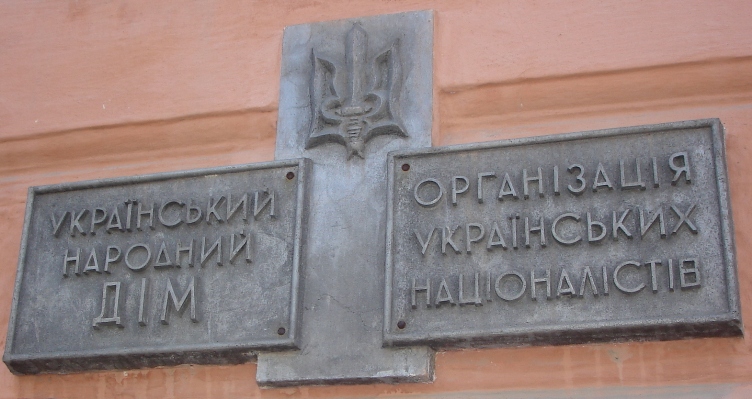
From 1993 to the present day, Volodymyr Staryk has been the chairman of the Ukrainian People's House society. The first public organizations to start their activities in the premises of the Ukrainian People's House in the early 1990s were the Taras Shevchenko Ukrainian Language Society "Prosvita", the Green Movement of Bukovyna, the Union of Ukrainian Students, the student corporation "Zaporozhe", the Organization of Ukrainian Nationalists, and the youth scouting organization "Plast". The restored Chas newspaper was also published here.
After the regional Teacher's House was moved to another building, the second floor of the building was returned to the Narodnyi Dim Society, which made it possible to place the offices of the Chernivtsi regional organization of the People's Movement of Ukraine and the Chernivtsi regional branch of the Taras Shevchenko All-Ukrainian Society "Prosvita". The People's House has once again become a venue for socio-political, cultural, and educational events organized by various Ukrainian organizations in Bukovyna.
The Ukrainian People's House is an architectural monument of local significance. The two-story building of the Ukrainian People's House is built in the classical style. Its main decoration is a variety of stucco moldings above the window openings and under the roof. The façade is painted in two colors: orange and pale beige, and the roof is gray. The building is an architectural monument of local significance. For more than 125 years, the building of the Ukrainian People's House has been the property of the Ukrainian Society.
The building of the Ukrainian National House is located on Ukrainska Street, not far from the Cathedral of the Holy Spirit. This is the central part of the city. You can get here by trolleybuses 3, 5, and 3A, which depart from the city's railway station, and by buses 1, 1A, 10A, and others, the stop is Poshtova.
Chernivtsi is the capital of Bukovyna. It is one of the most beautiful and pleasant Ukrainian cities. There is one of the most beautifulrailway stations in the country, theChurch of St. Paraskeva of Serbia, the Church of the Exaltation of the Cross, the ship house, the City Hall (every day at 12:00 a trumpeter plays the melody of "Marichka" from the tower), the Art Museum, then Kobylyanska Street, the German Folk House, the Armenian and Assumption Churches (the oldest stone Ukrainian Greek Catholic Church in Chernivtsi), the Theater Square and the Kobylyanska Theater. Kobylianska Theater Square, Jewish People's House, Chernivtsi University (included in the UNESCO World Heritage List), Turkish Square (Chernivtsi has been a part of Turkey, Modova, Romania, Austria-Hungary, the USSR, Rus, and Ukraine), and a large rover,cozy streets and cobblestones, the so-called Drunken Church, Nazariy Yaremchuk's house, then another house-ship, two houses with the same number (Olha Kobylianska lived here), the house where Volodymyr Ivasyuk lived, the pink church - the Cathedral of the Holy Spirit.
Chernivtsi sights
- St. Nicholas wooden church (from 1607, restored in 1954);
- stone Church of St. George on the Bitterroot (1767 in the Baroque style);
- the wooden Trinity Church in Muggles (one thousand seven hundred and seventy-four), moved in 1874 to Kłokuchka;
- wooden Assumption Church on Kaleczanka (1783);
- City Hall with a two-story, 45-meter-high Empire-style tower (1843-1847, architect A. Mykulych), now the City Council;
- Ukrainian Greek Catholic Church (1825-1830 in the Baroque style);
- Byzantine-style cathedral (1844-1864, architect Roll);
- Church of St. Paraskeva in the pseudo-Romanesque style, completed in 1662 (architect A. Pavlovsky);
- residence of Bukovyna metropolitans - since 1956 one of the buildings of Chernivtsi University);
- Armenian Gregorian Church (1869-1875, architect J. Hlavka);
- Chernivtsi University building (1874-1875);
- Jesuit church in the Neo-Gothic style (1893-1894);
- Railway station (1898-1903) in the Art Nouveau style;
- the City Theater (1904-1905, architects F. Fellner and G. Helmer) in the Viennese Baroque style with Art Nouveau elements (now the O. Kobylianska Music and Drama Theater), etc.