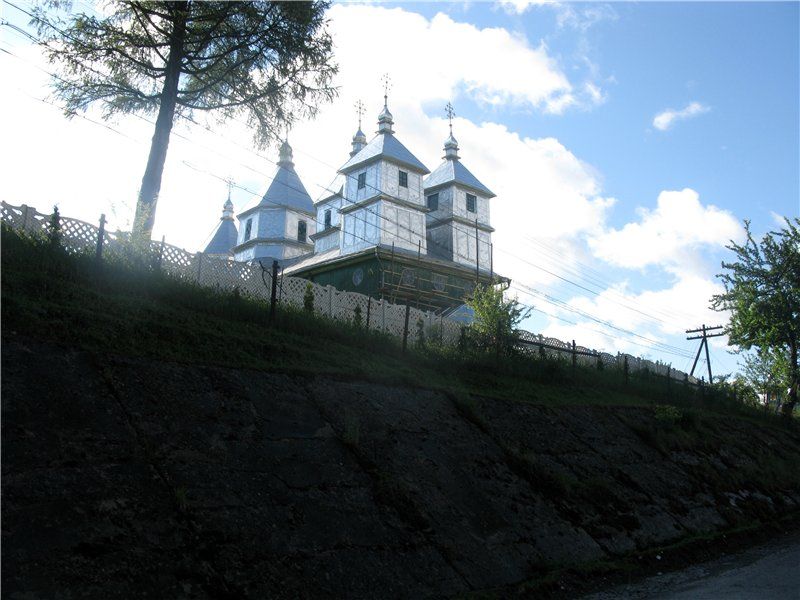
St. Dmitry's Church, Dykhtynets
On your way to Putyla, you will pass a village with an unusual name: Dykhtynets. In ancient times, tar was produced there, which is where the name came from. At the entrance, you will see a large rock near which a battle between the UPA and NKVD units took place. But the most interesting object in the village is the wooden St. Demetrius Church, which was built in a completely unusual shape for Bukovyna and the Hutsul region in general. It is a good place to visit after Ust-Putyla to see the famous "Stone Rich" rock.
The village of Dykhtynets is located in a narrow valley of the Putylka River, 35 km south of the railway station Vyzhnytsia. According to one version, its name comes from a combination of German words that mean "dense net", referring to the Carpathian forests that used to surround the village from all sides. The settlement was first mentioned in written sources in 1774.
The church was built in 1871. It is assumed that its style was originally similar to other churches in the Bukovyna Hutsul region-a three-story, three-domed church. However, after a while, two nice dome towers were added to the western façade, giving the church its original shape.
During the restorations, St. Dmitriy's Church lost its wooden roof, which was replaced with tin cladding, and the walls were covered with wood planks, which were repainted green. Today the church belongs to the parishioners of the Orthodox Church of the Moscow Patriarchate.
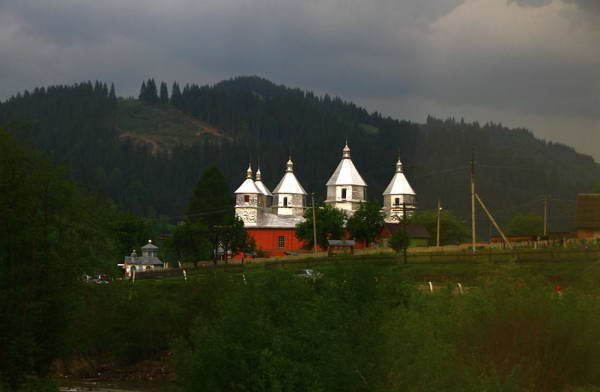
St. Dmitriy's Church is a very interesting and original object in itself, unlike any other object in Bukovyna. In its architectural design, the wooden church of St. Dmytro is a three-story, three-log building built on a stone foundation with a square narthex, faceted nave, and presbytery. The narthex is significantly lengthened and crowned with two additional two-tiered towers, most likely done later to increase the church's area. The log cabins are covered with three octagonal hipped roofs and end with decorative dormers. The walls of the sacred building were originally covered with shingles, later vertically and horizontally sheathed with planks and divided into two tiers by a small circular decorative fence. The interior of the temple shows a deep disclosure of the interior space. The choirs are located above the chancel. There are small round windows on the façade and near the sides; larger rectangular windows are also located on the sides of the log cabins and on the towers.
It is thanks to the addition of two two-tiered towers that the church resembles a church of the church type, which differs significantly from the typical wooden churches of Bukovyna. Nowadays, the roof and towers of the sacred building are covered with tin, and authentic old forged crosses have been preserved. The church is located on a high terrace that rises several meters above the road, facing the road, with a large open space in front and on the sides. Only behind the altar area does a slope and residential buildings begin almost directly to the altar area. There is no wooden bell tower.
At the entrance to the village from the direction of Chernivtsi is the Ostryva rock, which is popularly called the "Rock of the Three Chekists." Not far from it, under communist rule, a monument was erected to the deaths of three NKVD officers. Only recently did local authorities remove the inscription on the monument.
St.Dmitriy's Church is located in the very center of the village on the T-2601 road to Putyla. Its characteristic appearance will not allow you to miss the church. Buses from Putyla to Chernivtsi pass through the village. It is convenient to travel by your own transport, but the quality of the road surface leaves much to be desired. The distance from the regional center is about 100 kilometers.
St. Dmitry's Church in Dykhtynka, Putyla district, is one of the oldest operating churches in Putyla district, considered an original example of wooden sacred architecture of mountainous Bukovyna in the nineteenth century and is an architectural monument of national importance. This year, the villagers will celebrate the 140th anniversary of the church's foundation. According to legend, St. George's Church once stood on the site of St. Dmitry's, but in the mid-nineteenth century it was dismantled and moved to the village of Ispas. The historical monument, which survived two World Wars, is now one of the most beautiful churches in the Hutsul region.
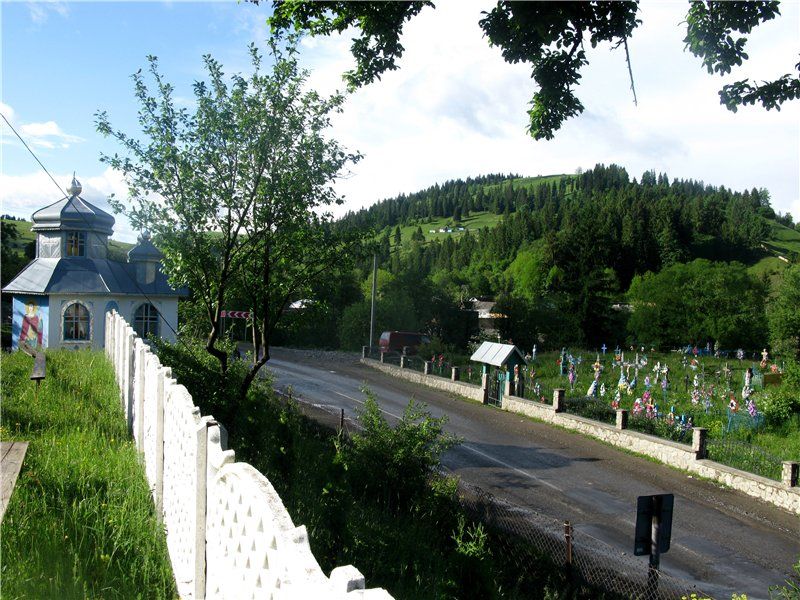
The area of the church is 105 square meters. The walls are decorated with many icons, including the icon "The Last Judgment" made in 1930. There is a bell tower on the territory, where among the new bells there is a bell from 1890 (according to documents brought from Vienna) and a bell from 1919 (brought from Bucharest and presented to the church by brothers Simon and Vasyl Hrytsiuk). At the entrance to the churchyard, next to the beautiful gate, there is a chapel built about 40 years ago and restored this year. There are three crosses for the blessing of water, one of which is associated with the year of construction of the church. Nearby are two cemeteries of the nineteenth and twentieth centuries.
The first priest of the church was Hryhorii Kantemir. At different times, Hryhorii Balosheskul, Stefan Malanchuk, Volynets Stakhii, and Aksentii Vozniuk, people known not only in the Putyla district but also far beyond its borders, served in the church. Since August 19, 2000, Father Dmytro (Fedorashchuk) has been the rector of St. Dmytro's Church.
In recent years, the village church has been significantly renovated. A new fence and gate were built, the walls of the church were restored, and a new cross was erected to bless the water. Today, St. Demetrius Church is an architectural monument of national importance.
The area is generally rich in ancient wooden churches, for example, in the neighboring villages there are the Church of St. Paraskeva and the Church of the Three Saints.
Opening hours: the church is open to the public during Sunday and holiday services.
Dykhtynets is a village in Ukraine, Chernivtsi region, Putyla district. According to the 2001 census, the population of the village together with the surrounding villages was 3883 people. The first archival mention of the village of Dykhtynets is in documents from 1774, when its population was already more than 1000 people. However, some scholars of the Chernivtsi National University disagree with this date and have some information that Dykhtynets was part of the Roman Empire and was its outpost many centuries ago, meaning that the village is much older. One of the confirmations of this fact is the discovery of a treasure trove of ancient Roman silver coins in the neighboring village of Ploska. The name of Dykhtynets village may have come from the time when oil was extracted from wells in the village and processed into tar and kerosene. Until the beginning of the twenty-first century, in the village of Dykhtynets (Malyi Dykhtynets), half-filled deep wells were preserved, from where oil was once taken with large buckets and processed in the simplest ways. (Already in the Soviet Union, geological exploration was carried out, which indeed proved the presence of small nonindustrial oil reserves in our region, which lie at a shallow depth. And in Lopushna in the Vyzhnytsia district (about 20 km over the mountains), there are commercial oil deposits that are being successfully developed and the oil is being processed).
The village, when it was described in the first documents (1774), belonged to the Moldavian principality. In 1775, after the Russo-Turkish War (1768-1774), Austria annexed Bukovyna. Since 1775 Dykhtynets has been part of the Duchy of Bukovyna. As of 1904, the village of Dykhtynets had 1620 inhabitants. The community used its own symbols: a seal with the image of a saw and an axe and an inscription in German: "Gemeinde Vorstand in Dichtenitz". Since 1918, the village of Dykhtynets, like the rest of Northern Bukovyna, has been occupied by Romania. At that time, the majority of the village's population was Ukrainian. On June 28, 1940, Northern Bukovyna was annexed to the Ukrainian SSR as a result of the Soviet annexation of a part of Romania in 1940. During 1941-1944, Northern Bukovyna was again under Romanian rule. In 1944, North Bukovyna was again occupied by Soviet troops.
The following is worth knowing about the village:
- it was famous for the brothers of Oleksa Dovbush who fought with him for justice and a better life;
- the mood of the inhabitants has always been marked by a rebellious spirit - the population actively participated in the peasants' uprising led by Lukian Kobyltsia (1843-1844);
- the mother of the famous Ukrainian writer Yuriy Fedkovych was a native of Dykhtynets village;
- many fragments of Yuriy Illienko and Ivan Mykolaychuk's movie masterpiece "White Bird with Black Mark" were filmed here. The hard life, way of life, customs of the peasants of Bukovyna and the inhabitants of Dykhtynets village in the 40s of the twentieth century;
- Since the 90s, our picturesque village has been chosen as a vacation spot by People's Artist of the USSR Edita Stanislavivna Piekha, who came here almost every summer with her grandson Stas for many years;
- In the fall of 2013, about 3700 people live here, two schools and a kindergarten are functioning;
- in the fall of 2012, Dykhtynets school celebrated its 150th anniversary.
Accommodation around St. Dmitry's Church, Dykhtynets:


Which trails pass by St. Dmitry's Church, Dykhtynets?
We suggest these hiking trails through or near St. Dmitry's Church, Dykhtynets: Pysanyi Kamin – Bukovets village, Bukovets village – Pysanyi Kamin – Bukovets village, Smuharski Waterfalls, Nimchych Pass – Protiate Kaminnia, To Dovbush Chambers, Kosmach village, via Mount Rotylo, Mount Hrehit and Mount Bila Kobyla to Bukovets village

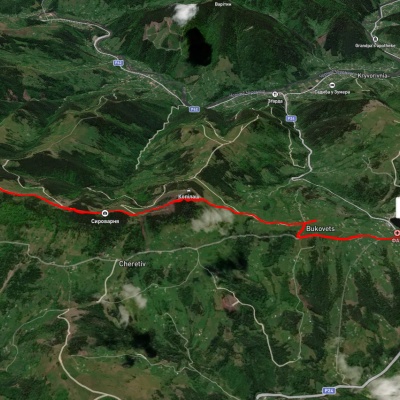
Pysanyi Kamin – Bukovets village
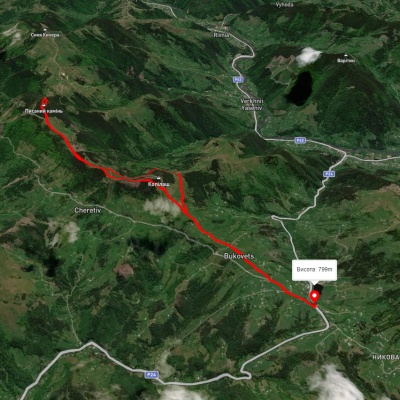
Bukovets village – Pysanyi Kamin – Bukovets village
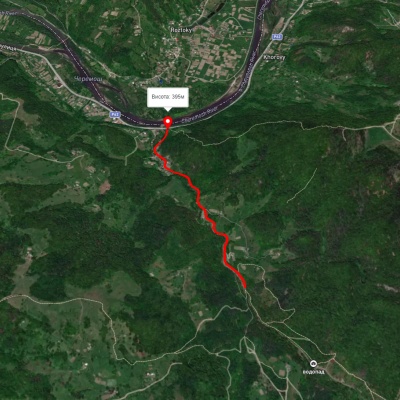
Smuharski Waterfalls
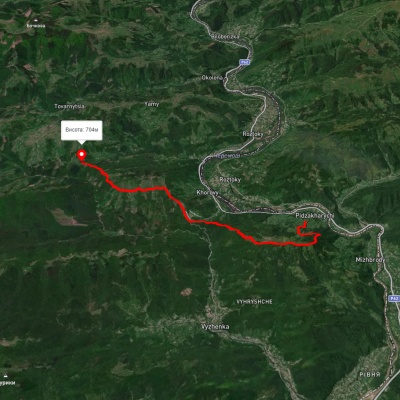
Nimchych Pass – Protiate Kaminnia