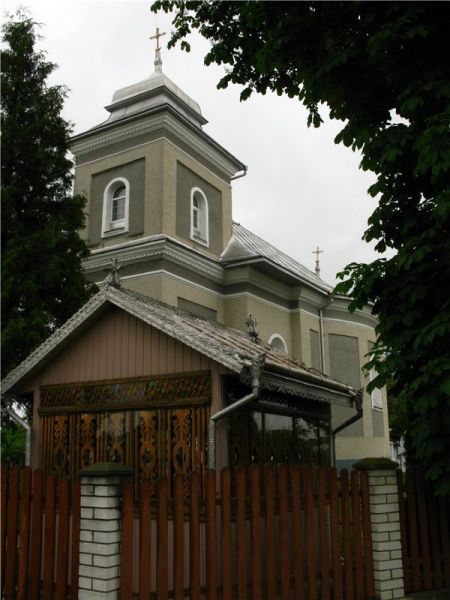
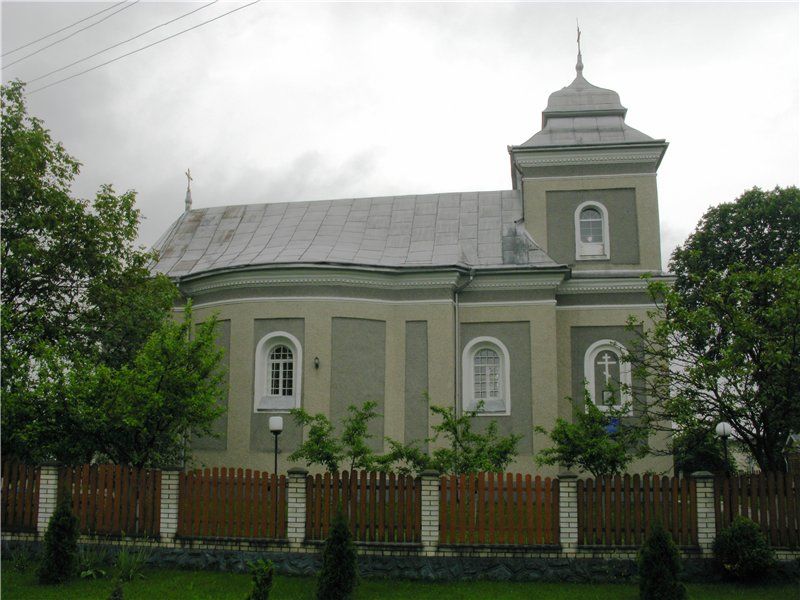
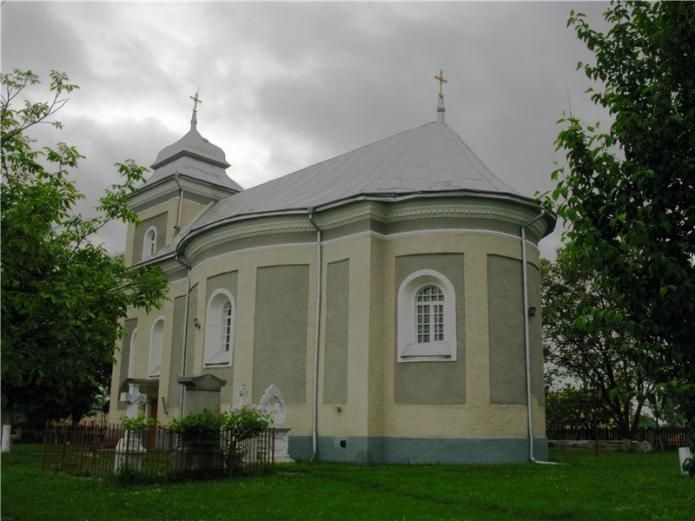
Church of the Nativity of the Virgin Mary, Shipintsy
Shypyntsi is one of the most mysterious villages in Bukovyna. In ancient times, it was the center of the Shipyntsi land, which was part of Kievan Rus and then the Galicia-Volyn principality. A Trypillian settlement was discovered here, and many archaeological finds from here are exhibited in European museums. Nowadays, the village's decoration is the stone church of the Nativity of the Virgin Mary.
The church was built in 1812. The founder of the church was a local landowner Myron de Kostin. His family is buried in the churchyard. With minor changes, the church has survived to this day. By the way, there used to be a landowner's residence in the village, but it has not survived. Today you can only see the remains of the count's park.
The church itself was built in the spirit of the architectural traditions of Bukovyna. There is a bell tower in front of the Babynets, which has some Baroque features. In general, the church is very small, but it makes an atmospheric impression.
It is a stone, plastered, three-part, domeless church with a low, Baroque bell tower above the western narthex. The main volume is covered with a cross vault. The church is covered with tiles. The facades are characterized by soft plasticity of the walls, typical of Bukovinian architecture. They end with a frieze of small niches and a row of curbstones, a traditional motif of the local school of architecture. The interior is separated from the nave by an arch. The single interior space is holistic and compact.
Themonument is an example of Bukovinian architecture of the early XIX century, the planning and spatial structure of which continued the traditions established in Ukrainian architecture of the XIV-XVII centuries.
Shypyntsi is located on the H-10 Ivano-Frankivsk-Chernivtsi highway, near the villages of Luzhany and Berehomet. It is convenient to get here by buses that run between Chernivtsi and Ivano-Frankivsk. By rail, you need to get to the Luzhany station, where suburban trains from Chernivtsi stop, and from there take a train to Shipyntsi.
Openinghours: the church is open during worship, so we recommend visiting on Sunday before lunch.
Shypyntsi is a village in the Kitsman district of the Chernivtsi region. Shypyntsi is located in the Bukovinian Carpathian region on the left bank of the Prut River in the valley of the Sovytsia River. In the village, the Vilkhovets stream flows into the Sovytsia. Shypyntsi is located in an area with a large number of bogs, and once there were even more of them. There were lakes in the valleys that were formed during spring snowmelt or when there was a lot of rain. So much water would accumulate that the lakes would remain even during the summer heat. People say that in ancient times, the water in those places hissed from the sun-heated water. Hence the name of the village of Shipyntsi.
During the Neolithic period, the tribes of the Trypillian culture (IV millennium BC - III millennium BC) settled here. There are many things of that era within the site of Shipyntsi: painted ceramics, human and animal figures. There were also finds from the Bronze (bracelet, ax) and Roman (coins) periods. A significant number of artifacts date back to the times of the Antean Union, Kyivan Rus, and the Galicia-Volyn principality.
Excavations in Shypyntsi were conducted by J. Sombaty (1893) and E. Kostin (1904-1914); the materials found are kept in the Chernivtsi and Vienna (natural history) museums. In his monograph "Schipenitz - Kunst und Geräte eines neolithischen Dorfes" ("Shypyntsi - Art and Tools of a Neolithic Village", 1937), Oleh Kandyba-Olzhych studied the finds of Shypyntsi.
In the times of the Galicia-Volhynia state, a territorial entity, the Shipyn Land, was born, the name of which came from the settlement of Shipyntsi. The first documentary mention of the Shipyn land was made by Jan Długosz in 1359 in connection with King Casimir's campaign in Moldova.
The development of the Shypyn land was due to the fact that this territory was remote from Tatar nomads and was on the trade route from Lviv to Suceava. In this regard, regular large fairs were held in Shypyntsi, where cattle were traded. To this day, the place is called Torgovytsia.
After the land became part of the Moldavian principality, the Chernivtsi and Khotyn lands were formed from the Shipyntsi land, and the region became known as Bukovyna. The administrative center moved to Chernivtsi.
There is another legend associated with Shypyntsi. Behind the village there is a small lake called "Round Swamp". People believed that it had no bottom. They said that since ancient times there was a village where there is a round swamp. People in this village lived very debauchedly, even during Lent they had various amusements. On the site of the "Round Swamp" there was a large tavern where people drank wine and had all kinds of fun, even in Lent (before Easter). God was angry with them and punished the sinners - the tavern, crowded with revelers, and the whole village fell into the ground, and the lake "Round Swamp" was formed on this place, inaccessible and bottomless. Residents of Shypyntsi believe that the time will come when the lake will disappear and the village will emerge.
The old count's park, which once surrounded the estate of Myron de Kostin, has been fragmentarily preserved in the village. Nowadays, the park is home to a rather popular tavern called "Pid Lypy".
In the middle of the nineteenth century, the community of Shypyntsi had its own symbols - a seal with a coat of arms: an image of a church altar with two candles and a cross crowned with a bishop's mitre; two worshipers kneel on either side of the altar. The coat of arms was accompanied by an inscription in German: "Siegel der Gemeinde Schippenitz" ("Seal of the community of Shypyntsi").
In Shypyntsi, in the center of the village, there is a stone three-domed Church of the Nativity, built at the expense of the local landowner Dmytro de Kostin in 1812. The founder of the church and his family are buried in the churchyard, where eight old crosses have been preserved. The church is typical for Bukovyna: domeless, with a low bell tower with a baroque roof over the narthex. The bell tower is much younger than the church: it was built in 2003, but the bells date back to the first third of the twentieth century. During the First World War, the old bells of the church in Shypyny were removed to make weapons. In Romanian times, the Church of the Nativity had an amateur men's choir under the direction of Orest Masikevych, who enchanted the people of Chernivtsi with his singing.
Nowadays, Shypyntsi is famous for its musicians. Local craftsmen are welcome guests at weddings and celebrations throughout the region.
Accommodation around Church of the Nativity of the Virgin Mary, Shipintsy:


Which trails pass by Church of the Nativity of the Virgin Mary, Shipintsy?
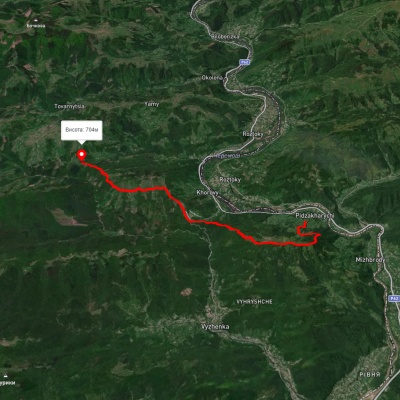
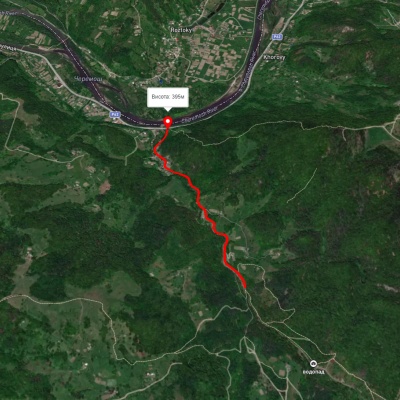
We suggest these hiking trails through or near Church of the Nativity of the Virgin Mary, Shipintsy: Nimchych Pass – Protiate Kaminnia, Smuharski Waterfalls