St. Nicholas Church, Izky
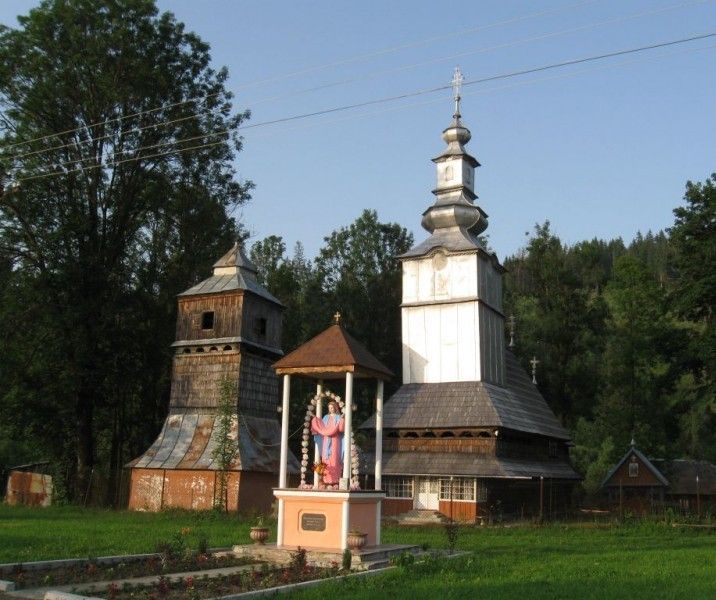
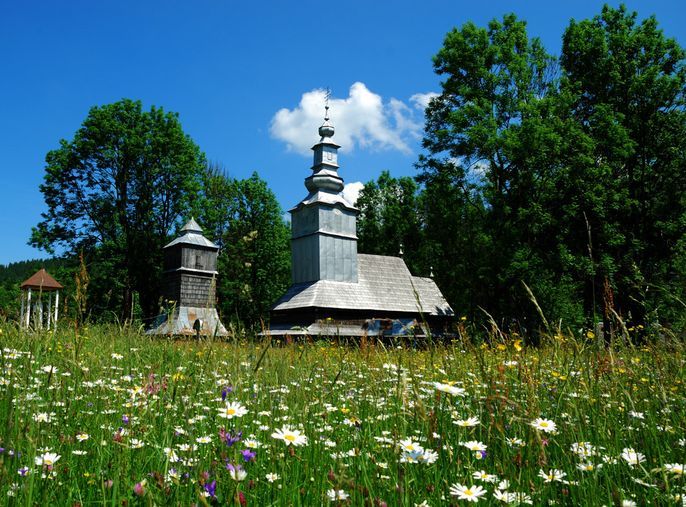
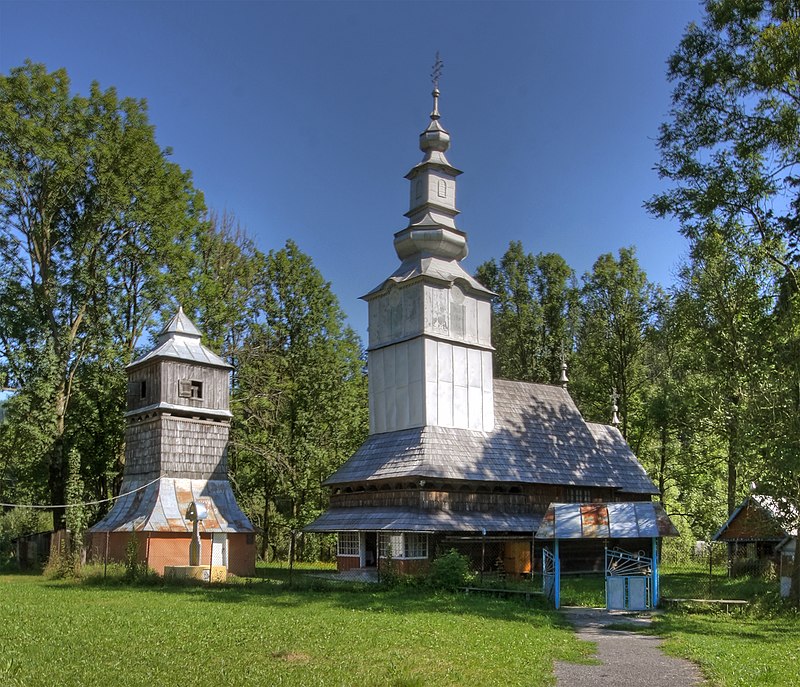
TheChurch of St. Nicholas the Wonderworker is a wooden church located in the village of Izky, Mizhhiria district, Transcarpathian region. The church is a classic example of Verkhovyna Baroque and is the largest church of the so-called Mezhyhiria group of monuments, an architectural monument of national importance (#215).
The Church of St. Nicholas in Izky is the largest of all the monuments of the Mezhyhiria group. The proportions of the volume and especially the rhythm of the arches of the gallery-porch with six carved columns and a low arcade on the second tier of the narthex are surprisingly well found. Due to the fact that the upper arches are less than a semicircle, they seem to be trapped by the overhang and the eaves of the church's roof. The cuts of the brackets that support the porch's eaves and roof, as well as the ends of the logs of the arch-cut connecting the Babynets to the nave, were made by a talented craftsman.
The church was originally built of spruce beams in the Boyko style with three tops. This is evidenced by certain elements inside the building. Today the church is a classic example of Verkhovyna Baroque. The volumes of the nave, the altar, and the high tower with a slender, clearly developed tiered ending are arranged with perfect taste and sense of proportion. The porch is supported by interestingly profiled beam releases; a beautiful porch arcade is now hidden behind boarded walls.
The corner joints of the spruce beams are made by mortises into a simple lock with a double-sided cutout and a straight hidden tenon. It is covered with shingles. Narrower rectangular log cabins are adjacent to the central rectangular log house to the west and east. An openwork two-tiered gallery is attached to the western wall of the Babynets. The arcade of the upper tier of the gallery circles the Babinets on three sides. The box vault of the nave and the flat ceiling of the narthex are covered with a high roof. A square frame bell tower rises above the chancel, divided into two parts by a cornice; decorative dials are located in the upper part on four sides. The tower is crowned with a multi-tiered Baroque finial.
A tall, three-tiered, square, frame bell tower was built to the northwest of the church. The bell tower's roof smoothly transitions into the vertical volume of the second tier, decorated in the upper part with a narrow arched belt. The third tier has rectangular openings covered with shutters. The bell tower is covered with a four-pitched hipped roof with a kink. The lower tier of the bell tower is covered with boards, the second tier is covered with shingles.
The rather tall bell tower uses some elements of ancient defensive towers, but in a decorative interpretation. Its lower tier is completed with a very wide dormer with a softly contoured roof, which smoothly transitions into the vertical volume of the second tier, where a belt of small loopholes-arches runs along the top. The third low tier of the bell tower is crowned with a pyramidal top with one crease, as in Boyko churches. The massif of this building is simple, its divisions are clear, and the small loopholes-arches at the end of the second tier contrast with its large forms, making it look monumental.
In 1751, there were three wooden churches in Izki, and St. Nicholas was undergoing repairs at the time, so it was built at least in the early eighteenth century or even earlier. 1798 is the year of the church's reconstruction.
The results of the field research suggest that the church was built in the seventeenth century; the main log walls, the lower crowns of the log cabins and the upper ones, and other traces of reconstruction have been preserved from this period. During the reconstruction, the church acquired a modern look.
The church houses a magnificent icon of the Virgin Mary, called the "Transcarpathian Madonna" by the prominent art historian Hryhorii Logvin. Unfortunately, all the old paintings of the church were mercilessly painted over by misguided "artists." The church has preserved examples of folk carvings, such as an eighteenth-century iconostasis, candlesticks, and a wooden chandelier. Various inscriptions tell us the names of the people involved in the church's arrangement: the icons of the feast day row were "painted by the priest, Father Maksym Marusynych," the icon of the Last Supper was "made by Father Hryhorii Luchynets... on September 25, 1730," the icon of the Mother of God was bought by "Petro Kelechynskyi... for his absolution," and the icon of St. Nicholas was "made" by the priest, Father Petro Kryvanych and his family.
Near the church stands a wooden bell tower of archaic shape and rare proportions. It is the only bell tower of this type in Zakarpattia - it is all pointing upwards, as if supporting the slight vertical rise of the church tower. The building is a frame structure, with a wide base that passes above the dome into a tall, slender volume. The windows with shutters and a low arcade serve as the voices. The hipped roof of the bell tower with one slope is artistically flawless. The bell tower, as well as the church, is taken care of as best they can, gradually increasing the amount of tin on it. The church tower is also covered with metal. In the summer of 2005, however, the community's efforts helped to give the roof a new shingle covering.
The church in Izky is a kind of museum of Ukrainian art of the 16th and 19th centuries. It houses many first-class works of iconography and applied art. The icon "Our Lady of Hodegetria with the Prophets" belongs to the pinnacles of Ukrainian painting of the sixteenth century. Painted with only whitewash, soot, yellow and red ochre, it creates an amazing impression with the exquisiteness of its color. It can be safely called the "Transcarpathian Madonna" because here the master gave his own interpretation of the image of Mary. She does not inherit either the strict hieratic type of Our Lady of Odyhytria or the lyrical one of the Mother of God. The artist paints a young mother with a baby in her arms as in the "Hodegetria," but gives her a different pose: she slightly bends her head toward the child. Mary supports the child with one hand and holds a lilac sprig in the other. A gray-blue maphora, painted only with soot and whitewash, adorns the ochre-pink face of the Virgin. She has a wonderful oval face with a soft, narrow chin and a very broad forehead. On the face, modulated only by a black line and light halftones of ocher-pink color, on which red lips are barely visible, incredibly large black eyes with huge pupils stand out. Her gaze, with an expression of boundless sadness, is directed as if into herself. In this icon, the artist managed to reflect not only the suffering of Ukrainian wives and mothers, their love, tenderness and loyalty, but also the sadness and grief of all mothers, and managed to create a sublime and poetic image.
The painting of the iconostasis, which dates back to the end of the eighteenth century, belongs to a master of unusual temperament, who has a great decorative flair, a monumentalist by nature. His broad style of painting reveals him to be an innate master of frescoes. He likes the type with wide open foreheads, with large eyes, figures of slender proportions. His images are folk, Ukrainian, executed with high dignity, inner concentration and grandeur.
The village where the church of St. Nicholas is located is especially popular in winter. The Izky ski resort is located here. This is one of the highlights of Zakarpattia.
Accommodation around St. Nicholas Church, Izky:


Which trails pass by St. Nicholas Church, Izky?
We suggest these hiking trails through or near St. Nicholas Church, Izky: Volovets village, via Mount Stiy, Mount Zhyd-Mahura, Mount Hemba and Mount Velykyi Verkh to Volovets village, Mount Zhyd-Mahura – Izky village, Kerechky village, via Mount Stiy, Mount Velykyi Verkh, Mount Hemba and Mount Zhyd-Mahura to Rychka village, Rychka village, via Mount Zhyd-Mahura, Mount Hemba, Shypit Waterfall and Mount Velykyi Verkh to Volovets, Pylypets village, via Shypit Waterfall, Mount Hemba and Mount Velykyi Verkh to Volovets, Pylypets village, via Shypit Waterfall and Mount Hemba to Pylypets village

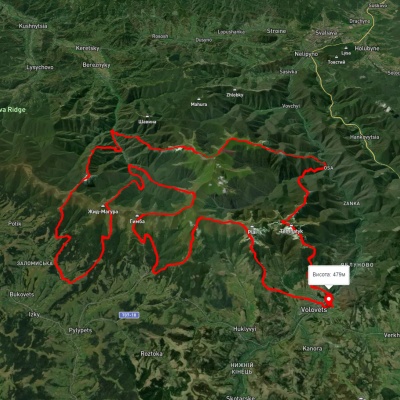
Volovets village, via Mount Stiy, Mount Zhyd-Mahura, Mount Hemba and Mount Velykyi Verkh to Volovets village
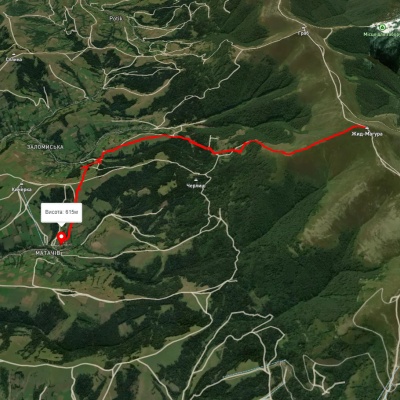
Mount Zhyd-Mahura – Izky village
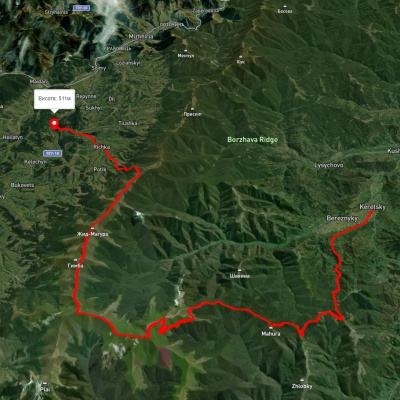
Kerechky village, via Mount Stiy, Mount Velykyi Verkh, Mount Hemba and Mount Zhyd-Mahura to Rychka village
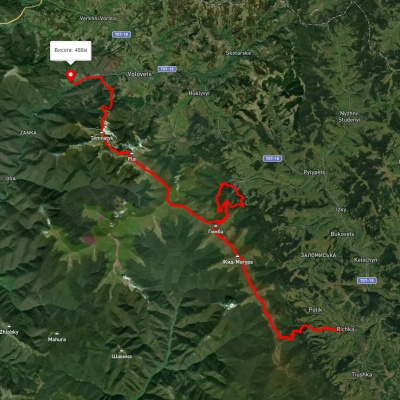
Rychka village, via Mount Zhyd-Mahura, Mount Hemba, Shypit Waterfall and Mount Velykyi Verkh to Volovets

