Church of the Exaltation of the Holy Cross, Burshtyn
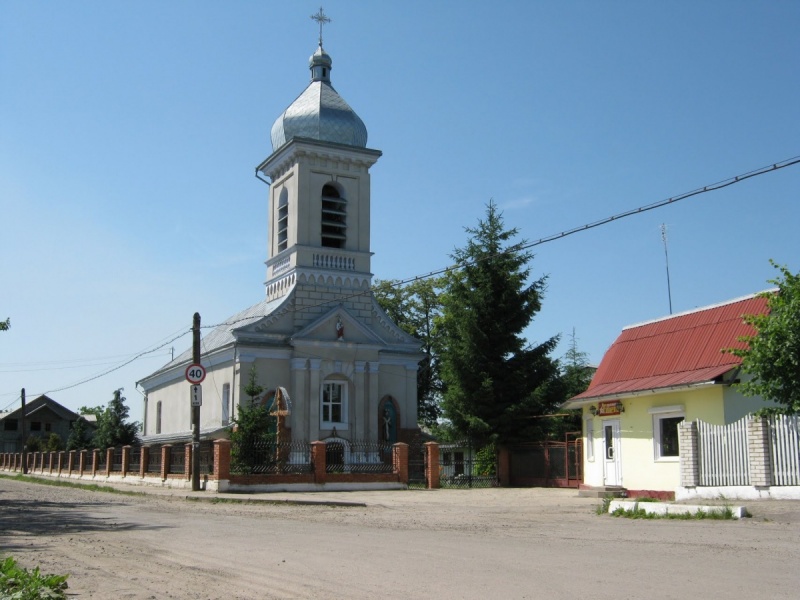
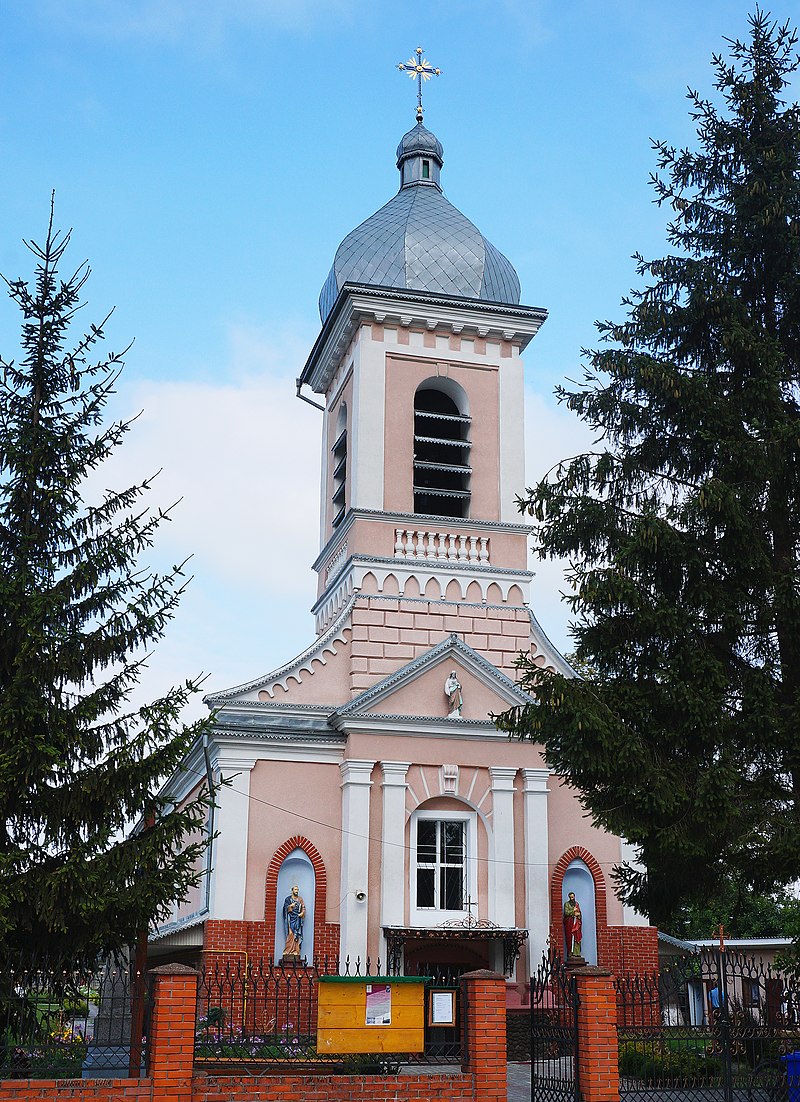
Greek Catholic church in the city of Burshtyn - Church of the Exaltation of the Holy Cross. The first wooden church in Burshtyn was built in the 16th century in the eastern part of the town at Priska Square (now submerged under the waters of the Burshtyn Reservoir).
Little is known about the early years of the Greek Catholic church at its current location. The wooden church was likely built in 1746 with funds from the local landowner, Pavlo Beno. A cemetery was located around the church, where burial of the deceased was prohibited by imperial rescript at the end of the 18th century. The wooden church stood at that location until the early 19th century, with the last mention of it dating back to 1820.
The exact date of the construction of the stone Church of the Exaltation of the Holy Cross was unknown for a long time. Only in 2002, during the church's reconstruction, builders discovered a document stating that the brick church was built in 1824 with funds from the crown's under-chamberlain and royal falconer of Galicia, Count Ignacy Skarbek.
The Greek Catholic church of Burshtyn owned significant lands, which were granted to it in the 18th century. By 1886, the church owned 67 morgs of fields and 64 morgs of meadows. By 1896, the area of fields increased by another 8 morgs. In 1904, an additional 444 sazhen of gardens were allocated to the local priests. From 1926 to 1939, the church received fifty zlotys for the meadow donated to the church by one of the residents of Burshtyn. By 1939, the church had 30 hectares of fields, 1 hectare of forest, 11 hectares of meadows, 96 ares of gardens, and 2 ares of pastures. Moreover, the parish priests had the right to free grinding of grain in the mills of the Burshtyn landowners.
Throughout the 19th century, the church did not suffer any damage despite frequent fires in the city at that time. The church was partially engulfed in flames only on the eve of World War I - June 25, 1914, when a significant part of the city was burning again. However, the flames were quickly extinguished.
In 1912, a memorial plaque made of black marble was installed in the church in honor of the centenary of the birth of the Galician enlightener Markiyan Shashkevych. The inscription reads: "To the Resurrector of the National Literature, Markiyan Shashkevych 1810-1843 On the centenary of his birth, Burshtyn region".
In 1914-1916, Burshtyn, particularly the area around the church, suffered significant destruction due to the battles of World War I, primarily due to the bombardment of the city by Russian artillery. Most houses, including the Skarbek Palace, were destroyed or severely damaged. However, the Greek Catholic church managed to withstand throughout the war without significant destruction.
In 1932, on the anniversary of the November National Liberation Uprising in Lviv, at the initiative of local priest Bohdan Yizhak, a grave was erected in the church for the Sich Riflemen, near which a memorial service and rally took place. Such actions by the priest provoked a sharp reaction from the Polish authorities and Catholics. After that, the local Polish and Jewish communities succeeded in transferring Father Bohdan to another parish.
In 1946, the Burshtyn Greek Catholic parish, along with all Galician parishes of the UGCC, came under pressure from the Soviet authorities to join the Russian Orthodox Church, and the union was liquidated. In 1961, a state inspection was conducted in the church to check for Catholic inventory. All Greek Catholic utensils, books, and icons were stored in an auxiliary room. Three years after the inspection, 23 items of Greek Catholic ritual inventory were taken to a warehouse at the Ivano-Frankivsk Cathedral.
After the proclamation of Ukraine's independence and the UGCC's emergence from underground, church life in the Church of the Exaltation of the Holy Cross resumed with even greater strength. Since at that time the city had significantly expanded compared to the pre-war years, the old church could not accommodate all the parishioners, so in 1992, the construction of a new church - the Church of All Saints and Martyr Josaphat began, which was located near the new part of the city on S. Bandera Street.
In 2001-2002, at the initiative of Father M. Rozhok, repairs and reconstruction were carried out in the church. Also, in the first half of the 2000s, a building for economic needs was added to the rear side of the church, a chapel was built nearby, and a fountain was installed.
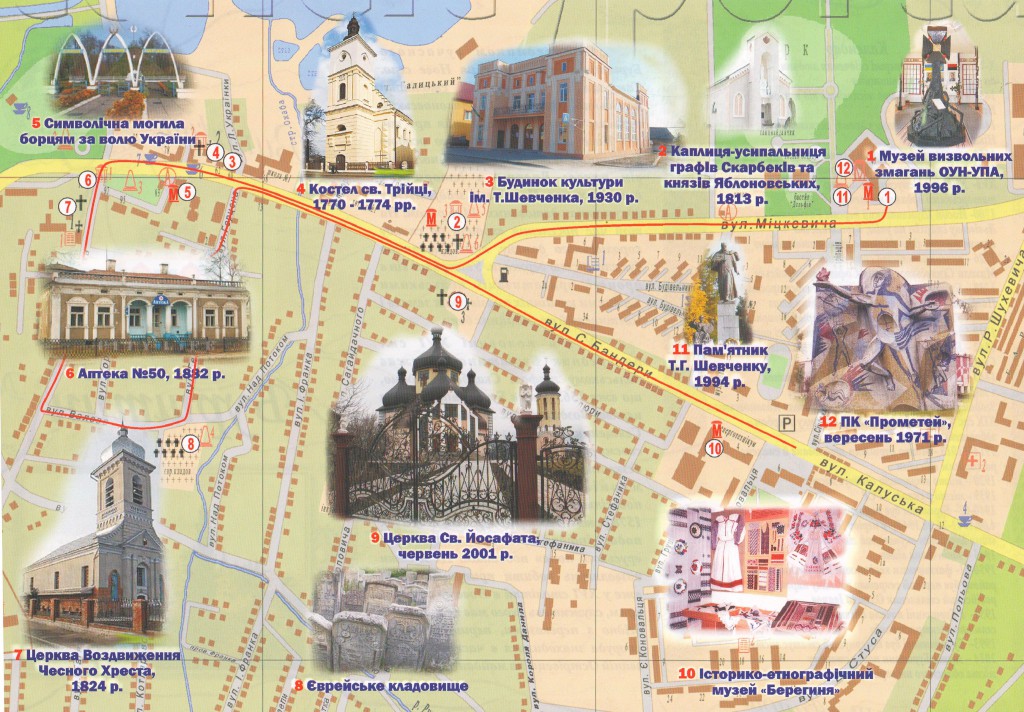
Below in the illustration, you will see all the landmarks of Burshtyn, and we also offer links to the pages of the famous mosaic cultural palace "Prometey", historical and ethnographic museum "Berehynya", and the Roman Catholic Church of the Holy Trinity in the old part of Burshtyn.
To add a comment you can: login or register.
Nearby hiking trails near Church of the Exaltation of the Holy Cross, Burshtyn:
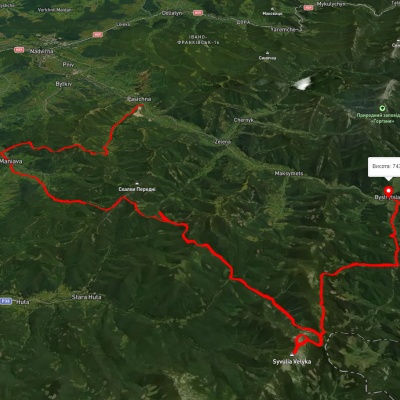
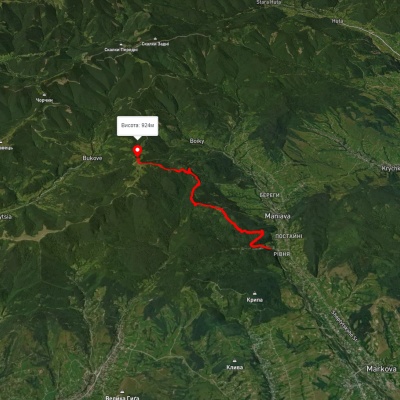
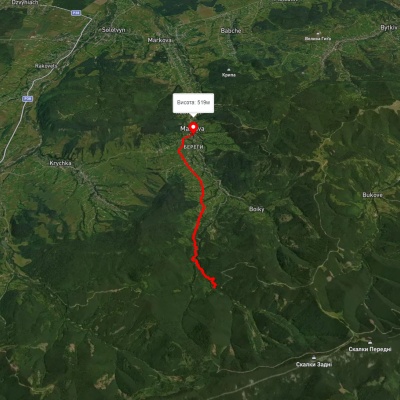
Which trails pass by Church of the Exaltation of the Holy Cross, Burshtyn?
We suggest these hiking trails through or near Church of the Exaltation of the Holy Cross, Burshtyn: Pasichna village, via Maniava village, Maniava Waterfall and Mount Velyka Syvulia to Bystrytsia village, Maniava village - Monastyretska polonyna, Maniava village – Maniava Waterfall, Huta village – Pasichna village, Pasichna village, via Mount Syniachka to Yaremche, Pasichna village – Pereslop Pass