Church of St. Bartholomew, Drohobych
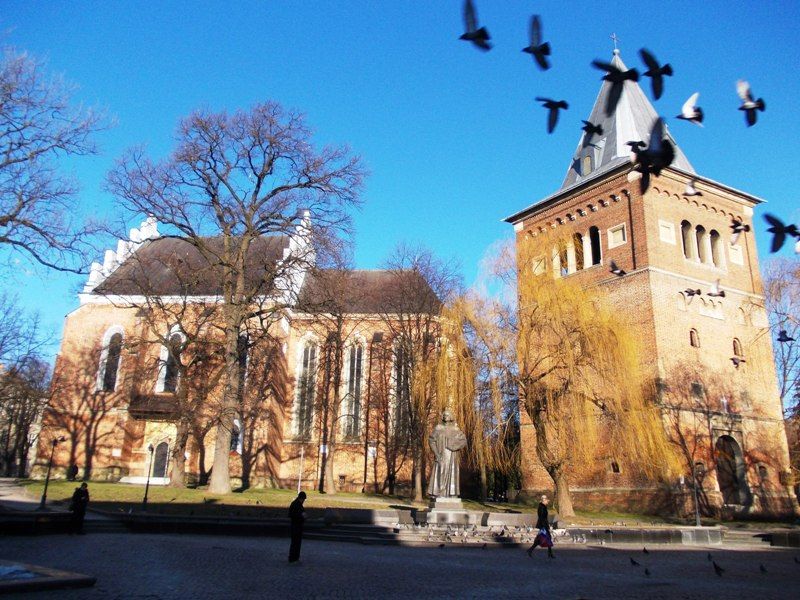
TheChurch of St. Bartholomew the Apostle (Assumption of the Blessed Virgin Mary) is a Roman Catholic church in Drohobych, Lviv region; an ancient spiritual center, an example of Gothic and Baroque architecture (interior paintings) of the late XIV-XVI centuries, a historical and architectural monument of national importance. It is included in the list of 15 mystical and mysterious churches in Ukraine. It is one of the oldest surviving structures in Drohobych, located in the center of Drohobych at 12 Danyla Halytskoho Street. The church's feast day is August 24.
Previously, a wooden church of the Blessed Virgin Mary was located on the site of the present church. However, in December 1392, King Władysław Jagiełło, while in Drohobych, issued a document on the foundation of a new brick Gothic church, which was to be a defense structure at the same time. The church was built on the site of the princely voivode's palace. At its consecration, the church was named the Church of the Assumption of the Blessed Virgin Mary and the Holy Apostle Bartholomew. It was the predecessor of the present-day Church of St. Bartholomew the Apostle, on the site of which the modern church later appeared.
In 1511, St. Bartholomew's Church was rebuilt after significant damage it sustained during the attack on the city by the Tatars and Vlachs in 1498. The first third of the fifteenth century is considered to be the time when the modern church was built. Over the centuries, the church was repeatedly destroyed (especially in the seventeenth century) and rebuilt. In the eighteenth century, restoration work was carried out here, as a result of which the interior of the church was painted in the late Baroque style by the artist Andrii Solytskyi. At the end of the same century, a chapel was added to the shrine. In 1882, as well as in 1906-1913, the church underwent restoration work, and in the 1930s the frescoes were restored. However, during the Second World War, part of its interior was destroyed, and the church's property was severely damaged. Then in 1949 the church was closed and its premises were used as a warehouse for theater props.
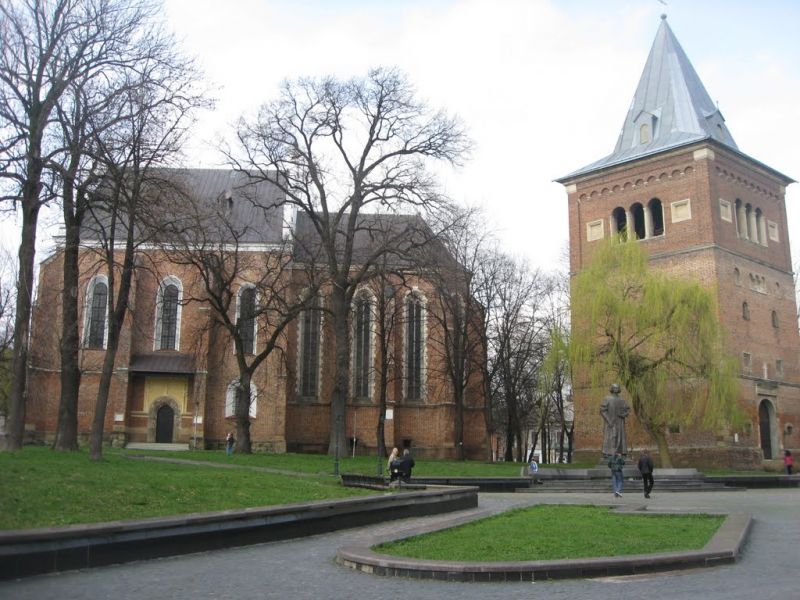
Bell Tower The Church of St. Bartholomew the Apostle is originally a 16th-century defensive tower with an entrance gate attached to the bell tower of St. Bartholomew's Church (from the 18th century) in Drohobych, an architectural monument of national importance. It is one of the oldest buildings in the city. The bell tower is a structure located to the southeast of the church, obliquely to its axis, with its front facing the corner of Rynok Square. The building is made of brick with interspersed stone, square in plan (13 by 13 m, the walls of the first tier are up to 2 m thick), and stands on a low sloping plinth. It is completed with a high hipped roof. The first tier has a through archway. The powerful walls are occasionally pierced by loopholes. The third tier, added in the late nineteenth century, is decorated with triple arched windows and panels and is crowned with an arched frieze.
The first tier has a vault. A frieze with coat of arms shields with floral motifs can be seen on the lined plinth topped by a cornice. A staircase built into the walls leads up from the west. There are paintings on the walls by T. Rybkovsky (1914): The Last Judgment, Healing of a Paralytic. On the vault is a scene of the Resurrection surrounded by cartouches. There are four bells on the bell tower: "St. Bartholomew" (1739) and three others (1926).
Now (2013) the bell tower belongs to the Roman Catholic community of Drohobych. On September 20, 2018, a permanent exhibition of icons of the Blessed Virgin Mary was opened in the bell tower of the Church of the Holy Apostle Bartholomew.
The attacks on the city, accompanied by the destruction of the shrine, continued in the future, in particular in 1594, 1624, and 1648. In 1664 the church was partially restored. During the XVII-XX centuries, the defensive tower was rebuilt into a bell tower (1739), old altars were remodeled and new altars were built, loopholes were eliminated, and the roof was lowered (1790-1793). At the same time, in the late eighteenth century, a chapel was added to the church.
Subsequent restorations of the Church of St. Bartholomew the Apostle in Drohobych were carried out in 1881-1882, 1906-1913, and in the 1930s (in particular, the frescoes were restored then). In 1949, after the Second World War, the church was closed by the Soviet Union and used as a warehouse for theater props. In 1989, the church was returned to the Roman Catholic community of the city.
In 2007, on Ukraine's Independence Day, which coincides with the feast day of Drohobych's oldest monument, the Church of St. Bartholomew the Apostle, a majestic monument to Pope John Paul II was erected and inaugurated in front of the church entrance, which at that time was the third monument to John Paul II (and the fifth in Ukraine). Among the guests who came to the celebrations were Bishop Marian Buchek of Lviv, Roman Catholic priests from Zhydachiv, Hnizdychiv, and Truskavets, representatives of the Polish community of Stryi, and a delegation from the city council of the Polish city of Sanok.
On August 24, 2017, a parish feast in honor of St. Bartholomew the Apostle and the consecration of the new high altar took place in Drohobych. The celebrations and the Eucharistic Liturgy were led by Auxiliary Bishop Edward Kava OFM Conv. During the Liturgy, he not only consecrated the new high altar, but also a copy of the image of Our Lady of Kohavyn, which is located in the side nave of the church.
The altar, which was consecrated that day, was being built over the course of a year. The rector, Fr. Myroslav Lekh, decided to start its construction in July 2016. The work was completed in August 2017. The altar was designed by Fr. Lavrentiy Ivanchuk OH. Carpenters from Zolochiv, led by Mr. Andriy Melnyk, began work on the altar.
St. Bartholomew's Church in Drohobych is a single-nave church with an elongated faceted five-walled altar. The facades of the church's brick walls and buttresses are decorated with a lace diamond-shaped ornament, also made of brick, which has a dark brown or dark red glaze. The nave of the church has high stepped Gothic pediments on the western and eastern facades. The church looks monumental due to the absence of small divisions.
The interior of the church has four supporting pillars that carry a system of cross vaults; in the altar part there is a nave vault. The altar consists of 3 parts (width 8 m, height approx. 15.5 m). In the side parts of the altar there are wooden white figures of the Apostles Peter and Paul, on the top of the side parts there are oil paintings in Drohobych, which represent the archangels Gabriel and Raphael. In the middle of the altar, the tabernacle is surrounded by a row of golden columns, above which there are 2 angels, and between them is the icon of the Mother of God of Perpetual Help (the icon of which has been a Roman copy from Stryi for more than 100 years). In the central part of the altar is a crucifix that was saved from burning. Above the cross is a figure of St. Bartholomew the Apostle, and at the end of the altar is a figure of St. Archangel Michael, made by a carver from the outskirts of Drohobych. The most important elements of the tabernacle, figures and images are illuminated by LED lighting.
The Church of St. Bartholomew the Apostle in Drohobych is characterized, as is all Gothic architecture, by a deep disclosure of the interior of the church space. During the restoration work that took place in the church in the eighteenth century, the interiors of the church were re-painted by the artist Andrii Solitskyi in the late Baroque style. In addition to religious paintings, there were also compositions on historical themes: the scene of the destruction of the Drohobych church by Bohdan Khmelnytsky's Cossacks and Tatars in 1648, the scene of the granting of ancient rights to Drohobych by Emperor Joseph II, and others. The frescoes were painted by the master Borshch around 1800. The stained glass windows were made in the nineteenth century.
Many valuable interior items were lost during the Second World War, and even more were destroyed by Bolshevik barbarians, but several interesting objects have survived. These include fragments of Solitsky's paintings, an ancient fresco depicting St. Christopher, which combines the artistic traditions of late Gothic and Renaissance. In the church you can also see the Renaissance tombstone of Kateryna Ramultova, made by Sevastian Czeszek in 1572. The stained-glass windows made according to the sketches of nineteenth-century artists J. Matejko, S. Vyspiansky, and J. Mehoffer are also worthy of attention. An ancient icon painted by the famous Italian artist Tommaso Dolabella has been preserved in the altar part of the church. The interior was also decorated by Ukrainian artist and carver Ivan Lukych Vendzilovych.
Today, the Church of St. Bartholomew the Apostle is served by priests from the Roman Catholic Parish of St. Bartholomew the Apostle in Drohobych. The church belongs to the Stryi Deanery of the RCC.
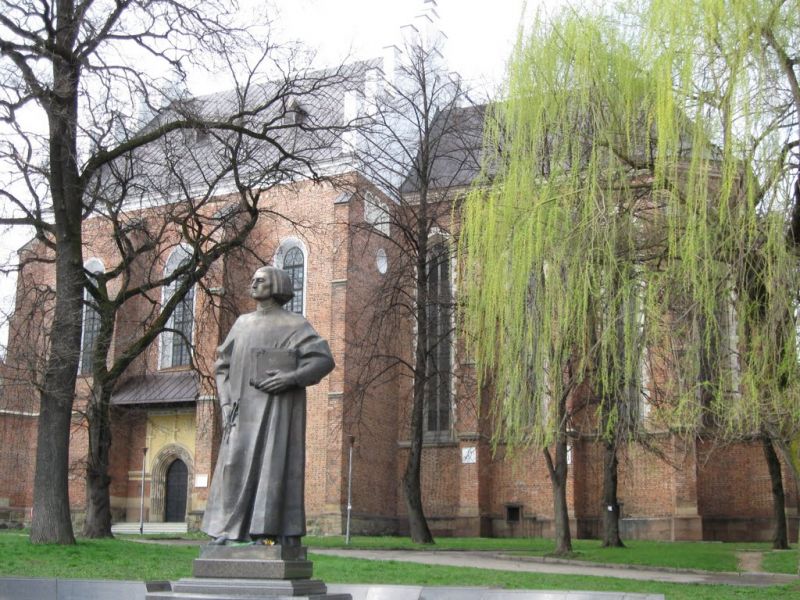
The building is a 5-minute walk from the city hall, and the famous St. George's Church, a UNESCO World Heritage Site, can be reached in 25 minutes. Next to the tower is a monument to Yurii Kotermak (Drohobych), a prominent Ukrainian scientist, by the famous sculptor Teodoziya Bryzh.
There are many things to see in the church today: Gothic white-stone portals, paintings by Andrii Solytskyi, stained-glass windows of the nineteenth century, a Renaissance tombstone of Kateryna Ramultova, an ancient icon by Italian artist Tomas Dolabella, and an ancient fresco depicting St. Christopher. Unique white stone reliefs have been preserved on the northern wall of the church - three windows with a head in a papal tiara, a foot, and a palm.
The Church of St. Bartholomew in Drohobych is considered a striking example of Gothic architecture of the XV - XVI centuries and is one of the outstanding historical and architectural monuments of national importance. The city of Drohobych lies in the picturesque foothills of the Beskydy Mountains. The famous resorts of Truskavets and Skhidnytsia are located a few kilometers to the south, where you can improve your health and drink Naftusia mineral water.
Accommodation around Church of St. Bartholomew, Drohobych:


Which trails pass by Church of St. Bartholomew, Drohobych?
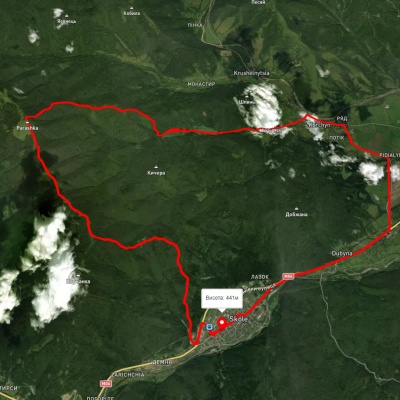
We suggest these hiking trails through or near Church of St. Bartholomew, Drohobych: Sopit village, via the Sopit polonynas to Sopit village, Korchyn village, via Hurkalo Waterfall and Mount Parashka to Krushelnytsia village, Kamianka village, via Mount Lopata, Skole and Mount Parashka to Krushelnytsia village, Korchyn village – Hurkalo Waterfall, Skole, via Mount Parashka, Hurkalo Waterfall and Korchyn village to Skole, Skole, via Mount Parashka, Hurkalo Waterfall and Korchyn village to Verkhnie Synovydne village



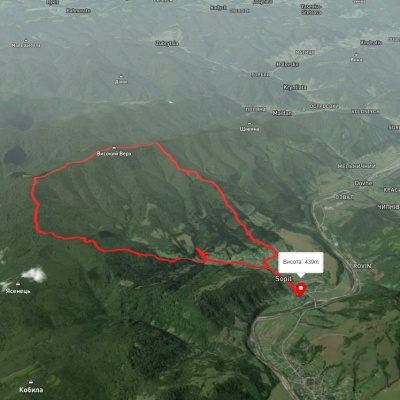
Sopit village, via the Sopit polonynas to Sopit village
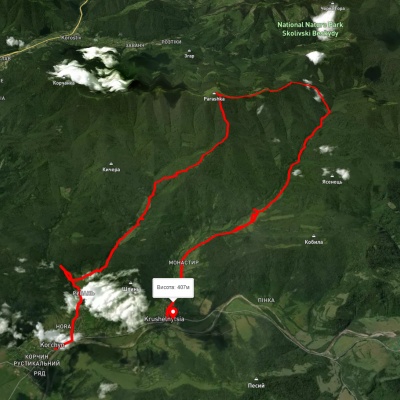
Korchyn village, via Hurkalo Waterfall and Mount Parashka to Krushelnytsia village
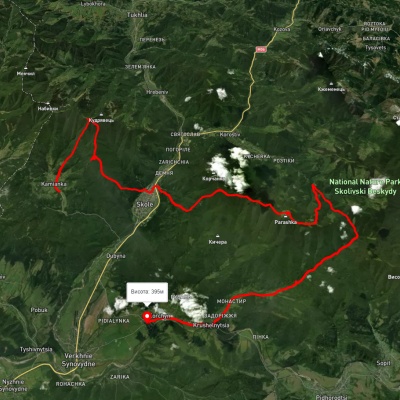
Kamianka village, via Mount Lopata, Skole and Mount Parashka to Krushelnytsia village
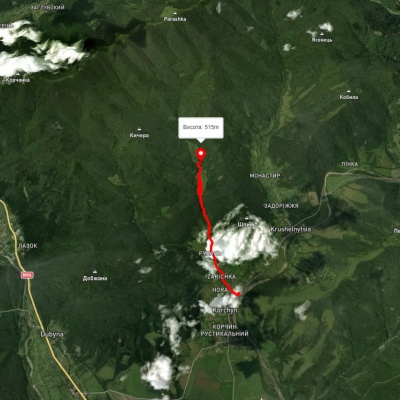
Korchyn village – Hurkalo Waterfall