Jewish People's House, Chernivtsi
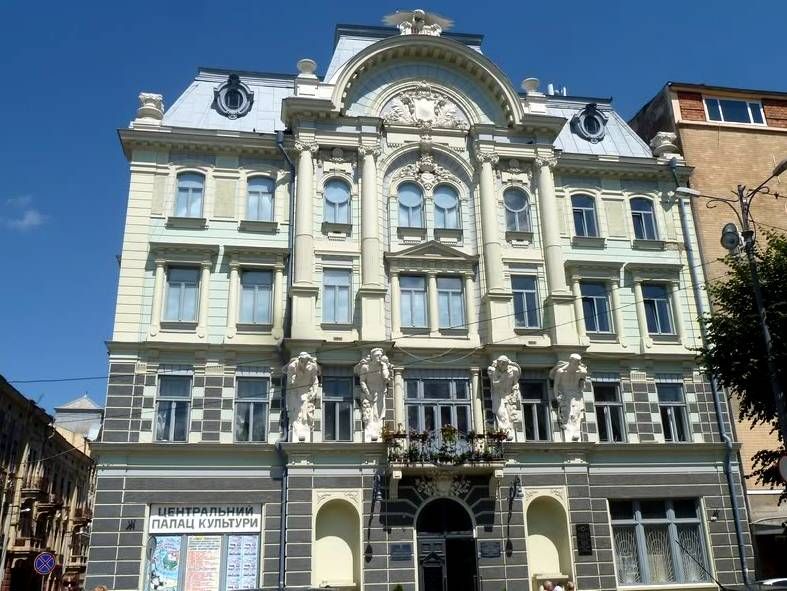
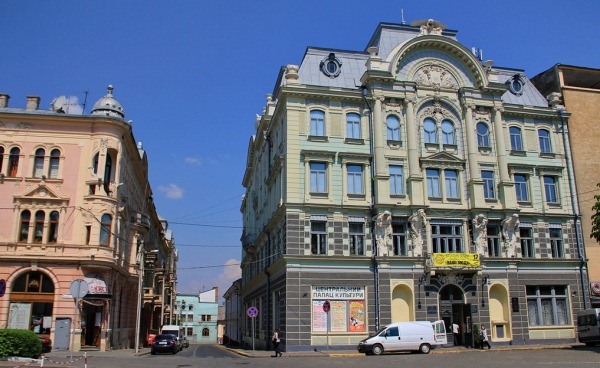
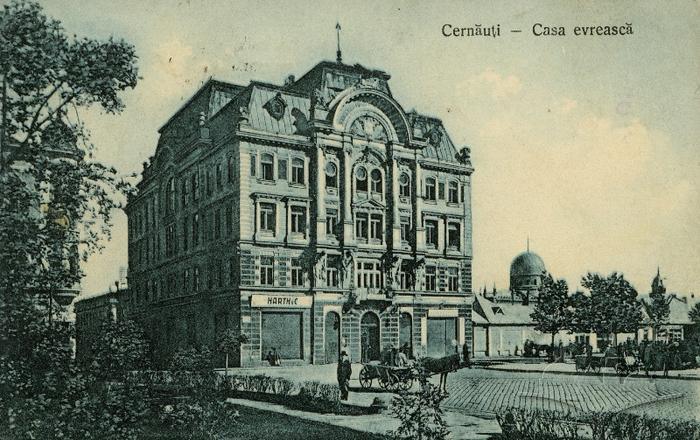
The Jewish People's House in Chernivtsi is a building built in the early twentieth century by the Jewish religious community that became the center of Jewish cultural and social life in Chernivtsi and Bukovyna. It has the status of an architectural monument of local significance. In 1908, an exquisite four-story Art Nouveau building with Baroque and Renaissance elements was erected in Chernivtsi, to the right of the newly constructed city theater, to house the Jewish People's House.
The appearance of the Jewish House harmoniously complemented the picture of the diversity of national life in Austrian Chernivtsi, which at that time was represented by the folk houses of the Ukrainian, Romanian, Polish, and German communities. Until World War II, it was the center of Jewish life in Chernivtsi; it housed various Jewish unions and organizations. It is known that in 1774, when Bukovyna came under Austrian patronage, there were 560 Jewish families here. In Chernivtsi itself, there were 112. This was noted in a detailed memo to Vienna by the first governor general of the region, Gabriel von Spleny. Describing Chernivtsi, he emphasized that the town was built up chaotically, but that the best houses were occupied by Jews.
Chernivtsi has a number of well-known addresses with a Jewish historical past: a special vocational school ("Safa-Art") on Eliezer Steinbarg Street; the Hasidic home of Tzadik Friedman in Sadhora; the Jewish cemetery (Zelena Street); and the former Great Synagogue (31 Barbusa Street). The Chernivtsi City Jewish Religious Community was established in 1786 by a decree of the Austrian Emperor. It united citizens who professed Judaism.
The Chernivtsi Jewish religious community had its own institutions, including a school, a hospital, public synagogues, a bathhouse, a cemetery, and a poultry slaughterhouse. Initially, the board of the Chernivtsi Jewish religious community worked in rented premises. With the construction of the Chernivtsi Jewish-German school (1860), the office of the Chernivtsi Jewish religious community with a meeting room, as well as the Jewish matriculation room, where civil status acts were registered, were located here. These institutions were located in the school building for 48 years.
It was time for the Jewish community of Chernivtsi to build its own building. The building was conceived as a gathering center for the entire Jewish community, a refuge for the spiritual and national life of the Jews of the region. The proposal for construction was supported by members of the community board, and the new president, Dr. Benjamin Straucher, had only one thing to do: bring the idea to life. Julius Bochner, a well-known architect at the time, was commissioned to design the building and was also instructed to produce detailed plans.
At a meeting of the Jewish community board, it was decided to issue an appeal to all Jews in Bukovyna to raise funds for the construction of the building and to obtain a loan from the Galician Mortgage Bank. Significant funds for the construction of the building were donated by Heinrich and Josephine Wagner. Funds from the Chernivtsi Jewish religious community and charitable contributions from community members were also used. A loan of 450,000 crowns was taken from a bank at 8 percent per annum. A construction committee was set up to supervise the construction, which included city architects and advisors to the Jewish community: Julius Bochner, Joachim Eisenberg, Josef Grünberg, and others. The committee was headed by the chairman of the community board, Dr. Benno Straucher.
One of the most famous architects of the time, Josef Schreiber, who in 1904-1905 supervised the construction of the city theater in Chernivtsi, was entrusted with the construction of the building. Construction of the People's House began with the digging of the foundation in the fall of 1906. The ceremonial groundbreaking took place in the spring of 1907. The work was carried out by various local construction companies: those engaged in concrete work, supplying sand and gravel, bricks, plaster, wood, slats and traverses, and beams. Several companies provided roofing and central heating. On June 20, 1907, the construction committee drew up requirements for the sculptures of the Atlanteans. The sculptures were made by the sculptor Oscar Czerny.
The Chernivtsi archive has preserved all the contracts for the work, including the electric lighting (the Siemens-Schuert company was responsible for this), which cost 2.1 thousand crowns.) Heating cost 4 thousand crowns. The windows and doors were made by Chaim Tannenbaum's company. By the end of 1908, the construction work was completed. On December 28, 1908, the building was declared complete. On that day, the ceremonial laying of the foundation stone took place. Here is how the local newspaper Bukowiner Post described the building itself: on the ground floor there was a wide front lobby and two side staircases. There were rooms for prayer, school classrooms, rooms for registering marriages and newborns, and on the second floor there was a conference room, a boardroom of the Chernivtsi Jewish religious community, the office of the community president, a reception area, secretary, accountant, and cashier's rooms, as well as a reading room and a library. The upper floor was used for housing. The semi-basement housed a kosher restaurant with a bowling alley, maid's room, and kitchen.
A special committee was set up to conduct the ceremonial consecration of the building, with pharmacist Füllenbaum as its chairman. In a short period of time, they prepared a very beautiful celebration. Numerous guests gathered in the large, luxurious hall of the Jewish People's House. These were quite respectable people who held a rather high position in Chernivtsi, Bukovyna, and Austria-Hungary. Among the guests was a member of the Austrian Chamber of Ambassadors, Dr. Arthur Weiler. After a festive chorale was performed, the floor was given to Chief Rabbi Dr. Rosenfeld, who spoke of the great importance of the new building for the cultural development of the Jewish people. On behalf of the student academic corporations Hasmonea, Emuna, and Hebronia, a member of the Hasmonea society, PhD in law M. Ariye, spoke, on behalf of the Zephyr society, PhD in law Shapiro, on behalf of the Jewish political society, Dr. Diamant, and on behalf of the women's society, a large landowner, Mrs. Blum. The speeches were concluded by the warmly received chairman of the board of the Chernivtsi Jewish religious community, member of the Austrian House of Ambassadors, Dr. Benno Straucher. The solemn blessing was followed by a performance by the Jewish Singing Society. At 9 p.m., a festive banquet was held. Representatives of religious communities from other Austrian cities were also invited to the banquet.
The premises of the People's House were rented to numerous Jewish societies for various events. Elections to the board of the Chernivtsi Jewish religious community, meetings of the commissioners of the Jewish National Party of Bukovyna, party congresses of the Bukovyna Zionist Regional Committee, regional conferences of Bukovyna Zionists, national meetings of the Jewish National Union, and numerous gatherings, including one on the occasion of providing material aid to the starving population of Southern Bessarabia (1935), were held here. Nahum Sokolov, president of the Executive Committee of the World Zionist Organization, was welcomed here (1929), and so on.
Societies worked at the Jewish People's House: "The Society of Chernivtsi Entrepreneurs (headed by H. Wender), the Jewish Society "Renaissance," the Union of Jewish Students (L. Kelner), a number of charitable organizations and societies, such as the Student Cafeteria of Academician Yudeik, the Marie-Réginc Union, the Folk Jewish Kitchen, the Union for the Protection of Children, and others. The Jewish community paid great attention to the development of art and literature, remained faithful to its traditions, and contributed to the development of the city of Chernivtsi and Bukovyna.
With the advent of Soviet rule (1944), the building was transferred to the city's House of Culture. Today it is the Central Palace of Culture of the Chernivtsi City Council. Numerous amateur groups, both adult and children, work here. Among them are the folk drama theater, the folk theater of variety miniatures and journalism "Homin", the folk opera studio, the folk dance ensemble "Yunist", the folk vocal and instrumental ensemble "Karpaty", folk brass band, folk vocal ensemble "Marichka", a group of tribal musicians, a studio of artistic words, a children's folk sports ballroom dance ensemble "Promin", children's studios of music and theater, etc.
Jewish community organizations returned to their People's House only in the early 1990s, in independent Ukraine. According to the decision of the Chernivtsi City Executive Committee, the Eliezer Steinbarg Society of Jewish Culture and the Museum of History and Culture of Jews of Bukovyna, opened in 2008, are located on the ground floor of the Jewish Home; the rest of the Jewish Home is occupied by the Chernivtsi City Palace of Culture. A black granite plaque with a bilingual inscription (in Ukrainian and Yiddish) about the building's construction in 1908 by the Jewish community of Chernivtsi is installed on the facade.
On 20.12.2019, the Jewish community restored the historical inscription on the facade: "JÜDISCHES HAUS - בית ישראל" and the image of the Star of David.
7 interesting facts about Jewish Chernivtsi
1. Three squares once adjoined the present-day Sahaidachnoho Street: Mariyska, Staryi Rynok, and Fontanna. Over time, they all disappeared.
2. A few years ago, Barbusa Street was given its old name, Synagogue Street. It is located in the oldest historical part of the city. It got its name from the Great Synagogue, which was located in house number 31. This neighborhood has long been called the "Jewish City" or "Dolishnyi Misto".
3. Jews settled in Chernivtsi in the fifteenth century. By 1941, up to 50 thousand Jews lived here. Almost half of them were shot and killed in ghettos and camps. The mayor of the city, Traian Popovych, managed to save more than 20 thousand Jews. Postwar Chernivtsi was home to 30-40 thousand Jews. Most of them left for Israel at the end of the twentieth century.
4. The Great Synagogue was built in 1853 on the site of an old wooden one. It was the only one to survive the terrible fire of 1865, which destroyed all the surrounding houses. Since then, the belief that the Great Synagogue is miraculous has been established among Jews. In 1959 it was closed for prayers and turned into a factory. The magnificent interior was destroyed, and the entire complex was abandoned.
5. On Synahohy Street, in house 29, there used to be a Jewish hospital built in 1791 at the expense of the Jewish community. Rich patients paid for themselves, while the local community paid for the poor. The chief physician had to be a graduate of an Austrian university, a doctor of medicine, a surgeon, and preferably a master of obstetrics. The hospital had a nursing home for poor elderly Jews, a synagogue, a bathhouse, and a cemetery. In Soviet times, the hospital became a city hospital.
6. On St. Mary's Square there used to be a one-story brick mikvah (ritual pool), which was an extremely important object in the life of the Jewish community. The pool for ritual bathing was filled with rainwater or from the Turkish well.
7. The Turkish Well was constructed in 1793. At that time it was called the "Panska" well. The well was guarded by a watchman so that the townspeople would take water only for drinking and cooking.
Chernivtsi is the capital of Bukovyna. It is one of the most beautiful and pleasant Ukrainian cities. There is one of the most beautifulrailway stations in the country, theChurch of St. Paraskeva of Serbia, the Church of the Exaltation of the Cross, the ship house, the City Hall (every day at 12:00 a trumpeter plays the melody of "Marichka" from the tower), the Art Museum, then Kobylianska Street, the German Folk House, the Armenian Church and the Assumption Church (the oldest stone Ukrainian Greek Catholic Church in Chernivtsi), the Theater Square and the Kobylianska Theater. Kobylianska Theater Square, Jewish People's House, Chernivtsi University (included in the UNESCO World Heritage List), Turkish Square (Chernivtsi has been a part of Turkey, Modova, Romania, Austria-Hungary, the USSR, Rus, and Ukraine), and a large rover,cozy streets and cobblestone streets, the so-called Drunken Church, Nazariy Yaremchuk's house, then another house-ship, two houses with the same number (Olha Kobylianska lived here), the house where Volodymyr Ivasyuk lived, the pink church - the Cathedral of the Holy Spirit.
Chernivtsi sights
- St. Nicholas wooden church (from 1607, restored in 1954);
- stone Church of St. George on the Bitterroot (1767 in the Baroque style);
- the wooden Trinity Church in Muggles (one thousand seven hundred and seventy-four), moved in 1874 to Kłokuchka;
- wooden Assumption Church on Kaleczanka (1783);
- City Hall with a two-story, 45-meter-high Empire-style tower (1843-1847, architect A. Mykulych), now the City Council;
- Ukrainian Greek Catholic Church (1825-1830 in the Baroque style);
- Byzantine-style cathedral (1844-1864, architect Roll);
- Church of St. Paraskeva in the pseudo-Romanesque style, completed in 1662 (architect A. Pavlovsky);
- residence of Bukovyna metropolitans - since 1956 one of the buildings of Chernivtsi University);
- Armenian Gregorian Church (1869-1875, architect J. Hlavka);
- Chernivtsi University building (1874-1875);
- Jesuit church in the Neo-Gothic style (1893-1894);
- Railway station (1898-1903) in the Art Nouveau style;
- the City Theater (1904-1905, architects F. Fellner and G. Helmer) in the Viennese Baroque style with Art Nouveau elements (now the O. Kobylianska Music and Drama Theater), etc.