Hotel "Bristol" Chernivtsi
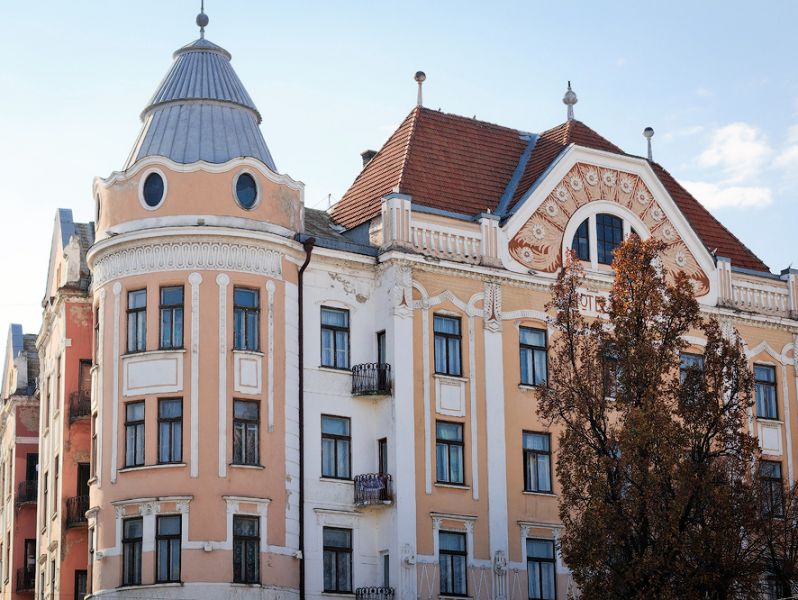
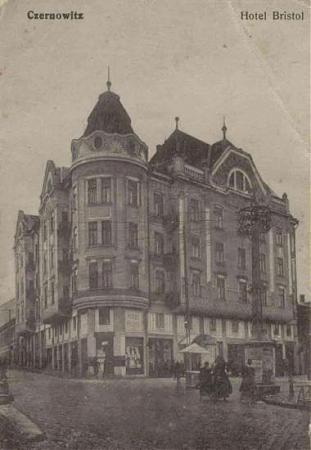
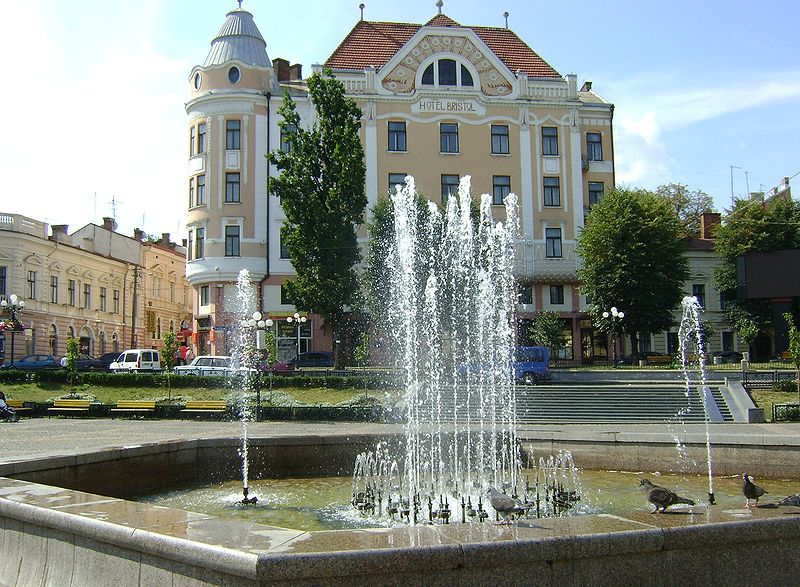
The Bristol Hotel is an architectural monument built in 1906 (och. No. 5-CHv), located in the historic center of Chernivtsi at a double address: 1 Philharmonia Square (11 M. Zankovetska Street). The building of the Bristol Hotel was built in the Viennese Secession style. The building consists of a basement and four floors. On the second, third, and fourth floors, the tower and facade of the building are equipped with bay windows.
The main entrance is located on the side of Philharmonic Square. The bay window ends with a complex pediment, in the center of which is a large arched window, under which a magnificent Secessionist inscription "Hotel Bristol" has been preserved. There are six balconies on either side of the bay window. The corner of the building has a stylized ("bay") tower, which culminates in a pediment with three lucarnes and a domed roof with a spire. The entrance to the restaurant is in the basement.
The side façade (from M. Zankovetska street) is equipped with two bay windows that end in triangular pediments, each with two dormers in the field. There are twelve balconies on either side of the bay windows. The house is decorated with stucco moldings, friezes, and cornices. The roof is multi-shingled and covered with tiles (nowadays in some places it is made of tin).
In the archival funds (1886), the owner of the real estate on the corner of Rudolfa Square and Karolina Street is listed as Leib Salter. According to a decision of the Chernivtsi District Court of April 5, 1904, the ownership was transferred to wealthy Chernivtsi residents Josef Landau and Max Meissner, who on October 14, 1905, received permission from the Chernivtsi City Magistrate to dismantle the old building and construct a modern multi-story hotel.
On July 31, 1906, the building was put into operation. The newly built hotel was considered one of the best in Chernivtsi. According to local legends that have survived to this day, the most expensive local prostitutes used to receive their clients in its rooms. In the basement there was a restaurant, one of the most popular in the city.
"The Bristol was one of the first buildings in the city to be equipped with an elevator system, which was maintained by local specialists Johan Ilchuk and Georg Herman. Later, at different times, the owners of the Bristol Hotel were: Carl and Ernestine Bilgray, Aurel and Albert Rescanu, Solomon Kinsbruner, and Amalia Linker.
In 1940, the 57-room Bristol Hotel was valued at 4 million lei, nationalized, and transferred to the local authorities for use. In 1944, the building was transferred to the newly founded Chernivtsi Medical Institute for use as a dormitory. The building remains in this status to this day.
In the late 2000s, the idea to revive the Bristol Hotel in the building came up. The Chernivtsi City Council announced its readiness to assist. The potential investor, having previously agreed with the current manager of the BSMU building to build a new dormitory, began negotiations with the State Property Fund of Ukraine. At the moment, the project is somewhat stalled due to the lack of a full-fledged government in the city. Nevertheless, everything is going to make sure that the Bristol Hotel in Chernivtsi will be reborn.
Chernivtsi is the capital of Bukovyna. It is one of the most beautiful and pleasant Ukrainian cities. There is one of the most beautifulrailway stations in the country, theChurch of St. Paraskeva of Serbia, the Church of the Exaltation of the Cross, the ship house, the City Hall (every day at 12:00 a trumpeter plays the melody of "Marichka" from the tower), the Art Museum, then Kobylianska Street, the German Folk House, the Armenian and Assumption Churches (the oldest stone Ukrainian Greek Catholic Church in Chernivtsi), the Theater Square and the Kobylianska Theater. Kobylianska Theater Square, Jewish People's House, Chernivtsi University (included in the UNESCO World Heritage List), Turkish Square (Chernivtsi has been a part of Turkey, Modova, Romania, Austria-Hungary, the USSR, Rus, and Ukraine), and a large rover,cozy streets and cobblestone streets, the so-called Drunken Church, Nazariy Yaremchuk's house, then another house-ship, two houses with the same number (Olha Kobylianska lived here), the house where Volodymyr Ivasyuk lived, the pink church - the Cathedral of the Holy Spirit.
Chernivtsi sights
- St. Nicholas wooden church (from 1607, restored in 1954);
- stone Church of St. George on the Bitterroot (1767 in the Baroque style);
- the wooden Trinity Church in Muggles (one thousand seven hundred and seventy-four), moved in 1874 to Kłokuchka;
- wooden Assumption Church on Kaleczanka (1783);
- City Hall with a two-story, 45-meter-high Empire-style tower (1843-1847, architect A. Mykulych), now the City Council;
- Ukrainian Greek Catholic Church (1825-1830 in the Baroque style);
- Byzantine-style cathedral (1844-1864, architect Roll);
- Church of St. Paraskeva in the pseudo-Romanesque style, completed in 1662 (architect A. Pavlovsky);
- residence of Bukovyna metropolitans - since 1956 one of the buildings of Chernivtsi University);
- Armenian Gregorian Church (1869-1875, architect J. Hlavka);
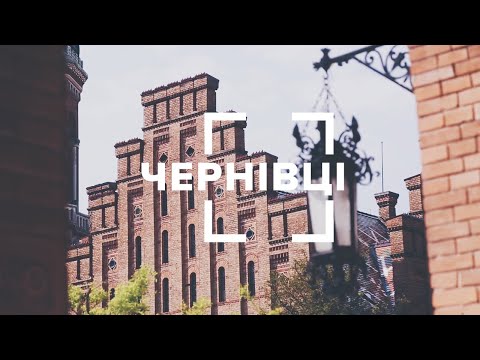
- Chernivtsi University building (1874-1875);
- Jesuit church in the Neo-Gothic style (1893-1894);
- Railway station (1898-1903) in the Art Nouveau style;
- the City Theater (1904-1905, architects F. Fellner and G. Helmer) in the Viennese Baroque style with Art Nouveau elements (now the O. Kobylianska Music and Drama Theater), and others.