Uzhhorod synagogue
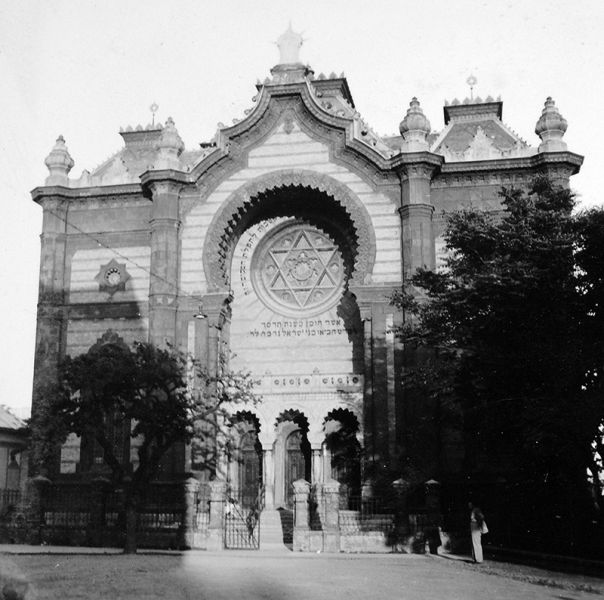
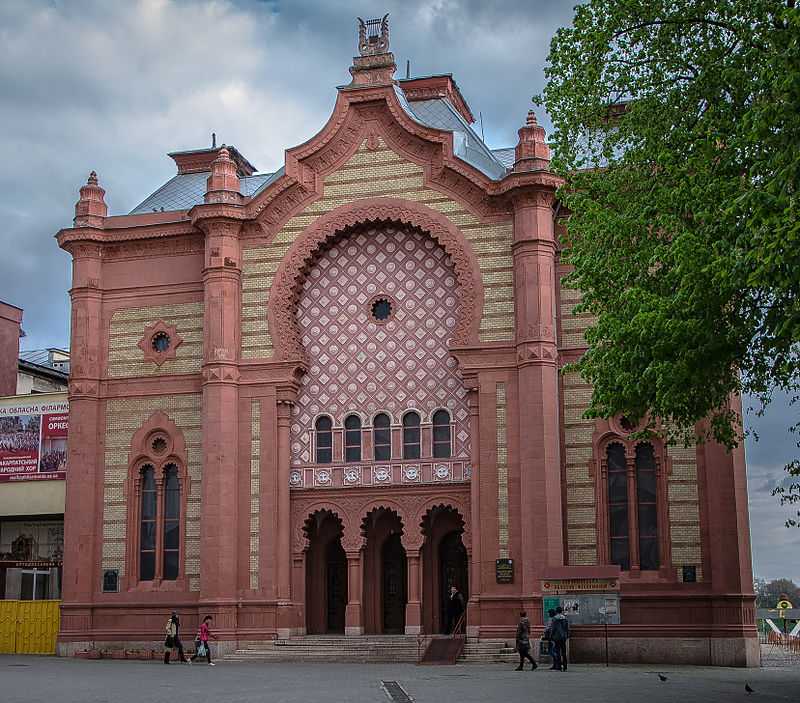
The Orthodox synagogue in Uzhhorod was opened by the Ashkenazi Jewish community on July 27, 1904, without any celebrations: at 7 o'clock in the evening, the holy books of the Jews, the Torah, were transferred from the house of worship to the new synagogue; a prayer service and the consecration of the building followed. The authors of the Neo-Moorish-style project were the architects Ferenc Szabolcs and Dyula Papp. At that time, the city of Uzhhorod was part of the Austro-Hungarian Empire, and the city authorities donated a very valuable plot of land on the banks of the Uzh River to fulfill the dream of the Jewish community of Transcarpathia to build a synagogue. The site was located a few hundred meters from the city's leading landmarks: the Cathedral and Uzhhorod Castle.
The estimate for the work was 200,000 crowns: central heating, electric lighting, water supply, and sewerage were to be installed. It was the first reinforced concrete building in Uzhhorod. The construction itself was funded both by wealthy Jewish patrons and by the entire community. According to the project, the synagogue could accommodate 900 people.
The synagogue was built in the then fashionable Neo-Moorish style with money from wealthy Jewish patrons. The building of pink marble, lined with red ceramic tiles and decorative bricks, stood out in the architectural style of Uzhhorod. A striking element of the synagogue was the image of the Star of David on the central balcony of the building's facade. The roof was especially pompously decorated: Neo-Moorish motifs were emphasized by copper ornaments and figured towers. The building was crowned with symbols of the Tablets of the Covenant.
The names of the craftsmen who built the synagogue are still preserved: The foundation work, masonry, stone carving, carpentry, locksmithing, and roofing were performed under the supervision of engineer Adolf Hadinger (Hungarian: Hadinger Adolf); the altar was made by Mayböhm J. (Hungarian: Mayböhm J.). Mayböhm J.) and his son; stained glass works were done by Miksa Róth; interior painting by Géza Fényi; mosaic works by Péter Meloccó; and ceramics by Hahn J.
Although the building survived the destruction of Jewish sacred buildings during World War II, German and Hungarian troops used the synagogue as a stable in the last years of the war: the building was in a deplorable state-the building had a large crack, groundwater washed away the foundation, and the walls were collapsing.
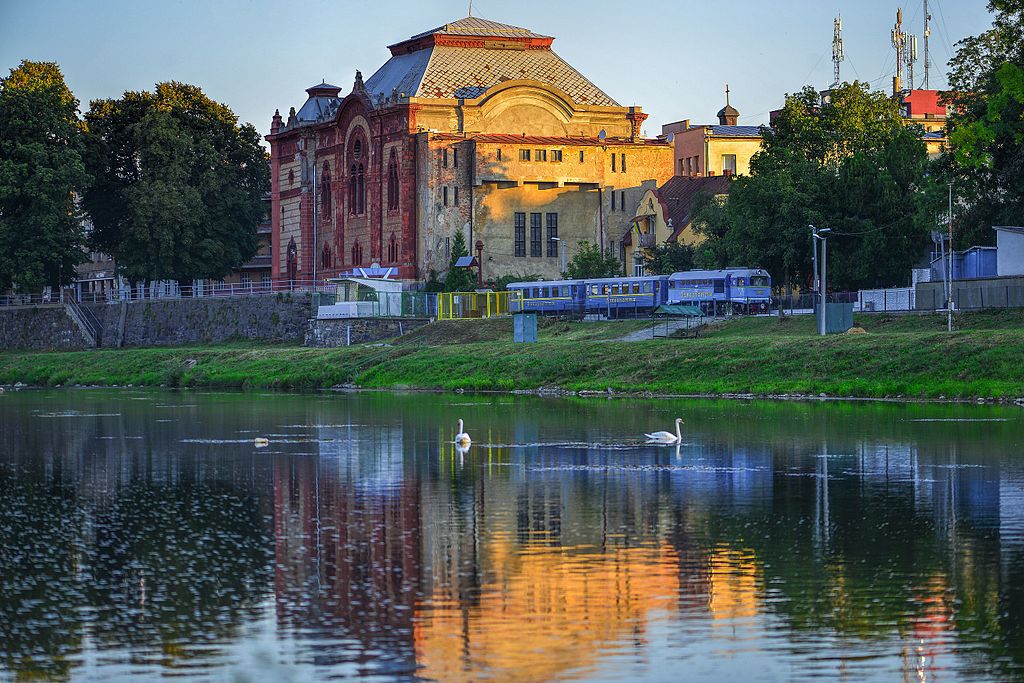
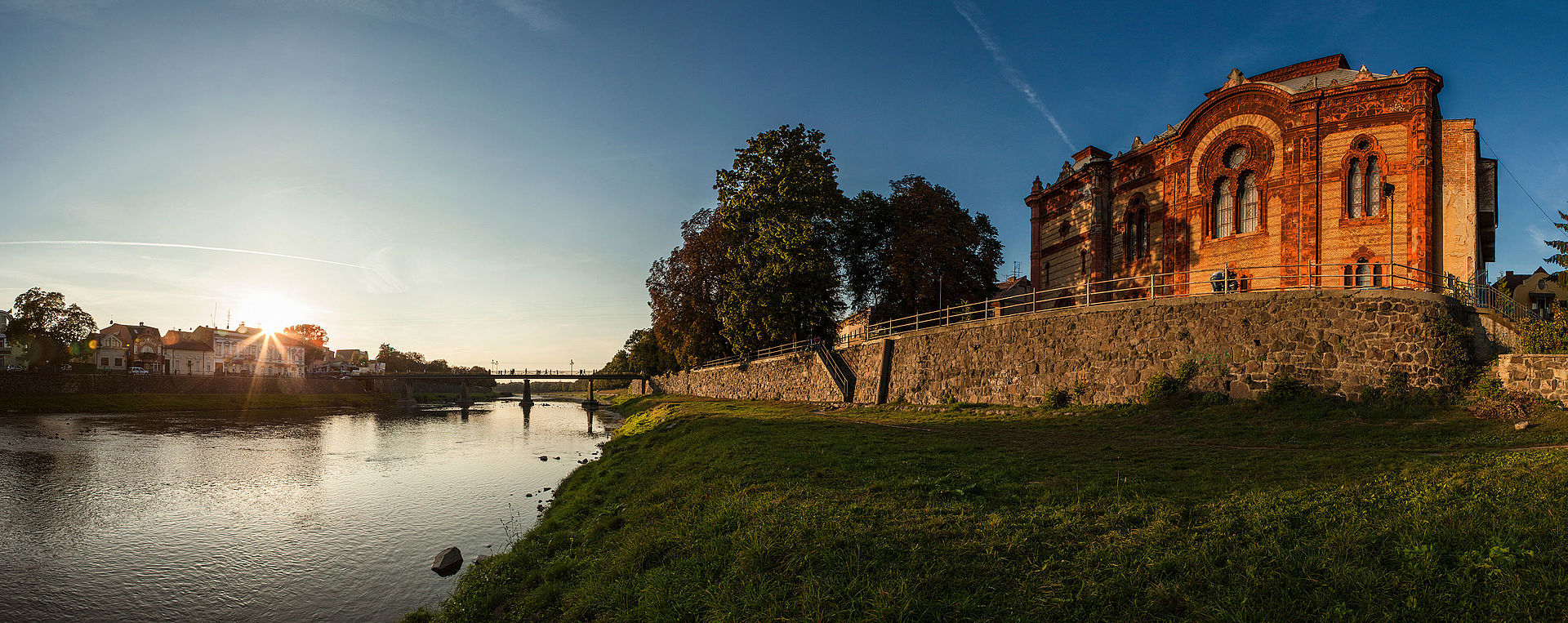
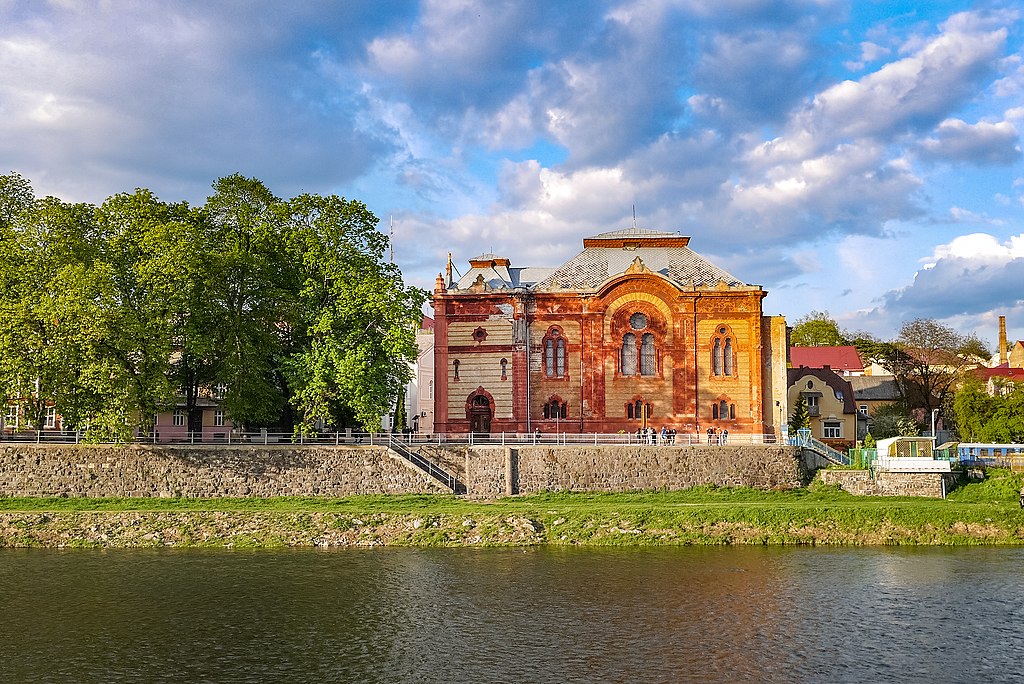
In 1944, after the destruction of the Transcarpathian Jews, the fate of the synagogue changed. In 1947, the Soviet government gave the synagogue to the Ministry of Culture of the USSR, where the Philharmonic was founded. The building was rebuilt in accordance with the requirements for such cultural objects. The Star of David was covered by a wall with a tiny window. All Moorish decorations and turrets were removed from the roof. The exterior of the building became much more modest. The changes also affected the interior of the building. Due to the alterations, the acoustics were completely destroyed. Later, an organ was installed inside the building. Thus, the synagogue became the Uzhhorod Philharmonic, and today it is the main concert hall of Uzhhorod. It houses the Transcarpathian Regional Philharmonic and a folk choir.
In 1974, a three-story Philharmonic building was added next to it, which houses a small hall with 360 seats, rehearsal rooms, and other facilities. The building of the former rabbinate has also been preserved, and today it houses a bank branch.
In the 1990s, it was renovated, although the work performed was not of high quality. For many years, the Jewish community of Uzhhorod has been engaged in a dialog with the authorities about returning the building to the Jewish community. In addition, there is another synagogue in the city, the Eichal-Aaron Synagogue, which belongs to the city's Jewish community.
The synagogue was built in the Neo-Moorish style, a romantic style that incorporated Byzantine and Arab-Moroccan motifs. The building itself stood on a pink marble plinth, its walls were lined with decorative clinker bricks and red ceramic tiles, and the window portal was decorated with red artificial marble. A striking element of the building's façade was the central balcony with the image of the Star of David inscribed in a large circle. One of the inscriptions reads: "Built in 5694 according to the Jewish calendar". The roof of the building was particularly lavishly decorated: Moorish motifs were emphasized by clay figured roof towers, various copper decorations, and ornaments. The building was crowned with symbolic Tablets of the Covenant.
In the postwar years, the Soviet authorities reconstructed the building and its exterior underwent dramatic changes: The recess in the central pediment with a balcony and a large Star of David was covered by a wall with a round window in the middle; the roof of the building was completely changed; the transparent mosaic dome through which the sun illuminated the entire building was covered with tin; all pseudo-Moorish decorations were removed from the roof; the turrets were replaced by simpler columns; the tablets were removed from the roof, and a lyre, a symbol of musical art, was put in their place. In general, the appearance of the building became much more modest.
Radical changes also affected the interior of the building: all interior changes were made in accordance with the requirements for such cultural objects. Prior to the reconstruction, the synagogue was a one-story building with traditional balconies for women; afterwards, the building was divided into two floors according to the level of the balconies, which destroyed the unique acoustics of the building. The first floor has a lobby, and the second floor has a hall with 830 seats and a stage. A staircase leading to the second floor was built on the site of the synagogue's main place, the ritual cabinet where Torah scrolls and other holy books are kept. Toilets were installed on the sides of the stairs.
Later, the Philharmonic installed an organ with three keyboards, one of the best in Ukraine, with three keyboards and 2,250 pipes. The old organ was brought from the Baltics, having been previously repaired in Prague. Another change was the demolition of the fence that enclosed the synagogue courtyard.
It is known that in the early twenty-first century cracks appeared on the facade. In the summer of 2011, design and estimate documentation for restoration work was prepared, but no funds were allocated at that time. Today, well-known musicians and bands continue to give concerts here, so art lovers have the opportunity to plunge into the whirlpool of classical music and chamber atmosphere. According to experts, there are no analogues of the majestic building in Europe, so Jews from all over the world come here to admire the architectural work of art and feel its ancient spirit. It was even suggested that the synagogue be dismantled brick by brick and taken to Israel to be reconstructed there.
The former Choral Synagogue in Uzhhorod is now a cultural institution (Transcarpathian Regional Philharmonic), considered a masterpiece of Jewish sacred construction of the early twentieth century, and is a local architectural monument. In general, this synagogue is the most interesting in the region from an artistic point of view. Many synagogues have survived in the towns of Transcarpathia, mostly rebuilt and adapted for other functions, but there are no such powerful or ancient structures as in the Lviv or Ternopil regions. The unique wooden synagogue in the village of Velyki Komyaty is interesting.
Video 2
 Унікальна закарпатська філармонія21 channel
Location on the map
Comments
Places to stay nearby
All stays HotelBoutique Hotel "Villa P" UzhhorodUzhhorodunder 1 km from Uzhhorod synagogueBBQParkingWi‑FiNearby: Uzhhorod Castle 200 mUzhhorod synagogue 400 m
 HotelHotel "U Anity" UzhhorodUzhhorodunder 1 km from Uzhhorod synagogueSaunaParkingWi‑FiNearby: Uzhhorod synagogue 600 mUzhhorod Castle 700 m
 HotelHotel "Flying Dutchman" UzhhorodUzhhorodunder 1 km from Uzhhorod synagogueBreakfastWi‑FiTransferNearby: Uzhhorod synagogue 600 mUzhhorod Castle 1.1 km
 HotelHotel "Ungvars'kyi" UzhhorodUzhhorod1.1 km from Uzhhorod synagogueHot tubSaunaSPANearby: Uzhhorod Castle 600 mUzhhorod synagogue 1.1 km
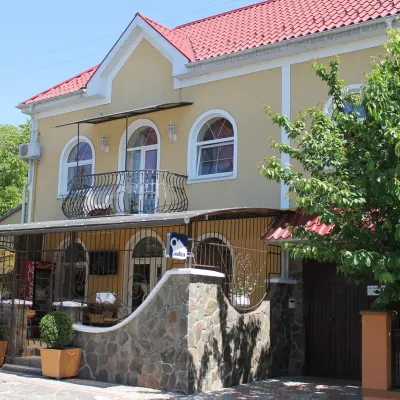 HotelMini-Hotel "Mala Praha" UzhhorodUzhhorod1.2 km from Uzhhorod synagogueSaunaBBQWi‑FiNearby: Uzhhorod Castle 1.1 kmUzhhorod synagogue 1.2 km
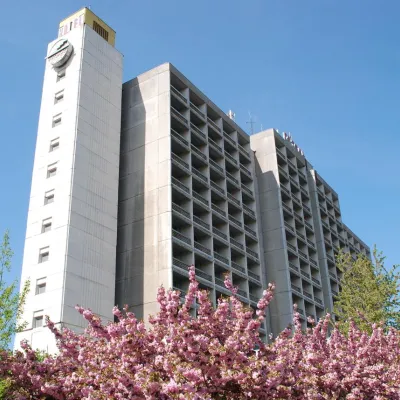 HotelHotel "Inturist-Zakarpattya" UzhhorodUzhhorod1.3 km from Uzhhorod synagogueWi‑FiTransferNearby: Uzhhorod synagogue 1.3 kmUzhhorod Castle 1.5 km
Trails nearby
All trails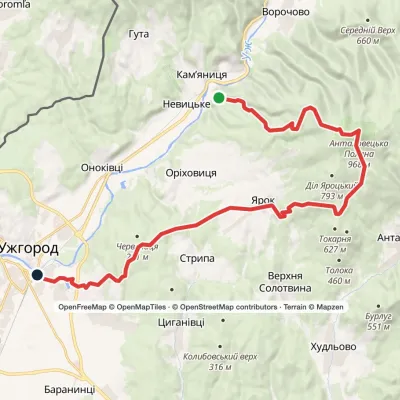 HardMulti-dayKamianytsia village to Uzhhorodvia Antalovetska Poliana, Yarok villageElevation profile117–967 m28.9 kmascent 893 m≈ 9 h walkingunder 1 km from Uzhhorod synagogue
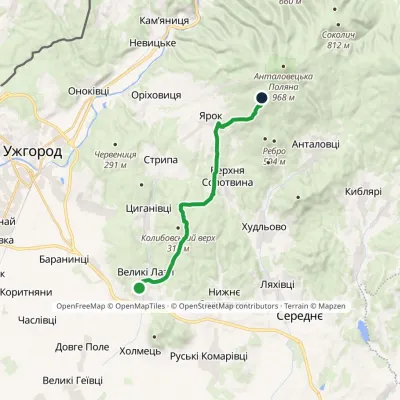 ModerateTwo-dayMarkedPlotenia Trail: Velyki Lazy village Mount Dil YarotskyiElevation profile120–807 m16.3 kmascent 769 m≈ 5.5 h walking8.9 km from Uzhhorod synagogue
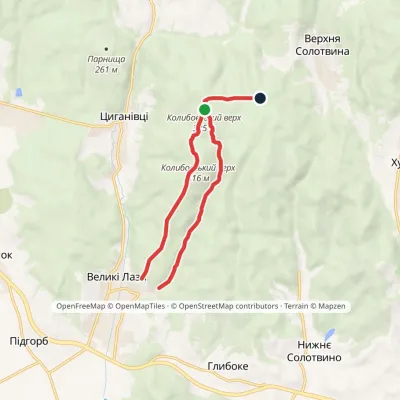 EasyOne-dayMarkedKolybovskyi Verkh loop trailElevation profile136–349 m10.4 kmascent 217 m≈ 3 h walking8.9 km from Uzhhorod synagogue
Nearby attractions
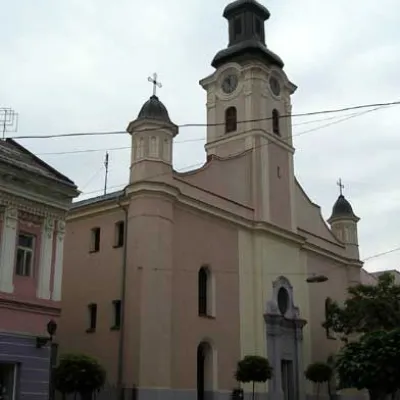 SightChurch of St. George, UzhhorodUzhhorodunder 1 km from Uzhhorod synagogueGeorge's Church is a magnificent work of architectural art that has been preserved in Uzhhorod since the early 17th century.
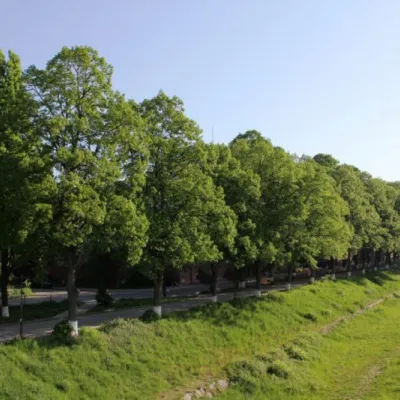 NatureLipova alley, UzhhorodUzhhorodunder 1 km from Uzhhorod synagogueIn addition to the majestic Uzhhorod Castle, along the winding Uzh River, there is the longest Linden Alley in Europe, a park and landscape art monument of local...
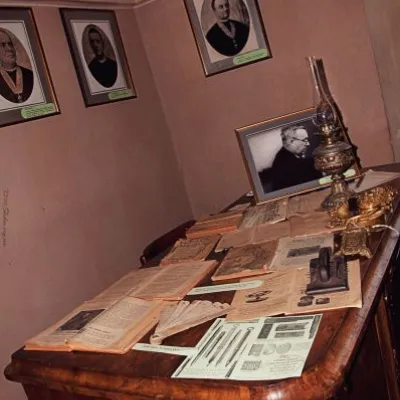 CastleUzhhorod Castle, UzhhorodUzhhorodunder 1 km from Uzhhorod synagogueUzhhorod Castle has a thousand-year history. It is the main tourist attraction in Uzhhorod.
Craft nearby
All craft places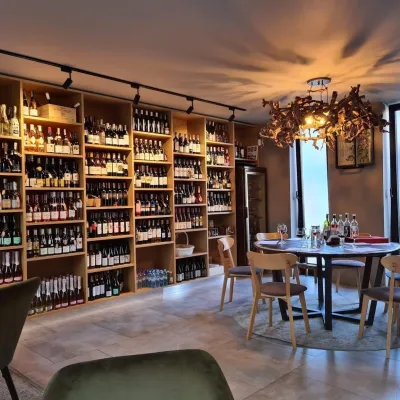 Wine & tastingsChardonnay Wine Tasting Hall, UzhhorodUzhhorodunder 1 km from Uzhhorod synagogueThe Chardonnay hall (Shardone) is considered Uzhhorod's first wine tasting room. It occupies an old wine cellar in the pedestrian heart of the historic centre, not far...
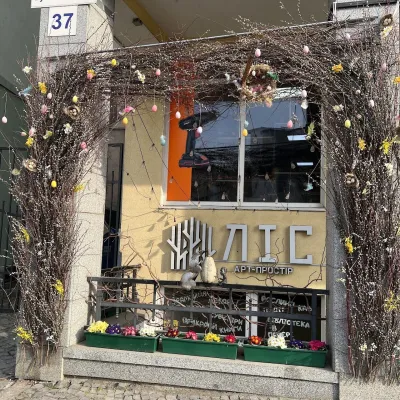 Craft shopsLIS art space – shop of Transcarpathian makers, UzhhorodUzhhorodunder 1 km from Uzhhorod synagogueThe LIS art space (“Lis” means “forest”) is a shop of handmade souvenirs and gifts and at the same time a cultural venue in the very heart of Uzhhorod, at 37 Fedyntsia...
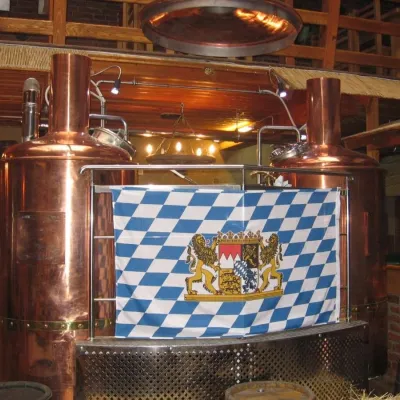 Craft beer & breweriesUngweiser Brewpub, UzhhorodUzhhorodunder 1 km from Uzhhorod synagogueUngweiser is one of the best-known city brewpubs in Zakarpattia. It stands at 20 Kapushanska Street in Uzhhorod, next to the regional hospital and a relaxed five...
 Craft producersZakarpatskyi Prianyk gingerbread, UzhhorodUzhhorodunder 1 km from Uzhhorod synagogueZakarpatskyi Prianyk (“Transcarpathian gingerbread”) is a family bakery in Uzhhorod that has been baking honey-ginger gingerbread with natural honey since 2008.
 Craft producersMedovyi Krai bee-breeding farm, Velyki LuchkyUzhhorodunder 1 km from Uzhhorod synagogueMedovyi Krai (“Honey Land”) is a family honey brand from Zakarpattia and at the same time a breeding farm for the Carpathian honeybee.
 Craft beer & breweriesYuber Brewery & Pub, UzhhorodUzhhorod3.2 km from Uzhhorod synagogueYuber Brewery & Pub is one of Uzhhorod's youngest and most modern craft breweries. It operates at the Praha hotel and restaurant complex at 38A Verkhovynska Street, on...