Jesuit Church (Sacred Heart of Jesus), Chernivtsi
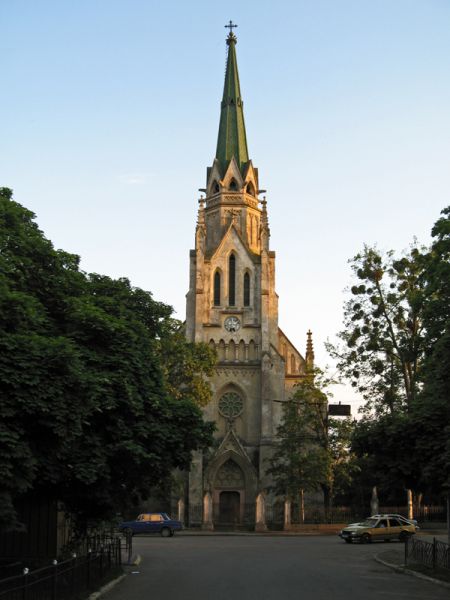
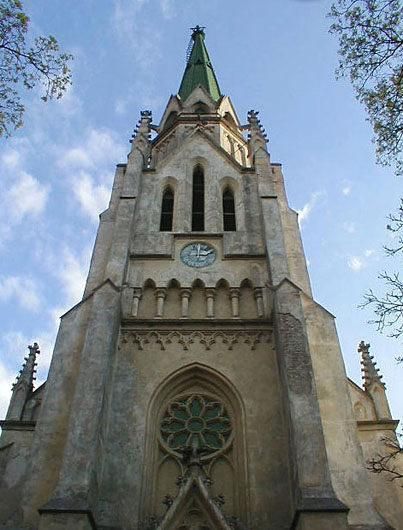
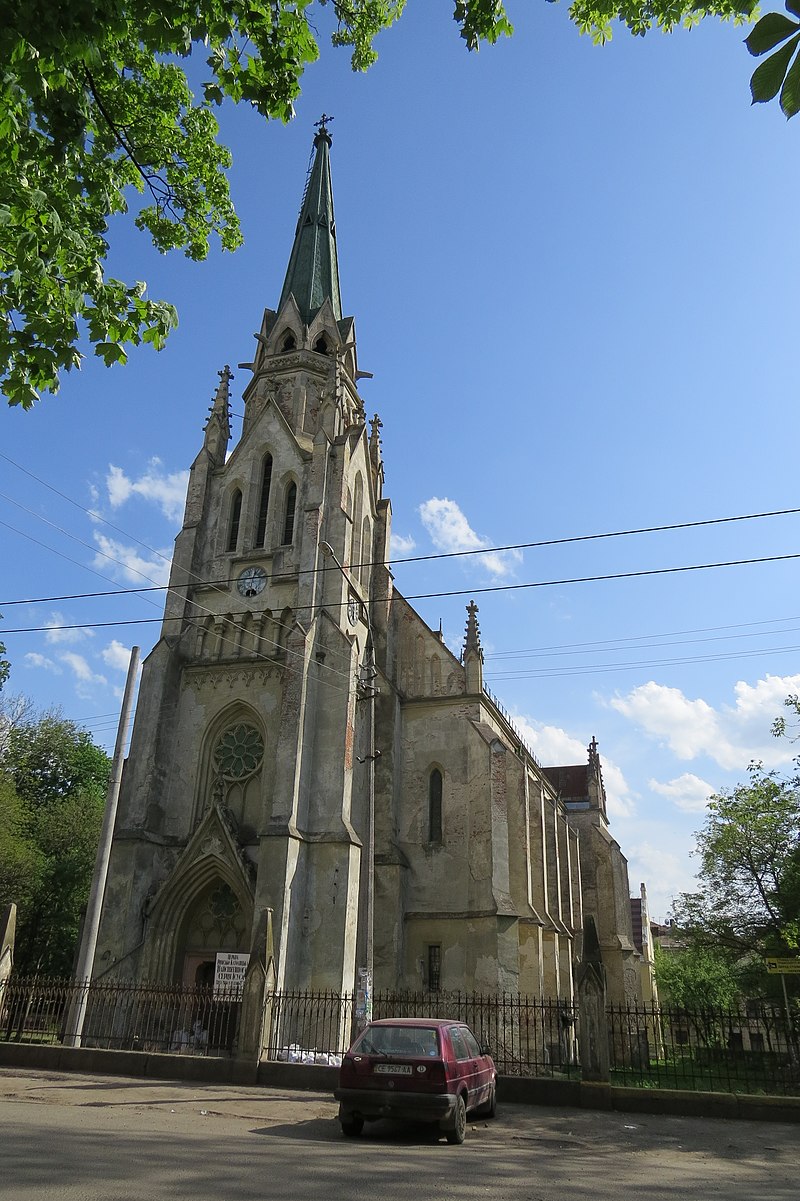
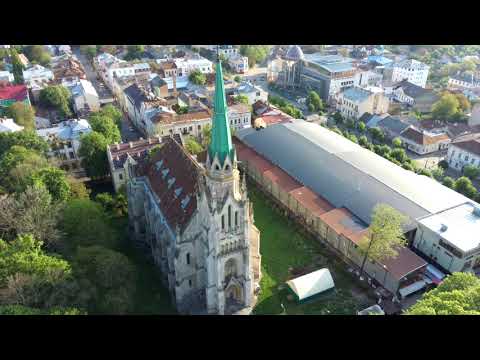
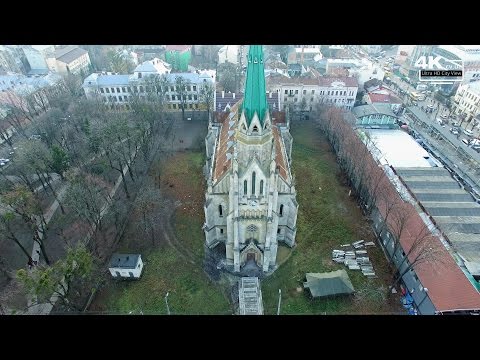
The Church of the Sacred Heart of Jesus is a Jesuit church in Chernivtsi. It is a monument of neo-Gothic architecture of the 19th century. Since 1963, the regional archive has been located here. Since March 1, 2010, the church has belonged to the religious community of the Roman Catholic Church. The tall, austere architecture with sharp spires attracts the attention of tourists.
The Church of the Sacred Heart of Jesus in Chernivtsi was built in 1892-1894 in the Neo-Gothic style at the expense of high-ranking officials and donations from future parishioners, designed by architectural professor Josef Leitzner, and is located south of the city center, on the way to the Botanical Garden, the Park of Culture , and the Church of St. Peter and Paul. The consecration of the church in honor of the Sacred Heart of Jesus took place on November 25, 1894, and was performed by Lviv Archbishop Severin Moravsky.
In the late 70s of the 19th century, the first Jesuit missionaries appeared in Chernivtsi. In 1885, Archbishop Zygmunt Szczesny Felinski officially appealed to the Society of Jesuits with a request to promote the expansion of the Jesuit fathers' activities to the territory of Chernivtsi. Among the civilians who contributed to the Jesuits' activities were the following: the burgomaster of the province, Baron Pino de Friedenthal; the burgomaster of Chernivtsi, Anton Kokhanovskyi; university professors Hiller, Skedel, and Holban; military doctor Pollack; military chaplain Captain Himmel; doctor Mayer; pharmacist Kryzhanovskyi; colonel Tum; court counselor Baron Fekete; and director of the provincial bank Pashkis.
In early September 1885, Father Simon Tychowski was appointed a Jesuit priest. He held his first services in a small chapel. As the number of Jesuit followers grew, it became necessary to immediately build a new church. The initiative belonged to Father Franciszek Xavier Eberhard. For the construction of the church, the city authorities donated to the Jesuits a plot of land where the soldiers of the 41st Bukovyna Regiment used to conduct their practical training.
The author of the church project was Professor Leitzner, director of the Chernivtsi Higher Industrial School (now the premises of secondary school No. 4). Funds for the construction came from donations from local believers and dignitaries, as well as donations from believers in neighboring Galicia. Architect Leitzner estimated the initial cost of the building at 160 thousand zlotys. In the end, together with sculptures, bells, a larger organ, and a residence built on the back of the church, the cost amounted to 208 thousand zlotys. The consecration of the church took place on June 7, 1891. The Lviv Metropolis was represented by Archbishop Severin Morawski. The consecration was attended by primates and believers of three faiths: Catholic, Orthodox, and Jewish.
Professor Leitzner was assisted in the construction of the church by builder A. Leopold, bricklayer L. Kukurudz, and locksmith Shuster. The window stained-glass windows were brought from Hrotów (Bielsko-Biała, Poland). The author of the wall paintings was the artist Kasha from Mykolaiv, and the author of the main altar and pulpit was the master Stufleser (Tyrol, Austria). The 5,000 florin organ installed in the church was made at the Rieger factory in Edendorf (Bienenbüttel, Germany). In the spring of 1894, three bells were brought from Edinburgh (Scotland, United Kingdom of Great Britain). The largest of them was named "Heart of Jesus".
On November 21, 1894, Joseph Schmidt consecrated the Jesuit parish in Chernivtsi, and on November 25 of the same year, Lviv Archbishop Severin Morawski consecrated the newly built shrine. On June 21, 1895, celebrations were held on the occasion of the naming of the church after the "Sacred Heart of Jesus." Catholic priests were periodically ordained in the church of the Sacred Heart of Jesus. On July 7, 1935, Metropolitan Mihai Robu came to Chernivtsi from Bucharest for this purpose. On this day, priests Josef Jędrzyjewski and Jan Nowacki were ordained in the Church of the Heart of Jesus.
No baptismal, wedding, or funeral services were held in the church, as it was a rectorial church. However, in 1941, during the occupation of Chernivtsi by the German and Romanian armies and with the beginning of repressions against Jews, many of them were baptized in this church. The main altar of the church was made in the Neo-Gothic style. In addition to the main altar, the church had side altars. On one side was the altar of the Blessed Virgin Mary. The icon placed in this altar had a crown decorated with 12 stars. On both sides of the icon were two sculptures: St. Therese of the Child Jesus (of Liège) and St. Margaret Mary of Alacoque. On the other side was the altar of St. Ignatius of Loyola, the founder of the Catholic Order of Educators and Missionaries of the Society of Jesus (Jesuits). In this altar was the figure of the pious St. Francis Xavier, a missionary and member of the Jesuit order. There were several other smaller figures nearby. The church also had altars of St. Stanisław Kostka (a Jesuit novice who was considered the patron saint of Lviv) and the Immaculate Conception of the Blessed Virgin Mary.
One of the church's decorations was the Way of the Cross, an integral part of the Lord's Passion, which includes the carrying of the cross and culminates in the Crucifixion. From the inside, the church was decorated with polychrome and stained glass windows, mostly destroyed during the reconstruction of the building for the archive.
In the interwar years, the Holy Mass in the church was held at 9 a.m. daily, and on Sundays also at 9 a.m., but only for German believers, and at 11.30 a.m. for Polish believers. At Christmas, the church was decorated, and nativity scenes were set up at the side altars. In addition to the organ, a small orchestra led by organist Zazhymskyi often played during the festive service. In 1940-1941 the church continued to operate, but was under the supervision of the NKVD. In 1945, local authorities transferred this Jesuit church to Orthodox believers. A year later, the church was taken away from the Orthodox community.
The church was closed for some time, and later it was decided to house the documents of the regional archive, which had been stored in four different buildings in the city. As a result, most of the church's interior was lost. The interior of the church was divided into three floors by two reinforced concrete floors, which were fixed in the walls of the church. Brick walls were erected between the columns to strengthen the archival shelves. The lower stained glass windows were destroyed, while the upper ones survived.
In 1996, the local community began to petition for the return of the Jesuit building complex. The church was returned to the local community in 2010. Its reconstruction is currently underway.
One of the chapels was located in the basement of the church. According to one version, 60 Polish soldiers who died during World War I were buried there. The other chapel is St. Anthony's. It was located in the park on the left side of the church. In October 1978, the building burned down, after which the ruins were soon demolished; according to one version, the KGB was involved.
The Jesuit Church of the Sacred Heart of Jesus in Chernivtsi is a functioning church, belongs to the Roman Catholic diocese, is considered one of the most original buildings in the regional center, and is an architectural monument of local significance. Not far from the church, to the north and east, there are monuments of public and administrative architecture - the Craft School and the Regional Government Building. Also nearby are the pharmacy-museum and the Olga Kobylianska Museum.
Chernivtsi is the capital of Bukovyna. It is one of the most beautiful and pleasant Ukrainian cities. It has one of the most beautifulrailway stations in the country, theChurch of St. Paraskeva of Serbia, the Church of the Exaltation of the Cross, a house-ship, the City Hall (every day at 12:00 a trumpeter plays the melody of "Marichka" from the tower), the Art Museum, then Kobylianska Street, the German Folk House, the Armenian and Assumption Churches (the oldest stone Ukrainian Greek Catholic Church in Chernivtsi), the Theater Square and the Kobylianska Theater. Kobylianska Theater Square, Jewish People's House, Chernivtsi University (included in the UNESCO World Heritage List), Turkish Square (Chernivtsi has been a part of Turkey, Modova, Romania, Austria-Hungary, the USSR, Rus, and Ukraine), and a large rover,cozy streets and cobblestone streets, the so-called Drunken Church, Nazariy Yaremchuk's house, then another house-ship, two houses with the same number (Olha Kobylianska lived here), the house where Volodymyr Ivasyuk lived, the pink church - the Cathedral of the Holy Spirit.
Chernivtsi sights
- St. Nicholas wooden church (from 1607, restored in 1954);
- stone Church of St. George on the Bitterroot (1767 in the Baroque style);
- the wooden Trinity Church in Muggles (one thousand seven hundred and seventy-four), moved in 1874 to Kłokuchka;
- wooden Assumption Church on Kaleczanka (1783);
- City Hall with a two-story, 45-meter-high Empire-style tower (1843-1847, architect A. Mykulych), now the City Council;
- Ukrainian Greek Catholic Church (1825-1830 in the Baroque style);
- Byzantine-style cathedral (1844-1864, architect Roll);
- Church of St. Paraskeva in the pseudo-Romanesque style, completed in 1662 (architect A. Pavlovsky);
- residence of Bukovyna metropolitans - since 1956 one of the buildings of Chernivtsi University);
- Armenian Gregorian Church (1869-1875, architect J. Hlavka);
- Chernivtsi University building (1874-1875);
- Jesuit church in the Neo-Gothic style (1893-1894);
- Railway station (1898-1903) in the Art Nouveau style;
- the City Theater (1904-1905, architects F. Fellner and G. Helmer) in the Viennese Baroque style with Art Nouveau elements (now the O. Kobylianska Music and Drama Theater), etc.