Drohobych Saltworks, Drohobych
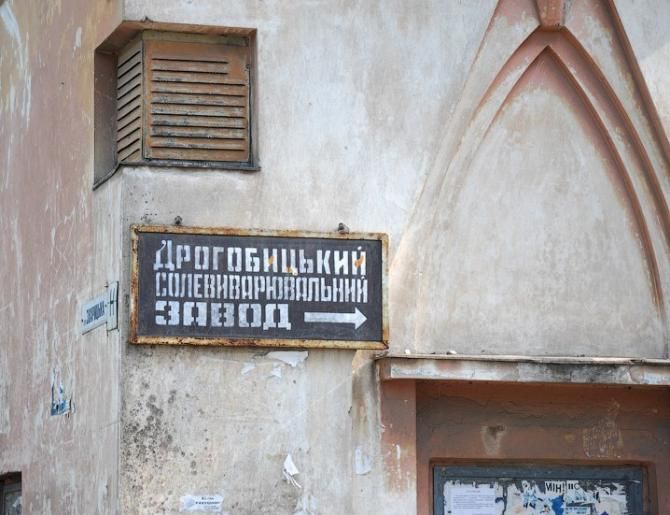
Drohobych Saltworks (SE "Saltworks Drohobych", Drohobych saltworks, Drohobych zhupa) - is the oldest operating saltworks in Ukraine and one of the oldest enterprises in Eastern Europe. It is a state-owned enterprise whose core business is salt production. It also extracts other minerals and develops quarries. It operates at the following address: 27 Solonyi Stavok Street, Drohobych, Lviv region, 82100.
In the times of Kyivan Rus (10-13th centuries), the fame of Drohobych salt spread across Ukrainian lands. The Drohobych saltworks was the largest in the Przemyśl region. In addition, the saltworks is the oldest in Ukraine. Production is carried out in the same way as before, namely by boiling brine.
The first mention of salt from Drohobych dates back to 1390, when Władysław Opolczyk donated a tithe of salt from Drohobych to the Galician archdiocese. It is commonly stated that the saltworks (zhupa) has been in continuous operation since 1250. This date has no historical basis. The Drohobych saltworks is located near the deposits of salt brine or raw materials. For many centuries, salt production was the main industry in Drohobych. This is reflected in the city's coat of arms: 9 salt furnaces (the molds into which salt was pressed) are depicted on a blue background.
In the last decades of the Galicia-Volhynia state, Drohobych became one of the wealthiest cities. Chumaks came from different parts of Ukraine-from Podillia, distant Bratslav, Kholm, and Volyn-for Drohobych salt. At the Volyn marinas above Sluch and Horynnia, Drohobych salt was loaded onto riverboats, komyahy, and floated to Prypiat, and then down the Dnipro River to Kyiv. Some of the towers in Drohobych, Yasenytsia, and other surrounding villages belonged to the king. Peasants were forced to work on them, subjects of the monarch, who leased them to rich Italian merchants, mostly Genoese, who traveled with merchant caravans from Italy through Lviv and Bukovyna to the Crimean city of Kafa.
Throughout the fourteenth and fifteenth centuries, they were almost continuously the managers and main workers of the zhupa (the old name for the saltworks) in Drohobych, skillfully pleasing the kings and not forgetting their own profit. The Italians produced high quality salt. They significantly expanded Drohobych's trade ties with Europe. However, acting monopolistically and profiting from exploitation, they often caused conflicts in the city. In 1491, a conflict between Italians and Drohobych residents and visiting merchants was resolved by royal decree. It was decreed that carts for loading salt should be made 14 cubits long, 17 salt furnaces wide at the bottom and 20 at the top, and 20 furnaces high, stacked on top of each other. A cart of this design could hold 6000 salt furnaces. Soon, in order to keep the streets in good condition, Drohobych residents were granted the right to collect 3 dinars from a cart that passed through the city with salt or goods. There is evidence that Zhupna Street, which connected the city to the saltworks via a bridge, had a wooden pavement, probably to avoid mud.
From the description of 1768 we know that Zhupna Street (which still exists today) had a wooden floor. It was connected to the territory of the Żupa by a bridge built over the then rather deep Pobuk stream. At the time of the above-mentioned description, there were two wells in the Drohobych zhupa: The Royal Well (pit #1) and the one with the restored private property of Baron Gartenberg (pit #2). Salt extraction was allowed at both of them for the benefit of the so-called "hospital for the poor"-a small hospital at the church. In 1565, 26 thousand barrels of salt were boiled in Drohobych, including about half in private saltworks and the rest in the royal zhupa.
Currently, the company produces two types of products: "Iodized table salt" and "Table salt without additives", which have the "Certificate of Conformity of the State Certification System of UKRSEPRO" registered in the Register under No. 11A 1.021.Х003763-07. The salt meets the requirements of DSTU 3583-97 (GOST 13830-97) "Salt. General technical conditions".
In 1339, Drohobych was captured by the Poles, and the salt from the surrounding enterprises became the property of the king. The mention of Drohobych salt is also found in the charter of King Władysław II on the supply of four wagons of Drohobych salt to the Lviv chapter of December 8, 1432.
Salt production in the vicinity of Drohobych ensured the development of the city. Archival data show that in 1565 there were 45 saltworks, including royal, monastery, and private ones. Thanks to the saltworks, Drohobych developed and built up. The appearance of the Church of St. George next to the saltworks is a popular local story. It is said that the salt workers literally exchanged it for salt in 1656 in the Carpathian village of Nadiiiv, near Dolyna, transported it in disassembled form by carts and reassembled it at its current location. However, another version says that only a part of the timbers was brought and the existing church in this place was completed.
In 1772, after the first partition of Poland, Eastern Galicia became part of the Austrian Empire. In addition to the salt industry, the oil refining industry was gaining momentum. The salt produced at the Drohobych enterprise was exported to many European countries. But the saltworks reached its peak during the Austrian rule.
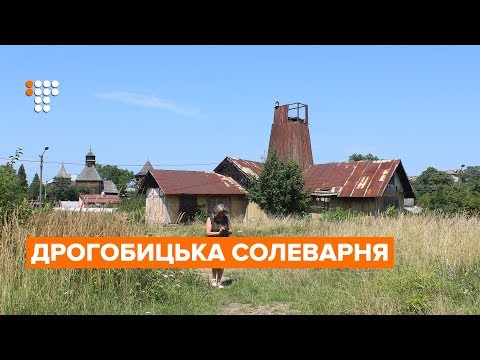
Unfortunately, nowadays the Drohobych saltworks does not look very presentable; the territory of the saltworks is large and spacious, but it is neglected. Red brick or wooden houses built without a single nail... One can only imagine how it looked like 100 years ago. Nowadays, only a few rooms are alive - the brine tanks, the house with the mine, and the place where salt is evaporated and packaged.
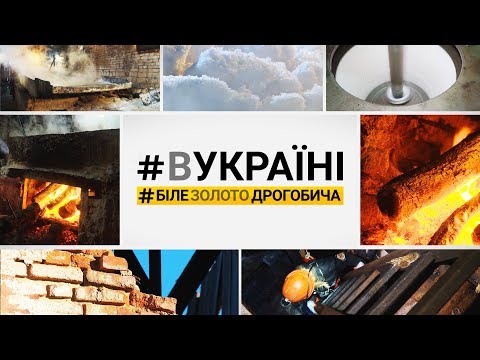
However, you can take a tour where tourists will be shown the salt mine and demonstrate how salt is extracted. By the way, this process hasn't changed much in several centuries. The production process consists of several main stages: brine extraction from the mine >> "gravity" cleaning in sumps >> salt evaporation in baths >> grinding >> packaging. The brine is extracted from a depth of 50 meters and then pumped into a special tank. The salt is then evaporated, crushed and sent for packaging. In the future, a museum is planned to be created on the basis of the old workshops.
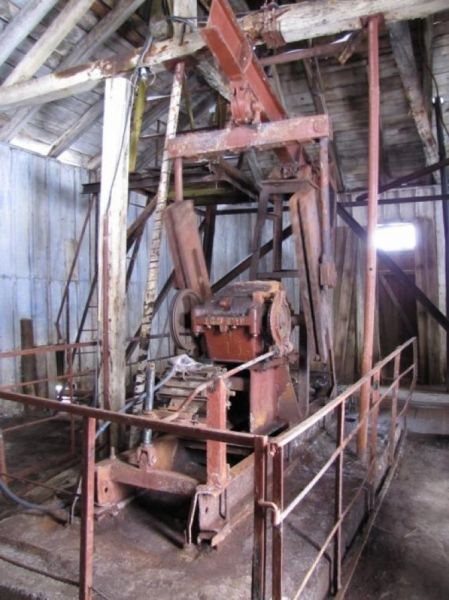
Once upon a time, brine was dragged by oxen and horses, and then a pump was installed, the same as the one used in oil production. Now the brine is pulled by an electric pump. The well is 50 meters deep, with steps inside to go down, and the walls are covered with an oak log cabin that has been preserved since 1473. The next stage is "gravity" purification in sumps. The brine from the mine is brought here through pipes. The buildings of the sumps are built without a single nail and have been salted to the foundation over the years.
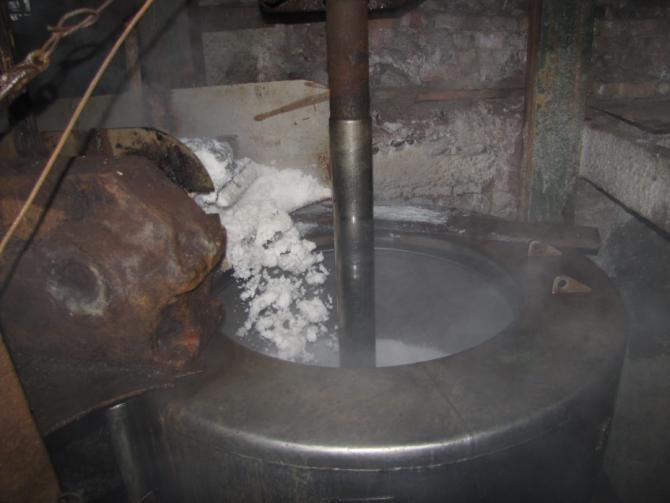
The evaporation of the brine extracted here is carried out "as in the old days": firewood is lit under wide and shallow baths of brine, the brine steams, salt settles at the bottom of the baths and collects in crystalline skins on the surface. It is collected with a "rake", packed in bags and sent for drying. Everything around the room is covered with salt "stalactites," and the air smells of fire and, obviously, salt. The people who work here joke that they are soaked in salt, have constant salt inhalations, and indeed hardly ever get sick.
However, the real treasure of the saltworks is the flakes of salt that are collected from the surface of the steaming brine, the "Carpathian fleur de sal". This salt is special - it tastes very delicate, has a delicate, fragile texture, and is highly valued in gastronomy. A petal of this salt can be not only a seasoning but also a decoration.
The Drohobych Saltworks is located near the city center in Uzhhorodskyi Lane. You can get to the saltworks from the ancient church of St. George or from Solonyi Stavok Street. St. George's Church, like many other buildings in Drohobych, was built by salt workers. They exchanged it for their products in 1656. Disassembled, it was transported on oxen from the Carpathian village of Nadiiiv and reassembled.
The saltworks now produces an average of 500 kg per day. This amounts to about 11 tons per month. The factory has modernized its equipment, but lacks the funds to bring this idea to fruition. If it were possible, production could be at least doubled, the plant's director is convinced. There are 9 cultural monuments of local importance on its territory. The company is located within the protected zone of a UNESCO monument. And part of the plant's territory has the status of a newly discovered archaeological site.
The townspeople consider Drohobych Saltworks to be the pearl of the town! It is on the map of the oldest continuously operating enterprises in the world, as it has been in operation since 1250. The saltworks is the origin of Drohobych as a city, and the coat of arms depicts 9 salt furnaces. One part of its territory is located within the buffer zone of the UNESCO World Heritage Site - St. George's Church, and the other part is within the protection zone of the national monument - the Church of the Exaltation of the Holy Cross. The entire territory of the saltworks, which is 5.8 hectares, is a local monument, and the northern part of the saltworks (3 hectares) has the status of a newly discovered archaeological site.
In the summer of 2018, the concept of revitalization (restoration) of the saltworks was developed with the participation of city residents and representatives of public organizations. Based on this concept, students of Lviv Polytechnic created an architectural project for the revitalization. Drohobych residents chose the city's tourist slogan through a public consultation: "Drohobych - all the salt is in it". By doing so, they once again emphasized the importance of preserving the city's historical heritage. Salt is a symbol of Drohobych. This is evidenced even by the city's coat of arms, which depicts nine salt furnaces. Local salt furnaces are one of the most popular souvenirs in Drohobych.
At the same time, local salt is actively used by Drohobych's kneippers. Some of them popularize the salt brand as a symbol of the city. For example, a cafe called "Watermelon" offers visitors salted cake and salted coffee, as well as Ivan Franko's favorite dish, based on a recipe by his daughter-in-law Olha Franko, called paprikash. It is potatoes stewed with chicken and mushrooms and covered with cheese. Another restaurant, Local on Panska Street, serves coffee made according to the recipe of St. Drogo, who is considered the patron saint of coffee and coffee shops. Although salt production in Drohobych has declined, the people of Drohobych remember and are proud of their "white gold". This is what gives them hope that they will succeed.
On February 22, 2021, the Drohobych Saltworks reopened its doors to visitors - anyone who wants to learn more about this unique enterprise and the unchanged salt-making technologies that have been in use in Drohobych for hundreds of years. The tour of the saltworks attracted not only Drohobych residents, but also visitors from Lviv, Stryi, Truskavets, Sambir and Stebnyk.
Today, the saltworks is on the verge of big changes. The management of the saltworks has recently changed, and the company has a new manager, Oleg Petrenko, a resident of Drohobych. Therefore, there will be changes at this enterprise, as there is a great desire to improve the situation at the saltworks and a team that is already working on it. In the long run, this is a successful enterprise and a powerful tourist destination in Drohobych and Lviv regions. According to geologists, the brine reserves here are inexhaustible and can last for thousands of years.
The potential for increasing the number of tourists can be seen in the number of tourists visiting the nearby St. George's Church (20 thousand tourists a year). The prospects for tourist and cultural development of the saltworks territory can also be discussed by looking at examples of the development of similar enterprises in other European cities. For example, in 2019, 68 events (from small lectures to large festivals) were held on the territory of the no longer operating Lion Saltworks (England), 38 events were held on the territory of the partially operating saltworks in Halle (Germany), and the operating Saline Lusenhall saltworks (Germany) can be visited at any time by pre-registering a tour group to see the production process. It is worth mentioning the salt mines in Wieliczka (Poland), which are a UNESCO World Heritage Site and were visited by 1.5 million tourists in 2016. All these examples indicate the interest of tourists in industrial heritage sites and the significant tourist potential of the Drohobych Saltworks, provided that the territory is minimally developed.
Accommodation around Drohobych Saltworks, Drohobych:


Які маршрути проходять повз Drohobych Saltworks, Drohobych?
Пропонуємо пройти такі туристичні (пішохідні) маршрути через/біля Drohobych Saltworks, Drohobych: с. Сопіт, через Сопітські полонини до с. Сопіт, с. Корчин, через вдсп. Гуркало, г. Парашка до с. Крушельниця, с. Кам'янка, через г. Лопата, м. Сколе, г. Парашка до с. Крушельниця, м. Сколе, через г. Парашка, вдсп. Гуркало, с. Корчин до м. Сколе, м. Сколе, через г. Парашка, вдсп. Гуркало, с. Корчин до с. Верхнє Синьовидне, м. Сколе, через г. Парашка, вдсп. Гуркало до с. Корчин





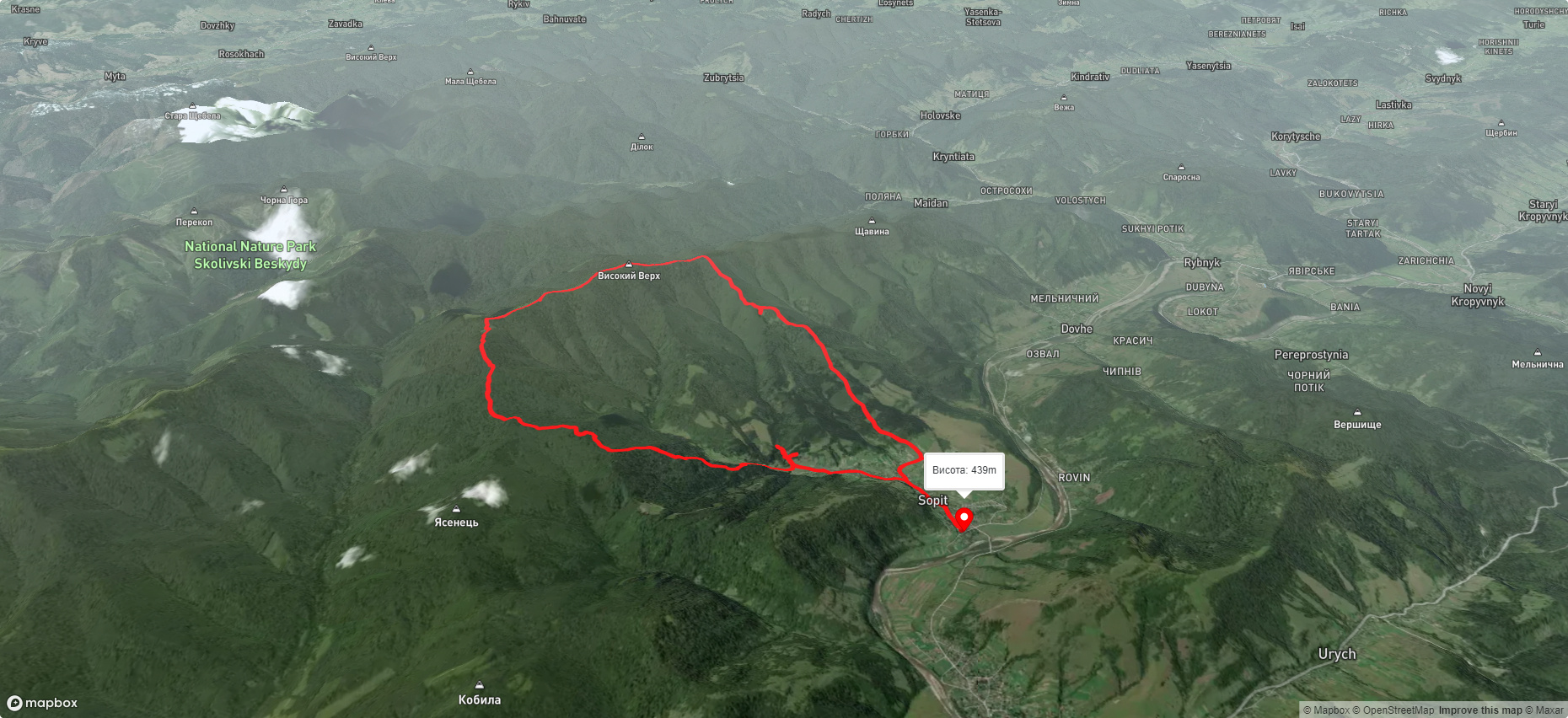
с. Сопіт, через Сопітські полонини до с. Сопіт
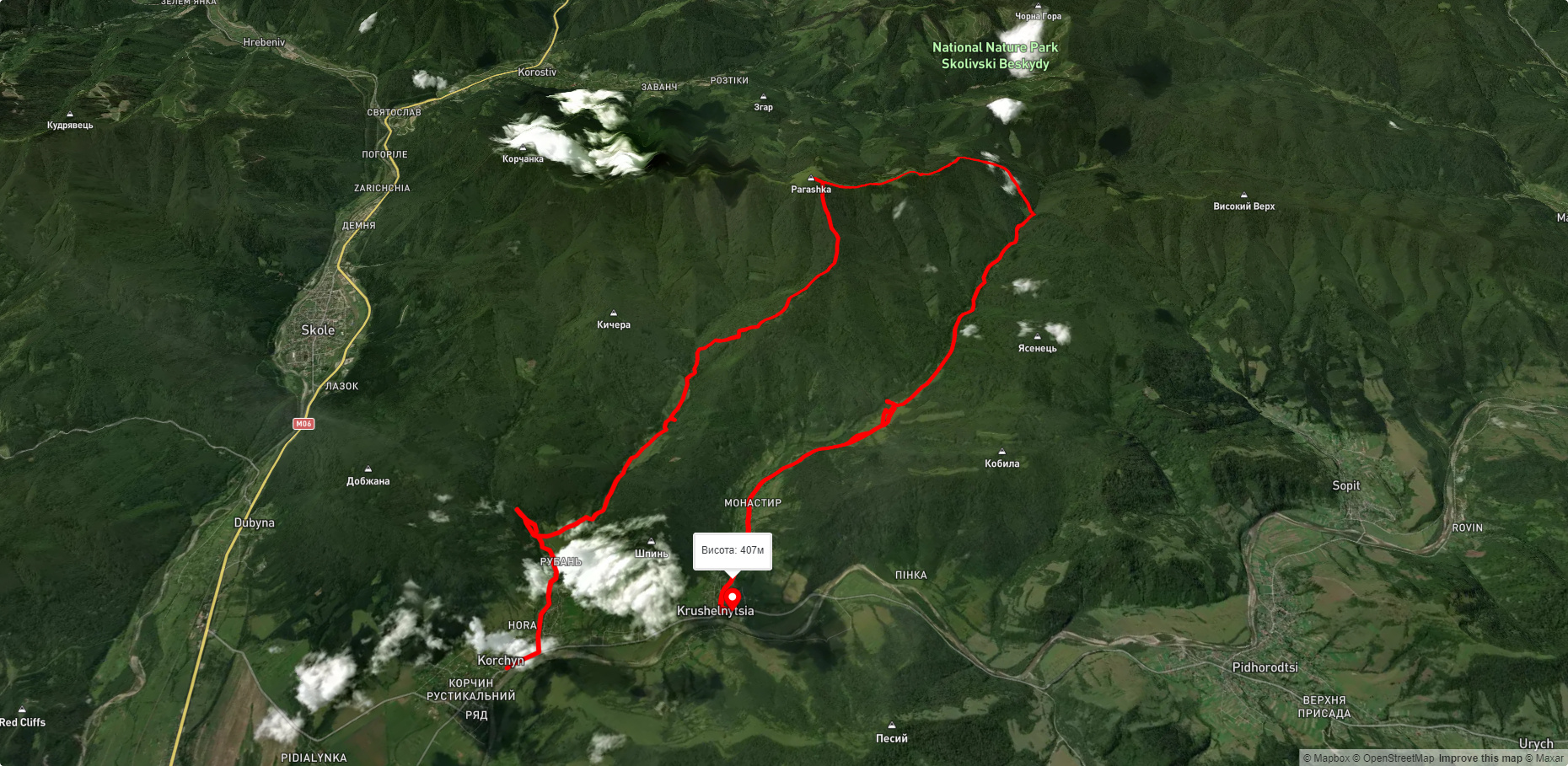
с. Корчин, через вдсп. Гуркало, г. Парашка до с. Крушельниця
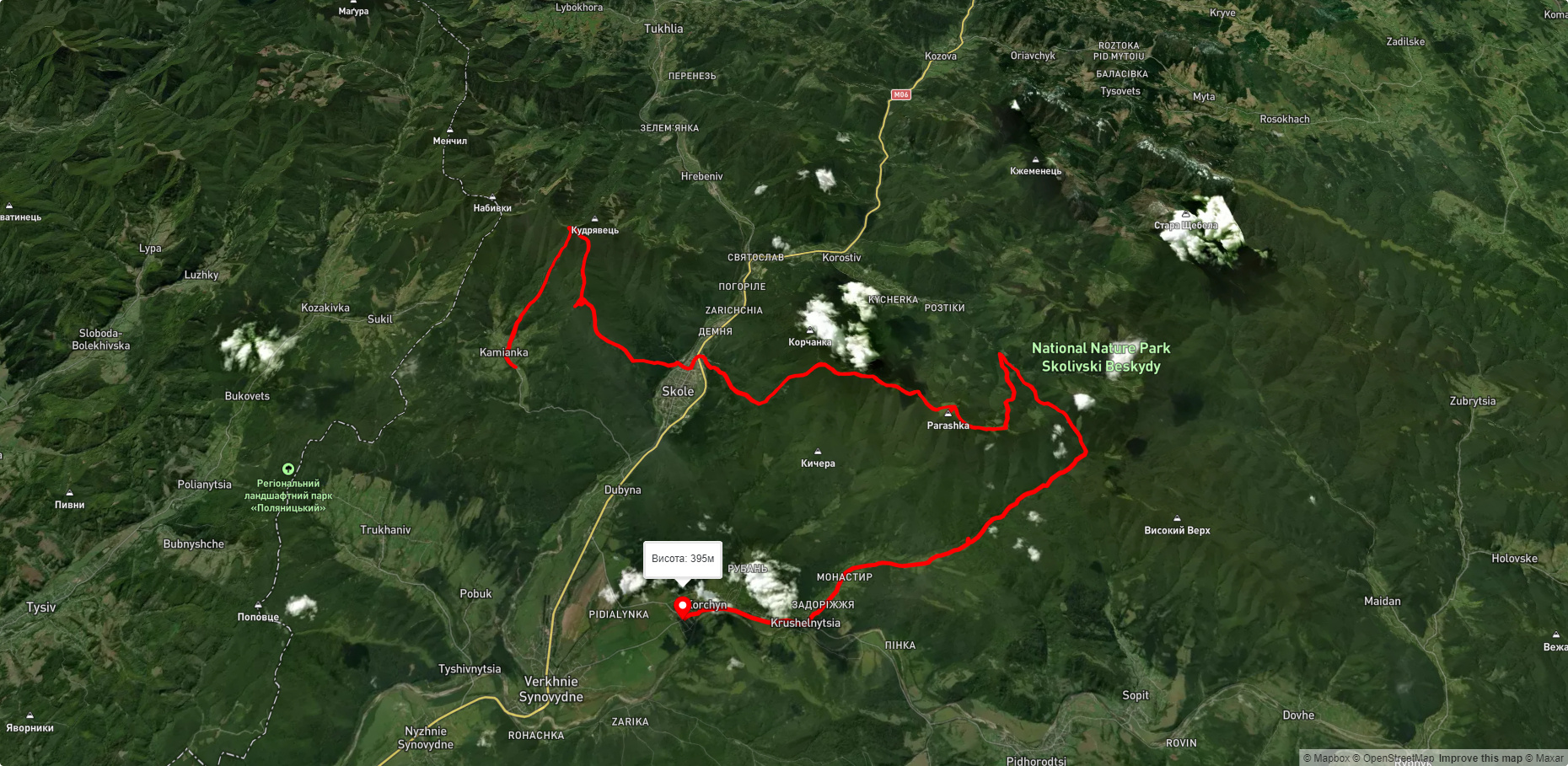
с. Кам'янка, через г. Лопата, м. Сколе, г. Парашка до с. Крушельниця
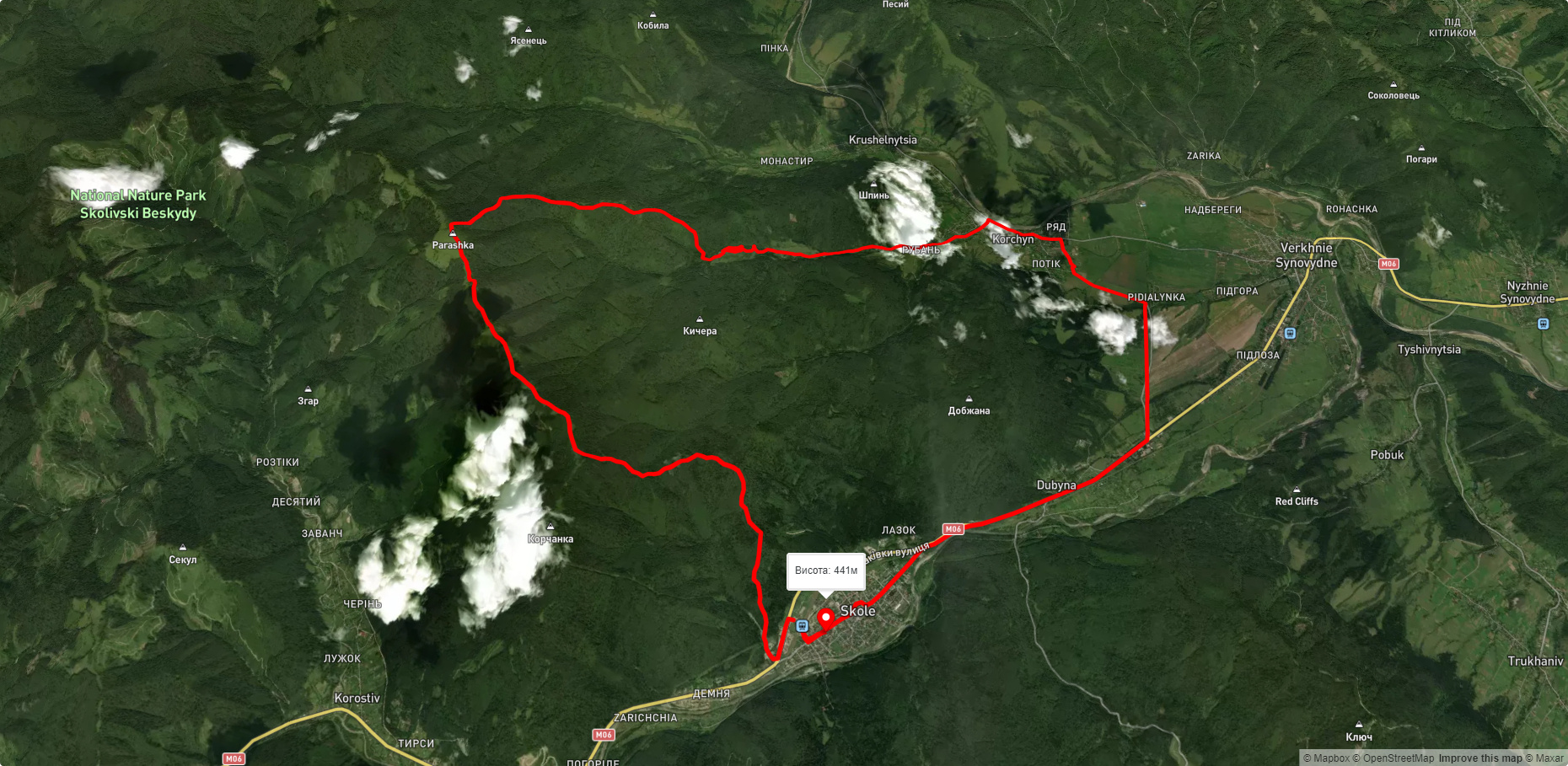
м. Сколе, через г. Парашка, вдсп. Гуркало, с. Корчин до м. Сколе