Church of St. Stanislav, Busk
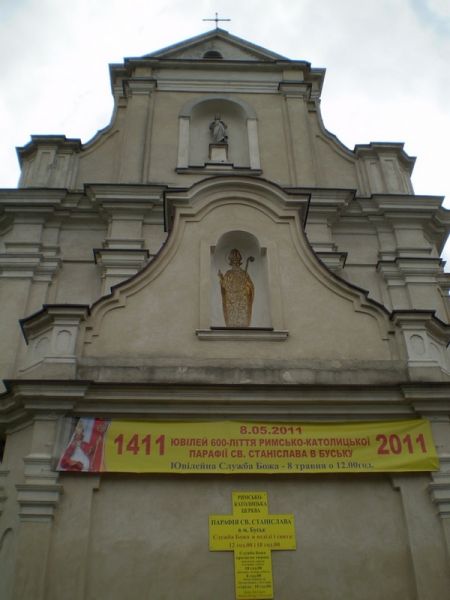
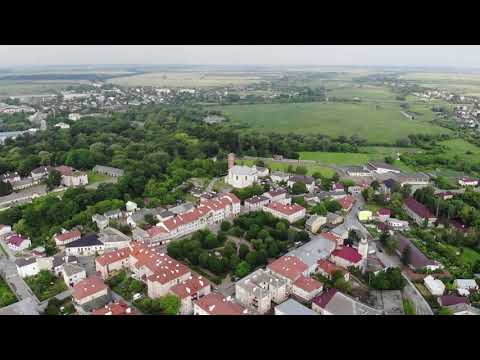
TheChurch of St. Stanislaus is an active parish church in the city of Busk, Lviv Archdiocese of the Roman Catholic Church in Ukraine. It was built in 1772-1779 in the Baroque style, modeled after the church in the village of Godovytsia, Pustomyty district, Lviv region, and designed by architect Bernard Meretyn. In 1780, a new church in honor of St. Stanisław was consecrated in Busk. The church is located near the central square of the town, behind the palace of Count Badeni. It has a security number 435-M. The founder of the construction was a Lviv canon of the RCC, Szczepan Mikulski.
According to researcher Zbigniew Hornung, the model for the building was the church in Godowice, designed by architect Bernard Meretyn. According to some sources, the church was built in 1778-1780, but Hornung dated the construction to 177-1780.
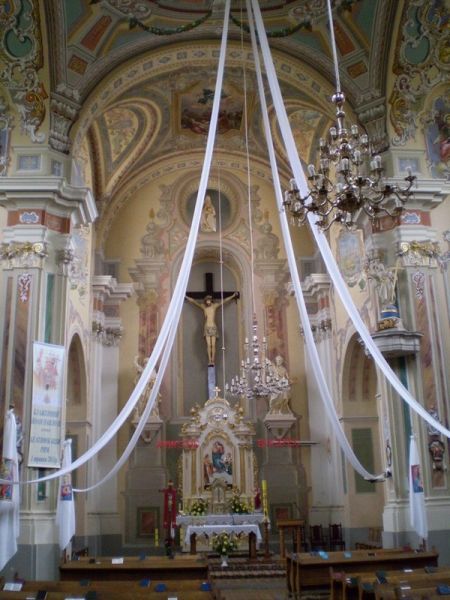
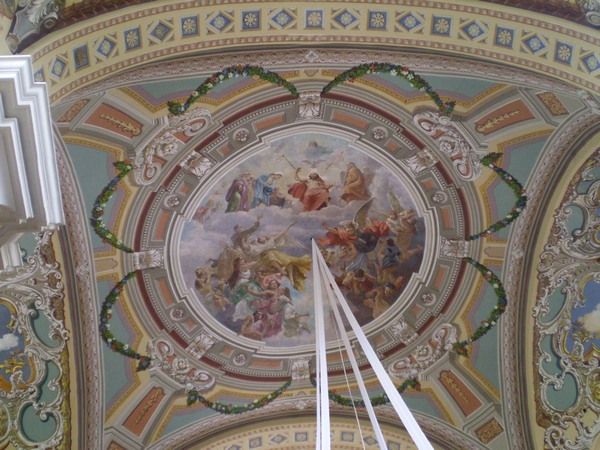
The brick church of St. Stanisław is single-nave in plan, plastered, cross-shaped with short side frames, and covered with a sloping roof. The main façade of the church is oriented to the east, with a developed cornice, and ends with a baroque pediment, on the edges of which stone vases were installed, which have not survived to this day. The main façade is characterized by a large semicircular window decorated with pilasters. The small cubic narthex ends with a high pediment with decorative Rococo vases. The side walls of the altar part are decorated with mirrors. The external and internal corners of the sacred building are cut and rounded. In the interior of the building, the central space of the nave is covered with a sail vault, and the transept's frames are cylindrical. There are wooden choirs near the east wall. On the walls and vaults of the church are monumental paintings dating from the second half of the nineteenth century. The church is considered a characteristic work of the Lviv architectural school of the second half of the eighteenth century.
In 1814 and 1819, fires damaged the church premises so badly that it was decided to move the liturgical services to the Greek Catholic Church. In 1829, the church was restored, but in 1849 a fire broke out again. The church was rebuilt only in 1856. It had five altars, with the main altar featuring a sculpture of the Holy Trinity and a miraculous image of the Mother of God of the Holy Rosary.
After the end of World War II, most of the parishioners and priests were forced to leave for Poland, a film library was placed in the church, and the church decorations were taken to the museum in Olesko.
In 1991, the sacred building was returned to the Roman Catholics, and in 1992 the church was re-consecrated by Bishop Raphael Kernytsky from Lviv, at which time restoration and renovation work began. In 2011, the Roman Catholic parish of St. Stanislav celebrated its 600th anniversary.
Today, the stone church of St. Stanisław in Busk is a functioning church, belongs to the diocese of the Roman Catholic Church, and is an architectural monument of local significance. Passing the church and going further north, after the bridge to the Solotvynia River, we come to a long street in the northern part of the city that stretches from west to east (B. Khmelnytskoho Street - M. Shashkevych Street). Almost at the opposite ends of these streets are the wooden churches of St. Onufriy and St. Paraskeva Pyatnitsia, monuments of national importance. The distance between these churches is 2.5 km.